The District Knows N.J.A.C. 6A:14. Now You Will Too.
You walked into that Child Study Team meeting prepared — or you thought you did. You read the PRISE booklet at 2 AM. You printed the procedural safeguards. You wrote down your concerns. And then the school psychologist, the social worker, and the LDTC smiled, used phrases you'd never heard before, and told you your child "doesn't qualify" or that certain services "aren't available at this school."
You left the meeting with the same IEP your child walked in with. No additional minutes. No new assessments. No Prior Written Notice explaining why they refused your requests — because you didn't know to ask for one.
The problem isn't that you're uninformed. The problem is that New Jersey's special education system is specifically designed to be navigated by professionals, not parents. Over 600 school districts, each with different local practices. A Child Study Team model unlike any other state — a triad of school psychologist, social worker, and learning disabilities teacher-consultant who control the entire evaluation and placement process. The lowest inclusion rates in the nation, with only 45% of students with disabilities spending the majority of their day in general education classrooms. And a state that publishes dense legal documents but zero fill-in-the-blank templates.
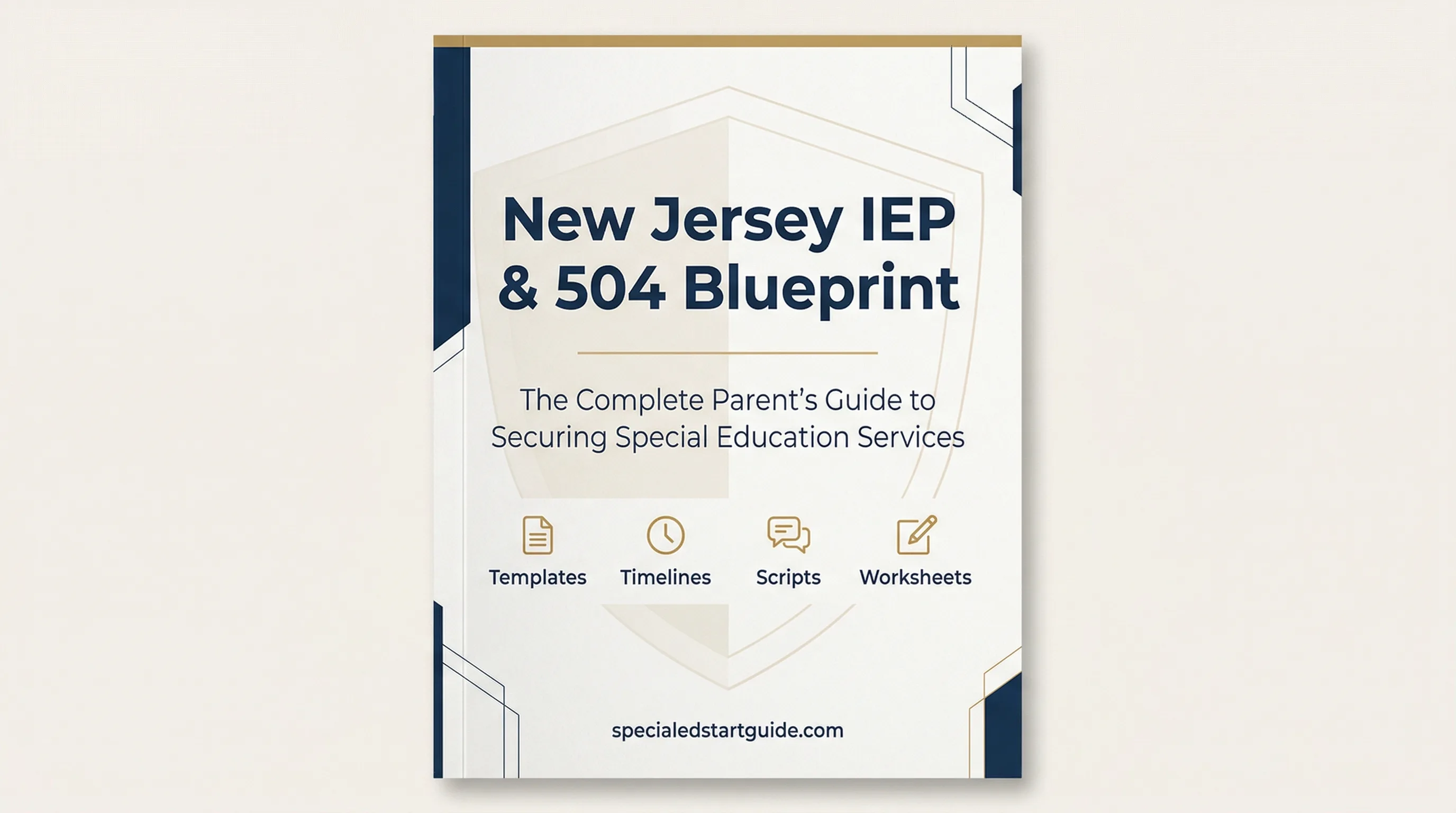
The New Jersey IEP & 504 Blueprint is the tactical enforcement toolkit that bridges the gap between knowing your rights and actually exercising them — with every template, script, and checklist grounded in the New Jersey Administrative Code.
What's Inside the Blueprint
The Copy-Paste Advocacy Letter Library
Every letter cites the exact New Jersey regulation. Request a Child Study Team evaluation under N.J.A.C. 6A:14-3.3 and start the district's 20-day identification meeting clock. Demand your child's evaluation reports 10 calendar days before the eligibility meeting — because that's the law under N.J.A.C. 6A:14, and most parents don't know to enforce it. Formally disagree with an IEP and request Prior Written Notice. Request an Independent Educational Evaluation when you believe the district's assessment is inadequate. These aren't generic samples — they're New Jersey enforcement tools that create a legally binding paper trail the moment you hit send.
The Child Study Team Power Map
New Jersey is the only state where a formalized three-member team — the school psychologist, the school social worker, and the LDTC — controls the entire evaluation and placement process. Most parents don't understand the internal dynamics: who writes the IEP, who makes placement recommendations, and why the case manager isn't always the person with decision-making power. The Blueprint explains each role, their professional motivations, and specific interpersonal strategies for building alliances with individual team members rather than facing the CST as a monolithic wall.
The 20-Day and 90-Day Timeline Tracker
The moment you submit a written referral, the district has exactly 20 calendar days to hold an identification meeting — not 20 school days, not "when the team has availability." After you sign consent for evaluations, the district has 90 calendar days to complete all assessments, determine eligibility, and develop an IEP. The Blueprint maps every milestone within these timelines, gives you the specific language to hold the district accountable at each checkpoint, and provides follow-up templates for when deadlines are missed — because in New Jersey, they frequently are.
The 10-Day Evaluation Review Checklist
New Jersey law requires the district to provide you with copies of all evaluation reports at least 10 calendar days before the eligibility meeting. Most parents receive this stack of technical data and have no idea what to do with it. The Blueprint includes a structured review worksheet: how to cross-reference the district's standardized test scores against private evaluations, how to identify missing assessments (Did they skip the Functional Behavioral Assessment? Was the occupational therapy evaluation omitted?), and how to prepare a written "punch list" of questions so you walk into the eligibility meeting ready to challenge inadequate data — not hearing it for the first time.
The Out-of-District Placement Roadmap
Securing an Approved Private School for Students with Disabilities (APSSD) placement is the hardest fight in New Jersey special education — because the district pays the tuition, and tuition at APSSDs averages $60,000–$120,000 per year. Districts resist these placements with everything they have. The Blueprint provides the strategic roadmap: how to document that the public school cannot provide FAPE, when and how to invoke the Burlington-Carter standard for unilateral placement, and the specific evidence trail that convinces an Administrative Law Judge to order district-funded placement.
IEP Meeting Scripts and Checklists
What to say when the CST tells you your child is "making progress" but the data shows otherwise. What to say when they offer a 504 instead of an IEP. What to say when the case manager claims they can't add service minutes "because the budget is set." Each script cites the N.J.A.C. 6A:14 section that proves them wrong — so you're not arguing opinions at the table, you're citing law. The pre-meeting checklist covers one-party consent recording rights under N.J.S.A. 2A:156A-4, team composition verification, and the specific documents to bring.
Goal-Tracking Worksheets
IEP goals are legally required to be measurable — with baselines, targets, and mastery criteria that meet the Endrew F. standard. But many goals are written so vaguely that progress is impossible to track. The worksheets give you a structured format to log data between meetings, compare school-reported progress against your own observations, and arrive at the annual review with documentation that either confirms the program is working or proves it isn't.
The Dispute Resolution Roadmap
When informal advocacy fails, you have three formal options in New Jersey: filing a state complaint with the NJDOE Office of Special Education, requesting mediation, or filing for a due process hearing through the Office of Administrative Law. For emergencies — placement changes, service stoppages, safety issues — you can petition for Emergent Relief, an immediate interim order from an ALJ. The Blueprint explains when each option is appropriate, the timeline and costs involved, and how the paper trail you've been building becomes the evidence that wins your case.
Who This Blueprint Is For
- Parents preparing for their first Child Study Team meeting who don't want to walk in blind against a team that does this every day — and who need to understand the 20-day and 90-day timelines before consent forms are pushed across the table
- Parents whose child has been evaluated but denied eligibility — and who need the legal language under N.J.A.C. 6A:14-3.5 to challenge that determination
- Parents in Newark, Jersey City, Paterson, Elizabeth, or any SDA district where inclusion rates are among the lowest in the state and out-of-district placements are the default for students with complex needs
- Parents in suburban districts — Millburn, Princeton, Chatham, Livingston — where the programs look strong on paper but the district resists costly placements, additional service minutes, or Extended School Year
- Parents whose child is turning three and transitioning from Early Intervention to preschool special education — and who need to start the CST referral process at least 110 days before the third birthday to avoid a gap in services
- Parents navigating the 504-to-IEP question — unsure whether their child's current accommodations are legally sufficient or whether they should push for a full CST evaluation
- Military families at Joint Base McGuire-Dix-Lakehurst transferring into the New Jersey system — and who need to understand how their child's existing IEP translates to N.J.A.C. 6A:14 requirements
- Parents who suspect the district isn't delivering the therapy minutes in the IEP but have no documentation to prove it
Why Not Just Use the Free Resources?
New Jersey has strong free special education resources. The NJDOE publishes the PRISE booklet. SPAN offers training and webinars. The Education Law Center and ACNJ publish legal guides. Here's why parents still struggle after consulting all of them:
- PRISE is a rulebook, not a playbook. The state's official procedural safeguards document tells you the district has 90 days to evaluate. It does not tell you what to say in the email to the case manager on Day 85 when nothing has happened. It outlines what the district must do, but never coaches you on what to do when the district fails to comply. For a parent in crisis, the gap between understanding a right and exercising it is the difference between winning and losing at the CST table.
- SPAN runs on fixed schedules. SPAN is an excellent resource, but securing personalized help means navigating a massive organizational website and attending lengthy webinars. When the district sends an inadequate evaluation report on a Thursday and your eligibility meeting is in 8 days, you cannot wait for next month's workshop. The Blueprint is available the moment the crisis hits.
- Legal guides read like textbooks. The Education Law Center and ACNJ publish accurate 40-60 page manuals. They inform you of the law but don't coach you on the interpersonal dynamics of enforcing it. Knowing your rights and exercising them at the CST table are two completely different skills — the Blueprint bridges that gap with scripts, templates, and meeting-day checklists.
- Etsy and TPT planners organize paperwork — they don't enforce rights. A pastel IEP binder helps you keep documents in order. It won't explain what the LDTC's role is, why the district is resisting your evaluation request, or how to cite N.J.A.C. 6A:14-3.4 to force the referral. Generic federal templates use terminology that New Jersey districts don't recognize — instantly marking you as unprepared.
The free resources explain what the law says. The Blueprint gives you the tools to make the district follow it.
— Less Than 3 Minutes of a Special Education Attorney
Special education attorneys in New Jersey charge $350–$700 per hour. A private advocate runs $100–$250 per meeting. Even if you eventually need professional help, the meticulous paper trail you build with this Blueprint saves thousands in billable hours — because you're handing your attorney an organized case, not a folder of unsigned IEP copies and half-remembered conversations.
Your download includes the complete Blueprint guide plus standalone printable PDFs — every template, worksheet, script, and reference card, ready to print and bring to your next meeting.
- Complete Blueprint Guide — 16 chapters covering the NJ special education landscape, IEP vs. 504, I&RS, CST dynamics, the 20-day and 90-day timelines, IEP development, the EI-to-preschool transition, ESY, behavior support, IEEs, out-of-district placements, transition planning, military transfers, charter schools, dispute resolution, and documentation systems
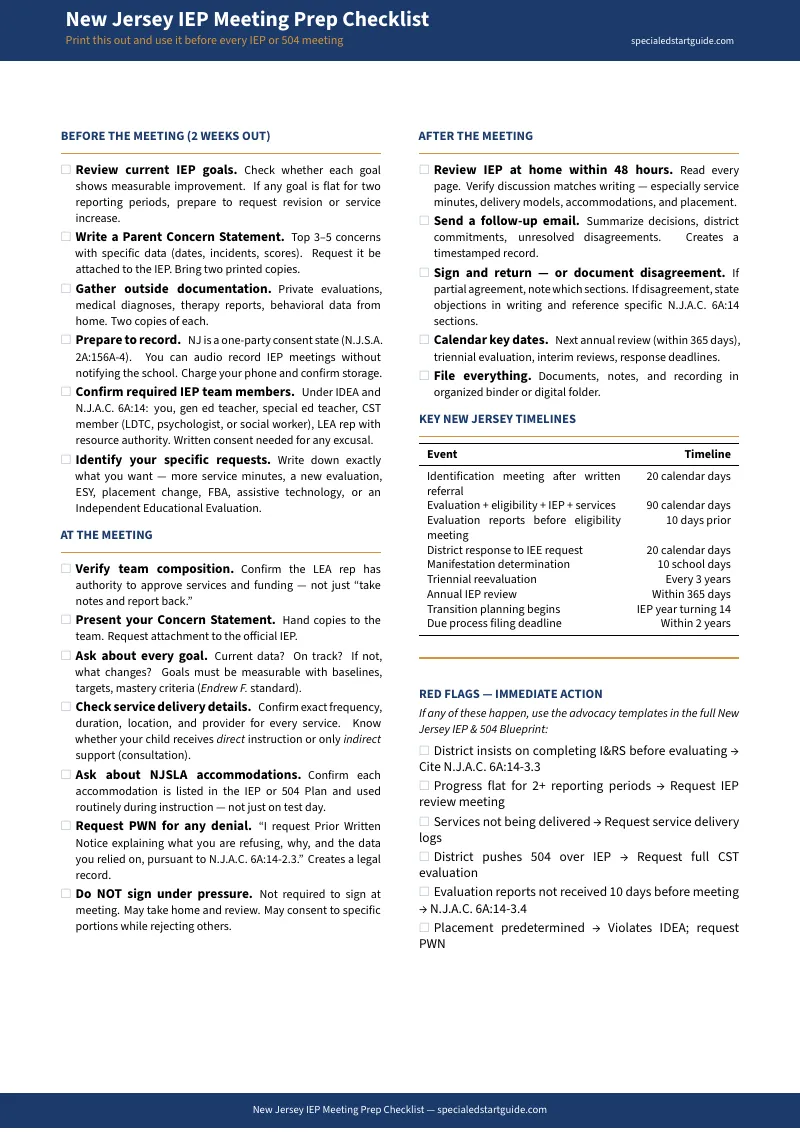
- IEP Meeting Prep Checklist — the before/during/after checklist with New Jersey timelines and N.J.A.C. 6A:14 citations for every step
- Advocacy Letter Templates — copy-paste letters citing exact N.J.A.C. 6A:14 sections for CST referrals, evaluation requests, IEEs, Prior Written Notice demands, formal disagreements, and addendum meeting requests
- Goal-Tracking Worksheet — structured fillable worksheet for measurable progress monitoring between annual reviews
- New Jersey Timeline Cheat Sheet — every legal deadline on one page: 20-day identification meeting, 90-day evaluation, 10-day report rule, annual reviews, triennial reviews, and transition dates
- IEP Meeting Scripts — word-for-word responses to common CST pushback tactics, each citing the specific N.J.A.C. 6A:14 section
- 10-Day Evaluation Review Worksheet — structured guide for analyzing district evaluation reports during the legally mandated review window
- Dispute Resolution Roadmap — your three formal options plus Emergent Relief, with a side-by-side comparison table
Instant PDF download. Print the templates tonight. Walk into tomorrow's meeting with the law on your side.
Money-back guarantee, no time limit. If the Blueprint doesn't change how you approach IEP meetings in New Jersey, email us for a full refund. No questions asked.
Not ready for the full Blueprint? Download the free New Jersey IEP Meeting Prep Checklist — a printable pre-meeting checklist with the NJ timelines, CST composition requirements, one-party consent recording rights, and red flags that require immediate action. It's enough to walk into your next meeting prepared, and it's free.
Your child's education is a legal right, not a favor. The district knows N.J.A.C. 6A:14. After tonight, so will you.