The District Has a Legal Team. Now You Have an Advocacy Playbook.
You've been through the meetings. You've asked nicely. You've written polite emails. And the Child Study Team keeps denying services, delaying evaluations, or offering an IEP that doesn't come close to what your child needs. The school psychologist, the social worker, and the LDTC sit across the table as a unified front — and you're sitting there alone, wondering why knowing your rights hasn't been enough to enforce them.
Here's what changed: you stopped asking the district to do the right thing and started making them prove — in writing — why they won't. That shift from requesting to enforcing is the difference between parents who accept inadequate IEPs and parents who win disputes. And in New Jersey, where the state's own due process system adjudicates only 5% of cases on time, winning at the local level isn't optional — it's the only strategy that works.
The New Jersey IEP & 504 Advocacy Playbook is the enforcement toolkit for parents who have moved past the basics. Every template, checklist, and strategy is built on N.J.A.C. 6A:14 — the specific New Jersey administrative code that governs special education — because citing federal law at a Child Study Team table marks you as someone who read a generic guide, while citing New Jersey law marks you as someone the district needs to take seriously.
What's Inside the Advocacy Playbook
The Dispute Letter Arsenal
Every letter cites the exact N.J.A.C. 6A:14 section that commands a legal response. Demand Prior Written Notice within 15 calendar days when the CST verbally refuses your request — because under N.J.A.C. 6A:14-2.3, an undocumented refusal is a procedural violation the district cannot defend. Invoke pendency protections within the critical 15-day window under N.J.A.C. 6A:14-2.7. Request an Independent Educational Evaluation at public expense when you disagree with the district's assessment. File a formal compliance complaint with the NJDOE Office of Special Education. These aren't polite requests — they're enforcement tools that create binding legal obligations the moment you hit send.
Due Process Hearing Preparation
Filing for due process in New Jersey means going before an Administrative Law Judge at the Office of Administrative Law. Most parents are terrified of the process because it sounds like a courtroom — and it essentially is. The Playbook walks you through evidence organization, witness preparation, the hearing timeline, and the specific burden of proof that New Jersey places on the district (not you). Even if you ultimately hire an attorney, the organizational groundwork you build with this Playbook saves thousands in billable hours — because you're handing over an organized case file, not a box of unsorted documents.
The Emergent Relief Protocol
When the district threatens immediate harm — stopping services, enforcing an illegal suspension, or violating stay-put protections — Emergent Relief is your emergency injunction. But securing it requires proving the four-prong Crowe v. De Gioia test: irreparable harm, a settled legal right, likelihood of prevailing on the merits, and a balancing of equities. Free resources mention this test exists. The Playbook breaks each prong into a concrete evidence-gathering checklist — what medical documentation proves "irreparable harm," what academic records establish "likelihood of prevailing," and how to frame the equities argument so the ALJ grants interim protection while your full case proceeds.
The CST Resistance Playbook
The Child Study Team is trained to operate as a unified professional front. The Playbook decodes the internal dynamics: why the case manager deflects certain requests to the Director of Special Services, how to identify which CST member actually controls the budget decision, and the specific conversational strategies that break through institutional stonewalling. When the school psychologist says "we don't offer that program in this district," you'll know the exact N.J.A.C. 6A:14 response that forces them to provide Prior Written Notice — turning a verbal brushoff into a documented refusal that strengthens your case.
The APSSD Placement Strategy
Out-of-district placement at an Approved Private School for Students with Disabilities is the most contested fight in New Jersey special education — because the district pays the tuition, and tuition at APSSDs runs $60,000–$120,000 per year. The Playbook provides the strategic evidence trail: how to document that the public school's program cannot provide FAPE, when to invoke the Burlington-Carter standard for unilateral placement and tuition reimbursement, and the specific documentation pattern that convinces an ALJ to order district-funded placement.
State Complaint Filing Guide
A complaint to the NJDOE Office of Special Education is sometimes more effective than due process — it's free, requires no hearing, and the state must investigate within 60 days. The Playbook covers exactly what to include, how to frame violations in terms the state investigator is looking for, which violations are best suited to complaints versus due process, and how to use complaint findings as leverage in settlement negotiations.
The Pendency (Stay-Put) Enforcement Protocol
When the district proposes changes you oppose, you have exactly 15 calendar days to file for mediation or due process and invoke stay-put protections under N.J.A.C. 6A:14-2.7. Miss that window and the proposed IEP automatically takes effect. The Playbook includes the exact invocation letter, explains what "current educational placement" means when the last agreed-upon IEP is ambiguous, and covers what to do when the district violates pendency — because some districts implement changes anyway and count on parents not knowing the enforcement mechanism.
The Documentation System
Every template and strategy in this Playbook generates documentation. The Documentation System chapter shows you how to organize it all into a case file that survives mediation, due process, and — if it comes to it — federal court appeal. Organized by incident type and statutory citation, with a naming convention that makes any attorney or advocate you eventually hire immediately productive on Day 1.
Who This Playbook Is For
- Parents whose requests have been denied, delayed, or ignored by the Child Study Team — and who need enforcement tools, not more information about what the law says
- Parents considering due process or mediation and want to understand the process before committing thousands to an attorney retainer
- Parents whose child was suspended and needs to understand manifestation determination rights, the 10-day rule, and when to file for Emergent Relief
- Parents in affluent districts — Millburn, Princeton, Chatham, Ridgewood — where the CST deploys sophisticated legal strategies to deny expensive placements and additional service minutes
- Parents in Newark, Jersey City, Paterson, or any SDA district where basic procedural compliance is the fight — getting evaluations completed, meetings scheduled, and services actually delivered
- Parents pursuing an out-of-district APSSD placement and building the evidence trail to prove the public school cannot provide FAPE
- Parents who already own the New Jersey IEP & 504 Blueprint and need the next level — dispute resolution, compliance complaints, and hearing preparation
Why Free Resources Won't Get You Through a Dispute
New Jersey has excellent free special education resources. SPAN trains thousands of parents. The PRISE booklet is legally mandated. The Education Law Center publishes accurate legal guides. Here's why parents still lose disputes after consulting all of them:
- PRISE explains your right to file — not how to win. The state's official procedural safeguards booklet contains the forms for mediation, due process, and Emergent Relief. It does not explain how to organize evidence, what the ALJ is actually looking for, or how to build the four-prong Crowe v. De Gioia argument that gets your emergency petition granted. The form is 10% of the battle. The strategy is 90%.
- SPAN can't attend your hearing. SPAN provides exceptional training, but they are a systemic advocacy organization — not your personal representative at the Office of Administrative Law. When you're preparing for a due process hearing in two weeks, you need templates and checklists, not a webinar registration link.
- Legal aid organizations triage the worst cases. DRNJ and the Education Law Center take precedent-setting civil rights cases, primarily for low-income families. If you're a suburban parent fighting an inadequate IEP — not a systemic civil rights violation — you're on your own. The Playbook is the bridge between free resources and a $350/hour attorney.
- National guides cite the wrong law. Wrightslaw is the gold standard for federal special education law. But citing IDEA at a New Jersey Child Study Team table is like citing the U.S. Constitution at a traffic stop — technically correct, practically useless. New Jersey has its own administrative code, its own timelines, its own CST structure, and its own dispute resolution quirks. The Playbook cites N.J.A.C. 6A:14 because that's the law the district has to follow.
Free resources teach you the law. The Advocacy Playbook teaches you how to enforce it when the district refuses to comply.
— Less Than 3 Minutes of a Special Education Attorney
Special education attorneys in New Jersey charge $350–$700 per hour. A private advocate runs $150–$300 per meeting. Even if you eventually need professional representation for a due process hearing, the meticulous evidence file you build with this Playbook saves thousands in billable hours — because your attorney inherits an organized case, not a stack of emails you printed at 2 AM the night before.
Your download includes the complete Advocacy Playbook guide plus 7 standalone printable PDFs — every template, checklist, and reference card, ready to print and bring to your next meeting or hearing.
- Complete Advocacy Playbook — 16 chapters covering the NJ advocacy landscape, your legal arsenal under N.J.A.C. 6A:14, forcing evaluations, IEEs at public expense, CST power dynamics, IEP meeting tactics, Prior Written Notice enforcement, dispute resolution (state complaints, mediation, due process), Emergent Relief, pendency protections, discipline and manifestation determinations, APSSD placements, key transitions, documentation systems, special populations, and the NJ resources directory
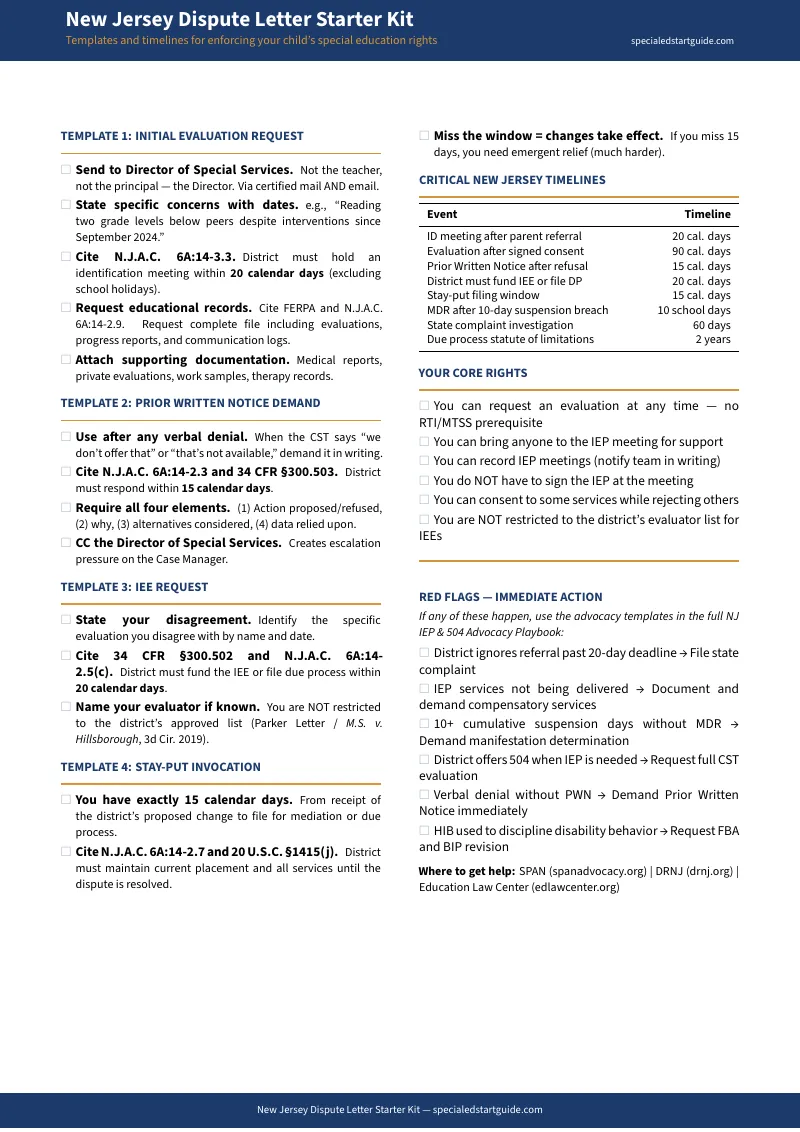
- Dispute Letter Templates — 5 ready-to-send enforcement letters for evaluation requests, Prior Written Notice demands, IEE requests, stay-put invocations, and state complaint filings — each citing exact N.J.A.C. 6A:14 sections
- Parent Rights One-Pager — every critical timeline, core right, and red flag on one printable page with statutory citations
- IEP Meeting Scripts — word-for-word responses for when the CST denies, deflects, or pressures you to sign
- Dispute Resolution Roadmap — side-by-side comparison of state complaints, mediation, due process, and emergent relief with costs, timelines, and when to use each
- NJ Timeline Cheatsheet — every critical deadline under N.J.A.C. 6A:14 on one printable page
- Emergent Relief Checklist — the four-prong Crowe v. De Gioia test broken into an actionable evidence-gathering checklist
Instant PDF download. Print the templates tonight. Walk into tomorrow's meeting with enforcement tools, not just information.
Money-back guarantee, no time limit. If the Playbook doesn't change how you handle disputes with your New Jersey school district, email us for a full refund. No questions asked.
Not ready for the full Playbook? Download the free New Jersey Dispute Letter Starter Kit — a sample dispute letter template and parent rights one-pager for special education disagreements in New Jersey. It's enough to send your first enforcement letter, and it's free.
Your child's education is a legal right, not a budget line item. The district knows N.J.A.C. 6A:14. After tonight, you'll know how to enforce it.