Your Child's Nevada School District Broke the Law. Here's the Paper Trail That Proves It.
You already know something is wrong. The IEP says 30 minutes of speech therapy twice a week, but the therapist position has been vacant since September and nobody replaced her. CCSD entered an emergency partnership with UNLV to fill 163 vacant special education positions — and your child is still waiting. The district evaluated your child in six weeks and declared them ineligible, even though the evaluation report reads like the examiner spent forty-five minutes. You asked for an Independent Educational Evaluation and they said no. You pushed back at the IEP meeting and the meeting ended. Your child was suspended for behavior caused by the disability the district refuses to address — and nobody mentioned a Manifestation Determination Review before it happened.
You are not imagining this. The U.S. Department of Education's Office of Special Education Programs issued a "Needs Assistance" determination for Nevada for the second consecutive year, citing critical failures in meeting IDEA requirements. A class-action lawsuit against CCSD and the Nevada Department of Education alleges systemic failures to provide Free Appropriate Public Education — including reliance on unqualified long-term substitutes and refusal to identify conditions like dyslexia because the district lacked resources to treat them. In Washoe County, Child Find evaluation waitlists have stretched to 18 months with individual school psychologists managing caseloads of 350 students. In rural Nevada — Elko, Nye, Lyon — there may be no physical specialist within 100 miles. And across the state, private special education advocates charge $125–$300 per hour, with attorneys demanding retainers of $5,000 or more.
If you earn too much for free legal aid and not nearly enough for a retainer, you are on your own — unless you know exactly how to build the case yourself.
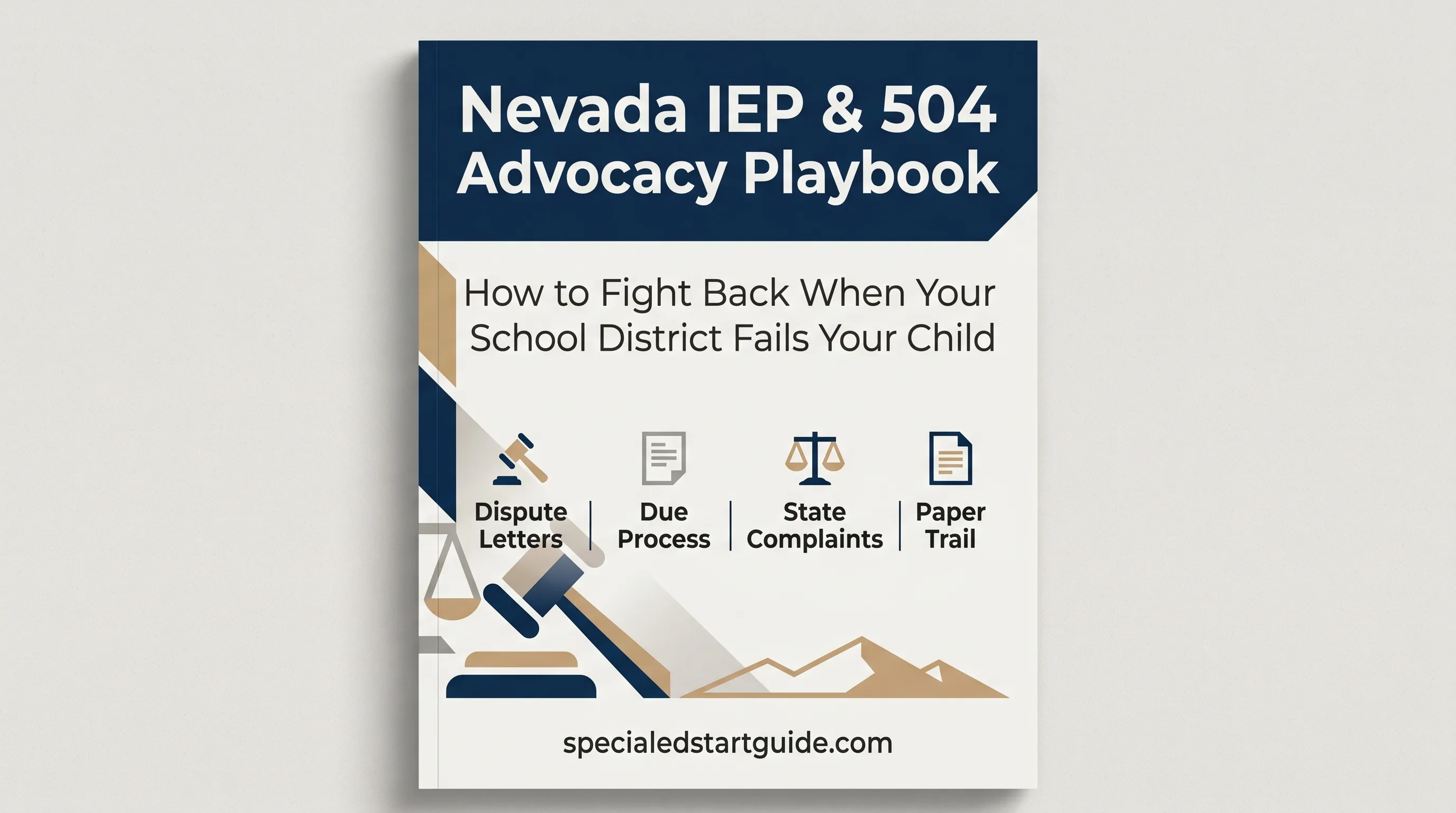
The Nevada IEP & 504 Advocacy Playbook is the Dispute Escalation System — the tactical toolkit that turns overwhelmed parents into effective advocates by providing the exact dispute letters, escalation procedures, and paper trail protocols grounded in NRS Chapter 388, NAC Chapter 388, and Nevada's district-burden-of-proof law (NRS 388.467) that force districts to respond on the record.
What's Inside the Playbook
The Fill-in-the-Blank Dispute Letter Library
Every letter cites the exact Nevada regulation. Demand an Independent Educational Evaluation at public expense — using the legal framework under 34 CFR 300.502 that triggers the district's obligation to either fund the IEE or file for due process to defend their evaluation. Request Prior Written Notice for every denial — because the district is required under NAC 388.300 to explain in writing what they refused, why, what data they relied on, and what alternatives they considered. Document service non-delivery with the specific timeline citations that prove the district violated the IEP. Challenge an evaluation you disagree with. Request a Functional Behavioral Assessment. These aren't generic federal templates — they cite the NRS and NAC sections that NDE compliance investigators check during state complaint investigations.
The Paper Trail System
In Nevada, something extraordinary works in your favor: the burden of proof in a due process hearing rests on the school district — not you. Under NRS 388.467, the district must prove its IEP was adequate, regardless of who filed the complaint. Most states follow the federal default that puts the burden on parents. Nevada overrode that. But even with this advantage, you need documented evidence. The Playbook includes communication logs, follow-up email templates for every verbal conversation, and a systematic documentation protocol that builds the record Nevada hearing officers require. Every phone call gets a summary email. Every meeting gets a written follow-up. Every denial triggers a Prior Written Notice demand. Districts respond differently when they know the parent is documenting everything — because they know who carries the burden at hearing.
The Manifestation Determination Prep Kit
When a student with a disability is removed from placement for more than 10 cumulative school days in a year, the district must conduct a Manifestation Determination Review within 10 school days. The MDR team must answer two legal questions: Was the behavior caused by or substantially related to the disability? Was the behavior a direct result of the district's failure to implement the IEP? If yes to either, the behavior is a manifestation — and the child cannot be expelled. The Playbook walks you through preparing for the MDR, requesting a Functional Behavioral Assessment, demanding a Behavioral Intervention Plan, and understanding your child's protections under Nevada's strict restraint and seclusion laws (NRS 388.471–388.515) — which prohibit seclusion, mechanical restraints, and physical restraint as punishment. Under NRS 392.472, the school must also attempt restorative justice before initiating suspension or expulsion.
The State Complaint Filing Guide
An NDE State Complaint is free, does not require an attorney, and frequently produces faster results than due process. You mail it to: Nevada Superintendent of Public Instruction, Nevada Department of Education, Office of Inclusive Education, 700 East Fifth Street, Carson City, NV 89701, with a copy to your local superintendent. The NDE has 60 calendar days to investigate and issue a decision. The Playbook explains which violations are best suited for state complaints versus mediation versus due process, how to frame the complaint for maximum impact, what evidence to attach, and the common mistakes that result in dismissed complaints.
The Due Process Hearing Roadmap
Due process is the highest administrative remedy before federal court. The statute of limitations is two years. The district must respond within 10 calendar days, hold a resolution meeting within 15 days, and the resolution period expires at 30 days. A hearing decision must be issued within 45 days after the resolution period. Your child stays in their current placement during the entire process — the stay-put provision. And under NRS 388.467, the district bears the burden of proof. The Playbook covers resolution session strategy, evidence organization, what hearing officers look for, and how to build a case that leverages Nevada's burden-of-proof advantage without spending thousands on an attorney.
The District Navigation Maps
In CCSD — the 5th-largest school district in the nation — you're fighting bureaucratic inertia, evaluation waitlists, and school-level inconsistency across hundreds of thousands of students. In Washoe County, you're dealing with rapid population growth and Child Find bottlenecks. In rural counties like Elko, Nye, and Lyon, you face resource deserts and depend entirely on teletherapy. The Playbook maps the escalation hierarchy within each system — who controls the special education budget, who to contact when the principal stonewalls, and how to bypass school-level bureaucracy to reach district-level decision-makers.
The OCR Complaint Option
When the issue involves disability-based discrimination, retaliation for advocacy, or systemic Section 504 failures, you can bypass the state system entirely by filing a complaint with the U.S. Department of Education Office for Civil Rights. This is a federal civil rights investigation — separate from IDEA due process — and it is free. The Playbook explains when an OCR complaint is more effective than a state complaint, what evidence to include, and how the two tracks can run simultaneously.
Who This Playbook Is For
- Parents whose child was denied special education eligibility despite clear academic, behavioral, or functional struggles — and who need to challenge the evaluation or request an IEE at public expense
- Parents whose child's IEP services are not being delivered — the speech therapist hasn't been replaced, the aide covers multiple classrooms, the goals haven't changed in two years — and who need to create the paper trail that forces accountability
- Parents facing disciplinary action against their child — suspensions, alternative school placements, restraint incidents — who need to understand Manifestation Determination Reviews and protect their child's right to stay in placement
- Parents in Clark County dealing with CCSD's massive bureaucracy, emergency staffing shortages, and school-level inconsistency across the Las Vegas valley
- Parents in Washoe County (Reno/Sparks) navigating Child Find waitlists, rapid district growth, and evaluation bottlenecks
- Parents in rural Nevada counties — Elko, Nye, Lyon, Churchill — facing resource deserts where the nearest specialist may be 100 miles away and teletherapy is the only option
- Military families at Nellis AFB, Creech AFB, or the Nevada Test and Training Range navigating disputes with an unfamiliar Nevada district
- Families who relocated to Nevada from states with better-funded special education programs and are experiencing institutional shock at the systemic limitations
- Parents of twice-exceptional students who are both gifted and disabled — and whose districts claim a child cannot hold both an IEP and GATE eligibility under Nevada law (they can, under NRS 388.520)
Why Not Just Use the Free Resources?
Nevada has serious free advocacy resources. Nevada PEP offers federally funded parent training workshops. NDALC provides high-level rights education. NDE distributes the legally required Procedural Safeguards notice. Here's why parents still lose disputes after consulting all of them:
- Nevada PEP's mandate forces collaborative language. PEP is an excellent resource for foundational education and emotional support. Their materials prioritize "teamwork," "partnering with professionals," and building "trust and respect." When a school district is operating in bad faith — or genuinely cannot hire the staff to deliver your child's services — cooperative strategies fail. Requesting a service politely does not generate funding for that service.
- NDALC is informational, not tactical. Every piece of their literature carries a disclaimer that it does not constitute legal advice. They explain what the law says — they do not provide the fill-in-the-blank dispute letter that cites NAC 388.300 to demand Prior Written Notice. Their format is rights awareness, not operational advocacy.
- The Procedural Safeguards notice protects the district, not you. CCSD and WCSD distribute this dense, legalistic document because federal law requires it. It is written to ensure the district's legal compliance, not to teach you how to challenge their decisions or build a paper trail.
- Wrightslaw covers federal IDEA — not NRS Chapter 388. Wrightslaw is the gold standard for federal special education law. It does not address Nevada's 45-school-day evaluation timeline, the NRS 388.467 burden-of-proof advantage, Nevada's restraint and seclusion laws, or how NDE processes state complaints. Federal citations are useful; Nevada-specific citations tell the district you know their playbook.
- Private advocates cost $125–$300 per hour. Special education attorneys charge $300–$700 for consultations, with retainers starting at $5,000. Most Nevada families cannot afford this — and advocates achieve better results when the parent arrives with an organized paper trail. This Playbook is how you build that trail.
The free resources explain what Nevada law says. This Playbook gives you the dispute tools to make the district comply.
— Less Than One Hour of a Special Education Advocate
Private advocates in Nevada charge $125–$300 per hour. Educational attorneys charge $300–$700 for a consultation. A single meeting with an advocate costs more than this entire Playbook. The Playbook gives you the dispute letters, escalation procedures, and documentation system that advocates use — so you can either handle the dispute yourself or arrive at a paid consultation with an organized case file that saves hundreds in billable hours.
Your download includes the complete Advocacy Playbook guide plus standalone printable PDFs — every dispute letter template, escalation checklist, and reference card, ready to print and use tonight.
- Complete Advocacy Playbook Guide — 14 chapters covering the Nevada advocacy landscape, your legal arsenal (NRS 388, NAC 388, NRS 388.467), forcing evaluations and controlling the 45-school-day timeline, Independent Educational Evaluations, navigating CCSD/WCSD/rural districts, IEP meeting tactics, Prior Written Notice strategy, dispute resolution (state complaints, mediation, due process), discipline protections and MDR, twice-exceptional students, combating "we don't have the staff," transition planning, documentation standards, and the Nevada resources directory
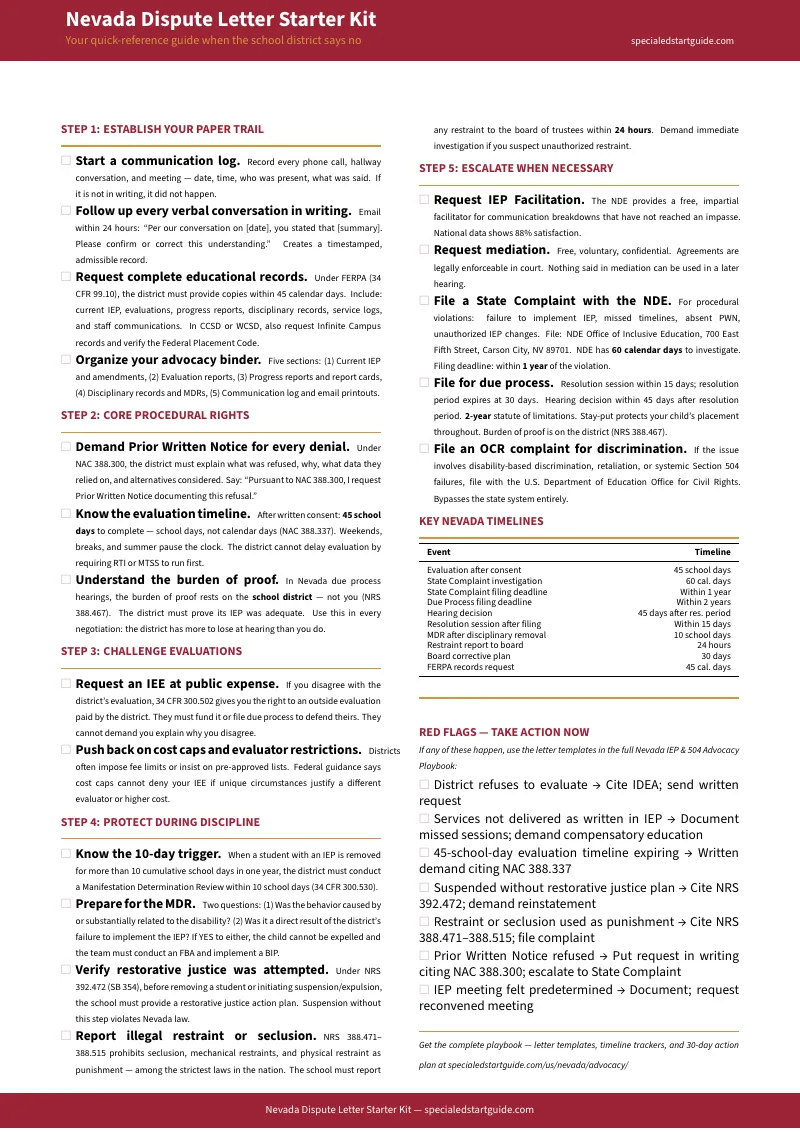
- Dispute Letter Starter Kit — the quick-reference checklist covering paper trail setup, core procedural rights, evaluation challenges, discipline protections, and escalation procedures with key Nevada timelines and NRS/NAC citations
- Advocacy Letter Templates — fill-in-the-blank letters citing exact NRS and NAC regulations for IEE demands, Prior Written Notice requests, service non-delivery documentation, and formal disagreements
- State Complaint Template — structured NDE complaint filing template with required elements, evidence attachment guide, and mailing instructions
- Communication Log — printable documentation tracker for every call, meeting, and conversation — the systematic paper trail that wins cases
- MDR Preparation Checklist — step-by-step Manifestation Determination Review preparation including the two legal questions, FBA demand templates, and BIP review protocol
- Dispute Escalation Ladder — visual roadmap from informal advocacy through IEP facilitation, mediation, state complaint, due process, and OCR complaint — with Nevada-specific timelines at every stage
- NRS 388.467 Burden-of-Proof Reference Card — one-page explainer of Nevada's district-burden-of-proof advantage with talking points for settlement negotiations and IEP meetings
Instant PDF download. Print the dispute letter that matches your situation tonight. Send it tomorrow morning.
Money-back guarantee, no time limit. If the Playbook doesn't change how you handle disputes with your Nevada school district, email us for a full refund. No questions asked.
Not ready for the full Playbook? Download the free Nevada Dispute Letter Starter Kit — a printable quick-reference guide covering paper trail setup, core procedural rights, evaluation challenges, discipline protections, and escalation steps with key Nevada timelines and NRS/NAC citations. It's enough to start building your case tonight, and it's free.
Your child's education is a legal right — and when the district violates it, Nevada law gives you the tools to fight back. This Playbook puts those tools in your hands.