The School Said "No." They Didn't Put It in Writing. And They're Counting on You Not Knowing That's Illegal.
You asked for more speech therapy minutes. The team said "we'll see what the ESU can do." You asked for an evaluation. The coordinator said "let's try more MTSS interventions first." You asked why your child's IEP services haven't been delivered for six weeks. The principal said "the ESU therapist resigned and we're working on a replacement."
None of those refusals were documented. No Prior Written Notice. No explanation of alternatives considered. No description of what data they used to justify the denial. Just verbal deflection in a meeting room full of people who do this every day — against one parent who doesn't.
Under Nebraska Rule 51 (92 NAC 51-009.05), the district is legally required to provide formal Prior Written Notice every time they refuse a parent's request. When they don't — when they give you a verbal "no" and send you home empty-handed — they're violating state law and counting on you not knowing how to force compliance. Meanwhile, your child loses weeks, months, sometimes entire school years of mandated services while the district runs out the clock.
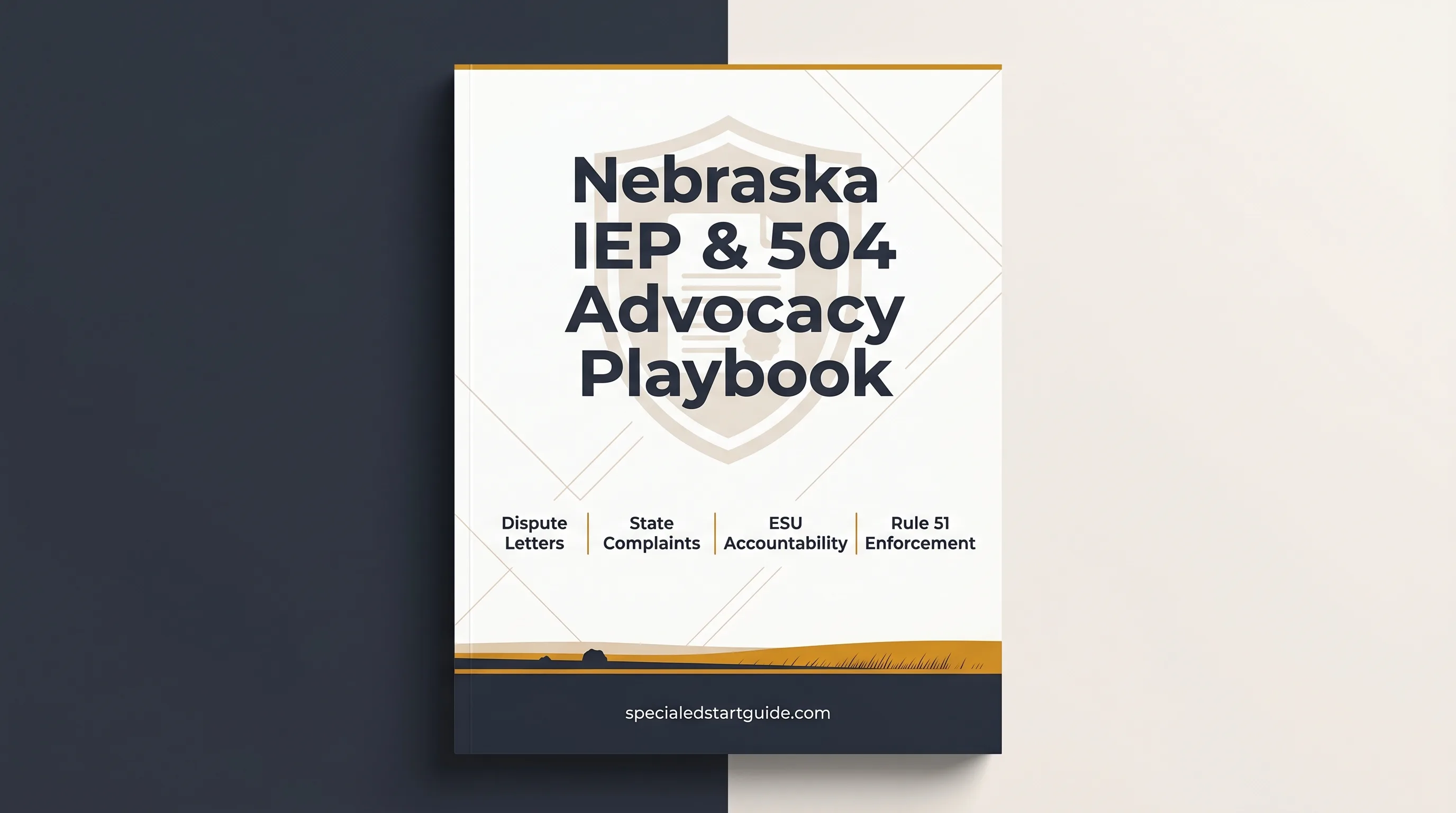
The Nebraska IEP & 504 Advocacy Playbook is the Rule 51 Enforcement System — seven ready-to-send dispute letters, a state complaint filing kit, ESU accountability tools, and meeting negotiation scripts that transform you from a frustrated parent asking for help into a documented advocate demanding compliance.
What's Inside the Playbook
The ESU Accountability System
Your child's speech therapist is employed by the ESU. The school says "talk to the ESU." The ESU says "the district schedules us." Meanwhile, six weeks of mandated therapy go undelivered. Under 92 NAC 51-004, the school district bears 100% legal responsibility for FAPE — regardless of what entity employs the therapist. The Playbook gives you the service tracking template, the compensatory minutes calculation method, and the demand letter directed at the superintendent that forces the district to hire a private contractor or answer to the NDE.
The Prior Written Notice Trap-Setter
The single most powerful tool in Nebraska special education advocacy is forcing the district to put their refusals in writing. When a school verbally denies your request, they avoid accountability. When you demand a PWN citing 92 NAC 51-009.05, they must document the refusal, explain their reasoning, describe the data they relied on, and list alternatives considered. This creates the paper trail that makes a state complaint winnable. The Playbook gives you the exact demand template with all five required legal elements.
The State Complaint Filing Kit
When documentation, demand letters, and meeting advocacy fail to produce compliance, the NDE State Complaint is your nuclear option short of due process — and it's faster, cheaper, and resolved within 60 calendar days. The Playbook gives you the complete filing template formatted exactly as the NDE Office of Special Education requires: the complaint address (301 Centennial Mall South, P.O. Box 94987, Lincoln, NE 68509), evidence organization guidance, proposed resolution language, and a model complaint narrative you can adapt to your situation.
The Dispute Resolution Decision Matrix
State complaint or due process hearing? Mediation or IEP facilitation? Most parents escalate based on emotion rather than strategy — filing due process when a state complaint would resolve faster, or requesting mediation when the district has already demonstrated bad faith. The Playbook includes a visual decision flowchart that maps your specific situation to the optimal dispute path: state complaint for compliance violations (missed services, timeline breaches, PWN failures), mediation for substantive disagreements (placement, goals), and due process only when FAPE is fundamentally denied.
7 Copy-Paste Dispute Letters
Every template cites the exact Nebraska regulation. Request an initial evaluation and start the 45-school-day clock. Demand Prior Written Notice when the district verbally refuses. Request an Independent Educational Evaluation at public expense. Demand compensatory services when the ESU fails to deliver. File a state complaint with the NDE. Request your child's complete educational records (including ESU-held records). Memorialize verbal agreements the same day so the district cannot later deny what was discussed. Fill in the brackets, hit send, and create the legally binding paper trail that protects your child.
IEP Meeting Negotiation Scripts
What to say when the team claims "we don't have the staff." What to say when they insist on more MTSS tiers before evaluating. What to say when the ESU representative wasn't invited to your child's meeting. What to say when they push a 504 plan instead of an IEP. What to say when the district offers a verbal "we'll look into it" instead of committing to a documented action. Each script cites the Rule 51 regulation that proves them wrong — you're not arguing opinions, you're citing Nebraska law.
The 30-Day Action Plan
Most parents know something is wrong but don't know where to start. The 30-Day Action Plan sequences every step: Day 1 starts your communication log and records request. Day 7 sends your first demand letter. Day 14 follows up with a PWN demand if the district hasn't responded. Day 21 escalates to the superintendent. Day 30 files the state complaint if compliance hasn't been achieved. No strategizing from scratch — just follow the timeline.
Who This Playbook Is For
- Parents whose district verbally denied a request — for an evaluation, additional services, a placement change — and never provided Prior Written Notice documenting the refusal
- Parents in rural Nebraska where ESU therapists drive between districts weekly, sessions get cancelled without replacement, and the school says "there's nothing we can do about ESU staffing"
- Parents in Omaha and Lincoln where large district bureaucracies delay responses, lose paperwork, and rely on parents giving up before the system delivers what the IEP requires
- Parents whose child has been stuck in MTSS/RTI interventions for months while the school refuses to evaluate — and who need the legal citation proving MTSS cannot delay or deny an evaluation request
- Parents who have already tried the collaborative approach — attending meetings, writing polite emails, trusting the team — and watched their child lose services while the district made promises it never kept
- Parents whose child was suspended for disability-related behavior without a Manifestation Determination Review and need to challenge the disciplinary action
- Parents who need to file a state complaint with the NDE but don't know the format, evidence requirements, or how to write an effective proposed resolution
- Parents who want to hold the district accountable without hiring a $260/hour attorney — but need the exact legal language and enforcement templates to do it themselves
Why Free Resources Aren't Enough When the District Won't Comply
Nebraska has genuine free advocacy organizations. PTI Nebraska provides parent training. Disability Rights Nebraska handles severe civil rights cases. The NDE publishes Rule 51 and procedural safeguard documents. Here's why parents still lose disputes after consulting all of them:
- PTI Nebraska teaches collaboration — not enforcement. Their materials emphasize the "parent-school partnership." When the partnership has broken down — when the school is actively violating the law — collaborative language doesn't create compliance. PTI cannot provide adversarial tactics, legal templates, or negotiation scripts designed for a district that refuses to cooperate.
- Disability Rights Nebraska has strict eligibility criteria. DRN provides excellent legal templates, but their direct legal representation is reserved for severe cases that meet their priority areas and resource limitations. The vast majority of parents don't qualify for DRN representation — and DRN's generic templates don't tell you how to sequence your advocacy, calculate compensatory minutes, or choose between a state complaint and mediation.
- Rule 51 is 100+ pages of administrative code. It covers funding formulas, federal reporting requirements, and district-level compliance procedures alongside parent rights. Finding the one section that applies to your dispute — and knowing how to cite it in a letter that forces the district to respond — requires translating regulatory language into tactical advocacy.
- National guides ignore Nebraska's ESU system entirely. Wrightslaw, TPT binders, and Etsy advocacy templates reference federal IDEA — they have zero guidance on ESU accountability, the non-delegable duty under 92 NAC 51-004, or how to demand compensatory services when a contracted provider fails to deliver.
- Private advocates cost $100–$300 per hour. Attorneys demand $5,000 retainers. And they prefer cases where the parent has already built a paper trail. The Playbook teaches you how to build that trail — either empowering you to resolve the dispute yourself or saving thousands in billable hours if you do hire a professional.
Free resources explain what the law says. The Playbook gives you the enforcement tools for when the district breaks it.
— Less Than 10 Minutes of a Private Advocate's Time
Private advocates in Nebraska charge $100–$300 per hour. A single consultation covers barely enough time to review your file. The Advocacy Playbook gives you the same enforcement frameworks, letter templates, and regulatory citations that professional advocates use — formatted for parents who need to act tonight, not schedule a $200 intake appointment.
Your download includes the complete 13-chapter Advocacy Playbook, 6 standalone printable tools, and the Nebraska Dispute Letter Starter Kit:
- Complete Advocacy Playbook Guide (guide.pdf) — 13 chapters covering your legal foundation (Rule 51 and federal IDEA), the ESU system and who is actually accountable, the 45-school-day evaluation timeline, Prior Written Notice enforcement, Nebraska's three dispute resolution paths (state complaint, mediation, due process), evidence building, IEP meeting negotiation strategies, specific advocacy scenarios (MTSS bypass, disciplinary removals, IEP-to-504 downgrades, ESU service failures), 7 ready-to-send letter templates, transition planning ages 14–21, Nebraska resources and contacts, and the 30-Day Action Plan
- Advocacy Letter Templates (advocacy-letters.pdf) — all 7 copy-paste dispute letters extracted as a standalone printable, each citing exact Nebraska Rule 51 regulations
- NDE State Complaint Template (state-complaint-template.pdf) — fill-in-the-blank complaint formatted exactly as the NDE Office of Special Education requires, with evidence checklist and proposed resolution guidance
- ESU Service Tracking Log (service-tracking-log.pdf) — fillable worksheet for documenting missed therapy sessions, calculating compensatory minutes owed, and building the mathematical evidence for your demand letter
- Communication Log (communication-log.pdf) — printable log for every phone call, hallway conversation, and meeting — the foundation of your paper trail
- Dispute Escalation Ladder (escalation-ladder.pdf) — visual reference showing the 5-step path from informal advocacy through NDE state complaint and due process, with Nebraska-specific timelines at each stage
- 30-Day Action Plan (30-day-action-plan.pdf) — the week-by-week checklist from first records request through resolution — print it and follow the timeline
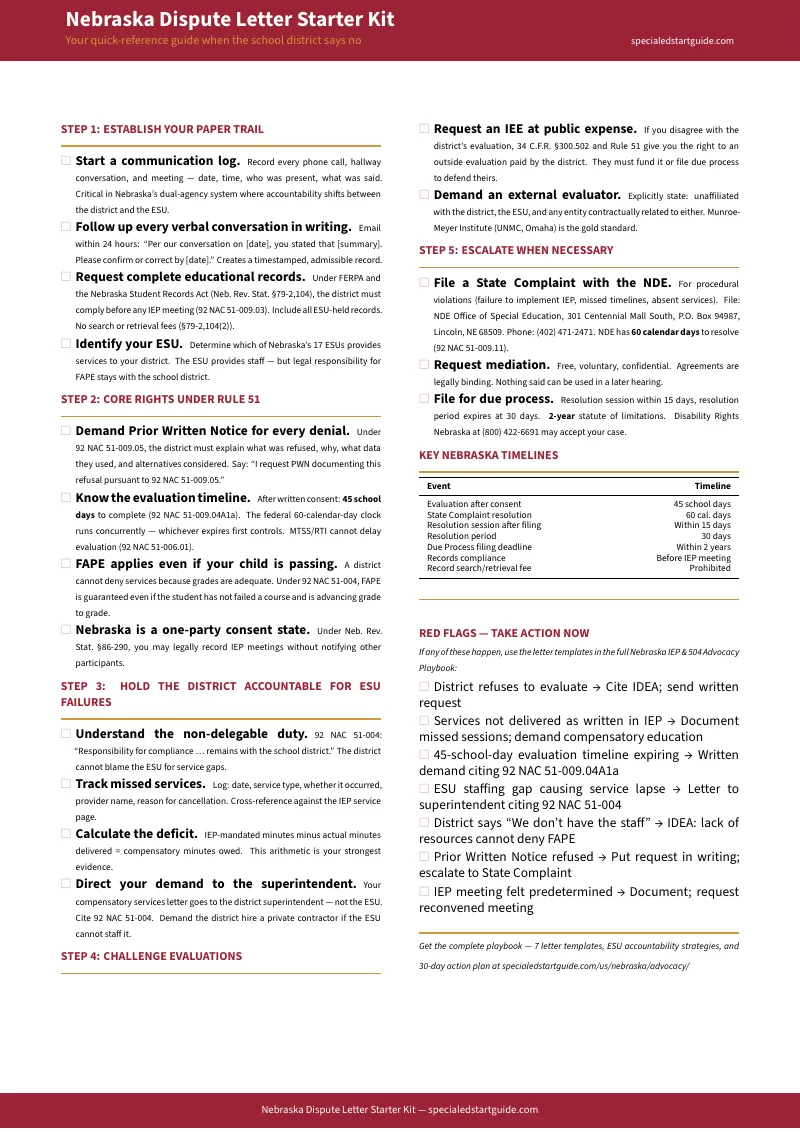
- Nebraska Dispute Letter Starter Kit (checklist.pdf) — the free quick-reference checklist covering paper trail establishment, core Rule 51 rights, ESU accountability steps, evaluation challenge procedures, and escalation paths with NDE contact information and key timelines
Instant PDF download. Send your first dispute letter tonight. Start the paper trail that holds the district accountable.
Money-back guarantee, no time limit. If the Playbook doesn't change how you approach disputes with your Nebraska school district, email us for a full refund. No questions asked.
Not ready for the full Playbook? Download the free Nebraska Dispute Letter Starter Kit — a printable quick-reference checklist covering your core Rule 51 rights, ESU accountability basics, and the key contacts and timelines you need for your next conversation with the district. It's enough to start building your paper trail, and it's free.
Your child's services aren't a favor the district grants when staffing allows. They're a legal mandate. The Playbook teaches you how to enforce it.