You Know Something Is Wrong. The District Knows You Don't Know the Right Words to Prove It.
Your child came home from school in tears again. Or they were sent home early — for the third time this month — and nobody called it a suspension. Or the cooperative therapist cancelled another session, and the principal shrugged: "We can't control co-op scheduling." Or you walked into an IEP meeting and asked for an evaluation, and the team said "Let's try RTI first" and showed you the door. Or your request was simply ignored — no letter, no explanation, no response.
You searched for help. You found PLUK — which closed permanently in 2019. You found the Montana Empowerment Center — but the callback takes days and your next IEP meeting is Thursday. You found Disability Rights Montana's Student Rights Handbook — 98 pages of legal citations that assume you already understand what ARM 10.16.3321 means. You found Wrightslaw — which covers federal IDEA but says nothing about Montana's cooperative service model, tribal school jurisdictions, or how OPI state complaints actually work in Helena. You priced a private special education advocate at $125–$200 per hour and a special education attorney at $200–$400. The nearest one is in Billings or Missoula — a three-hour drive each way.
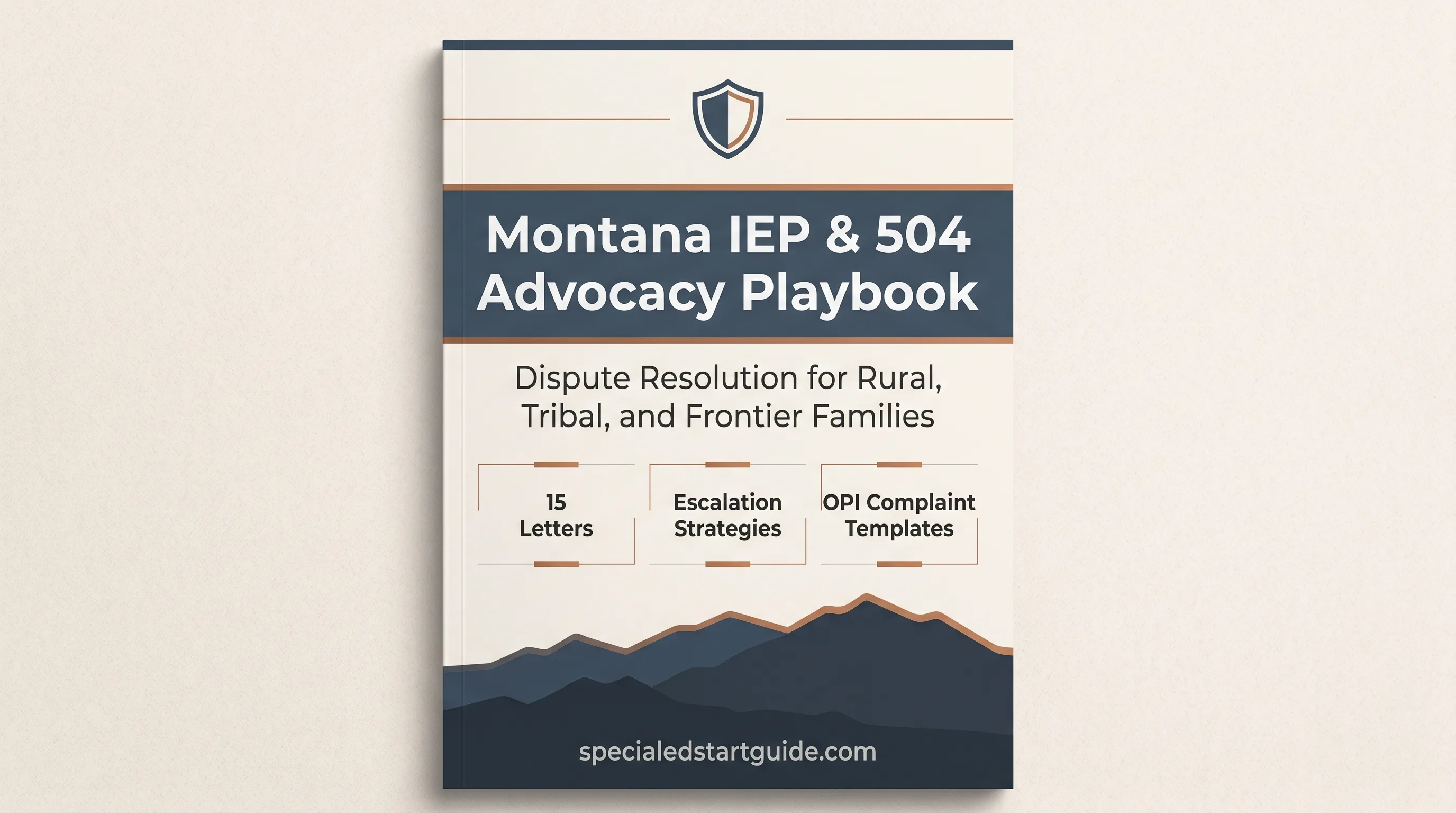
The Montana IEP & 504 Advocacy Playbook is the Diplomatic Authority System — 15 ready-to-send letter templates, tactical dispute scripts, and escalation strategies built entirely around Montana's Administrative Rules (ARM Title 10, Chapter 16), Montana Code Annotated (MCA Title 20, Chapter 7, Part 4), and OPI dispute resolution procedures. Every template is designed to enforce your child's rights firmly and procedurally without burning bridges in the small community where you live.
What's Inside the Playbook
15 Copy-Paste Advocacy Letter Templates
Each letter cites the exact Montana regulation that compels the district to act. Request a formal evaluation and start the 60-calendar-day clock under ARM 10.16.3321. Demand Prior Written Notice when the district verbally refuses a service. Request an Independent Educational Evaluation at public expense under ARM 10.16.3504. File a state complaint with OPI under ARM 10.16.3662 when deadlines expire. Demand compensatory education when cooperative staff miss sessions. Request transportation reimbursement under an Individual Transportation Contract (TR4) citing MCA §20-7-442. You fill in your child's name and hit send — the legal language is already done.
The Small-District Diplomacy Framework
National advocacy guides tell you to "fight the district." In a Montana town of 400 people — where the special education director's spouse runs the only grocery store and the superintendent coaches your child's basketball team — confrontation doesn't just risk the IEP relationship, it risks your entire social network. This framework gives you procedurally firm language that cites ARM Title 10 and MCA Title 20 while leaving room for the district to comply without losing face. You are not accusing anyone of failure. You are creating a paper trail that makes compliance the path of least resistance.
The Tribal School Jurisdiction Navigator
Montana encompasses eight federally recognized tribes across seven reservations. Whether your child attends a state public school on or near a reservation, a Bureau of Indian Education (BIE) operated school, or a tribally controlled grant school determines which oversight body handles disputes, where complaints get filed, and which procedural timelines apply. The Navigator maps both pathways — OPI for state schools, BIE Division of Performance and Accountability for BIE schools — and provides the specific advocacy letters for each system.
The Rural Service Delivery Enforcer
When your child's IEP mandates 60 minutes per week of speech therapy but the cooperative SLP visits once every two weeks — or cancels for weather, staffing gaps, or scheduling conflicts — those minutes do not disappear. They accumulate as a compensatory education debt the district owes your child. The Enforcer includes a service delivery tracking log, the compensatory education calculation method, and the demand letter that forces the district to propose a specific makeup plan with dates, minutes, and provider name.
The Teletherapy Rights Toolkit
Rural districts increasingly default to teletherapy when no provider exists within 100 miles. Parents are told "this is what we have" without being informed that teletherapy requires documented consent in the IEP, that the district must provide a trained paraprofessional to assist the child during virtual sessions, and that inadequate teletherapy does not satisfy the IEP service mandate. The Toolkit gives you the consent requirements, the IEP language that locks in quality safeguards, and the compensatory education script when the district provided screen time instead of therapy.
The OPI State Complaint Filing Guide
A state complaint filed with the Montana Office of Public Instruction is investigated and resolved within 60 calendar days. You do not need an attorney to file one. The guide walks you through exactly what OPI accepts, how to structure the complaint for maximum impact, which violations are strongest (timeline violations and service delivery failures), and the specific documentation to attach. It includes the complaint letter template pre-formatted for OPI's intake requirements.
The Complete Dispute Escalation Ladder
Not every disagreement requires a state complaint. The ladder maps your options from lowest-stakes to highest: reconvened IEP meeting → facilitated IEP meeting → OPI Early Assistance Program (406-444-5664) → formal mediation → state complaint → due process hearing. Each level includes when to use it, what it costs (most are free), typical timelines, and the specific template to initiate it.
Who This Playbook Is For
- Parents whose district refused an evaluation — verbally or with inadequate justification — and who need the exact letter that forces a written response under PWN requirements
- Parents stuck in RTI purgatory where the school insists on prolonged Response to Intervention while the child falls further behind — and who need the legal citation proving RTI cannot delay an evaluation request under IDEA 300.301(b)
- Parents in rural and frontier Montana — one-room districts, Class C schools, communities where the itinerant therapist visits once a week and the nearest independent evaluator is three hours away — who are told "we don't have the staff" for every service gap
- Parents on or near Montana's seven reservations navigating the jurisdictional maze between public school districts, BIE schools, and tribally controlled schools — where filing a complaint to the wrong entity accomplishes nothing
- Parents in Billings, Missoula, Great Falls, Bozeman, or Helena dealing with overcrowded caseloads, procedural delays, and cooperative buck-passing between the school and the co-op
- Parents whose child was suspended or sent home repeatedly without a Manifestation Determination Review — or where the school's "modified schedule" is really an undocumented exclusion
- Parents who cannot afford a private advocate or attorney ($125–$400/hour) and need to build a professional paper trail themselves — or who want to arrive at an advocate's office with documentation already organized so they're not paying $200/hour for file review
- Parents who fear small-town retaliation — social consequences, teacher resentment, or administrative payback — and need advocacy language that enforces rights without making it personal
Why Not Just Use the Free Resources?
Montana has genuine free special education support. Here is exactly why each one fails at the moment you need it most:
- PLUK closed in 2019. For decades, Parents Let's Unite for Kids was the resource Montana parents were told to call. It no longer exists. Older school handouts, Facebook posts, and provider directories still reference PLUK — sending desperate parents to dead links and disconnected numbers.
- The Montana Empowerment Center has capacity limits. MEC provides excellent consultations, but they serve 56 counties with limited staff. They cannot write your letters, attend your meeting, or tell you what to say when the district pushes back. Their federal mandate requires neutrality — they facilitate resolution, not adversarial advocacy.
- Disability Rights Montana's handbook is a legal textbook. At 98 pages of continuous CFR and ARM citations, the DRM Student Rights Handbook explains what the law says — but gives you zero templates, zero scripts, and zero step-by-step dispute strategies. When your child was just excluded from class, you do not have the bandwidth to distill a legal manual into tonight's email.
- OPI publications are written for compliance officers. The Montana Special Education Guidance document ensures the district passes its state audit. It tells the district what to do. It does not tell you what to say when the district doesn't do it.
- Wrightslaw covers federal law — not Montana procedures. Wrightslaw doesn't address cooperative service delivery, tribal school jurisdictions, TR4 transportation contracts, or how OPI state complaints work in Helena. Using generic national terminology signals to the district that you don't know your local procedures.
- Private advocates cost $125–$200 per hour in Montana. Attorneys run $200–$400. Most families can't afford that — and there are almost no education law specialists outside Billings, Missoula, and Helena.
Free resources tell you what Montana law says. This Playbook gives you the exact words to make the district follow it.
— Less Than Fifteen Minutes of an Advocate's Time
A private special education advocate in Montana charges $125–$200 per hour. An attorney runs $200–$400. If you hand a professional a disorganized file and no paper trail, you'll spend hundreds just for them to review the situation. The Playbook teaches you to build the trail, file the right requests, and escalate disputes procedurally — either handling it yourself or cutting significant billable hours if you do hire help later.
Your download includes 8 printable PDFs — the complete Advocacy Playbook, the dispute letter starter kit checklist, and 6 standalone tools ready to use tonight.
- Complete Advocacy Playbook — 17 chapters covering Montana special education law (ARM Title 10, MCA Title 20), paper trail strategies, Prior Written Notice, evaluation timelines, IEP dispute tactics, cooperative accountability, teletherapy rights, rural transportation reimbursement (TR4), discipline and Manifestation Determinations, the OPI state complaint system, tribal school jurisdiction, and the complete dispute escalation ladder
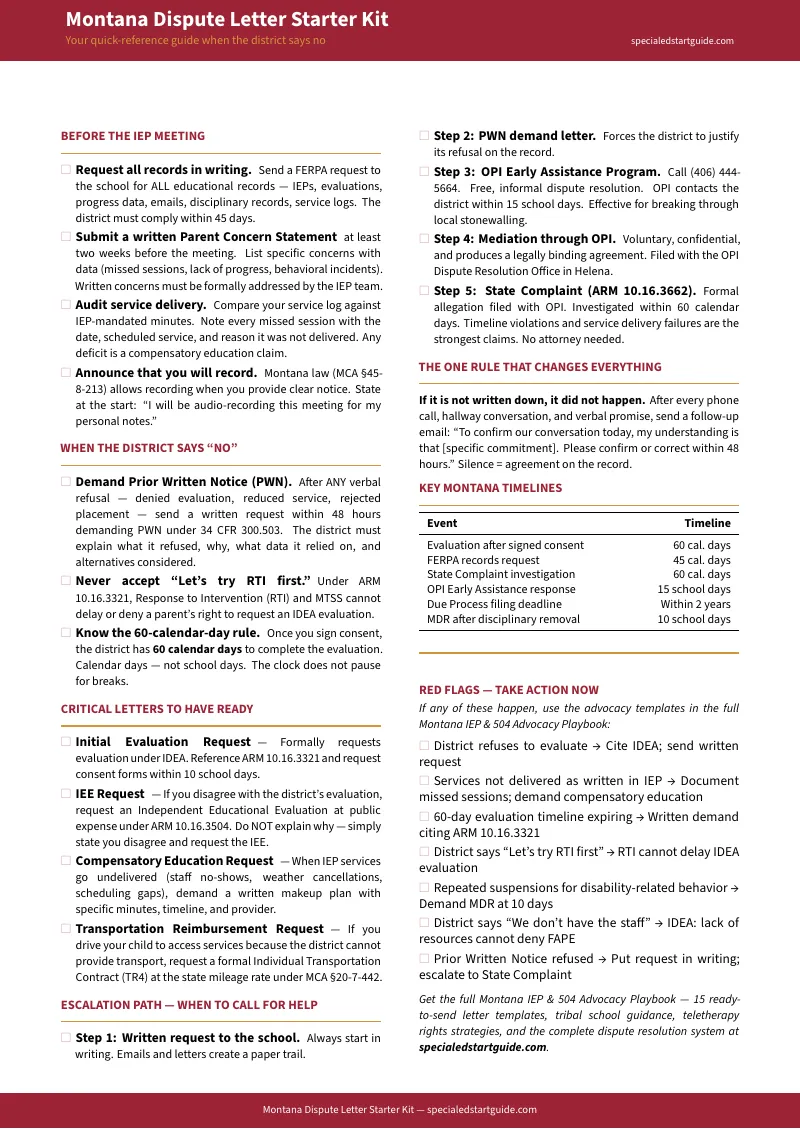
- Montana Dispute Letter Starter Kit — the 2-page quick-start checklist covering pre-meeting preparation, PWN demands, critical letter summaries, and the full escalation path from written request through state complaint
- 15 Ready-to-Send Letter Templates — standalone printable with all fill-in-the-blank templates citing exact Montana ARM and MCA sections for evaluation requests, PWN demands, IEE requests, compensatory education claims, cooperative service complaints, transportation reimbursement, state complaint filing, and more
- Service Delivery Tracking Log — fillable weekly worksheet for documenting whether mandated services were actually delivered, by whom, and for how long — evidence that becomes undeniable in a state complaint
- Communication Log — fillable log for recording every interaction with school and cooperative staff so no verbal promise goes undocumented
- Dispute Escalation Ladder — one-page reference card showing the full path from informal advocacy through OPI Early Assistance, mediation, state complaint, and due process hearing — with triggers and timelines for each level
- OPI State Complaint Template — fillable form pre-formatted for the Montana Office of Public Instruction's intake requirements under ARM 10.16.3662
- MDR Preparation Checklist — print-and-complete checklist for Manifestation Determination Review meetings covering the two legal questions, your rights, and documentation to bring
Instant PDF download. Customize and send the first letter tonight. Walk into your next IEP meeting with the law — and the specific language to cite it — on your side.
Money-back guarantee, no time limit. If the Playbook doesn't change how you handle IEP disputes in Montana, email us for a full refund. No questions asked.
Not ready for the full Playbook? Download the free Montana Dispute Letter Starter Kit — a printable 2-page checklist with pre-meeting preparation steps, PWN demand instructions, critical letter summaries, and the complete escalation path. It's enough to walk into your next meeting with a plan, and it's free.
Your child's education is a federal right, not a favor the district grants at its convenience. The district knows ARM Title 10, Chapter 16 and MCA Title 20, Chapter 7. After tonight, you will too — and you'll have the letters to prove it.