
The District Brought Five Professionals to Your IEP Meeting. You Brought Good Intentions.
You sat at one side of the table — across from the special education coordinator, the LEA representative, the general education teacher, the school psychologist, and maybe a district attorney. They used acronyms you'd never heard before — PLAAFP, LRE, SDI, ESY. They slid a pre-written IEP across the table, pointed to the signature line, and moved on. In St. Louis County, it was even more confusing: the teacher in the room works for the Special School District but the principal works for Parkway or Rockwood, and when you asked who was actually responsible for your child's services, both pointed at the other.
When you got home you Googled "Missouri IEP rights" and found Wrightslaw (federal law only — nothing about RSMo Chapter 162, Policy KKB, or the Administrative Hearing Commission), MPACT (excellent but state-funded and focused on mediation, not adversarial leverage), and Teachers Pay Teachers (organizational binders that don't explain a single Missouri regulation). A private special education advocate charges $40 to $150 per hour. A special education attorney in Missouri bills $150 or more. If you earn too much for free legal aid but not enough for a retainer, you are on your own.
The Missouri IEP & 504 Blueprint is the Compliance Navigation System — the tactical toolkit that bridges the gap between knowing your rights in theory and exercising them at the IEP table, with every template, script, and checklist grounded in RSMo Chapter 162 (§162.670–162.999), 5 CSR 20-300, the Missouri State Plan for Special Education, and IDEA.
What's Inside the Blueprint
The SSD Chain of Command — Decoded
The Special School District of St. Louis County operates as a county-wide overlay handling special education for 22 component districts — Parkway, Rockwood, University City, Ladue, Mehlville, Lindbergh, and others. Your child's special education teacher works in a Parkway school but is employed by SSD, reports to an SSD Area Coordinator, and can be involuntarily reassigned to another district to patch staffing gaps. When services fail, the building principal says "that's SSD's staff" and the SSD coordinator says "that's a building-level issue." The Blueprint maps exactly who controls staffing, who controls discipline, when to pressure the component district principal, when to escalate to the SSD Area Coordinator, and when to go directly to the SSD Superintendent. After the DOJ documented systemic civil rights violations regarding SSD's use of seclusion and restraint for minor infractions, you cannot afford to let two bureaucracies point fingers while your child falls through the gap.
The Policy KKB Recording Playbook
Missouri is a one-party consent state — you can legally record any conversation to which you are a party. But local school boards across Missouri implement Policy KKB requiring 24-hour written notice before recording, and when parents comply, the district brings their own recorder and legal counsel, immediately escalating hostility. The Blueprint gives you the legal analysis, the Missouri Attorney General's explicit position that school boards have "no authority whatsoever" to limit your statutory right, and the exact script to read to the principal when they attempt to confiscate your phone or halt the meeting.
The 60-Calendar-Day Timeline Enforcer
The moment you consent to an evaluation, Missouri law gives the district 60 calendar days to complete it — and that clock runs continuously, including weekends, holidays, and breaks. Districts exploit the timeline by telling parents "we need to finish RTI first" (illegal under IDEA 300.301(b)), citing 6-to-8-week observation periods before starting the clock, or scheduling evaluations in April knowing summer delays will follow. The Blueprint gives you the evaluation request letter that starts the clock, the follow-up templates at each checkpoint, and the compliance demand letter when the 60 days expire without an eligibility determination.
The Copy-Paste Advocacy Letter Library
Every letter cites the exact Missouri regulation. Request a formal evaluation and start the 60-calendar-day clock. Demand an Independent Educational Evaluation at public expense. Request a Functional Behavioral Assessment. Document constructive removal when the school sends your child home early without logging it as a suspension. Demand Prior Written Notice when the district verbally refuses a service. These are Missouri enforcement tools that create a legally binding paper trail the moment you hit send.
IEP Meeting Scripts and Checklists
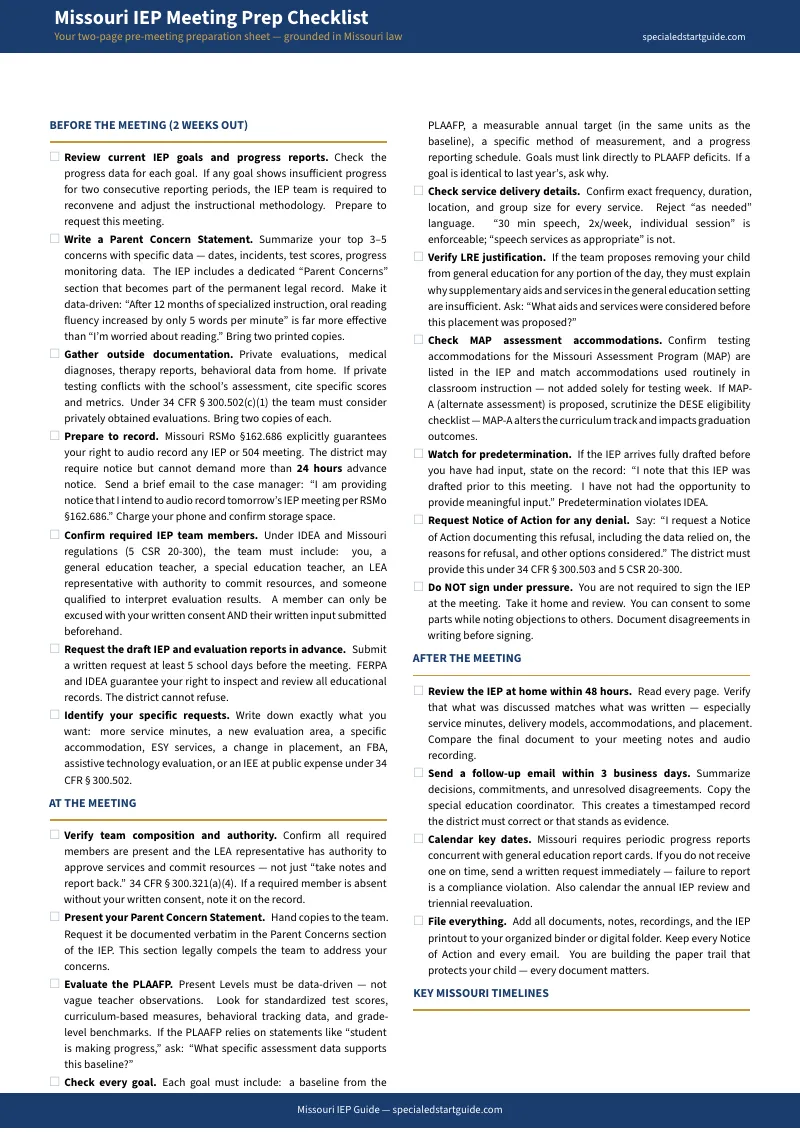
What to say when the team tells you your child doesn't qualify because their grades are passing. What to say when they push a 504 instead of an IEP. What to say when the LEA representative claims they can't add service minutes "because of staffing." Each script cites the RSMo Chapter 162 or 5 CSR 20-300 regulation that proves them wrong — so you're not arguing opinions at the table, you're citing Missouri law. The pre-meeting checklist covers one-party consent recording rights under RSMo §162.686, required IEP team composition, and the specific documents to bring.
Goal-Tracking Worksheets
IEP goals are legally required to be measurable — with baselines, targets, and mastery criteria that meet the Endrew F. standard. But many goals in Missouri are written so vaguely that progress is impossible to track. The worksheets give you a structured format to log data between meetings, compare school-reported progress against your own observations, and arrive at the annual review with documentation that either confirms the program is working or proves it isn't.
The AHC Dispute Resolution Ladder
Older guides and forum posts still reference Missouri's abolished three-member hearing panel. It no longer exists. Senate Bill 595 transferred all special education due process hearings to the Administrative Hearing Commission (AHC). Under RSMo 162.961, disputes are now heard by a single AHC commissioner with strict neutrality requirements. The Blueprint explains the full escalation ladder — reconvened IEP meeting, DESE mediation, DESE State Child Complaint (60-day investigation), and AHC due process hearing — with the procedural requirements, timelines, and paper trail needed for each.
Who This Blueprint Is For
- Parents preparing for their first IEP meeting who don't want to walk in blind against a team that does this every day — and who need to understand the IEP document before it's discussed at the table
- Parents whose child has been pushed into a 504 Plan when they should be receiving specially designed instruction under an IEP — especially when the school says "let's try accommodations first"
- Parents in St. Louis County trapped between their local Parkway, Rockwood, Ladue, or Mehlville principal and the Special School District — unsure which entity controls staffing, which controls discipline, and who to escalate to when services fail
- Parents in Kansas City — Park Hill, North Kansas City, Blue Springs, Lee's Summit, Independence — where districts have segregated special education classes or charter schools are uncertain about their IDEA obligations
- Parents in Springfield, Columbia, Joplin, or rural Missouri where the nearest BCBA is an hour away, the school psychologist's caseload is full, and the district says "we don't have the staff" for every unmet need
- Parents whose child has ADHD, autism, dyslexia, or anxiety and was told they're "too smart for special education" or "grades are too high" — and who need to understand that academic performance is not the legal standard
- Parents whose child was suspended without a Manifestation Determination Review — or who is being sent home early every week without anyone calling it a suspension
- Parents who want to record their IEP meeting but were told "district policy doesn't allow that" — and who need the Missouri AG's position and the exact pushback script
Why Not Just Use the Free Resources?
Missouri has genuine free special education resources. MPACT publishes training videos and factsheets. DESE provides procedural safeguards documents. Disability Rights Missouri handles severe civil rights violations. Here's why parents still struggle after consulting all of them:
- MPACT is state-funded and partnered with DESE. Their guides are frequently co-developed with DESE's Compliance Section, and their philosophy prioritizes mediation and early resolution. When a school district is brazenly denying an evaluation or ignoring behavioral data, you don't need mediation — you need legal leverage. MPACT also relies on volunteer mentors, and parents face intake surveys and waitlists while their child's educational timeline keeps ticking.
- DESE publications are written for compliance officers, not parents. The Prior Written Notice templates are published as administrative tools — they ensure the district passes its audit, not that you navigate the system successfully. The regulatory language is impenetrable without plain-English translation.
- Wrightslaw covers federal law — not RSMo Chapter 162 or 5 CSR 20-300. Wrightslaw doesn't address the SSD dual-bureaucracy, Policy KKB recording conflicts, Missouri's 16 disability categories, or the Administrative Hearing Commission. Using national terminology without understanding Missouri's implementation signals to the district that you don't know your local rights.
- Disability Rights Missouri handles severe systemic violations, not daily IEP disputes. Their resources are limited and their intake criteria are strict. Most families don't qualify for direct representation.
- TPT and Etsy planners organize paperwork — they don't enforce rights. A pastel IEP binder won't explain what the IEP document means, why the district is pushing a 504, or how to cite 5 CSR 20-300 to demand Prior Written Notice for a refusal.
- Private advocates cost $40–$150 per hour in Missouri. Attorneys run $150 or more. Most families can't afford that — and advocates prefer cases where a solid paper trail already exists. The Blueprint is how you build that trail.
The free resources explain what Missouri law says. The Blueprint gives you the tools to make the district follow it.
— Less Than One Hour of a Special Education Advocate
Private advocates in Missouri charge $40–$150 per hour. Special education attorneys run $150 or more. If you hand an advocate a disorganized pile of papers, you'll spend hundreds just for them to review the file and formulate a strategy. The Blueprint teaches you how to organize the binder, decode the IEP document, and draft the initial requests — either empowering you to advocate effectively without an advocate, or saving significant billable hours if you do hire one.
Your download includes the complete Blueprint guide, the meeting prep checklist, and 7 standalone printables — every template, script, and reference ready to print and bring to your next IEP meeting.
- Complete Blueprint Guide — 16 chapters covering the Missouri special education landscape, IEP vs. 504, referral and evaluation timelines (60-calendar-day evaluation clock), the IEP document walkthrough, goals and progress monitoring, the SSD chain of command for St. Louis County, recording rights vs. Policy KKB, accommodations and related services, discipline and Manifestation Determinations, ESY services, transition planning, dispute resolution through the Administrative Hearing Commission, documentation strategies, Independent Educational Evaluations, Missouri resources, and a complete templates and scripts library
- IEP Meeting Prep Checklist — the before/during/after checklist with Missouri timelines, IEP team composition requirements under 5 CSR 20-300, and recording rights under RSMo §162.686
- 60-Day Timeline Enforcer — the complete evaluation-to-services timeline on one printable sheet, with checkpoint actions and the RTI/MTSS bypass script
- Copy-Paste Advocacy Letters — all 5 fill-in-the-blank templates ready to send: Evaluation Request, Prior Written Notice Demand, IEE Request, Meeting Recording Notice, and Follow-Up Email
- IEP Meeting Scripts — word-for-word responses to "we need to do RTI first," IEP-to-504 downgrades, and predetermined IEPs
- Goal-Tracking Worksheets — structured progress monitoring for up to 6 IEP goals with data collection rows, a service delivery log, and annual review summary
- AHC Dispute Resolution Ladder — the full escalation path from Notice of Action through DESE State Complaint, mediation, and due process hearing
- SSD Chain of Command Reference — the 4-level escalation ladder for St. Louis County's dual-bureaucracy with contact roles and the buck-passing script
- Policy KKB Recording Playbook — RSMo §162.686 reference, notification email template, and the 3-step pushback script
Instant PDF download — 9 files total. Print the standalone templates tonight. Walk into tomorrow's IEP meeting with the law on your side.
Money-back guarantee, no time limit. If the Blueprint doesn't change how you approach IEP meetings in Missouri, email us for a full refund. No questions asked.
Not ready for the full Blueprint? Download the free Missouri IEP Meeting Prep Checklist — a printable pre-meeting checklist with Missouri timelines, IEP team composition requirements, one-party consent recording rules under RSMo §162.686, and red flags that require immediate action. It's enough to walk into your next meeting prepared, and it's free.
Your child's education is a legal right, not a favor. The district knows RSMo Chapter 162 and 5 CSR 20-300. After tonight, so will you.