The District Runs the Clock on Minnesota Rule 3525. After Tonight, You Own It.
You walked into that IEP meeting as prepared as you could be. You downloaded PACER's 50-page guide. You read the MDE Part B Notice of Procedural Safeguards. You even attended a free workshop and learned what FAPE, LRE, PLAAFP, and DAPE stand for. But nobody told you what to do when the team hands you a Prior Written Notice and the 14 calendar day passive consent clock starts ticking from the day you receive it. Nobody gave you the exact language to formally object before the proposal becomes law by default. Nobody explained that Minnesota is one of only a handful of states with a mandatory Conciliation Conference — or that the written memorandum the district must produce five school days later becomes binding evidence in any future dispute.
So you sat across from the special education director, the case manager, the school psychologist, and the general ed teacher — and they told you your child was "making progress" while the data showed two years of stagnation. They offered a 504 when your child needs specially designed instruction. They said they'd "look into it." And you didn't know enough to freeze the proposal, force a conciliation memorandum, or cite Minnesota Rule 3525.2710 to enforce the 30-school-day evaluation deadline — because no free Minnesota resource teaches you how to weaponize the procedural safeguards the state wrote for compliance officers.
The problem isn't that you lack effort. The problem is that Minnesota's special education system operates on two overlapping legal frameworks — federal IDEA and Minnesota Rules Chapter 3525 layered on Minnesota Statutes Chapter 125A — across more than 500 school districts, charter schools, and rural service cooperatives where every district has its own special education culture. The statewide special education cross-subsidy hit an estimated $502.6 million in FY 2024. Districts were trained in an era of budget triage, and old habits die hard. When a director says "we don't do that here," what you are hearing is a budget reflex. Parents absorb the consequences.
The Minnesota IEP & 504 Blueprint is the tactical enforcement toolkit that bridges the gap between knowing your rights exist and actually exercising them — with every template, script, and checklist grounded in Chapter 3525 and the Minnesota Statutes that govern special education in this state.
What's Inside the Blueprint
The Chapter 3525 Script Library
Copy-paste letters that cite the exact Minnesota rule. Request an initial evaluation under Minn. R. 3525.2710 and start the 30-school-day clock (not the federal 60 calendar days). File a formal written objection to a Prior Written Notice under Minn. R. 3525.3600 to freeze the proposal before the 14 calendar day passive consent window closes. Demand an Independent Educational Evaluation at public expense. Request service delivery logs to verify whether the minutes on paper are actually being delivered. These aren't generic national samples — they're Minnesota-specific letters that create a legally binding paper trail the moment you hit send.
The Conciliation Conference Blueprint
Minnesota is one of the very few states with a formal, mandatory Conciliation Conference step under Minn. Stat. § 125A.091, Subd. 7. National guides do not teach you how to use it — PACER and MDE explain that it exists. This Blueprint tells you exactly how to invoke it in writing, who to demand in the room, what to say, and how to weaponize the mandatory five-school-day written memorandum the district must produce afterward. That memorandum becomes evidence in every subsequent complaint, mediation, or hearing. Most Minnesota parents never use this lever. The ones who do win settlements quietly.
The 30 / 14 / 5 Minnesota Timeline Decoder
Minnesota runs on different deadlines than federal IDEA. 30 school days to complete an evaluation once consent is signed. 14 calendar days to object in writing to a Prior Written Notice before passive consent kicks in. 5 school days for the district to produce the conciliation memorandum. 10 calendar days to schedule the conciliation conference once you object. The Blueprint maps every Minnesota-specific deadline so you know the exact date the district's obligation expires — and what to do when they miss it.
IEP Meeting Scripts and Checklists
What to say when the team tells you your child is "making progress" but the data shows otherwise. What to say when they offer a 504 instead of an IEP. What to say when the case manager claims they "don't have the resources." Each script cites the Chapter 3525 rule or Minn. Stat. provision that proves them wrong — so you are not arguing opinions, you are citing law. The pre-meeting checklist covers Minnesota's one-party recording consent (Minn. Stat. § 626A.02), team composition verification, and the specific documents to bring.
Minnesota's 13 Eligibility Categories Decoded
Minnesota defines 13 disability categories under Chapter 3525 — Autism Spectrum Disorders, Deaf-Blind, Deaf and Hard of Hearing, Developmental Cognitive Disability, Developmental Delay (through age 7), Emotional or Behavioral Disorders, Other Health Disabilities, Physically Impaired, Severely Multiply Impaired, Specific Learning Disability, Speech or Language Impairments, Traumatic Brain Injury, and Visually Impaired. Each has precise criteria under its own rule (e.g., 3525.1325 for ASD, 3525.1341 for SLD). The Blueprint explains each category in plain English, shows how teams evaluate eligibility, and identifies the common gaps where schools deny services despite qualifying conditions.
The Grade 9 / Age 14 Transition Playbook
Federal IDEA requires transition planning at age 16. Minnesota Statutes § 125A.08(b) requires it to begin by grade 9 or age 14, whichever comes first — two full years earlier than federal law. Most generic guides miss this entirely. The Blueprint covers the transition IEP components, coordination with Vocational Rehabilitation Services (VRS) and Pre-Employment Transition Services (Pre-ETS), and how to force the district to conduct the transition assessments Minnesota requires.
The READ Act Audit
Minnesota's 2023 READ Act overhauled statewide literacy instruction — mandating evidence-based "science of reading" curricula, dyslexia screeners, and local literacy plans. If your child's IEP still references Fountas & Pinnell, Lucy Calkins, or other three-cueing curricula, the goals are out of compliance. The Blueprint shows you how to audit existing reading goals against READ Act requirements and force the district to align them with Structured Literacy methodology.
The Rural Cooperative Navigator
Outside the Twin Cities metro, most districts deliver special education through service cooperatives — District 287, District 916, District 917, Southwest West Central Service Cooperative (SWWC), Northwest Regional Inter-District Council (NWRIC), Lakes Country, and others. Cooperatives pool specialists across small districts, but they also create layers of administration where parent requests get lost. The Blueprint explains how to bypass the runaround, hold the resident district accountable for FAPE even when services are delivered through a cooperative, and leverage MDE's complaint process when rural districts cite "we don't have that here."
Dispute Resolution Roadmap
When advocacy fails, Minnesota gives you a ladder: Conciliation Conference, facilitated IEP, state-sponsored mediation through MNSEMS, formal complaint to MDE under Minn. R. 3525.4770, and due process hearing before the Office of Administrative Hearings (OAH). The Blueprint explains when each option is appropriate, the timeline and cost, and how the paper trail you built with the advocacy templates becomes the evidence that wins your case — or convinces the district to settle before you ever reach a hearing.
Goal-Tracking Worksheets
IEP goals are legally required to be measurable under Endrew F. — with baselines, targets, and mastery criteria. Many Minnesota IEPs are written so vaguely that progress is impossible to track. The worksheets give you a structured format to log data between meetings, compare school-reported progress against your own observations, and arrive at the annual review with documentation that either confirms the program is working or proves it isn't.
Who This Blueprint Is For
- Minnesota parents preparing for their first IEP meeting who don't want to walk in blind against a team that does this every day
- Parents whose initial evaluation request was refused by the district, and who need the Chapter 3525 citation to force it forward
- Parents who just received a Prior Written Notice and need to know exactly how to formally object in writing before the 14 calendar day passive consent window closes
- Parents in the Twin Cities metro — Minneapolis, St. Paul, Anoka-Hennepin, Osseo, Rosemount-Apple Valley-Eagan, South Washington County, Wayzata, Edina, Minnetonka — where large bureaucratic districts have entrenched legal teams
- Parents in Rochester who are dealing with the gap between sophisticated Mayo Clinic diagnoses and district reluctance to match programming
- Parents in Duluth, St. Cloud, Mankato, or Moorhead where personnel shortages mean evaluations and therapies are backlogged
- Parents in rural Minnesota — Iron Range, southern Minnesota, western prairie, north woods — being served through District 287, 916, 917, SWWC, NWRIC, Lakes Country, or other service cooperatives
- Parents who've been told their child "doesn't qualify" despite a medical diagnosis of Autism, ADHD, dyslexia, or a mental health condition
- Parents navigating an unexpected move from an IEP to a 504 Plan during an annual review or triennial reevaluation
- Parents of students approaching grade 9 or age 14 who need transition planning under Minn. Stat. § 125A.08(b) — not the federal age 16 timeline
- Parents whose child was suspended, removed from school, or sent home informally and the team never raised a Manifestation Determination Review
- Parents of children receiving reading instruction that doesn't look like Structured Literacy — and who want to audit IEP goals against the 2023 READ Act
- Parents who have consulted PACER, MDE, Arc Minnesota, or the Minnesota Disability Law Center and still don't know what to actually do tomorrow morning
Why Not Just Use the Free Resources?
Minnesota has genuinely excellent free special education resources. PACER Center publishes a 50-page IEP guide. MDE distributes the Part B Notice of Procedural Safeguards. Arc Minnesota publishes fact sheets. The Minnesota Disability Law Center can intervene in serious cases. Decoding Dyslexia Minnesota distributes a free IEP/504 binder. Here's why parents still struggle after consulting all of them:
- PACER is the encyclopedia — not the weapon. PACER Center is nationally respected and federally funded as Minnesota's Parent Training and Information Center. Their materials are legally accurate and encyclopedic. But because PACER is grant-funded and partners with MDE, their mandate is to promote collaboration. They explain what a Conciliation Conference is. They do not tell you how to weaponize the five-school-day memorandum as binding evidence in a future due process hearing. They cannot say "the district is acting in bad faith." When the administration is stonewalling, an encyclopedia does not save you.
- MDE publications protect the state, not you. The Part B Notice of Procedural Safeguards is written in legalese designed to fulfill federal compliance mandates. It tells you that you have the right to receive Prior Written Notice. It does not give you the exact phrasing to demand one when a principal verbally refuses a service in the hallway.
- Wrightslaw and Understood.org actively sabotage Minnesota parents. Wrightslaw is the gold standard for federal special education law. It also teaches you that schools have 60 days to evaluate, which is wrong in Minnesota — Rule 3525.2710 cuts that to 30 school days. It does not cover Conciliation Conferences because no other state has them in the same form. Using generic national templates in a Minnesota IEP meeting signals to the district immediately that you don't know your local rights, and they will use that against you.
- Arc Minnesota and MDLC publish fact sheets, not playbooks. Their PDFs explain specific concepts well — 504 Plans, parental rights, evaluations. But you have to hunt down and download dozens of them to assemble a strategy. There is no single narrative that walks you from initial evaluation request through transition to adulthood.
- Decoding Dyslexia MN is excellent but narrow. Their binder is first-rate for families dealing with dyslexia and the READ Act. Parents of children with Autism, EBD, TBI, or complex medical needs find the scope limited.
- Etsy and TPT templates miss Minnesota entirely. Pastel binders and generic federal templates do not cite Chapter 3525. They do not include the Conciliation Conference. They do not know that transition planning starts at grade 9 in this state. Generic templates miss every Minnesota nuance that actually determines your outcome.
The free resources explain what the law says. The Blueprint gives you the tools to make the district follow it.
— A Fraction of One Hour with a Minnesota Advocate
Private special education advocates in Minnesota charge $100–$300 per hour. A standard engagement — records review, goal drafting, and attendance at a single IEP meeting — runs $1,500 to $2,250. Special education attorneys bill $200–$500 per hour, with retainers starting at $3,500–$5,000 for due process work. Even if you eventually need professional help, the meticulous paper trail you build with this Blueprint saves thousands in billable hours — because you are handing your advocate an organized case, not a shoebox of unsigned IEP copies and half-remembered conversations.
Your download includes 8 PDFs — the complete Blueprint guide plus seven standalone printables you can bring to meetings or load onto your phone.
- Complete Blueprint Guide — 23 chapters and 3 appendices covering the Minnesota special education landscape, Chapter 3525, the 13 eligibility categories, the 30-school-day evaluation timeline, IEP drafting, LRE in Minnesota, 504 vs. IEP, accommodations in the context of the MCA and Minnesota Test of Academic Skills, the 14-day passive consent rule, the Conciliation Conference, Independent Educational Evaluations, the full dispute resolution continuum, manifestation determination, early transition planning at grade 9, charter schools and open enrollment, rural cooperatives, Extended School Year, records and the Minnesota Government Data Practices Act, the parent concerns letter, documentation and recording, and a full resource directory
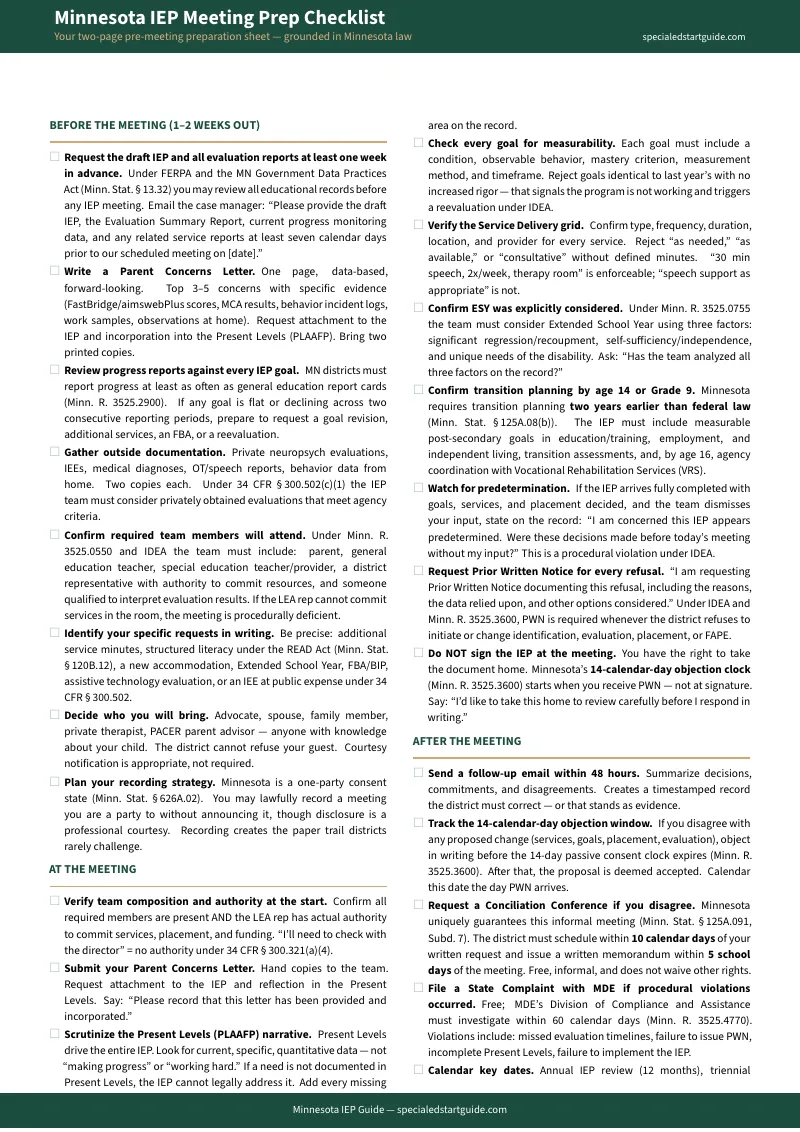
- Minnesota IEP Meeting Prep Checklist — the printable pre-meeting checklist with Chapter 3525 timelines, team composition requirements, and the red flags that require immediate action
- Advocacy Letters Library — 12 copy-paste letter templates citing the exact Minnesota rule for evaluation requests under Minn. R. 3525.2710, Prior Written Notice objections within the 14-day window under Minn. R. 3525.3600, IEE demands, Conciliation Conference requests under Minn. Stat. § 125A.091 Subd. 7, service delivery log requests, FBA requests, records requests under the Minnesota Government Data Practices Act, and MDE state complaint letters under Minn. R. 3525.4770
- Minnesota Timeline Cheatsheet — every legal deadline on one page: the 30-school-day evaluation clock, the 14-calendar-day passive consent window, the 10-calendar-day conciliation conference trigger, the 5-school-day memorandum rule, annual reviews, triennial reevaluation, and due process filing windows — plus the tripwires that reset each clock
- IEP Meeting Scripts — word-for-word opening scripts, They-Say / You-Say pushback pairs, in-meeting prompts, closing scripts, and a post-meeting checklist — every script cites the Chapter 3525 rule or Minnesota Statute that proves the team wrong
- Dispute Resolution Roadmap — a decision-tree standalone covering every rung of Minnesota's ladder: IEP team problem-solving, Conciliation Conference, facilitated IEP, MNSEMS mediation, MDE state complaint under Minn. R. 3525.4770, and due process hearing before the Office of Administrative Hearings, with When / How / Timeline / Evidence / Cost / Citation for each
- Goal-Tracking Worksheet — fillable pages to log baselines, annual targets, quarterly data points, and Endrew F. compliance checks for every IEP goal so you arrive at the annual review with documentation, not just memory
- Accommodation Reference Card — accommodations vs. modifications side-by-side, a 7-category accommodations table, MCA-III vs. MTAS Q&A with a script for when MTAS is proposed, 504 vs. IEP comparison, and the red flags for misclassification and Certificate of Completion risk
Instant PDF download. Print the Checklist tonight. Walk into tomorrow's meeting with Chapter 3525 on your side.
Money-back guarantee, no time limit. If the Blueprint doesn't change how you approach IEP meetings in Minnesota, email us for a full refund. No questions asked.
Not ready for the full Blueprint? Download the free Minnesota IEP Meeting Prep Checklist — a printable pre-meeting checklist with Chapter 3525 timelines, team composition requirements, and the red flags that require immediate action. It's enough to walk into your next meeting prepared, and it's free.
Your child's education is a legal right under Chapter 3525, not a favor the district grants. The district knows the rules. After tonight, so will you.