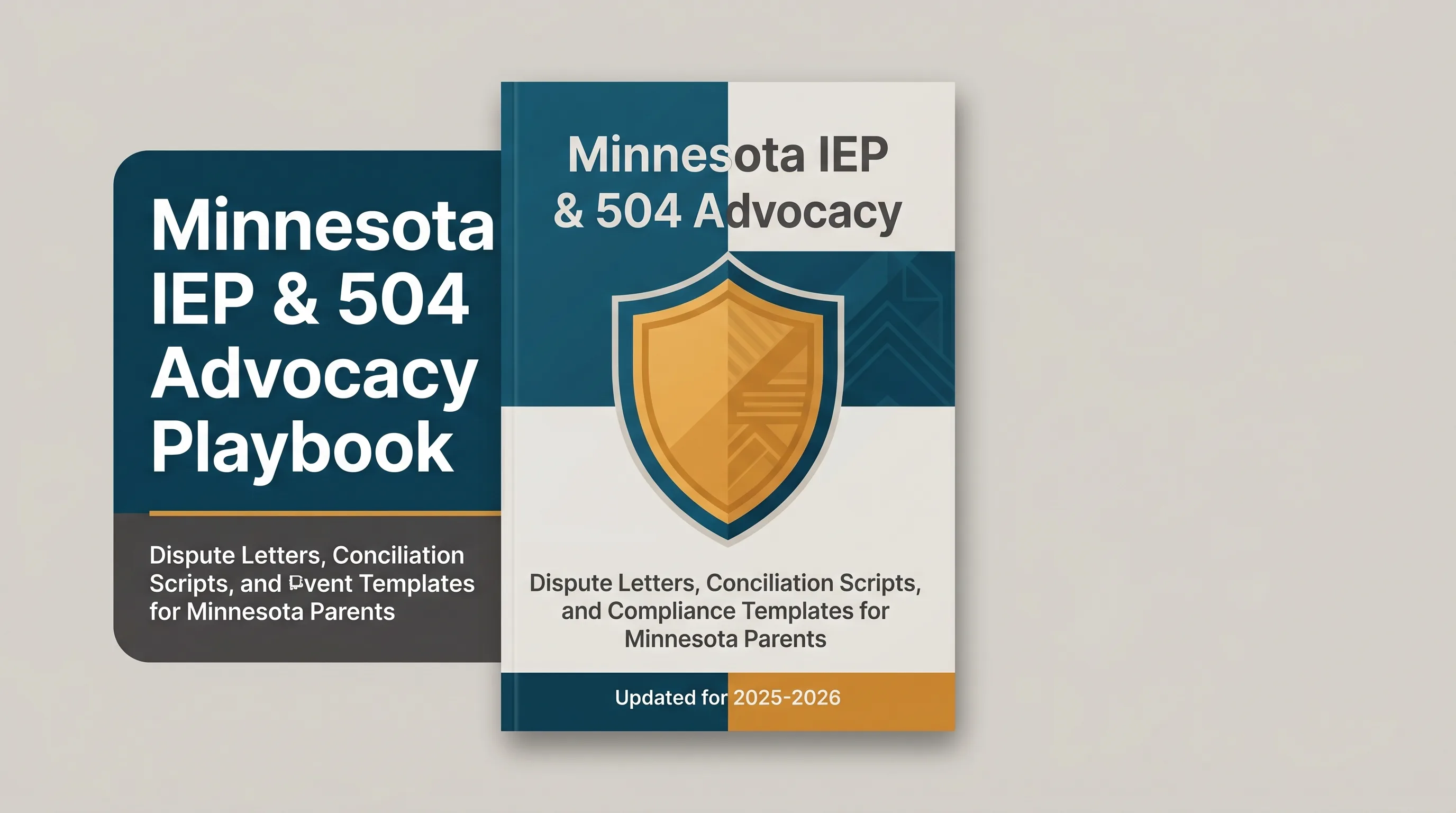
The District Relies on You Not Knowing Minnesota Law. The Advocacy Playbook Changes That Tonight.
The school handed you a Prior Written Notice. Maybe it proposes to cut speech therapy hours. Maybe it reduces paraprofessional support. Maybe it moves your child to a more restrictive placement. Under Minnesota Statute § 125A.091, you have exactly 14 calendar days to formally object in writing — or your silence is treated as consent and the change takes effect permanently. No reminder. No extension. No second chance. And the district knows that most parents don't respond in time, because most parents don't know the clock exists.
You've already tried the free resources. PACER published a 50-page guide, and it's excellent — but PACER's mandate is collaboration, not confrontation. MDE distributes the Part B Notice of Procedural Safeguards, which reads like legislation because it is legislation. You downloaded a generic IEP template from Etsy that doesn't mention Conciliation Conferences because no other state has them in the same form. You looked up Wrightslaw and learned about the 60-day federal evaluation timeline — except in Minnesota the deadline is 30 school days under Rule 3525.2550, and nobody told you the difference could cost your child a full school year of missed services.
The real problem is the gap between information and execution. You know your child has rights. You even know some of the acronyms — FAPE, LRE, IEE, PWN. But when you sit across from five district administrators who negotiate these meetings professionally, you freeze. You don't know the exact statute to cite. You don't have a letter ready to send. You don't know whether to agree to the conciliation memorandum or reject it. So you leave the meeting with nothing but a promise that they'll "look into it" — and the 14-day clock keeps ticking.
The Minnesota IEP & 504 Advocacy Playbook is the tactical dispute toolkit that bridges that gap — with every template, script, and checklist grounded in Minnesota Statutes Chapter 125A, Minnesota Rules Chapter 3525, and the Minnesota Government Data Practices Act.
What's Inside the Advocacy Playbook
The 14-Day PWN Objection System
Fill-in-the-blank objection letters that cite Minn. Stat. § 125A.091 and Minn. R. 3525.3600. Open the template, insert your child's name and the specific change you're objecting to, and send it to the Director of Special Education before the passive consent window closes. Your objection freezes the proposal and automatically triggers the district's obligation to schedule a Conciliation Conference within 10 calendar days. Most Minnesota parents learn about this mechanism after the deadline has already passed. You'll have the letter ready before the ink dries on the PWN.
Conciliation Conference Survival Scripts
Minnesota's Conciliation Conference under Minn. Stat. § 125A.091, Subd. 7 is a mandatory off-the-record negotiation that national guides completely ignore — because no other state has it in the same form. The district sends administrators with authority to override the building-level team, and they use the confidentiality to lower your expectations. The Playbook gives you word-for-word scripts for holding firm, a checklist of what documentation to bring, and a strategy for the five-school-day written memorandum the district must produce afterward — because that memorandum becomes admissible evidence in every subsequent complaint, mediation, or hearing.
Evaluation Demand and IEE Templates
Letters to formally request an initial evaluation and start the 30-school-day clock under Minn. R. 3525.2550 — not the federal 60-day timeline. Templates to demand an Independent Educational Evaluation at public expense when you disagree with the district's findings. Scripts to counter districts that try to redirect you into MTSS or RTI interventions instead of evaluating. Each template creates a legally binding paper trail the moment you send it.
The Medical-to-Educational Translation Matrix
Your child has a private diagnosis — Autism, ADHD, dyslexia, anxiety — but the school says it "doesn't impact their education." This matrix shows you exactly how to translate DSM-5 diagnostic criteria into the educational impact language required by Minnesota's eligibility rules under Chapter 3525. It bridges the gap between what the doctor documented and what the district demands, eliminating the most common reason Minnesota parents lose at the eligibility meeting.
The Full Dispute Resolution Ladder
When advocacy fails, Minnesota gives you a ladder. Conciliation Conference. Facilitated IEP. State-sponsored mediation through MNSEMS. Formal complaint to MDE under Minn. R. 3525.4770. Due process hearing before the Office of Administrative Hearings. The Playbook maps every rung — when each option is appropriate, the timeline and cost, the evidence you need, and how the paper trail you built with these templates becomes the evidence that wins your case or convinces the district to settle before you ever reach a hearing.
Discipline and Manifestation Determination Strategy
If your child has been suspended, removed from school, or sent home informally more than 10 school days in a year, the district must hold a Manifestation Determination Review. The Playbook covers what happens when the district skips the MDR entirely, how to invoke stay-put rights, when to demand compensatory education for missed instructional time, and the specific Chapter 3525 authorities to cite in your demand letter.
MDE State Complaint Templates
Ready-to-file complaint letters under Minn. R. 3525.4770 for FAPE violations, evaluation timeline breaches, and service delivery failures. Each template walks you through the required elements so MDE doesn't reject your complaint on procedural grounds before it's even reviewed.
Records Requests Under the MGDPA
Under the Minnesota Government Data Practices Act (Minn. Stat. § 13.32), the district must provide your child's records immediately or within 10 days — not the 45 days FERPA allows. The Playbook includes a template that cites the MGDPA so the district cannot claim it has a month and a half to respond to a records request you need before next week's meeting.
Who This Playbook Is For
- Minnesota parents who just received a Prior Written Notice and need to formally object before the 14-day window closes
- Parents preparing for a Conciliation Conference who don't know what to say, what to agree to, or how to use the mandatory memorandum strategically
- Parents whose evaluation request was denied or redirected to MTSS — and who need the exact Chapter 3525 citation to force it forward
- Parents with a private medical diagnosis that the district dismissed because it "doesn't affect education"
- Parents in the Twin Cities metro — Minneapolis, St. Paul, Anoka-Hennepin, Osseo, Rosemount-Apple Valley-Eagan — dealing with large districts under severe budget pressure
- Parents in Rochester, Duluth, St. Cloud, Mankato, or Moorhead navigating personnel shortages and evaluation backlogs
- Parents in rural Minnesota — Iron Range, southern Minnesota, western prairie — where independent advocates are hours away and the digital toolkit is the only advocate within reach
- Parents whose child is facing suspension, seclusion, or informal removal from school without a Manifestation Determination Review
- Parents who've consulted PACER, MDE, Arc Minnesota, or the Disability Law Center and still don't know what to actually send the district tomorrow morning
Why Not Just Use the Free Resources?
Minnesota has genuinely excellent free advocacy resources. But each one has structural limits that leave parents exposed at the exact moments they need help most:
- PACER explains the landscape — it doesn't hand you the weapon. PACER Center is grant-funded and partners with MDE. Their mandate is to promote collaboration. They explain what a Conciliation Conference is. They do not tell you how to weaponize the five-school-day memorandum as binding evidence in a future due process hearing. And when you need help tonight, PACER's statewide scale means waitlists and callback delays you cannot afford on a 14-day deadline.
- MDE publications protect the state's compliance record, not your child. The Part B Notice of Procedural Safeguards tells you that you have the right to Prior Written Notice. It does not give you the exact phrasing to demand one when a principal verbally refuses a service in the hallway.
- Wrightslaw actively misleads Minnesota parents. Wrightslaw is the gold standard for federal law — and it teaches 60-day evaluation timelines that are wrong in Minnesota, where Rule 3525.2710 cuts it to 30 school days. It doesn't cover Conciliation Conferences at all. Using generic national templates signals to the district that you don't know your local rights.
- Etsy and TPT templates miss every Minnesota nuance. Generic federal templates do not cite Chapter 3525. They don't mention the 14-day passive consent rule. They've never heard of a Conciliation Conference. They cost the same or more and deliver none of the state-specific enforcement that actually determines your outcome.
The free resources explain what the law says. This Playbook gives you the tools to make the district follow it.
— Less Than 5 Minutes of a Minnesota Advocate's Time
Private special education advocates in Minnesota charge $100–$300 per hour. A standard engagement — records review, strategy session, and meeting attendance — runs $1,500 to $2,250. Special education attorneys bill $200–$500 per hour, with retainers starting at $3,500 for due process work. Even if you eventually need professional help, the meticulous paper trail you build with this Playbook saves thousands in billable hours — because you hand your advocate an organized, documented case instead of scattered notes and half-remembered conversations.
Your download includes the complete 19-chapter Advocacy Playbook guide plus 10 standalone printable tools you can bring to meetings, file with MDE, or send to the district tonight.
- Advocacy Playbook Guide (PDF) — 19 chapters covering Minnesota's legal framework, the cross-subsidy crisis, the 14-day PWN system, Conciliation Conference strategy, the full dispute resolution ladder, evaluation tactics, IEP meeting scripts, discipline and MDR, service reductions and stay-put, placement disputes, transition planning at grade 9, Extended School Year, compensatory education, records access under the MGDPA, advocacy binder construction, Minnesota-specific resources, 2024-2026 legislative updates, and 504 plans
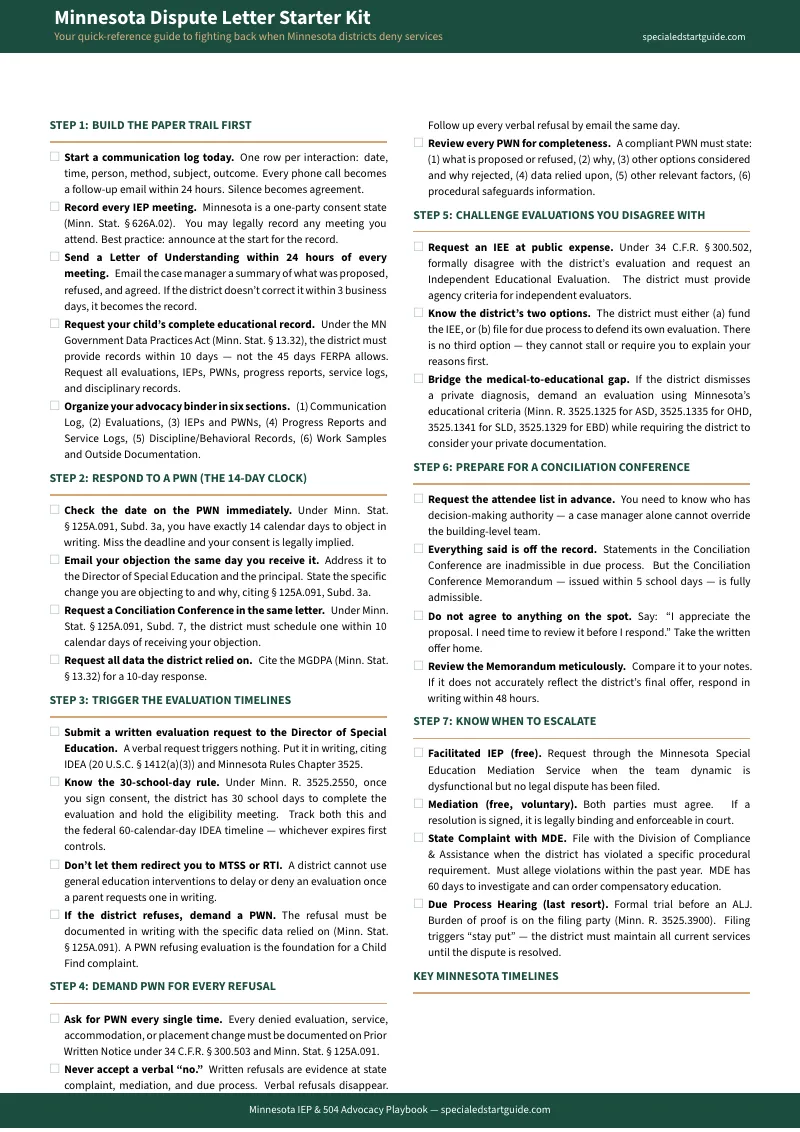
- Minnesota Dispute Letter Starter Kit (PDF) — a printable 7-step checklist with fill-in-the-blank template openers for every common advocacy scenario
- Advocacy Letter Templates (PDF) — 6 fill-in-the-blank letters citing Minnesota law: PWN objection, evaluation request, IEE demand, MGDPA records request, service non-delivery complaint, and follow-up Letter of Understanding
- Conciliation Conference Prep Guide (PDF) — preparation checklist, word-for-word negotiation scripts, the confidentiality trap explained, and a decision tree for next steps after the memorandum
- Conciliation Memorandum Response Templates (PDF) — fill-in-the-blank letters for correcting, accepting, or rejecting the district's binding memorandum
- Dispute Escalation Ladder (PDF) — visual reference from informal advocacy through Conciliation Conference, mediation, MDE state complaint, and due process hearing with Minnesota-specific timelines and a quick-reference comparison table
- MDE State Complaint Template (PDF) — ready-to-file complaint form with sections for violations, facts, evidence, and proposed resolution under Minn. R. 3525.4770
- IEP Meeting Scripts (PDF) — what to say when the district denies services, cites budget, pressures you to sign, or uses "team consensus" — plus the Letter of Understanding template and pre-meeting checklist
- MDR Preparation Checklist (PDF) — the two legal questions, documents to bring, key arguments to make, and step-by-step guidance for after the Manifestation Determination Review
- Medical-to-Educational Translation Matrix (PDF) — single-page reference card mapping DSM-5 diagnoses to Minnesota educational eligibility criteria under Rules Chapter 3525
- Minnesota Timelines Cheat Sheet (PDF) — every critical deadline on one page, showing where Minnesota exceeds federal standards and the dispute/compliance timelines that govern your case
- Communication Log (PDF) — printable worksheet for tracking every interaction with the district, with the 24-hour follow-up rule built in
Instant PDF download. 12 PDFs total — print the tools you need tonight. Send your first objection letter before the PWN deadline closes.
Money-back guarantee, no time limit. If the Playbook doesn't change how you fight for your child's rights in Minnesota, email us for a full refund. No questions asked.
Not ready for the full Playbook? Download the free Minnesota Dispute Letter Starter Kit — a printable dispute checklist with template openers and Minnesota statute citations for the most common advocacy scenarios. It's enough to send your first objection letter tonight, and it's free.
The district has a legal team, a budget spreadsheet, and institutional patience. After tonight, you'll have the exact Minnesota statutes, the ready-to-send templates, and the tactical playbook to make them comply.