Massachusetts Just Redesigned the Entire IEP Form. Your Team Meeting Is on the New Document — Whether You Understand It or Not.
In the fall of 2024, the Massachusetts Department of Elementary and Secondary Education replaced the IEP template every district had used since 2000. The new form opens with the student's Vision rather than a disability label. The "primary disability" single checkbox is gone — the Team now selects multiple categories. Transition planning is embedded at age 14, no longer an attached Transition Planning Form. English Learner status is mandatory documentation. Assistive technology is a distinct consideration. Every annual review, amendment, or new IEP written in Massachusetts after the rollout uses this form. If your child had an IEP before fall 2024, the next Team meeting migrates them — and sections you relied on have moved, changed, or disappeared.
At the same time, most of what parents in Massachusetts think they know is dangerously out of date. The "maximum possible development" standard that made Chapter 766 famous in 1972 was eliminated by the legislature in 2002 — Massachusetts now follows the federal FAPE "appropriately ambitious" standard from Endrew F., and arguing MPD at a Team meeting or at BSEA loses your case. Under Schaffer v. Weast, the U.S. Supreme Court put the burden of proof on the parent challenging the IEP, not the district. Ballot Question 2 in November 2024 eliminated the MCAS graduation requirement, forcing DESE to amend 603 CMR 30.00 and leaving alternative Competency Determination pathways in flux. MassAbility — the agency you file Chapter 688 referrals with two years before your student ages out at 22 — is the same agency that used to be the Massachusetts Rehabilitation Commission (MRC) before its 2024 rebrand.
Roughly 19.7% of Massachusetts public school students receive special education services. That is nearly 200,000 children. The Bureau of Special Education Appeals logged 14,326 rejected-IEP notifications in FY 2024 alone. Special education attorneys in the Commonwealth charge $350 to $600 per hour with retainers of $5,000 to $10,000. Non-attorney advocates charge $125 to $275 per hour, and a 90-minute first consultation runs $200 before any real work begins. Free resources like DESE's 1,000-page technical guides, the Federation for Children with Special Needs' 40-to-54-hour Parent Consultant Training Institute ($275), and the Massachusetts Advocates for Children systemic reports are each excellent — and each wrong for a parent whose Team meeting is next Tuesday.
The Massachusetts IEP & 504 Blueprint is the Massachusetts Team Meeting Navigation System — a 22-chapter, plain-English walk through the Commonwealth's own 603 CMR 28.00 and MGL Chapter 71B rules, organized section-by-section around the new 2024-25 DESE IEP form and designed to be printed, hole-punched, and carried into the meeting with you.
What's Inside the Blueprint
The New 2024-25 DESE IEP Form, Decoded Section by Section
Anyone teaching you about the "old" Massachusetts IEP is teaching you about a document that no longer exists. The Blueprint walks every field of the new form: Student and Team Vision (now at the front), Student Profile, Current Performance and Progress, Accommodations, Specially Designed Instruction, Goals and Benchmarks, the Service Delivery Grid, the embedded Transition Planning, Placement, and Signatures. Each section includes the exact language to insert, the common district gaming patterns to watch for, and the 603 CMR citation that makes the field legally binding.
The 30 / 45 School-Working-Day Clock
Massachusetts is far stricter than federal IDEA. Districts have 30 school working days from your written consent to complete evaluations and 45 school working days from consent to propose an IEP — not the federal 60 calendar days. A school working day is any day students are in attendance, including partial days; it is not weekends, holidays, or vacation. The Blueprint teaches you how to start the clock in writing, how to document the start date the district cannot deny, and what to do on day 31 and day 46 when the district has missed its deadline.
N-1, N-2, and N-3 — Massachusetts' Prior Written Notice System
Federal law requires "Prior Written Notice." In Massachusetts, PWN is codified in three specific forms: N-1 (Notice of District's Proposed Action), N-2 (Parent Response accepting, rejecting, or partially rejecting), and N-3 (Notice of District's Refusal to Act). If a parent verbally asks for an evaluation and the school verbally declines, legally it did not happen. The Blueprint teaches you to read each form, spot when the district has left required fields blank, force the district to issue an N-3 when they refuse, and use the N-2 partial rejection to trigger stay-put.
Eligibility — The 14 Massachusetts Disability Categories and the "Effective Progress" Standard
Massachusetts recognizes 14 categories — the 13 federal IDEA categories plus Neurological Impairment, a category unique to Massachusetts that captures students whose needs fragment across OHI or TBI in other states. Crucially, Massachusetts uses a broader eligibility threshold: a child qualifies if their disability prevents them from making "effective progress in the general curriculum" and they require specially designed instruction or related services to access the curriculum — wider than federal IDEA's specially-designed-instruction-only test. The Blueprint decodes each category and shows you how to marshal benchmark scores, curriculum-based measurements, and teacher reports to qualify a child the district insists "seems fine."
IEP vs. 504 — The Massachusetts-Specific Decision Framework
Massachusetts districts often steer parents toward a 504 Plan "to try first" rather than conducting a full IEP evaluation. That is not how the law is supposed to work. The Blueprint walks you through the exact distinctions that matter in Massachusetts — including the dual-jurisdiction reality that makes Massachusetts 504 unusually strong (BSEA can hear 504 disputes here, which is not true in most other states) and the manifestation-determination discipline gap that makes an IEP materially safer for any child whose disability affects behavior.
The Team Meeting Protocol — Before, During, After
The full pre-, during-, and post-meeting protocol: the written evaluation request that starts the clock, the Parent Concerns statement that rewrites the agenda, the IEE request at public expense when you disagree with the district's evaluation, the two-party consent recording framework under MGL c. 272 § 99 (including the transparent-consent workaround that holds up at BSEA), how to detect predetermination when the IEP arrives pre-drafted, the seating script for the meeting itself, and the 24-hour follow-up email rule that converts every oral commitment into written evidence.
The Partial Rejection — Massachusetts' Single Most Important Tactical Move
Most states force you to accept or reject an entire IEP. Massachusetts regulation 603 CMR 28.05(7) explicitly allows parents to accept some provisions and reject others on the N-2 form. The rejected portions trigger stay-put — the last-agreed IEP remains in force — while the accepted portions begin implementation immediately. The Blueprint shows you exactly which sections to partially reject, the specific language that makes the rejection legally effective, and how stay-put interacts with the rest of the dispute process. The district almost never explains this to parents.
Independent Educational Evaluations (IEEs) at Public Expense
603 CMR 28.04(5) gives you the right to request an IEE when you disagree with the district's evaluation. The district must either fund the IEE or file at the BSEA to defend its own evaluation as appropriate — within 5 school days. The Blueprint gives you the written IEE request template, the state rate schedule for covered IEE costs, the preferred evaluator directories by specialty (neuropsychology, speech-language, OT, AAC, assistive technology), and the "stream of independent evaluators" strategy that keeps the evidentiary record growing.
Transition Planning at Age 14 and the Chapter 688 Two-Year Rule
Massachusetts mandates transition planning two years before federal IDEA does — at age 14 under 603 CMR 28.05(4)(c), not age 16. Age 14 triggers vocational assessment, postsecondary goals, and integrated transition services in the new IEP. By age 20 at the latest, you must file a Chapter 688 referral with MassAbility (formerly MRC), the Department of Developmental Services, the Massachusetts Commission for the Blind, or the Department of Mental Health — and missing the two-year window before your student ages out at 22 typically means an 18-month wait for adult services. The Blueprint gives you the timeline, the referral language, and the diploma-vs-Certificate-of-Attainment decision framework that preserves IEP eligibility through age 22.
Out-of-District Placement and Chapter 766 Schools
Massachusetts maintains a statewide list of DESE-approved private special education day and residential schools — Landmark, Carroll, Commonwealth Learning Center, Dearborn Academy, Learning Prep, Perkins, Boston Higashi, Riverview, Evergreen, League School, and the rest — along with the education collaboratives (EDCO, LABBB, READS, ACCEPT, CASE, BICO, Northshore, and others). Annual tuition runs from $60,000 for a day program to over $200,000 for a residential placement. Massachusetts public schools spend more than $1 billion per year on OOD tuition. The Blueprint explains the three-prong Carter/Burlington reimbursement framework, the 10-business-day notice that preserves tuition reimbursement rights for unilateral placements, and the failure-based paper trail districts require before approving in-Team OOD placement.
Discipline, Manifestation Determination, and 603 CMR 46.00 Restraint Rules
The 10-cumulative-day suspension trigger, how to frame a Manifestation Determination Review so the behavior is correctly identified, Functional Behavioral Assessments and Behavior Intervention Plans, and Massachusetts' restraint and seclusion rules — stricter than most states. Prone restraint is flatly prohibited in Massachusetts public schools. Mechanical restraint and seclusion are prohibited in public schools. Written debriefing is mandatory after any physical restraint. Parent notification is required within specific timelines. The Blueprint explains what triggers a reportable incident and what the district is required to provide you afterward.
Bilingual Evaluations and English Learner IEP Rights
603 CMR 28.04 requires evaluations in the student's dominant language and communication mode. The new 2024-25 IEP form mandates documentation of EL status. For parents in Chelsea, Lynn, Lawrence, Everett, Revere, Worcester, Springfield, Lowell, Holyoke, Framingham, or Brockton — or any district with a large Spanish-, Portuguese-, Haitian-Creole-, Vietnamese-, Chinese-, or Arabic-speaking population — the Blueprint covers the specific language-access rights and the N-1 template that forces the district to document compliance or refusal.
BSEA Dispute Resolution — An Honest Map of the Escalation Ladder
When a Team meeting breaks down, the options are a reconvened Team, a DESE Problem Resolution System complaint (60-day investigation timeline), BSEA Mediation (free, confidential, non-binding, 82% settlement rate in FY 2024), a BSEA Advisory Opinion (hearing officer previews the likely outcome), a BSEA Settlement Conference (explicitly opened to pro se parents in 2024), and a BSEA Due Process Hearing. The Blueprint explains which forum fits which dispute, what each costs in time and stress, and when to stop escalating and settle. This is a navigation guide, not a dispute playbook — when your situation has clearly become adversarial, the companion Massachusetts IEP & 504 Advocacy Playbook picks up where this one leaves off.
Urban, Suburban, and Gateway-City Realities
The rules are the same everywhere in Massachusetts. The experience is not. The Blueprint is honest about how advocacy works differently in Newton, Lexington, Wellesley, Concord, Weston, Wayland, and Winchester — affluent suburbs with well-funded, legally sophisticated programs — versus Boston Public Schools, where the special education transportation complaint filed by Greater Boston Legal Services documented 16.4% of buses running late or missing and 35-40% of monitor-required routes uncovered — versus Springfield, Worcester, Lawrence, Lynn, Brockton, Fall River, Lowell, Chelsea, and Holyoke, Gateway Cities where staffing shortages routinely blow past the 30-day clock. Same regulation. Different tactical angle. The Blueprint names the angle for each region.
Who This Blueprint Is For
- Parents whose child's preschool teacher or pediatrician suggested a special education evaluation — and who don't know whether to ask for an IEP, a 504 Plan, or something else, or how to put the request in writing so the 30/45 school-working-day clocks actually start
- Parents transitioning a child from Early Intervention at age 3 to school-age special education — who need to understand the Child Find process, what "specially designed instruction" looks like at age 3, and how the IEP differs from the EI Individualized Family Service Plan
- Parents who have been handed the new 2024-25 DESE IEP form and don't recognize it — the Vision is at the front, the primary disability box is gone, transition planning is embedded rather than attached, and nobody on the Team has explained where anything moved
- Parents offered a Section 504 Plan when they suspected their child needed an IEP — and who need to understand the "effective progress" standard, the 14 Massachusetts disability categories, and the 30/45-day clock a written evaluation request triggers
- Parents preparing for a first Team meeting and staring at a pre-drafted IEP, wondering what an N-1 form is, what the Vision statement is supposed to say, what "Specially Designed Instruction" means on the service delivery grid, and what the signatures at the bottom legally commit them to
- Parents whose child has had an IEP for years on the old form — and whose annual review this spring will migrate them to the 2024-25 format, risking services quietly dropping during the translation
- Parents whose child turns 14 this year and the Team has not mentioned transition planning, vocational assessment, or a Chapter 688 referral — and who don't know that Massachusetts requires transition planning two years earlier than federal IDEA or that Chapter 688 must be filed by age 20
- Parents in Newton, Lexington, Concord, Wellesley, Weston, Wayland, Winchester, Andover, Brookline, or another affluent suburb — trying to understand why well-resourced districts still require organized written advocacy, because the dollars are bigger and the districts retain counsel
- Parents in Boston, Springfield, Worcester, Lawrence, Lynn, Lowell, Fall River, New Bedford, Chelsea, Brockton, Holyoke, or another Gateway City where staffing shortages have blown the 30-school-day clock and the Team coordinator keeps saying "we're trying to find someone"
- Parents whose primary language is Spanish, Portuguese, Haitian-Creole, Vietnamese, Chinese, Arabic, or another language, and whose district has been running evaluations or Team meetings in English without a qualified interpreter — in violation of 603 CMR 28.04
- Parents told their child is making "effective progress in the general curriculum" and therefore doesn't qualify — even though benchmark scores, missing assignments, teacher concerns, or social-emotional data tell a different story
- Parents whose child has been restrained or secluded, whose incident report is two sentences, and who need to understand 603 CMR 46.00, the prone-restraint ban, the debriefing requirement, and the notification deadlines the district may have just violated
- Parents considering whether an out-of-district Chapter 766 placement is appropriate — who need to understand the Carter/Burlington three-prong standard, the 10-business-day unilateral placement notice, and the multi-year failure-based paper trail districts demand before they approve in-Team OOD placement
- Parents who earn too much for free legal aid through the Disability Law Center and not nearly enough for a Boston-area attorney's $5,000-$10,000 retainer, and who need a tactical, print-and-bring-to-the-meeting resource that sits between DESE's 1,000-page technical guide and a paid consultation
Why Not Just Use the Free Resources?
Massachusetts has some of the best free special education resources in the country. Each one is excellent at what it is — and each one is the wrong tool for the Team meeting on your calendar next Tuesday.
- DESE publishes compliance-grade materials. The Massachusetts Individual Education Program (IEP) Technical Guide is authoritative and dense. DESE's "What Parents Need to Know About the New IEP" Quick Reference Guide is a two-page overview that tells parents what the form is, not how to use it to secure services. DESE materials are written for district compliance officers and educators. They are not written for an anxious parent sitting down at a Team table on Tuesday morning.
- The Federation for Children with Special Needs (FCSN) runs an outstanding Parent Consultant Training Institute. PCTI is genuinely the gold standard for Massachusetts parent education — 40 to 54 hours of instruction over four weeks or five days, for $275. If you have five weeks and $275, take it. If you have a Team meeting next Tuesday, you do not have five weeks.
- Exceptional Lives and spedhelper.org have good Massachusetts-specific online content. They explain the new form section-by-section and the 603 CMR 28.00 framework in plain language. They are web pages — which means you cannot easily print them, highlight them, annotate them, or slip them into a binder. A parent sitting across from a Team of five district staff needs a physical artifact they can turn to without opening a browser.
- Massachusetts Advocates for Children (MAC) and the Disability Law Center (DLC) do outstanding systemic work and occasional direct representation. Their written resources tilt toward marginalized, low-income, or severely impacted populations — BPS transportation, restraint and seclusion in residential placements, bullying of autistic students. They are not going to give you a page-by-page walkthrough of the new DESE IEP form at a suburban Team meeting.
- Wrightslaw is the national federal-law heavyweight. Pete and Pam Wright's books and website are essential reading for serious advocates. They do not cover 603 CMR 28.00, the new 2024-25 Massachusetts IEP form, the N-1/N-2/N-3 Notice system, the 5-school-day consent timeline, the 30/45-school-working-day evaluation deadlines, the MGL c. 272, § 99 two-party consent statute, the DESE Problem Resolution System, the BSEA Advisory Opinion process, Chapter 766 approved private schools, the Carter/Burlington standard as applied in the First Circuit, or the Chapter 688 transition referral. Federal citations help. Massachusetts-specific citations tell your district you know their playbook.
- Massachusetts special education attorneys charge $350 to $600+ per hour with $5,000 to $10,000 retainers. A fully litigated BSEA due process hearing can exceed $75,000 in attorney's fees. Non-attorney advocates charge $125 to $275 per hour; a 90-minute first consultation runs $200. Under IDEA, parents cannot recover non-attorney advocate fees even if you win. The financial asymmetry is uniquely punishing in this state.
The free resources explain what Massachusetts law says. The Blueprint translates what it says into what you actually do on Tuesday.
— Less Than One Hour of a Massachusetts Advocate
A single consultation with a Massachusetts educational advocate runs $200 before any work begins. An attorney runs $350 to $600 per hour. PCTI is $275 and 40+ hours of your time. The Blueprint gives you the same Massachusetts-specific framework, timelines, form walkthroughs, and meeting protocols — for the price of lunch — so you can either handle the Team meeting yourself or arrive at a paid consultation already organized and save hundreds in billable hours.
Your download is a 9-PDF package — the complete 22-chapter Blueprint plus 8 standalone printables, each designed to be pulled out, tabbed into a binder, and carried into the Team meeting on its own.
- Complete Massachusetts IEP & 504 Blueprint (guide.pdf) — 22 chapters covering the Massachusetts legal framework (IDEA, MGL c. 71B, 603 CMR 28.00), the 14 disability categories, the new 2024-25 DESE IEP form section by section, the 30/45 school-working-day clock, the N-1/N-2/N-3 form system, Team meeting protocol, partial rejection and stay-put under 603 CMR 28.05(7), IEEs at public expense, transition planning at age 14, Chapter 688 referrals, Chapter 766 out-of-district placement, discipline/MDR/restraint under 603 CMR 46.00, bilingual evaluation rights, BSEA dispute resolution, and a full Massachusetts resources directory
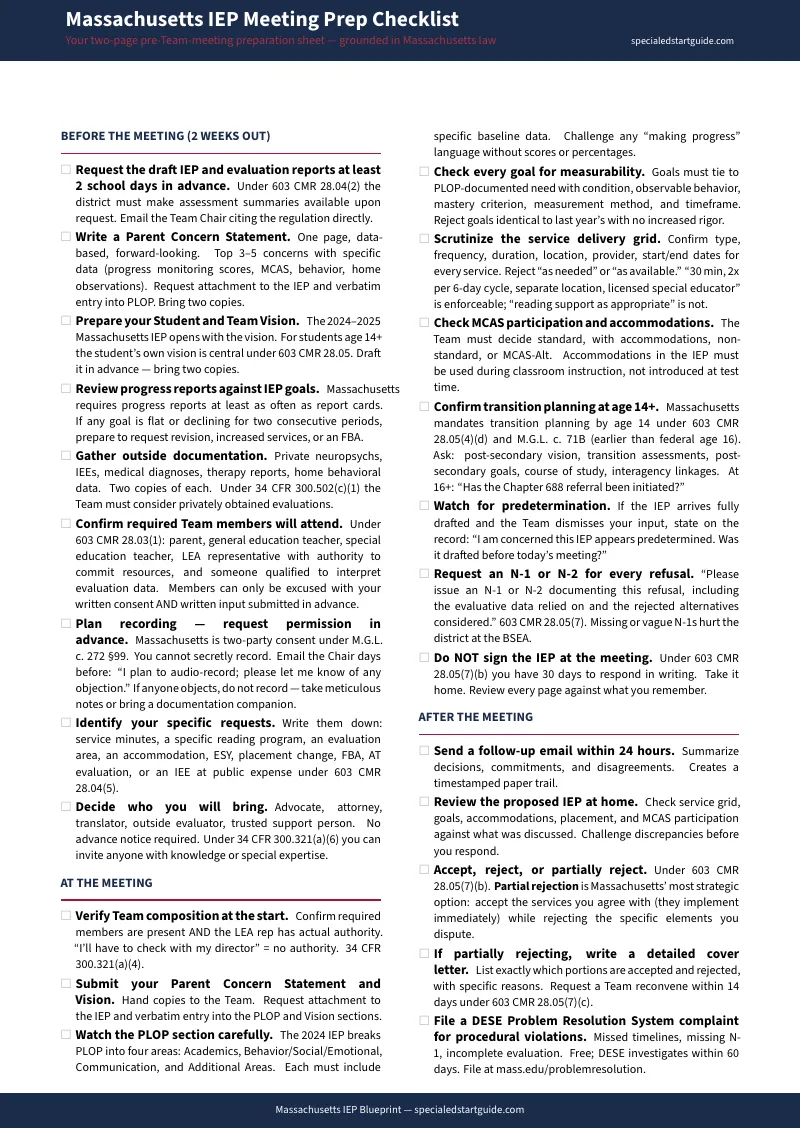
- Massachusetts IEP Meeting Prep Checklist (checklist.pdf) — a printable Before/At/After Team meeting checklist covering documents to bring, questions to ask, accommodation requests to consider, the exact phrases to open the meeting with, and a Massachusetts timelines table (5/30/45 school-day deadlines, 60-day PRS, 2-year statute of limitations) — designed to be folded and slipped into the front of your binder
- 2024-25 DESE IEP Form Decoder (iep-form-decoder.pdf) — section-by-section walkthrough of the current form: Student and Team Vision, Student Profile, Current Performance and Progress, Accommodations, Specially Designed Instruction, Goals, Service Delivery Grid, Transition Planning, Placement, and Signatures — each section paired with the exact language to insert, the common district water-downs to refuse, and the 603 CMR / MGL c. 71B / IDEA citation that makes the field binding
- N-1 / N-2 / N-3 Forms Walkthrough (n-forms-walkthrough.pdf) — the N-1 demand-at-meeting script to use when the district hands you a form with blank required fields, the full annotated N-2 partial-rejection template with stay-put language under 603 CMR 28.08, and the parent-drafted N-3 demand letter that converts a verbal refusal into written evidence
- Evaluation Packet (evaluation-packet.pdf) — four templates in one: (1) the written evaluation request citing 603 CMR 28.04(1) that starts the 30-school-working-day clock on paper, (2) the annotated consent form showing where districts often insert overbroad language you should strike, (3) the bilingual evaluation demand citing MGL c. 71B §3 and 603 CMR 28.04(2)(a), and (4) the Independent Educational Evaluation request at public expense under 603 CMR 28.04(5)
- Partial Rejection Script (partial-rejection-script.pdf) — deep-dive on Massachusetts' single most important tactical move: the 603 CMR 28.05(7) mechanics, the exact signature-page fill-in language, how stay-put interacts with federal 34 C.F.R. §300.518, the Day 0 through 2-year timeline, and the full partial-rejection letter template you attach to the N-2
- Age-14 Transition & Chapter 688 Timeline (transition-timeline.pdf) — landscape age 14→22 timeline plus detail cards: the age-14 vocational assessment trigger, the fill-in-the-blank Chapter 688 referral with adult-agency routing table (MassAbility/DDS/MCB/MCDHH/DMH/DCF), the diploma-vs-Certificate-of-Attainment decision framework that preserves IEP eligibility through age 22, and the seven most common transition failures
- Restraint & Seclusion Response Guide (restraint-response.pdf) — the 603 CMR 46.00 parent-action checklist: reportable-incident definitions under 46.02/46.03(2), the 24-hour / 3-day / 10-day parent response timeline, the district's mandatory written-debriefing obligations, a demand-letter template, and the PRS/BSEA/OCR escalation ladder when the district stonewalls
- Massachusetts Resources Directory (resources-directory.pdf) — the full Commonwealth directory: state agencies (DESE, BSEA, PRS, MassAbility, DDS, MCB, MCDHH, DMH, DCF), legal advocacy (MAC, DLC, MHLAC, Greater Boston Legal Services), DESE-approved Chapter 766 schools organized by profile (Landmark, Carroll, Perkins, Learning Prep, Riverview, League, Evergreen, and more), education collaboratives (EDCO, LABBB, READS, ACCEPT, CASE, BICO, Northshore), parent networks (FCSN, SEPACs), and a statutes quick-reference card
Instant 9-PDF download. Print the checklist, the form decoder, and the N-forms walkthrough tonight. Bring them to the meeting on Tuesday.
Money-back guarantee, no time limit. If the Blueprint doesn't change how you prepare for your next Team meeting, email us for a full refund. No questions asked.
Not ready for the full Blueprint? Download the free Massachusetts IEP Meeting Prep Checklist — a one-page pre-meeting checklist covering what to bring, what to ask, the 30/45-day clock, partial rejection basics, and the exact phrases to open the meeting with. It is enough to walk in organized on Tuesday, and it is free.
Massachusetts wrote some of the strongest special education law in the country. Your child is entitled to the protection that law offers — but only if you can read the form, start the clock, and sit at the table on Tuesday with the right words on the right page. This Blueprint puts those tools in your hands.