
The District Knows MUSER Chapter 101. After Tonight, So Will You.
You walked into that IEP meeting with your child's report cards, the teacher's progress notes, and a printout from Understood.org you found at midnight. The special education director used terms you'd never heard — "MUSER adverse effect standard," "PLAAFP," "Least Restrictive Environment continuum." The school psychologist smiled and said your child "just needs more time with the interventions." They told you the RTI team would continue monitoring. They asked you to come back in six weeks.
Six weeks turned into a full semester. Your child fell further behind. And when you finally asked why a formal evaluation hadn't started, the special education coordinator said: "We can't refer until the MTSS process is complete."
That statement was wrong. Under MUSER, Response to Intervention cannot be used to deny or delay a parent-requested special education evaluation. The SAU has 15 school days to convene the IEP team after receiving your referral, and 45 school days from your written consent to complete the evaluation. But you didn't know that then. And the district counted on it.
The problem isn't that Maine parents don't care. The problem is that Maine runs special education through a system unlike any other state — with its own regulations (MUSER Chapter 101, not just federal IDEA), a school governance maze of SAUs, RSUs, SADs, and AOS units where budget disputes between constituent towns bleed into placement decisions, and a once-in-a-generation early childhood earthquake as Child Development Services transfers responsibility for 3-to-5-year-olds to local school districts through 2028. National guides from Wrightslaw or Understood.org will never mention MUSER. They won't explain the CDS-to-SAU transition. They don't cover how RSU budget politics affect your child's services. Generic federal templates are structurally useless in Maine — like using a map of Massachusetts to navigate the back roads of Aroostook County.
The Maine IEP & 504 Blueprint is the MUSER enforcement toolkit that bridges the gap between knowing your rights exist and actually exercising them at the IEP table — with every template, script, and checklist grounded in Maine state law and the CDS transition procedures that are reshaping special education across the state right now.
What's Inside the Blueprint
The MUSER Evaluation Enforcement Playbook
Maine's 45-school-day evaluation timeline is your most powerful tool — and the one districts violate most often. Schools routinely tell parents the child must "complete RTI tiers" before a referral can happen. That's not what MUSER says. The Blueprint explains exactly how Maine's pre-referral process works, when RTI/MTSS can legally delay a referral and when it cannot, and gives you the exact written request that starts the SAU's 15-school-day referral clock — regardless of where your child sits in the intervention tiers. When the district blows past the 45-day deadline, you'll have the follow-up template that forces action.
The CDS-to-SAU Transition Survival Guide
The single biggest disruption to Maine special education in decades is happening right now. Child Development Services — the quasi-governmental agency that historically managed all special education for children birth to age 5 — is transferring responsibility to local SAUs through a four-year phased transition ending in 2028 under LD 345. Parents are terrified of losing therapy hours during the handover. The Blueprint includes a dedicated chapter mapping the entire transition: which cohort your SAU falls into, what happens to your child's IFSP when they turn 3, the 90-day transition conference requirement, how to ensure services transfer without gaps, and the exact language to use when the receiving SAU claims they "aren't ready" to provide what CDS was delivering.
The Copy-Paste Advocacy Template Library
Every template cites the exact MUSER section. Request an evaluation and start the SAU's 45-school-day clock. Demand Prior Written Notice when the IEP team refuses anything. Request an Independent Educational Evaluation at public expense when you disagree with the school's conclusions — and trigger the SAU's 30-calendar-day deadline to either fund the IEE or file for due process. Invoke stay-put protections when the school tries to change placement during a dispute. These aren't generic IDEA samples — they're Maine-specific enforcement tools that reference MUSER by section number and create a legally binding record the moment you hit send.
The Small-District Advocacy Playbook
In many of Maine's smaller SAUs and RSUs, the superintendent, special education director, and building principal are the same person. Everyone knows everyone. Parents worry that pushing too hard will alienate the teachers who are also their neighbors, or that demanding expensive services will anger a school board focused on minimizing property tax increases. The Blueprint teaches collaborative advocacy — email scripts that frame requests as data-driven team decisions rather than personal attacks, strategies for holding the district accountable to MUSER without burning community bridges, and specific guidance for navigating the power dynamics of districts where the person who oversees the budget also supervises the special education teachers and runs the building.
IEP Meeting Scripts and Checklists
What to say when the team tells you your child is "making progress" but the data shows otherwise. What to say when they offer a 504 instead of an IEP. What to say when the SAU representative claims the district "doesn't have the staff" for the services your child needs. Each script cites the MUSER section or federal provision that proves them wrong — so you're not arguing opinions, you're citing law. The pre-meeting checklist covers Maine's one-party recording consent rule (MUSER VI.2.K explicitly permits audio recording), IEP team composition requirements, and the specific documents to bring.
The IEP vs. 504 Decision Framework
Parents frequently confuse accommodations with specially designed instruction — and schools exploit that confusion to steer children toward the cheaper, weaker 504 Plan. Under MUSER, the "adverse effect" standard determines whether your child qualifies for an IEP. The Blueprint explains exactly what "adverse effect" means in Maine, how schools manipulate the definition to deny eligibility, and the specific data you need to present to prove your child requires specially designed instruction — not just extended time and preferential seating.
MEA Testing Accommodations
Maine's Educational Assessment is the state's standardized testing system. The Blueprint maps every allowable testing accommodation, the documentation requirements to get each one written into the IEP, and the critical rule that testing accommodations must be used routinely during classroom instruction — not added solely for testing week. If your child needs extended time, text-to-speech, a scribe, or a separate setting, the process starts months before the test.
Discipline Protections — FBAs, BIPs, and Manifestation Determinations
When a student with a disability faces suspension exceeding 10 cumulative days, the school must conduct a Manifestation Determination Review to determine if the behavior was caused by the disability or a failure to implement the IEP. If it was, standard disciplinary removal cannot proceed. The Blueprint covers your child's MDR rights, Functional Behavioral Assessment requirements, Behavior Intervention Plan development, and the exact language to demand when the school skips the process.
The Dispute Resolution Roadmap
When advocacy fails, you have four formal options in Maine: requesting mediation through the MDOE, filing a State Complaint with OSSIE, filing for a Due Process Hearing, or contacting Disability Rights Maine for legal representation. The Blueprint explains when each option is appropriate, the timeline involved, and how the paper trail you've built with the advocacy templates becomes the evidence that wins your case — or convinces the district to settle before you ever reach a hearing.
Who This Blueprint Is For
- Parents preparing for their first IEP or 504 meeting who don't want to walk in blind against a table of professionals who do this every day
- Parents whose child has been stuck in RTI/MTSS interventions for months with no formal evaluation — and who need the legal language to start the SAU's 45-school-day clock
- Parents navigating the CDS-to-SAU transition — whose child is turning 3 and moving from an IFSP to an IEP, and who need to ensure therapy hours survive the handover
- Parents in small SAUs and RSUs where the superintendent, special ed director, and principal are the same person — and where advocating feels like fighting your neighbor
- Rural Maine parents in Aroostook, Washington, Somerset, or Piscataquis counties where speech-language pathologists and BCBAs are scarce and IEP services exist on paper but not in practice
- Parents navigating the 504-to-IEP question — unsure whether their child's current accommodations are legally sufficient or whether they should push for a full MUSER evaluation
- Parents whose child needs MEA testing accommodations documented and delivered
- Parents whose child was disciplined for behavior related to an unaddressed disability — and who need to understand Manifestation Determination rights
Why Not Just Use the Free Resources?
Maine has legitimate free special education resources. The MDOE publishes Procedural Safeguards. The Maine Parent Federation operates as the federally designated Parent Training and Information Center. Disability Rights Maine provides legal advocacy. Here's why parents still struggle after consulting all of them:
- The MDOE's Procedural Safeguards protect the state, not you. They are dense, clinical documents written by compliance officers to explain what MUSER says without telling you how to enforce it. They tell you that you have the right to request an evaluation. They do not give you the pre-written email to send tonight citing the specific MUSER section and starting the SAU's clock. For a parent in crisis, the gap between understanding a right and exercising it is the gap between winning and losing at the IEP table.
- The Maine Parent Federation requires time you may not have. MPF provides excellent, empathetic support through Family Support Navigators who can even accompany you to meetings. But their best resources require scheduling a call, waiting for a callback, or attending hour-long webinars. When the school hands you an IEP draft at 4 PM on a Thursday and the meeting is Friday morning, MPF simply cannot respond fast enough.
- Disability Rights Maine covers everything — which means less depth on your specific problem. DRM's publications carry high legal authority across housing, employment, voting, and education. Their focus is systemic advocacy and severe rights violations — due process hearings, restraint and seclusion, civil rights complaints. They don't offer step-by-step tactical scripts for a parent facing their first confusing IEP meeting next week.
- TPT and Etsy templates organize paperwork — they don't enforce rights. A color-coded IEP binder helps you sort documents. It won't explain the MUSER evaluation timeline, the CDS-to-SAU transition procedures, the adverse effect standard, or how RSU budget politics affect your child's placement. A search for Maine-specific IEP advocacy materials on these platforms yields zero relevant results. These templates are built by teachers for teachers — not by advocates for parents.
The free resources explain what the law says. The Blueprint gives you the tools to make the school follow it.
— Less Than 10 Minutes of a Special Education Advocate
Private special education advocates in Maine charge $100–$150 per hour. Attorneys require retainers starting at $300 and bill $100–$250 per hour. Even if you eventually need professional help, the meticulous paper trail you build with this Blueprint saves hours of billable time — because you're handing your advocate an organized case, not a folder of unsigned IEP copies and half-remembered conversations from meetings where you didn't know what to ask.
Your download includes 10 printable PDFs — the complete Blueprint guide, the IEP Meeting Prep Checklist, and 8 standalone worksheets and reference cards you can print individually and bring to meetings, tape to your binder, or hand to your advocate.
- Complete Blueprint Guide (guide.pdf) — 14 chapters covering the Maine special education landscape, IEP vs. 504 decisions, RTI/MTSS navigation, the MUSER evaluation process, building strong IEPs, key Maine laws and MUSER provisions, the CDS-to-SAU early childhood transition, small SAU/RSU advocacy strategies, discipline protections and manifestation determinations, MEA testing accommodations, transition planning for older students, dispute resolution from mediation to due process, 504 plans in depth, and ongoing monitoring strategies
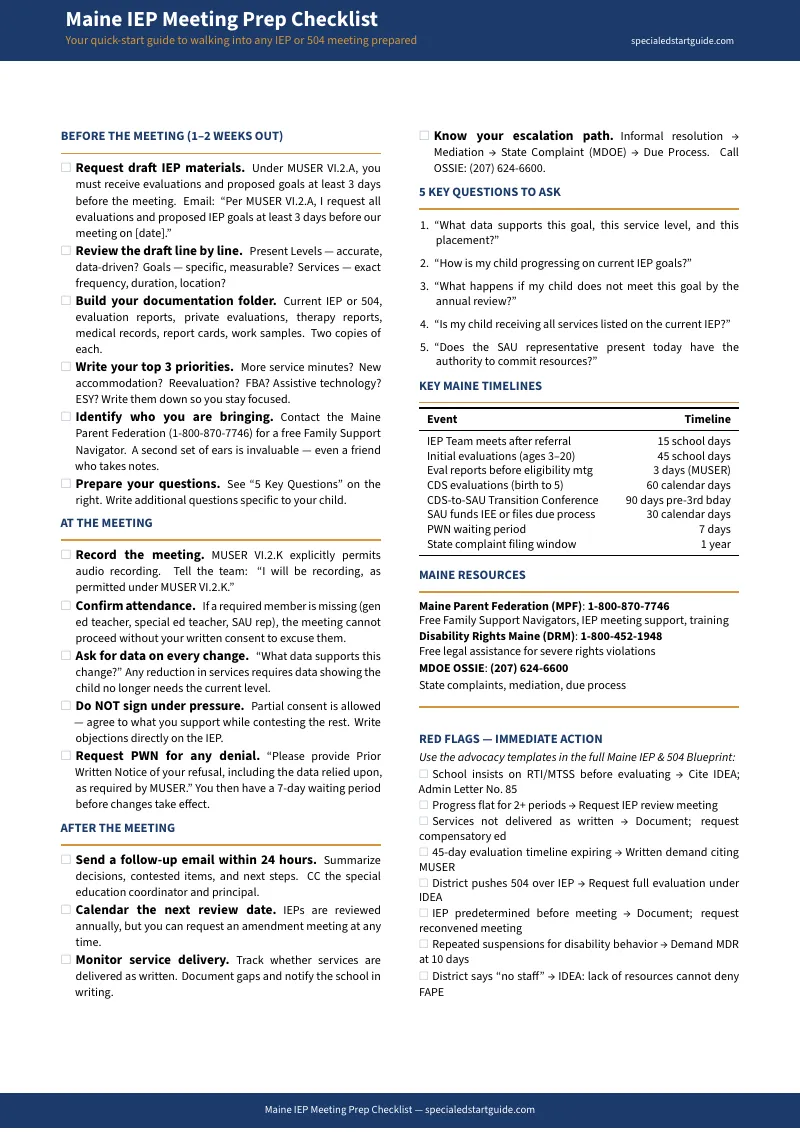
- IEP Meeting Prep Checklist (checklist.pdf) — the before/during/after checklist with Maine timelines, IEP team composition requirements, MUSER VI.2.A draft materials rule, MUSER VI.2.K recording rights, and the escalation path from mediation to due process
- Advocacy Letter Templates (advocacy-letters.pdf) — 7 copy-paste letters citing exact MUSER sections: evaluation request, RTI bypass, IEE demand, PWN demand, amendment request, service failure documentation, and MDOE state complaint
- IEP Meeting Scripts (meeting-scripts.pdf) — word-for-word responses to 7 common pushback tactics, each citing the MUSER section or federal provision that proves them wrong
- 504 vs. IEP Decision Matrix (504-vs-iep-matrix.pdf) — side-by-side comparison across 14 dimensions with Maine-specific details, the discipline gap warning, and the ADHD/OHI evaluation note
- Maine Timeline Cheat Sheet (timeline-cheat-sheet.pdf) — every legal deadline on one page: evaluation, IEP meeting, CDS transition, discipline, and dispute resolution timelines
- Dispute Resolution Roadmap (dispute-roadmap.pdf) — your four formal options from informal resolution to due process, with contact information, timelines, and a quick comparison table
- Goal-Tracking Worksheet (goal-tracking.pdf) — fillable IEP goal progress log, service delivery tracker, and red flags checklist to bring to every annual review
- Service Tracking Log (service-tracking.pdf) — weekly service delivery log, monthly summary with cumulative missed sessions, and communication log for your paper trail
- CDS Transition Checklist (cds-transition-checklist.pdf) — before/at/after checklists for the CDS-to-SAU Transition Conference, LD 345 cohort reference, and service preservation strategies
Instant PDF download. Print the templates tonight. Walk into tomorrow's IEP meeting with MUSER Chapter 101 on your side.
Money-back guarantee, no time limit. If the Blueprint doesn't change how you approach IEP meetings in Maine, email us for a full refund. No questions asked.
Not ready for the full Blueprint? Download the free Maine IEP Meeting Prep Checklist — a printable pre-meeting checklist with Maine timelines, MUSER citations, and the questions to ask at every IEP and 504 meeting. It's enough to walk into your next meeting prepared, and it's free.
Your child's education is a legal right, not a favor the school grants. The district knows MUSER Chapter 101. After tonight, so will you.