The School Knows Bulletin 1508. After Tonight, So Will You.
You walked into that SBLC meeting with your child's report cards, the teacher's notes, and a stack of articles you printed from Understood.org at midnight. The school psychologist used terms you'd never heard before — "Pupil Appraisal," "Bulletin 1508 criteria," "Response to Intervention tiers." The principal smiled and said your child "just needs more time with the interventions." They told you the School Building Level Committee would monitor things. They asked you to come back in six weeks.
Six weeks turned into three months. Three months turned into a full school year. Your child fell further behind. And when you finally asked why an evaluation hadn't started, the coordinator said: "We can't refer for Pupil Appraisal until the SBLC process is complete."
That statement was wrong. Under Louisiana's revised Bulletin 1508, Response to Intervention cannot be used to delay a special education referral. And under Act 198 — passed in 2024 — the school has exactly 15 days to respond to your written evaluation request. But you didn't know that then. And the school counted on it.
The problem isn't that Louisiana parents don't care. The problem is that Louisiana runs special education through a system unlike any other state — with its own vocabulary, its own regulatory Bulletins, and a charter school structure in New Orleans where 68 different operators each function as their own school district for special education purposes. National guides from Wrightslaw or Understood.org will never mention the SBLC. They won't explain the difference between Bulletin 1508 and Bulletin 1530. They don't cover Act 512's 10-day service reduction notice. Generic federal templates are structurally useless in Louisiana — like using a map of Texas to navigate the streets of New Orleans.
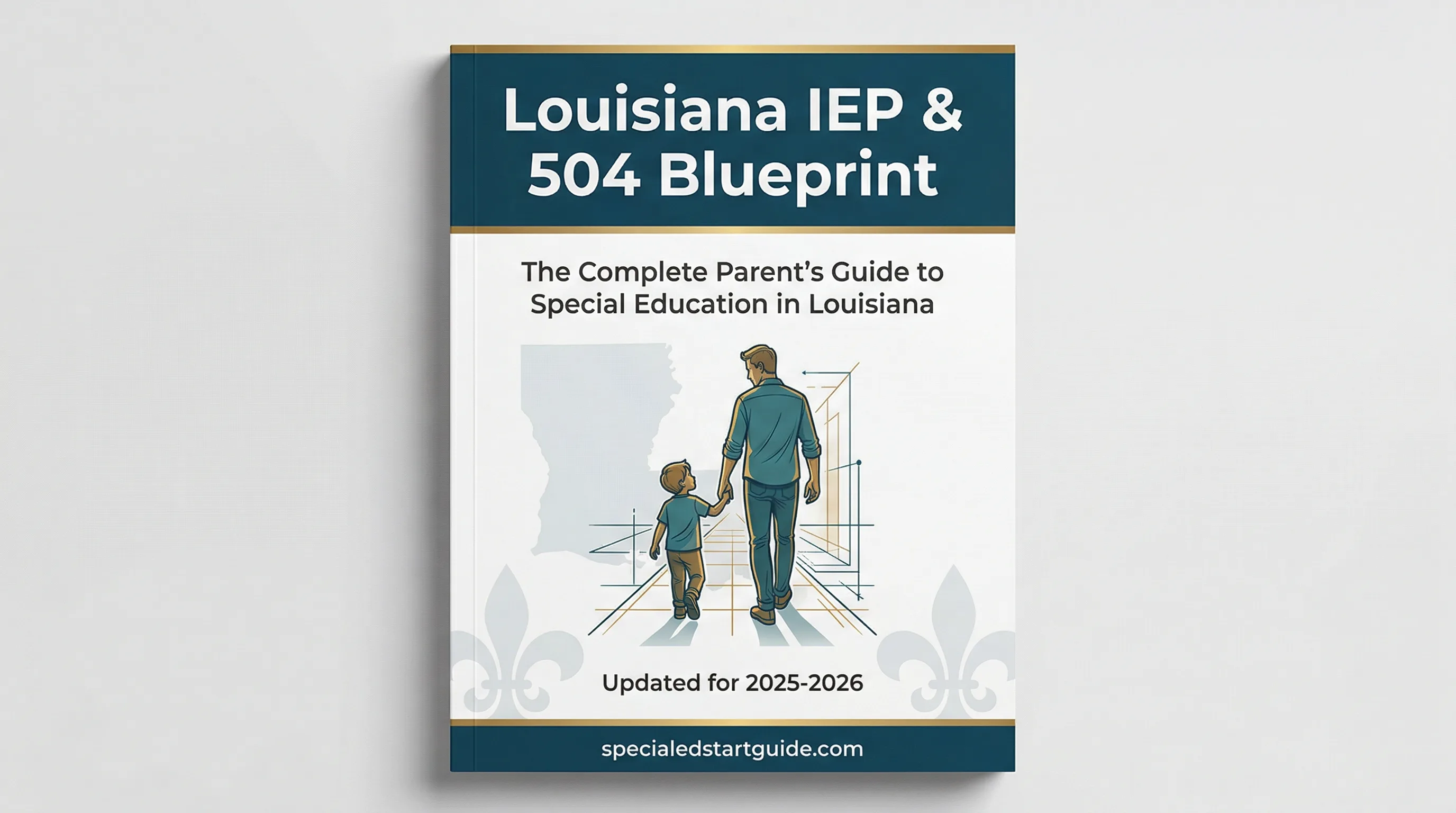
The Louisiana IEP & 504 Blueprint is the Bulletin 1508 enforcement toolkit that bridges the gap between knowing your rights exist and actually exercising them at the IEP table — with every template, script, and checklist grounded in Louisiana state law and the 2024 legislative reforms that changed everything.
What's Inside the Blueprint
The SBLC Bypass Strategy
The School Building Level Committee is Louisiana's unique gatekeeping structure — and the single biggest reason evaluations get delayed by months. Schools routinely tell parents the child must "complete RTI tiers" before a Pupil Appraisal referral can happen. That's not what the law says. The Blueprint explains exactly how the SBLC works, when it can legally delay a referral and when it cannot, and gives you the exact written request that forces the school to initiate a Bulletin 1508 evaluation — regardless of where your child sits in the intervention tiers. The revised "no-delay rule" in Bulletin 1508 is your strongest weapon. The Blueprint puts it in your hands.
The Act 198 & Act 512 Enforcement Playbook
The 2024 Louisiana legislative session passed two laws that fundamentally strengthened parental rights — and most schools haven't updated their practices to match. Act 198 forces districts to respond to evaluation requests within 15 days, requires draft IEPs at least 3 business days before the meeting, and extends the due process filing window from one year to two years. Act 512 requires 10 days' notice before any IEP change that reduces or removes services — giving you the exact window to invoke "stay-put" rights and freeze the status quo. The Blueprint includes copy-paste email templates citing both Acts by section number, so you can enforce these protections tonight.
The Copy-Paste Advocacy Letter Library
Every letter cites the exact Louisiana Bulletin or statute. Request an evaluation under Bulletin 1508 and start the district's 60-business-day clock. Demand Prior Written Notice when the IEP team refuses anything. Request an Independent Educational Evaluation at public expense when you disagree with the school's Pupil Appraisal. Invoke Act 512's stay-put protections when the school tries to cut services. These aren't generic IDEA samples — they're Louisiana-specific enforcement tools that reference Bulletins 1508, 1530, and 1706 by section number and create a legally binding record the moment you hit send.
The Bulletin 1508 vs. 1530 Decoder
Parents frequently confuse the evaluation process with the education plan — and schools exploit that confusion. Bulletin 1508 (Pupil Appraisal) strictly governs eligibility: how the school determines whether your child qualifies for one of the 13 exceptionalities. Bulletin 1530 (the IEP Handbook) governs placement and programming: what services your child receives and how they're delivered. Understanding this separation prevents you from arguing about services during an eligibility meeting — or letting the school conflate the two to minimize your child's support. The Blueprint maps both processes with plain-language checklists so you know exactly where you are and what comes next.
Charter School Accountability — The New Orleans Factor
If your child attends a charter school in Orleans Parish, Baton Rouge, or Jefferson Parish, you face a structural problem most states don't have. Independent charter schools (Type 2 and Type 5) function as their own Local Education Agencies — solely responsible for evaluation, IEP development, and service delivery. Some charter operators subtly "counsel out" students with disabilities, suggesting the child would be better served elsewhere. Others apply zero-tolerance discipline policies to behaviors that stem from undocumented disabilities. The Blueprint gives you the exact legal language to hold charter schools accountable under the same IDEA rules that bind traditional public schools — including the right to a Manifestation Determination Review before any expulsion.
IEP Meeting Scripts and Checklists
What to say when the team tells you your child is "making progress" but the data shows otherwise. What to say when they offer a 504 instead of an IEP. What to say when the LEA representative claims the school "doesn't have the resources" for the services your child needs. Each script cites the Louisiana Bulletin or statute that proves them wrong — so you're not arguing opinions, you're citing law. The pre-meeting checklist covers Louisiana's one-party recording consent rule, IEP team composition requirements under Bulletin 1530, and the specific documents to bring.
LEAP 2025 Testing Accommodations
Louisiana's high-stakes LEAP 2025 assessments are required for state graduation pathways. The Blueprint maps the three tiers of testing supports — Features for All, Accessibility Features, and IEP/504 Accommodations — and explains exactly what your child is entitled to, how to get accommodations documented on the Personal Needs Profile 30 days before testing, and what to do if the school fails to provide them on test day. If your child needs extended time, text-to-speech, a scribe, or a human reader, the process starts months before the test — not the week of.
The April Dunn Act — Alternate Graduation Pathway
If your child with an IEP struggles to pass LEAP 2025 assessments, they are not locked out of a standard diploma. The April Dunn Act allows eligible students to earn a TOPS University or Jump Start diploma through Individualized Performance Criteria (IPCs) — alternate, rigorous goals that bypass the standardized testing barrier. The Blueprint explains exactly how to qualify, the 30-day window for establishing IPCs, and what to demand from the IEP team to ensure your child's graduation pathway is protected.
Discipline Protections — FBAs, BIPs, and Manifestation Determinations
When a student with a disability faces suspension exceeding 10 days, the school must conduct a Manifestation Determination Review to determine if the behavior was caused by the disability or a failure to implement the IEP. If it was, standard expulsion cannot proceed. The Blueprint covers your child's MDR rights, Functional Behavioral Assessment requirements, Behavior Intervention Plan development, and the exact language to demand when the school skips the process — including the special protections under Act 745 for students receiving ABA therapy in school.
The Dispute Resolution Roadmap
When advocacy fails, you have five formal options in Louisiana: contacting the Special Education Ombudsman, requesting IEP Facilitation, requesting mediation, filing a Formal State Complaint with the LDOE, or filing for a Due Process Hearing. The Blueprint explains when each option is appropriate, the timeline involved, and how the paper trail you've built with the advocacy templates becomes the evidence that wins your case — or convinces the district to settle before you ever reach a hearing. Act 198 extended the due process filing window to two years, giving you more time to build your case.
Who This Blueprint Is For
- Parents preparing for their first SBLC or IEP meeting who don't want to walk in blind against a table of professionals who do this every day
- Parents whose child has been stuck in SBLC "interventions" for months with no formal Pupil Appraisal — and who need the legal language to force the school's hand
- New Orleans parents navigating the charter school maze — 68 independent operators, each with their own special education compliance, and a history of counseling out students with disabilities
- Baton Rouge and Jefferson Parish parents dealing with large district bureaucracies, staffing shortages, and IEPs that look the same year after year
- Rural parents in northern, central, and southwestern Louisiana where a single speech-language pathologist covers multiple schools and IEP services exist on paper but not in practice
- Parents who just received a 10-day notice under Act 512 that the school intends to reduce or remove services — and need to invoke stay-put protections immediately
- Parents navigating the 504-to-IEP question — unsure whether their child's current accommodations are legally sufficient or whether they should push for a full Pupil Appraisal evaluation
- Parents whose child needs LEAP 2025 testing accommodations or an alternate graduation pathway under the April Dunn Act
- Parents whose child was disciplined for behavior related to an unaddressed disability — and who need to understand Manifestation Determination rights
Why Not Just Use the Free Resources?
Louisiana has legitimate free special education resources. The LDOE publishes Procedural Safeguards. Families Helping Families operates nine regional centers statewide. Disability Rights Louisiana provides legal advocacy publications. Here's why parents still struggle after consulting all of them:
- The LDOE's Procedural Safeguards protect the state, not you. They are dense, clinical documents written by compliance officers to explain what the law says without telling you how to enforce it. They tell you that you have the right to request an evaluation. They do not give you the pre-written email to send tonight citing Bulletin 1508 and Act 198. For a parent in crisis, the gap between understanding a right and exercising it is the gap between winning and losing at the IEP table.
- Families Helping Families requires time you may not have. FHF provides excellent, empathetic support staffed by parents who've been through the system. But their best resources require scheduling an appointment, waiting for a callback, or committing to a multi-week training cohort. Their beginner advocacy course requires a 10-session online commitment at 4-5 hours per week. When the school hands you an IEP draft at 4 PM on a Friday and demands a meeting Monday morning, FHF simply cannot respond fast enough.
- Disability Rights Louisiana covers everything — which means less depth on your specific problem. Their publications carry high legal authority across housing, employment, voting, and education. Their K-12 materials are excellent for systemic litigation and post-secondary transition. But they don't offer step-by-step tactical scripts for a parent facing their first confusing SBLC meeting or Pupil Appraisal evaluation next week.
- TPT and Etsy templates organize paperwork — they don't enforce rights. A color-coded IEP binder helps you sort documents. It won't explain the SBLC bypass strategy, the 60-business-day evaluation timeline, the difference between Bulletin 1508 and 1530, or why Act 512 gives you a 10-day window to freeze service reductions. These templates are built by teachers for teachers — not by advocates for parents.
The free resources explain what the law says. The Blueprint gives you the tools to make the school follow it.
— Less Than 10 Minutes of a Special Education Advocate
Private special education advocates in Louisiana charge $100–$250 per hour. Attorneys require retainers starting at $3,000 and bill $150–$300 per hour. Even if you eventually need professional help, the meticulous paper trail you build with this Blueprint saves thousands in billable hours — because you're handing your advocate an organized case, not a folder of unsigned IEP copies and half-remembered conversations from meetings where you didn't know what to ask.
Your download includes the complete Blueprint guide, the IEP Meeting Prep Checklist, and four standalone printable tools — every template, script, and timeline reference, ready to print and bring to your next meeting.
- Complete Blueprint Guide (guide.pdf) — 14 chapters covering the Louisiana special education landscape, IEP vs. 504 decisions, the SBLC bypass strategy, the Pupil Appraisal process under Bulletin 1508, building strong IEPs under Bulletin 1530, Acts 198 and 512 enforcement, charter school accountability, discipline protections and manifestation determinations, LEAP 2025 testing accommodations, graduation pathways and the April Dunn Act, dispute resolution from facilitation to due process, Act 745 ABA therapy in schools, parent rights and procedural safeguards, and the Louisiana resource directory
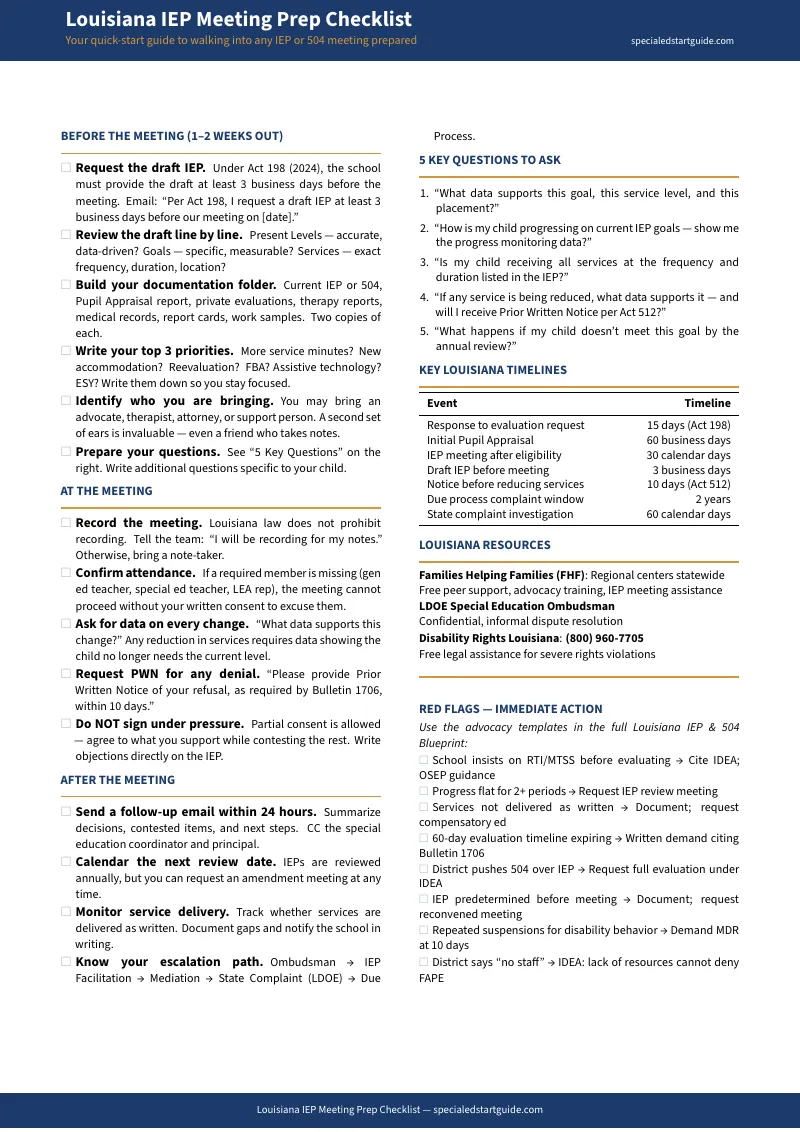
- IEP Meeting Prep Checklist (checklist.pdf) — the before/during/after checklist with Louisiana timelines, IEP team composition requirements, Act 198's draft IEP rule, Act 512's service reduction notice, and the escalation path from ombudsman to due process
- Copy-Paste Advocacy Letter Library (advocacy-letters.pdf) — pre-written letters citing Bulletins 1508, 1530, and 1706 for evaluation requests, IEE demands, Prior Written Notice, Act 198 timeline enforcement, Act 512 stay-put invocations, and formal state complaints
- Key Louisiana Timelines (timeline-cheat-sheet.pdf) — a printable reference sheet with every critical deadline: evaluation timelines, Act 198 and Act 512 deadlines, IEP review cycles, discipline timelines, and dispute resolution windows with Bulletin and statutory citations
- 504 vs. IEP Decision Matrix (504-vs-iep-matrix.pdf) — side-by-side comparison of Section 504 Plans and IDEA-backed IEPs across eligibility, services, protections, enforcement, and dispute resolution
- Dispute Resolution Roadmap (dispute-roadmap.pdf) — your five formal options when advocacy fails, with timelines, best-for scenarios, and filing instructions for each pathway
Instant PDF download. Print the templates tonight. Walk into tomorrow's IEP meeting with Bulletins 1508 and 1530 on your side.
Money-back guarantee, no time limit. If the Blueprint doesn't change how you approach IEP meetings in Louisiana, email us for a full refund. No questions asked.
Not ready for the full Blueprint? Download the free Louisiana IEP Meeting Prep Checklist — a printable pre-meeting checklist with Louisiana timelines, Act 198 and Act 512 references, and the questions to ask at every IEP, 504, and SBLC meeting. It's enough to walk into your next meeting prepared, and it's free.
Your child's education is a legal right, not a favor the school grants. The school knows Bulletin 1508. After tonight, so will you.