The School Knows K.A.R. Article 34. After Tonight, So Will You.
You walked into that IEP meeting as prepared as you could be. You downloaded the KSDE's 250-page Process Handbook. You printed the Procedural Safeguards notice. You even called Families Together's helpline — and they were kind, and knowledgeable, and unable to call you back before your meeting because their staff is stretched across the entire state.
So you sat across from six school employees — the special education teacher, the school psychologist, the general education teacher, the LEA representative, the speech-language pathologist, and the cooperative liaison — and they used Kansas acronyms you'd never heard before. ECSETS. MTSS. K.A.R. Article 34. They smiled. They said your child was "making progress." They recommended keeping everything the same because the data "supports current services." And you didn't know enough to challenge a single word of it.
You left with the same IEP your child walked in with. No additional minutes. No new evaluations. No Prior Written Notice explaining why they refused your requests — because you didn't know to demand one.
The problem isn't that you lack effort. The problem is that Kansas special education has a structural complexity most states don't: the Interlocal Cooperative System. More than 200 of Kansas's 286 Unified School Districts don't employ their own special education staff — they share therapists, psychologists, and specialists through regional cooperatives that cover thousands of square miles. When services aren't delivered, you call the principal; the principal says the therapist works for the cooperative. You call the cooperative; the cooperative says scheduling is the district's responsibility. Neither side claims accountability, and your child goes without services while you chase a bureaucratic circle.
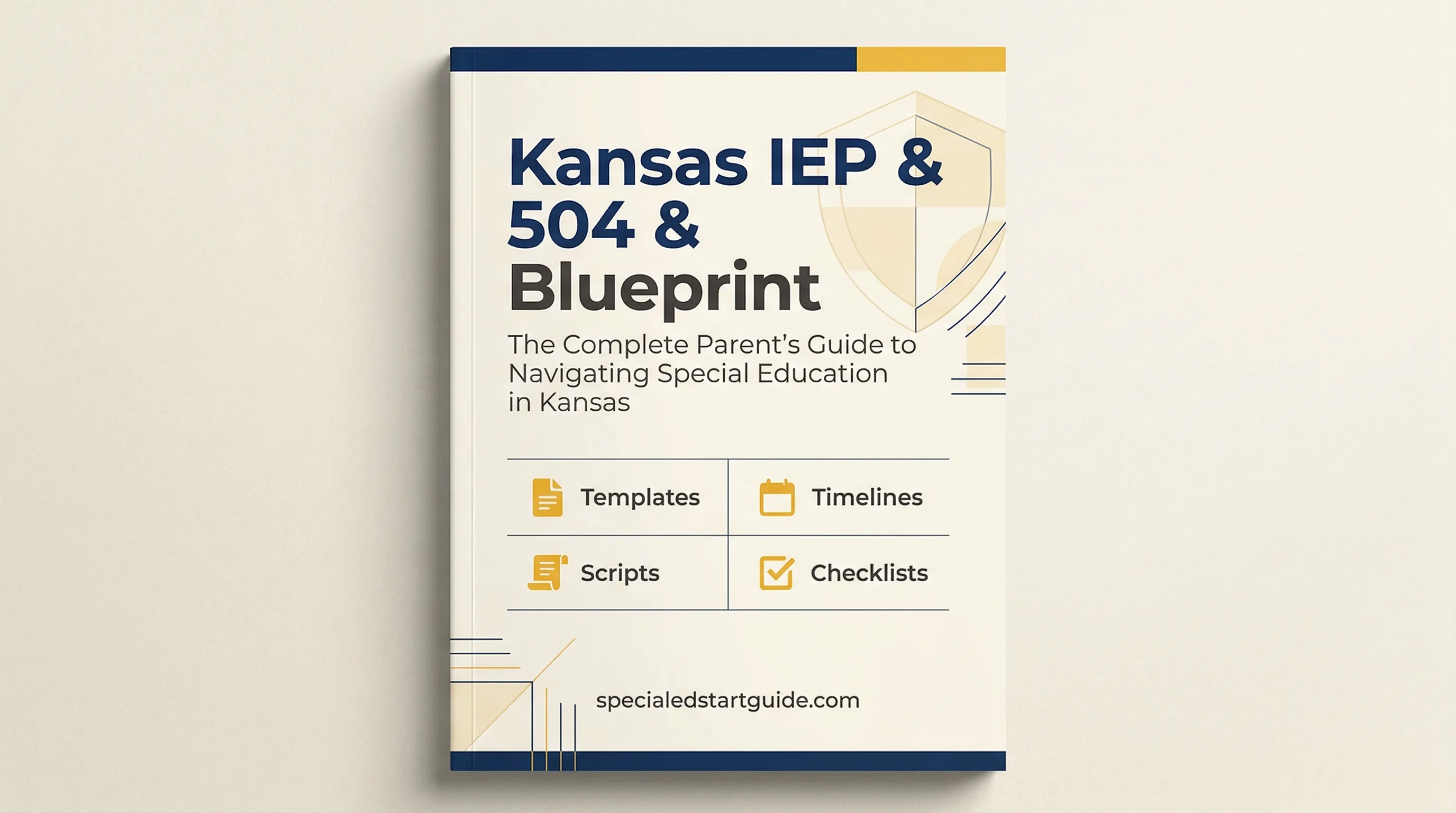
The Kansas IEP & 504 Blueprint is the K.A.R. Article 34 enforcement toolkit that bridges the gap between knowing your rights exist and actually exercising them — with every template, script, and checklist grounded in Kansas Administrative Regulations and Kansas state statute.
What's Inside the Blueprint
The Interlocal Cooperative Accountability System
No other guide at any price explains this. Kansas is the only state where most parents' special education complaints fail because they're filed with the wrong organization. The Blueprint maps the dual-authority chain of command — who employs the therapist, who controls scheduling, who approves evaluations — and tells you exactly where to escalate when the district and the cooperative point fingers at each other. Whether you're in the Southwest Kansas Area Cooperative District covering 6,500 square miles or the Central Kansas Cooperative in Education serving 12 districts, you'll know who to contact, what to demand, and how to escalate to KSDE ECSETS when local advocacy fails.
The Copy-Paste Advocacy Letter Library
Every letter cites the exact Kansas regulation. Request an evaluation under K.A.R. 91-40-8 and start the district's 60-school-day clock. Demand Prior Written Notice when the IEP team refuses anything — because without it, their refusal isn't documented and your paper trail has a hole. Request an Independent Educational Evaluation at public expense when you disagree with the school psychologist's assessment. These aren't generic IDEA samples — they're Kansas-specific enforcement tools that reference K.A.R. Article 34 by section number and create a legally binding record the moment you hit send.
The 60-School-Day Timeline Decoder
Kansas's evaluation timeline is unique — 60 school days from written parental consent to a completed evaluation, eligibility determination, and an implemented IEP. School days means weekends don't count. Holidays don't count. Summer doesn't count. A consent form signed in March may not result in a completed IEP until September. The Blueprint maps every deadline, explains exactly which days are excluded, and gives you the exact language to send when the school blows past the 60-day limit — or tries to stretch it by claiming the clock started later than it did.
The 25% Rule Protection Guide
Kansas law gives you a protection most parents never hear about. Under K.A.R. Article 34, a school cannot reduce any special education service by 25% or more — or change your child's educational environment by more than 25% of the school day — without your explicit written consent. Schools experiencing budget cuts or staffing shortages quietly reduce paraprofessional hours, speech therapy minutes, or pull-out time. The Blueprint gives you the exact regulatory citation and the pre-written letter to send the moment you suspect an unauthorized reduction.
The MTSS Bypass Strategy
Schools across Kansas use the Multi-Tiered System of Supports as a legitimate framework — and as a delay tactic. "Let's finish Tier 2 first." "We need to see more data." "Interventions take time." Here's what they're not telling you: under Kansas law, a parent's written evaluation request triggers the 60-school-day clock regardless of where the child sits in the MTSS tiers. The school cannot use MTSS to delay or deny an evaluation. The Blueprint gives you the exact letter to send that forces the clock to start — citing K.A.R. 91-40-8 — and explains your options when the school tries to run the clock anyway.
IEP Meeting Scripts and Checklists
What to say when the team tells you your child is "making progress" but the data shows otherwise. What to say when they offer a 504 instead of an IEP. What to say when the LEA representative claims the district "doesn't have the resources" for the services your child needs. Each script cites the Kansas regulation or statute that proves them wrong — so you're not arguing opinions, you're citing law. The pre-meeting checklist covers Kansas's one-party recording consent law (K.S.A. 21-6101), IEP team composition verification under K.A.R. 91-40-17, and the specific documents to bring.
The ESI Crisis Toolkit — Seclusion and Restraint Protections
When your child is subjected to seclusion or physical restraint at school, Kansas law requires same-day parent notification and written documentation by the next school day. The Blueprint covers the exact ESI reporting timelines under K.S.A. 72-6151, your right to a mandatory 10-school-day review meeting, the documentation the school must provide, and the pre-written demand letter you send when the school fails to notify you or refuses to schedule the review. No generic national guide covers Kansas's specific ESI requirements.
Transition Planning — Starting at Age 14 in Kansas
Kansas requires transition services beginning no later than the first IEP meeting after a student turns 14 — earlier than the federal age-16 minimum. The Blueprint maps the exact Kansas requirements, explains what should be in the transition IEP, and gives you the language to demand age-appropriate transition assessments, post-secondary goal development, and community agency referrals.
Goal-Tracking Worksheets
IEP goals are legally required to be measurable — with baselines, targets, and mastery criteria meeting the Endrew F. standard. But many goals are written so vaguely that progress is impossible to track. The worksheets give you a structured format to log data between meetings, compare school-reported progress against your own observations, and arrive at the annual review with documentation that either confirms the program is working or proves it isn't.
The Dispute Resolution Roadmap
When advocacy fails, you have three formal options in Kansas: filing a formal State Complaint with KSDE ECSETS, requesting mediation through KSDE, or filing for a Due Process Hearing. The Blueprint explains when each option is appropriate, the timeline and costs involved, and how the paper trail you've been building with the advocacy templates becomes the evidence that wins your case — or convinces the district to settle before you ever reach a hearing.
Who This Blueprint Is For
- Parents preparing for their first IEP meeting who don't want to walk in blind against a table of professionals who do this every day
- Parents whose child has been stuck in MTSS "interventions" for months with no formal evaluation — and who need the legal language to force the 60-school-day clock to start
- Parents in Johnson County districts — Olathe, Blue Valley, Shawnee Mission — dealing with well-resourced districts that deploy aggressive gatekeeping on eligibility and services
- Kansas City KS parents navigating KCKPS, a system plagued by staff shortages and institutional instability — who need documentation templates to force compliance
- Wichita USD 259 parents dealing with the state's largest district bureaucracy, teacher turnover, and subjective eligibility determinations
- Rural parents who depend on interlocal cooperatives where a single specialist covers five buildings across thousands of square miles and evaluations are stretched to their statutory limits
- Parents whose child was subjected to seclusion or restraint and who need the exact ESI documentation requirements and the demand letter for a mandatory review meeting
- Parents whose child's services were quietly reduced without written consent — and who need to invoke the 25% Rule with the exact K.A.R. citation
- Parents navigating the 504-to-IEP question — unsure whether their child's current plan is legally sufficient or whether they should push for a full special education evaluation
Why Not Just Use the Free Resources?
Kansas has legitimate free special education resources. KSDE publishes the Process Handbook. Families Together operates a statewide helpline. The Disability Rights Center provides self-advocacy templates. Here's why parents still struggle after consulting all of them:
- KSDE's Process Handbook protects the state, not you. It exceeds 250 pages of dense compliance prose written to explain K.A.R. Article 34 rules without telling you how to enforce them. It tells you that you have procedural rights. It does not give you the pre-written email to send tonight citing those rights. For a parent in crisis, the gap between understanding a right and exercising it is the gap between winning and losing at the IEP table.
- Families Together is structurally neutral. As Kansas's federally funded Parent Training and Information Center, Families Together provides warm support and process overviews. Their mandate is to bridge the gap between parents and schools — not to arm you with adversarial legal templates. They can educate. They cannot give you the aggressive letter to send when the school refuses to evaluate.
- The Disability Rights Center supports — they don't specialize. The DRC covers disability rights across housing, employment, voting, and education. Their K-12 materials are buried within a much larger institutional ecosystem. Their templates carry legal disclaimers stating they don't constitute legal advice — the focused, tactical authority of a dedicated guide is exactly what's missing.
- Etsy and TPT planners organize paperwork — they don't enforce rights. A pastel IEP binder helps you sort documents. It won't explain the 60-school-day evaluation timeline, the 25% Rule, the interlocal cooperative system, or why Kansas has specific ESI reporting mandates. Generic federal templates miss every Kansas nuance that actually determines your outcome.
The free resources explain what the law says. The Blueprint gives you the tools to make the school follow it.
— Less Than 3 Minutes of a Special Education Advocate
Special education advocates in Kansas charge $100–$300 per hour. Attorneys require retainers starting at $5,000 and bill $250–$500 per hour. Even if you eventually need professional help, the meticulous paper trail you build with this Blueprint saves thousands in billable hours — because you're handing your advocate an organized case, not a shoebox of unsigned IEP copies and half-remembered conversations.
Your download includes the complete Blueprint guide plus 8 standalone printable PDFs — every template, worksheet, script, and reference card, ready to print and bring to your next meeting.
- Complete Blueprint Guide (guide.pdf) — 15 chapters covering the Kansas special education landscape, IEP vs. 504 decisions, the evaluation process and 60-school-day timeline, building strong IEP goals, navigating the interlocal cooperative system, your rights as a Kansas parent, IEP meeting preparation and advocacy scripts, ESY and transfer procedures, seclusion and restraint protections, discipline and manifestation determinations, transition planning at age 14, private school and homeschool rights, dispute resolution, Kansas resource directory, and copy-paste advocacy letter templates
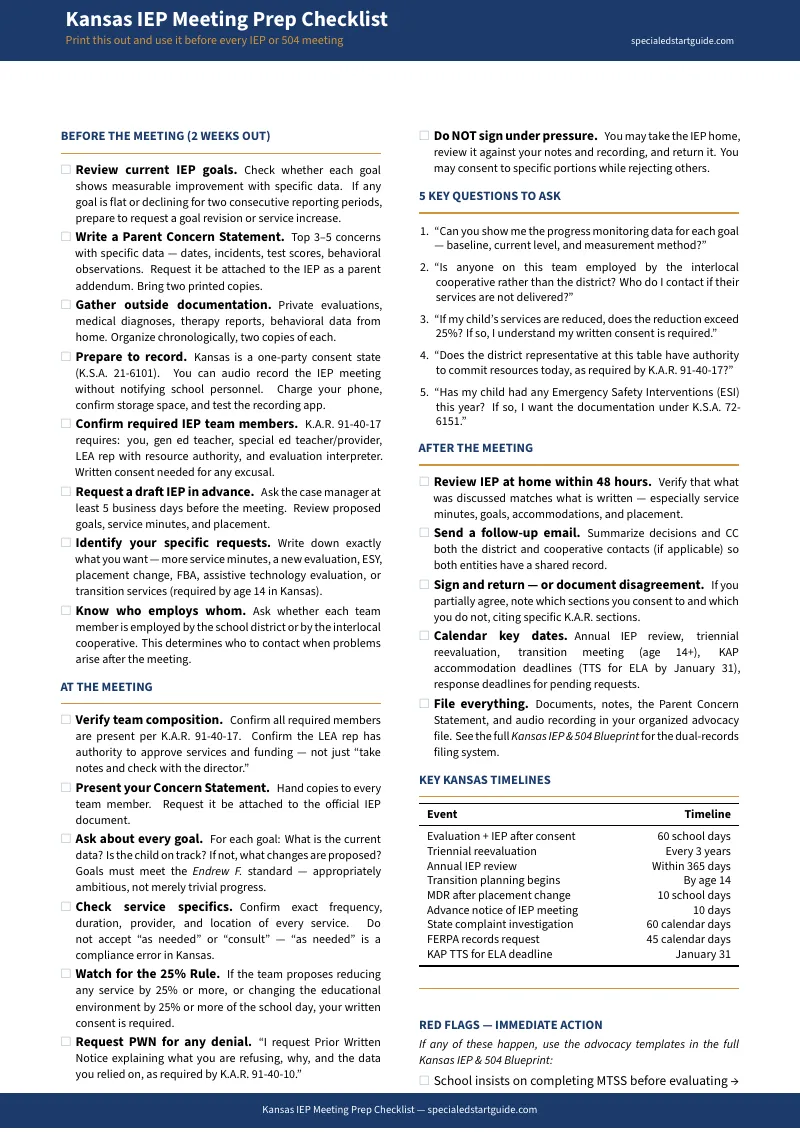
- IEP Meeting Prep Checklist (checklist.pdf) — the before/during/after checklist with Kansas timelines, IEP team composition requirements under K.A.R. 91-40-17, one-party recording consent law, the 25% Rule, and red flags that require immediate action
- Advocacy Letter Templates (advocacy-letters.pdf) — 10 copy-paste letters citing exact K.A.R. Article 34 provisions for evaluation requests, IEEs, Prior Written Notice demands, MTSS bypass, 25% Rule enforcement, ESI documentation, dual records requests, state complaints, and compensatory education
- IEP Meeting Scripts (meeting-scripts.pdf) — word-for-word responses to 7 common school pushback tactics, each citing the specific K.A.R. regulation or Kansas statute
- Goal-Tracking Worksheet (goal-tracking.pdf) — fillable progress monitoring with IEP goal log, service delivery tracker, and red flags checklist
- Kansas Timeline Cheat Sheet (timeline-cheat-sheet.pdf) — every legal deadline on two pages: evaluation, IEP meetings, discipline, ESI, and dispute resolution timelines with K.A.R. and K.S.A. citations
- Dispute Resolution Roadmap (dispute-roadmap.pdf) — your formal options when advocacy fails: IEP amendment, mediation, KSDE state complaint, due process hearing, and OCR complaint with a side-by-side comparison
- ESI Crisis Toolkit (esi-toolkit.pdf) — seclusion and restraint protections under K.S.A. 72-6151, notification requirements, the demand letter template, and what to do after an incident
- 504 vs. IEP Decision Matrix (504-vs-iep-matrix.pdf) — side-by-side comparison of IEP and 504 protections with Kansas-specific details including gifted eligibility, the discipline gap, and the 25% Rule
Instant PDF download. Print the templates tonight. Walk into tomorrow's IEP meeting with K.A.R. Article 34 on your side.
Money-back guarantee, no time limit. If the Blueprint doesn't change how you approach IEP meetings in Kansas, email us for a full refund. No questions asked.
Not ready for the full Blueprint? Download the free Kansas IEP Meeting Prep Checklist — a printable pre-meeting checklist with Kansas timelines, IEP team composition requirements, the 25% Rule, and the red flags that require immediate action. It's enough to walk into your next meeting prepared, and it's free.
Your child's education is a legal right, not a favor the school grants. The school knows K.A.R. Article 34. After tonight, so will you.