Your Child's District and Cooperative Both Broke the Law. Here's the Paper Trail That Proves It.
You already know something is wrong. The IEP says 30 minutes of speech therapy twice a week, but the cooperative speech-language pathologist who used to visit your school left four months ago and nobody replaced her. You called the principal. The principal told you to call the cooperative. The cooperative told you scheduling is the district's responsibility. Your child hasn't received services in two months and nobody will take ownership — because in Kansas, your child's special education staff work for the Interlocal Cooperative, not the school district, and neither organization will put their refusal in writing.
Kansas serves approximately 15 percent of its public school students through special education — and a statewide funding shortfall exceeding $423.2 million means districts resist evaluations, push 504 Plans over IEPs, and quietly reduce service minutes. You've been in the IEP meeting where five district employees and three cooperative staff presented a document they'd clearly finalized before you arrived, spoke in acronyms — PLAAFP, SDI, LRE, BIP, ESY — and gave you fifteen minutes to review and sign. You've called Families Together and received excellent general information. You've downloaded the KSDE Special Education Process Handbook — hundreds of pages of compliance language written by bureaucrats for bureaucrats. You've looked up special education attorneys at $312 per hour average — with retainers starting at $3,500 before anyone reviews your child's file.
If you earn too much for free legal aid and not nearly enough for a retainer, you are on your own — unless you know exactly how to build the case yourself.
The Kansas IEP & 504 Advocacy Playbook is the Cooperative Accountability System — the tactical toolkit that turns overwhelmed parents into effective advocates by providing the exact dispute letters, interlocal cooperative escalation procedures, and paper trail protocols grounded in Kansas Administrative Regulations (K.A.R.) Article 34, K.S.A. Chapter 72, and federal IDEA that force both the district and the cooperative to respond on the record.
What's Inside the Playbook
The Fill-in-the-Blank Dispute Letter Library
Every letter cites the exact Kansas regulation. Demand an Independent Educational Evaluation at public expense — using the specific legal phrase under K.A.R. 91-40-12 and 34 C.F.R. §300.502 that triggers the district's obligation to either fund the IEE or file for due process to defend their evaluation. Request Prior Written Notice for every denial — because the district is required under K.A.R. 91-40-10 to explain in writing what they refused, why, what data they relied on, and what alternatives they considered. Document service non-delivery with the specific timeline citations that prove the district and cooperative violated the IEP. Challenge an evaluation you disagree with. Request a Functional Behavioral Assessment. Every template is addressed to both the district superintendent and the cooperative director simultaneously — because in Kansas's dual-employer system, addressing only one lets the other dodge accountability.
The Interlocal Cooperative Accountability Map
Kansas's cooperative system — where multiple districts pool IDEA funds under K.S.A. 72-13,100 to share special education personnel — is unlike any other state. Your child's school psychologist, speech therapist, and occupational therapist are often employed by the cooperative, not the district. When services fail, the principal says "that's the cooperative's employee." The cooperative says "scheduling is the district's responsibility." The Playbook breaks this system apart: who is legally responsible for what, when to direct your complaint to the building principal versus the district superintendent versus the cooperative director, and how to write dispute letters that copy all three to eliminate the administrative finger-pointing that exhausts parents.
The KSDE Formal Complaint Translation Matrix
KSDE provides blank model complaint forms, but those forms require you to articulate exactly which federal or state statute the district violated. Without a translator, the forms are useless. The Playbook includes a plug-and-play matrix that maps common daily frustrations — "the paraprofessional wasn't there today" — to legally actionable formal complaint language — "failure to implement the IEP as written, constituting a denial of FAPE and violating 34 C.F.R. § 300.323." File with KSDE ECSETS Dispute Resolution, and the state investigates within 30 days. Kansas also allows you to appeal the complaint decision to a state appeal committee — a protection most states do not offer.
The Emergency Safety Intervention (ESI) Audit Toolkit
Kansas maintains highly specific ESI laws that most parents do not know exist. State law strictly prohibits prone restraint, supine restraint, airway restriction, communication restriction, and unmonitored seclusion. Parents must be notified on the same day of any ESI incident, written documentation must follow the next school day, and a formal meeting is required after a third incident. The Playbook includes a complete ESI audit checklist and demand-for-documentation letter citing the specific K.S.A. 72-6151 regulations the school must comply with. If your child was restrained or placed in seclusion and the school did not follow these requirements, you have immediate grounds for a formal complaint.
The Paper Trail System
In Kansas, the burden of proof in a due process hearing rests on the party seeking relief — almost always the parent (Schaffer v. Weast, 2005). Without a documented paper trail, you lose. The Playbook includes communication logs, follow-up email templates for every verbal conversation, and a systematic documentation protocol that builds the evidence Kansas hearing officers require. Every phone call gets a summary email. Every meeting gets a written follow-up. Every denial triggers a Prior Written Notice demand. This is the foundation that wins cases — or prevents them from being necessary, because districts and cooperatives respond differently when they know the parent is documenting everything.
The Due Process & Mediation Roadmap
Due process is the highest administrative remedy. The district must hold a resolution session within 15 days, and the resolution period expires at 30 days. The hearing officer must be a licensed attorney under K.A.R. 91-40-29. Your child stays in current placement during the entire process — the stay-put provision. The Playbook covers resolution session strategy, evidence organization, what hearing officers look for, and how to build a case that survives the preponderance-of-evidence standard. It also covers free mediation — voluntary, confidential, and legally enforceable if you reach agreement.
Rural Service Enforcement
When a rural school says the cooperative speech therapist quit and there is no replacement, your legal options include demanding the district fund a private provider, approve telehealth delivery, reimburse travel to Wichita, Kansas City, Topeka, or Lawrence for evaluations or therapy, or provide compensatory education for every session missed. The Playbook includes specific letter templates citing K.A.R. Article 34 and IDEA that turn "we don't have the staff" into a legal obligation the district must address — whether you're in Dodge City, Garden City, Hays, or any other community where the nearest specialist is a three-hour drive.
The 25% Rule Shield
Under K.S.A. 72-3430(b)(6), the district cannot reduce your child's services by 25% or more, or change the educational environment by 25% or more of the school day, without your explicit written consent. When services are being quietly cut — due to staffing shortages, cooperative turnover, or budget pressure — the Playbook teaches you how to calculate the percentage, document the reduction, and invoke this Kansas-specific protection that most parents do not know exists.
Who This Playbook Is For
- Parents whose child's IEP services are not being delivered — the speech therapist hasn't been replaced, the aide covers multiple classrooms, the goals haven't changed in two years — and who need to create the paper trail that forces both the district and the cooperative to act
- Parents caught in the finger-pointing loop between the district and the interlocal cooperative — where no single administrator claims responsibility for the service failures and each blames the other
- Parents whose child was denied a special education evaluation because the General Education Interventions team "needs more data" — even though the child has been struggling for years and has a private diagnosis
- Parents in rural or western Kansas where the cooperative cannot staff the position — and who need to force the district to fund private providers, telehealth, or compensatory education instead of accepting "there's nothing we can do"
- Parents in Overland Park, Olathe, Shawnee Mission, or Johnson County dealing with well-funded districts that present pre-written IEPs and pressure families to accept proposals without adequate time to review
- Parents in Kansas City, Wichita, or Topeka dealing with chronically understaffed districts where special education non-compliance is institutional and children with behavioral challenges face undocumented removals weaponized as truancy
- Parents whose child was subjected to physical restraint or placed in a seclusion room — and who learned about it days later instead of the same day as required by Kansas ESI law
- Parents facing disciplinary action against their child — suspensions, alternative placements, soft suspensions disguised as "staffing issues" — who need to understand Manifestation Determination Reviews and protect their child's right to stay in placement
- Parents in a small town who are afraid that challenging the district or cooperative will make things worse — but who cannot accept another year of inadequate services
Why Not Just Use the Free Resources?
Kansas has serious free advocacy resources. Families Together publishes a 68-page "Know Your Special Education Rights" guide. KSDE provides the Special Education Process Handbook. The Disability Rights Center of Kansas offers free legal advocacy for severe civil rights violations. Here's why parents still lose disputes after consulting all of them:
- Families Together's guide is 68 pages of educational text. It is legally accurate and well-organized. It is also paralyzing to read the night before a Manifestation Determination Review. It explains what the law says — it does not give you the fill-in-the-blank dispute letter that cites K.A.R. 91-40-12 to demand an IEE at public expense. As a state-partnered entity, their institutional tone encourages collaboration and "working with the team." When collaboration has failed, you need instruments, not information.
- The KSDE Process Handbook was written by bureaucrats for bureaucrats. It cites K.A.R. 91-40-51 and 34 C.F.R. 300.151 without translation. KSDE provides model complaint forms — but those forms are blank canvases that require you to articulate the exact statute the district violated. Without the translation matrix that maps your child's experience to the correct regulatory violation, the free forms are effectively useless.
- The Disability Rights Center handles the most severe cases. DRC is the federally mandated Protection and Advocacy agency for Kansas — they triage hundreds of cases and prioritize systemic abuse, institutionalization, and severe civil rights violations. If your child's services are being quietly eroded rather than dramatically denied, you may wait months for individualized help. You cannot afford to wait while the statute of limitations runs.
- Wrightslaw covers federal IDEA — not K.A.R. Article 34. Wrightslaw is the gold standard for federal special education law. It does not address Kansas interlocal cooperatives, the KSDE formal complaint process, the 25% rule, Kansas ESI laws, or how Kansas hearing officers interpret burden of proof. Federal citations are useful; Kansas-specific citations tell the district you know their playbook.
- Generic IEP planners from Etsy and Teachers Pay Teachers assume a single school district. They cost $20–$36 and focus on organization and goal tracking. None of them address Kansas cooperatives, K.A.R. Article 34, ESI audit procedures, or how to write a dispute letter that copies both the superintendent and the cooperative director. They are built for states with simpler structures.
- Private advocates cost $100–$300 per hour. Special education attorneys charge $312 average, with specialized rates reaching $595. Retainers start at $3,500. Most Kansas families cannot afford this — and advocates achieve better results when the parent arrives with an organized paper trail. This Playbook is how you build that trail.
The free resources explain what Kansas law says. This Playbook gives you the dispute tools to make the district and cooperative comply.
— Less Than One Hour of a Special Education Advocate
Private advocates in Kansas charge $100–$300 per hour. Educational attorneys average $312 per hour, with specialized rates climbing to $595. A single consultation to review your situation costs more than this entire Playbook. The Playbook gives you the dispute letters, cooperative escalation procedures, and documentation system that advocates use — so you can either handle the dispute yourself or arrive at a paid consultation with an organized case file that saves hundreds in billable hours.
Your download includes the complete Advocacy Playbook guide plus standalone printable PDFs — every dispute letter template, escalation checklist, and reference card, ready to print and use tonight.
- Complete Advocacy Playbook Guide — 10 chapters covering your legal foundation and procedural safeguards, building a bulletproof paper trail, the interlocal cooperative accountability system, Independent Educational Evaluations, discipline protections and Manifestation Determinations, ESI audit procedures, filing KSDE State Complaints, mediation and due process hearings, federal OCR complaints, and compensatory education strategies
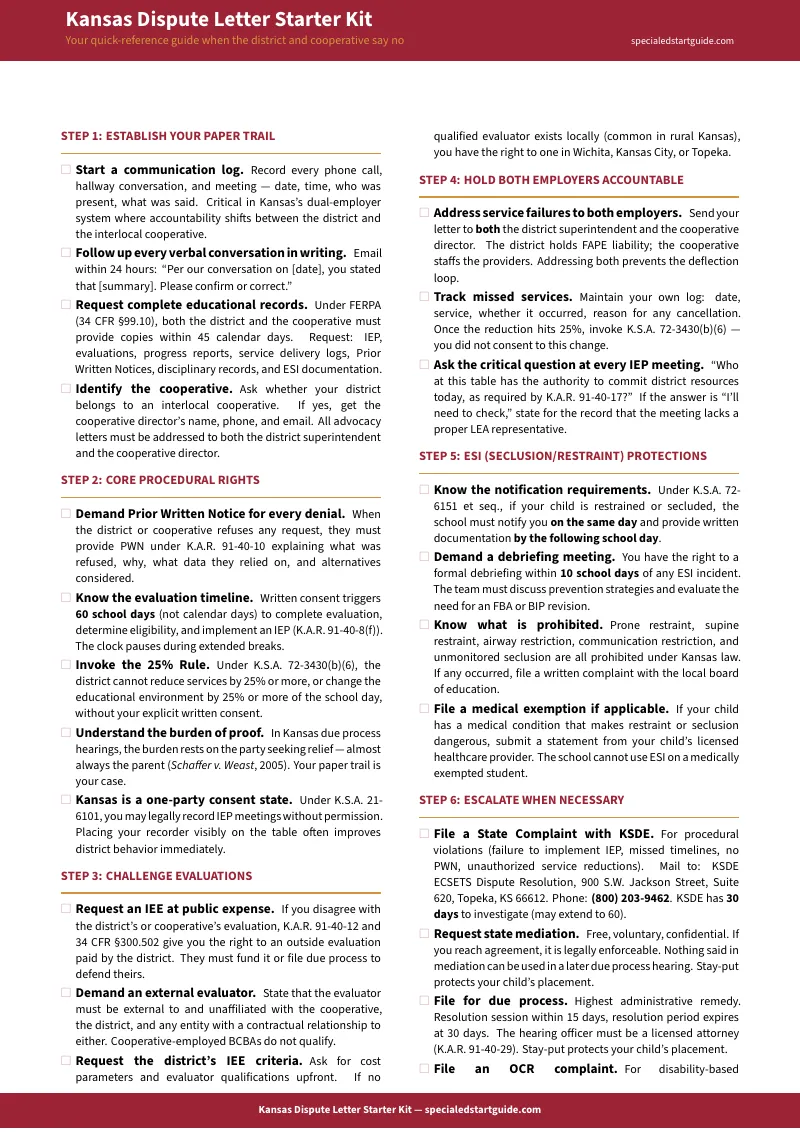
- Dispute Letter Starter Kit — the quick-reference checklist covering paper trail setup, core procedural rights, evaluation challenges, cooperative accountability, ESI protections, and escalation procedures with key Kansas timelines
- Advocacy Letter Templates — fill-in-the-blank letters citing exact K.A.R. Article 34 regulations for IEE demands, Prior Written Notice requests, service non-delivery documentation, cooperative accountability, and formal disagreements
- KSDE Complaint Template — structured state complaint filing template with required elements, evidence attachment guide, and mailing instructions for KSDE ECSETS Dispute Resolution
- Communication Log — printable documentation tracker for every call, meeting, and conversation — the systematic paper trail that wins cases
- ESI Audit Checklist — Kansas-specific seclusion and restraint compliance checklist with demand-for-documentation letter citing K.S.A. 72-6151
- Dispute Escalation Ladder — visual roadmap from informal advocacy through KSDE complaint, mediation, due process, and OCR complaint — with Kansas-specific timelines at every stage
- Compensatory Education Tracker — missed service calculator and demand letter template for make-up services when the IEP is not being implemented
Instant PDF download. Print the dispute letter that matches your situation tonight. Send it tomorrow morning.
Money-back guarantee, no time limit. If the Playbook doesn't change how you handle disputes with your Kansas school district and cooperative, email us for a full refund. No questions asked.
Not ready for the full Playbook? Download the free Kansas Dispute Letter Starter Kit — a printable quick-reference guide covering paper trail setup, core procedural rights, evaluation challenges, cooperative accountability, ESI protections, and escalation steps with key Kansas timelines and K.A.R. Article 34 citations. It's enough to start building your case tonight, and it's free.
Your child's education is a legal right — and when the district and cooperative violate it, Kansas law gives you the tools to fight back. This Playbook puts those tools in your hands.