The AEA Knows Iowa's Special Education Rules. After Tonight, So Will You.
You walked into that IEP meeting as prepared as you could be. You called the ASK Resource Center. You downloaded the Iowa Procedural Safeguards Manual. You even contacted your AEA's family liaison — and she was kind, and empathetic, and an employee of the same regional agency that controls the evaluations, the therapy schedules, and the staffing decisions you're trying to challenge.
So you sat across from the special education teacher, the school psychologist, the AEA consultant, the general ed teacher, and the district's LEA representative — and they used Iowa acronyms you'd never heard before. MTSS. Eligible Individual. ACHIEVE. Performance domains. PLAAFP. They smiled. They said your child was "responding to Tier 2 interventions" and the team needed "more data" before they could consider a formal evaluation. And you didn't know enough to tell them that Iowa law explicitly prohibits MTSS from delaying a parent-initiated evaluation request.
You left with no evaluation timeline, no consent form, and no written explanation of why they refused your request — because you didn't know to demand Prior Written Notice.
The problem isn't that you lack effort. The problem is that Iowa's special education system is structurally different from every other state in America — and that difference is designed for compliance officers, not parents. A dual AEA-district model that splits responsibility between two agencies, each pointing at the other when services fall through. A noncategorical "Eligible Individual" system that doesn't use the disability labels every other state requires. An ACHIEVE platform managing your child's IEP that you may not even have login access to. And a 2024 legislative overhaul — HF 2612 — that stripped AEA governance, shifted funding to districts, and drove over 400 specialists out of the system, leaving the remaining staff stretched across unsustainable caseloads.
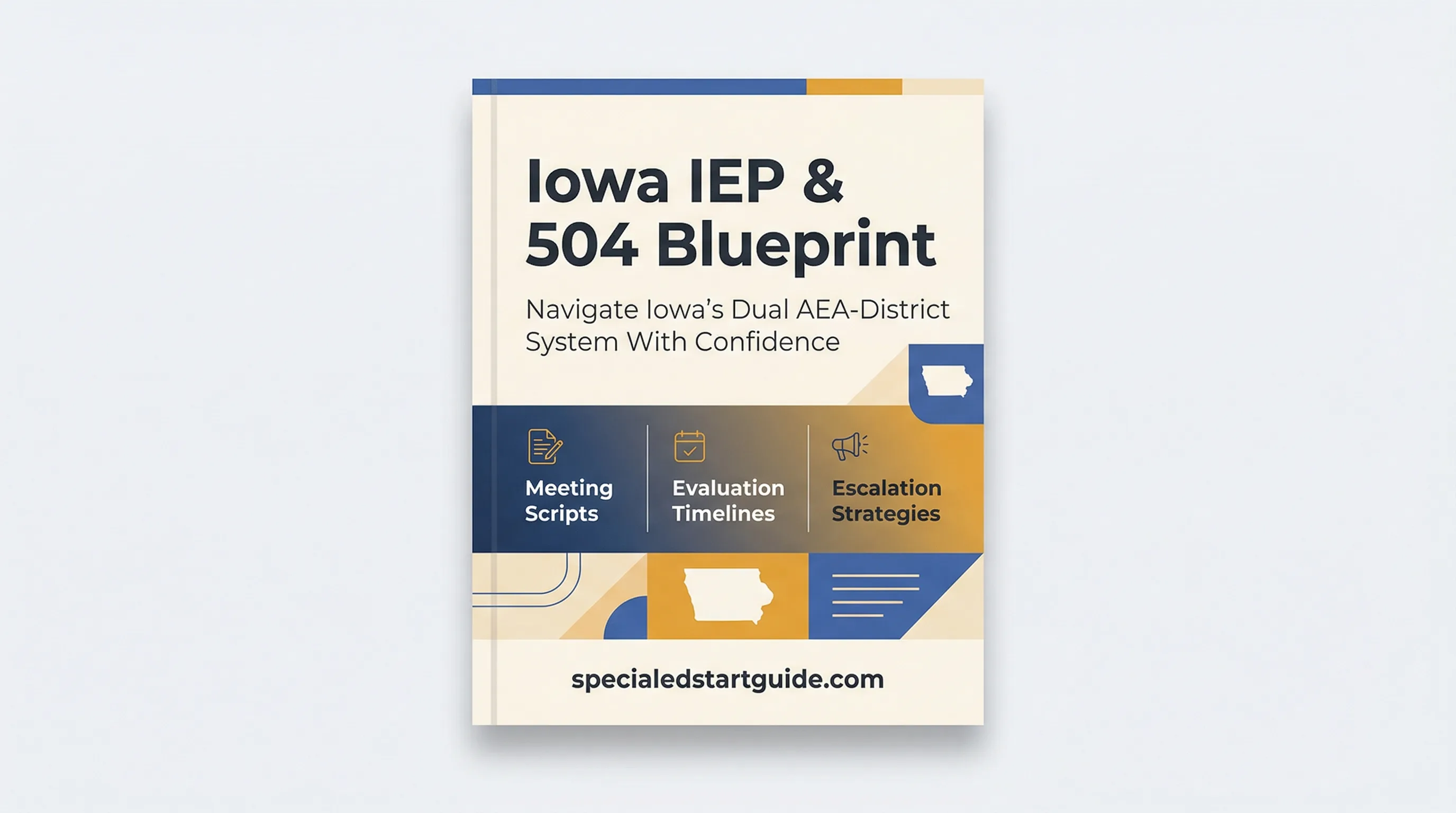
The Iowa IEP & 504 Blueprint is the tactical enforcement toolkit that bridges the gap between knowing your rights exist and actually exercising them — with every template, script, and checklist grounded in Iowa Administrative Code Chapter 41 and calibrated for the post-HF 2612 reality.
What's Inside the Blueprint
The AEA-District Accountability Map
Iowa is the only state where a regional agency (the AEA) provides your child's related services while a separate entity (the district) provides classroom instruction. When speech sessions get canceled, when evaluations are delayed, when nobody responds to your emails — you may not even know which agency to contact. The district says it's the AEA's responsibility. The AEA says the district handles that. The Blueprint maps exactly who does what, who to contact for each service type, and the escalation chain when both sides point fingers: AEA contact → AEA Director → DOE Bureau of Learner Strategies and Supports. No existing free resource provides this dual-agency accountability framework.
The Copy-Paste Advocacy Letter Library
Every letter cites the exact Iowa Administrative Code section. Request an evaluation under IAC 281-41.226 and start the 60-calendar-day clock. Demand Prior Written Notice when the team refuses anything — because without it, their refusal isn't documented and your paper trail has a hole. Request an Independent Educational Evaluation at public expense when you disagree with the AEA's assessment. Submit dual records requests to both the AEA and the district simultaneously — because Iowa's split system means your child's complete file exists in two separate agencies, and requesting from only one leaves critical documents missing. These aren't generic national samples — they're Iowa-specific enforcement tools that create a legally binding record the moment you hit send.
The MTSS Trap Bypass
Iowa's Multi-Tiered System of Supports is designed for early intervention. In practice, districts use it to delay formal special education evaluations for months — sometimes years — while they "collect data" and "try more Tier 2 interventions." But IAC 281-41.226(3) explicitly states that MTSS cannot delay a parent-initiated evaluation request. The Blueprint provides the pre-written template letter citing the exact Iowa code to force consent forms and start the 60-day evaluation clock immediately. No existing free resource provides this template.
The HF 2612 Survival Strategies
The 2024 legislative overhaul shifted AEA governance to the DOE, redirected funding to districts, and created a fee-for-service dynamic that has driven over 400 AEA specialists out of the system. Rural AEAs are hit hardest — districts that relied entirely on AEA therapists now face provider deserts. The Blueprint explains what changed, what it means for your child's services, how to document service gaps caused by staffing shortages, and how to demand compensatory education when AEA services go undelivered because there is literally no provider available.
IEP Meeting Scripts and Checklists
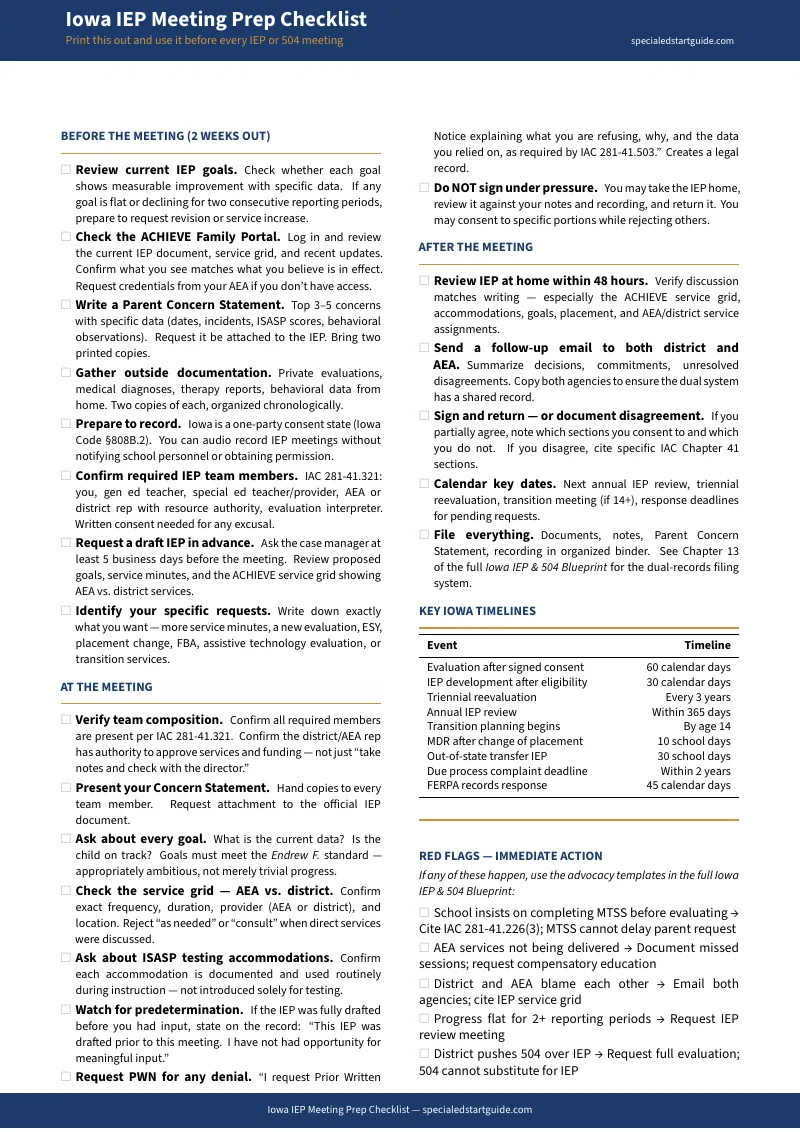
What to say when the team tells you your child is "making progress" but the data shows otherwise. What to say when they offer a 504 instead of an IEP. What to say when the AEA representative claims they "don't have staff" for your child's therapy sessions. Each script cites the Iowa Administrative Code section or IDEA provision that supports your position — so you're not arguing opinions, you're citing law. The pre-meeting checklist covers one-party recording consent (Iowa Code §808B.2), team composition verification under IAC 281-41.321, and the specific documents to bring.
The Early ACCESS Transition Survival Guide
When your child turns three, Early ACCESS home-based services end and the school district takes over — often with dramatically reduced services or an outright denial of special education eligibility. Parents describe this as falling off a cliff. The Blueprint maps the exact transition timeline, explains why school-based eligibility criteria differ from medical diagnoses under Iowa's noncategorical model, and provides specific arguments for demonstrating that therapies your child received under Part C remain educationally necessary under Part B.
The Rural Iowa Strategy Guide
If you live in a district served by Prairie Lakes AEA, Green Hills AEA, or any rural region where the nearest pediatric neuropsychologist is a two-hour drive and the AEA SLP covers six districts — the Blueprint addresses your reality specifically. Demand letters for compensatory education when services go undelivered, strategies for requesting telehealth delivery, and tactics for leveraging the AEA's obligation to provide services regardless of funding shortfalls under Iowa Code §257.10(7).
The Dual-Records Protocol
Iowa's split system creates a records trap that catches most parents. The AEA maintains evaluation reports, therapy logs, and psychological assessments. The district maintains the permanent transcript, attendance records, and disciplinary files. If you request records only from the principal, you'll get grades and attendance — but not the underlying AEA evaluations that actually drive your child's services. The Blueprint provides the exact dual-request procedure to get your child's complete file from both agencies simultaneously.
The Iowa Dispute Resolution Roadmap
When advocacy fails, you have three formal options in Iowa: filing a state complaint with the DOE, requesting mediation, or filing for a due process hearing. Iowa also offers a unique AEA Resolution Facilitator process — a less adversarial step that most parents don't know exists. The Blueprint explains when each option is appropriate, the timeline and costs involved, and how the paper trail you've been building with the advocacy templates becomes the evidence that wins your case.
Who This Blueprint Is For
- Parents whose child is turning three and Early ACCESS is ending — and who need to know exactly how to prevent therapy gaps when the school district takes over
- Parents stuck in the MTSS data-collection loop while their child falls further behind — and who need the legal citation to force a formal evaluation immediately
- Parents in the Des Moines metro served by Heartland AEA, the Cedar Rapids corridor served by Grant Wood AEA, or the Quad Cities served by Mississippi Bend AEA — where evaluations are backlogged and meetings keep getting rescheduled
- Parents in rural Iowa — served by Prairie Lakes, Green Hills, Northwest, or Great Prairie AEA — where the AEA specialist covers multiple districts and your child's therapy sessions keep getting canceled because there is no replacement provider
- Parents who've been told their child "doesn't qualify" despite holding a medical diagnosis — and who need to understand Iowa's noncategorical "Eligible Individual" model and the 3-prong test that actually determines eligibility
- Parents navigating the 504-to-IEP question — unsure whether their child's current plan is legally sufficient or whether they should push for a full special education evaluation
- Parents whose child is approaching 10 cumulative days of suspension — and nobody mentioned a Manifestation Determination Review or the behavioral protections under IAC 281-41.530
- Military families at Camp Dodge or moving to Iowa from another state — navigating Iowa's unique noncategorical system after a transfer from a state that uses disability labels
- Parents preparing for their first IEP meeting who don't want to walk in blind against a team that does this every day
Why Not Just Use the Free Resources?
Iowa has legitimate free special education resources. The ASK Resource Center provides training and family support specialists. Disability Rights Iowa publishes legal guides. The Iowa DOE distributes procedural safeguards. Here's why parents still struggle after consulting all of them:
- The ASK Resource Center is fragmented, not synthesized. ASK provides excellent webinars, individual fact sheets, and access to family support specialists. But finding exactly what you need requires clicking through dozens of disconnected web pages, downloading separate PDFs, and piecing the strategy together yourself. And ASK's specialists — managing thousands of cases across the entire state on grant funding — cannot provide the immediate, personalized tactical help you need at 9 PM the night before an emergency IEP meeting.
- The Iowa Procedural Safeguards Manual protects the state, not you. The official manual is a dense, bureaucratic PDF that outlines the strict letter of IAC Chapter 41. It tells you the right to request an Independent Educational Evaluation exists. It provides absolutely zero instruction on how to write that request, when to submit it for maximum leverage, or what to do when the AEA ignores it. It is designed to prove parents were formally informed of their rights — not to teach parents how to use them.
- Disability Rights Iowa focuses on severe violations, not daily advocacy. DRI handles systemic civil rights violations, institutional abuse, and formal litigation. Their resources are legally precise and clinically helpful — but they are not designed for the parent who needs to know exactly what to say at Tuesday morning's annual IEP review or how to challenge a vague 504 accommodation list.
- Etsy and TPT planners organize paperwork — they don't enforce rights. A pastel IEP binder helps you sort documents. It won't explain Iowa's AEA-district dual system, won't warn you about the dual-records trap, won't cite IAC Chapter 41, and won't teach you how to bypass the MTSS delay tactic. Generic federal templates miss every Iowa nuance that actually determines your outcome.
The free resources explain what the law says. The Blueprint gives you the tools to make the district and AEA follow it.
— Less Than 6 Minutes of an Iowa Special Education Advocate
Independent special education advocates in Iowa charge $150–$200 per hour. Attorneys charge $300–$500 per hour with retainers exceeding $5,000. Even if you eventually need professional help, the meticulous paper trail you build with this Blueprint saves thousands in billable hours — because you're handing your advocate an organized case, not a shoebox of unsigned IEP copies and half-remembered conversations from meetings you didn't record.
Your download includes the complete Blueprint guide plus standalone printable PDFs — every template, worksheet, script, and reference card, ready to print and bring to your next meeting.
- Complete Blueprint Guide — 14 chapters covering the Iowa special education landscape, IEP vs. 504, evaluations and the MTSS trap, IEP components and the ACHIEVE service grid, meeting preparation and recording rights, the AEA-district dual system and escalation chain, rural Iowa strategies, Early ACCESS transition, Independent Educational Evaluations, dispute resolution, 504 Plans, special considerations (transition, ESY, discipline, ESAs), the dual-records protocol, and the Iowa resource directory
- IEP Meeting Prep Checklist — the before/during/after checklist with Iowa timelines, IAC Chapter 41 citations, team composition requirements, and red flags requiring immediate action
- Advocacy Letter Templates — copy-paste letters citing exact IAC Chapter 41 sections for evaluation requests, MTSS bypass, Prior Written Notice demands, AEA escalation, IEE requests, dual records requests, compensatory education demands, and meeting follow-ups
- Iowa Timeline Cheat Sheet — every legal deadline on one page: 60-day evaluation, annual review, triennial reevaluation, transition at 14, MDR triggers, due process filing windows, and FERPA response deadlines
- IEP Meeting Scripts — word-for-word responses for common school and AEA pushback tactics, each citing the specific Iowa code or IDEA section that supports your position
- AEA-District Accountability Map — who does what, who to contact, and the escalation chain when both agencies point fingers
- Dispute Resolution Roadmap — your formal options when advocacy fails: DOE state complaint, mediation, AEA Resolution Facilitator, and due process hearing — with a side-by-side comparison
- Goal-Tracking Worksheet — printable log to monitor IEP goal progress between annual reviews, with red flags that trigger immediate escalation
- Service Delivery Tracking Log — weekly session log to document delivered and missed AEA and district services — the evidence Iowa hearing officers require for compensatory education claims
Instant PDF download. Print the templates tonight. Walk into tomorrow's meeting with Iowa law on your side.
Money-back guarantee, no time limit. If the Blueprint doesn't change how you approach IEP meetings in Iowa, email us for a full refund. No questions asked.
Not ready for the full Blueprint? Download the free Iowa IEP Meeting Prep Checklist — a printable pre-meeting checklist with Iowa timelines, IAC Chapter 41 citations, team composition requirements, and the red flags that require immediate action. It's enough to walk into your next meeting prepared, and it's free.
Your child's education is a legal right, not a favor the district grants. The AEA and district know Iowa law. After tonight, so will you.