Your Child's IEP Services Were Cut. The District Blames the AEA. The AEA Blames the District. Nobody Is Fixing It.
You already know something is wrong. The IEP says 30 minutes of speech therapy twice a week, but the AEA speech-language pathologist who used to come to your school left six months ago and nobody replaced her. The district evaluated your child in four months instead of the 60 calendar days required by Iowa law and declared them ineligible — even though your child struggles through every school day. You asked for an Independent Educational Evaluation and the district said no. You pushed back at the IEP meeting and five district employees plus two AEA consultants presented a pre-written IEP and gave you 20 minutes to sign. Your child was suspended for behavior caused by the disability the district refuses to address — and nobody mentioned a Manifestation Determination Review before it happened.
Iowa is different from every other state. Your child's special education services are delivered through a dual-employer system where the local school district holds legal liability for FAPE but the regional Area Education Agency (AEA) employs the speech therapists, school psychologists, and occupational therapists who actually provide the services. When something goes wrong, you face a jurisdictional maze. The district blames the AEA for staffing shortages. The AEA blames the district for failing to contract adequate services. Your child falls through the gap while two bureaucracies point fingers.
And it just got worse. In 2024, House File 2612 restructured how Iowa funds special education — shifting money from AEAs to districts and triggering the departure of 429 AEA employees statewide. Heartland AEA dropped from 750 to 600 staff. Central Rivers lost 60 employees. These are the therapists and psychologists who were supposed to be serving your child. If you live in rural Iowa where the nearest independent advocate is two counties away and a special education attorney requires a $5,000 retainer, you need the tools to fight this yourself.
The Iowa IEP & 504 Advocacy Playbook is the AEA Accountability System — the tactical toolkit that turns overwhelmed parents into effective advocates by providing the exact dispute letters, escalation procedures, and paper trail protocols grounded in Iowa Administrative Code Chapter 41, HF 2612, and federal IDEA that force both the district and the AEA to respond on the record.
What's Inside the Playbook
The Fill-in-the-Blank Dispute Letter Library
Every letter cites the exact Iowa regulation. Demand an Independent Educational Evaluation at public expense — using the specific legal language under IAC 281-41.308 and 34 CFR §300.502 that triggers the district's obligation to either fund the IEE or file for due process to defend the AEA's evaluation. Request Prior Written Notice for every denial — because the district is required under IAC 281-41.503 to explain in writing what they refused, why, what data they relied on, and what alternatives they considered. Document service non-delivery with the specific timeline citations that prove the IEP was violated. These are not generic federal templates — they cite the Iowa Administrative Code Chapter 41 provisions that Iowa DOE compliance investigators check during state complaint investigations.
The District-AEA Accountability Framework
In every other state, parents know who to hold responsible: the district. In Iowa, responsibility is split between the district (legal liability) and the AEA (service delivery). When your child's speech therapy stops, you need to know whether the district failed to submit a service request or the AEA failed to staff the position. The Playbook maps the accountability chain, explains who is responsible at each step under the post-HF 2612 fee-for-service model, and provides dual-addressed demand letters that force both the district superintendent and the AEA regional director to respond — ending the deflection loop.
The HF 2612 Reform Navigation Guide
The 2024 AEA reform shifted special education funding from AEAs to districts, created a fee-for-service contracting model, and transferred oversight duties to the Iowa DOE. The Playbook explains exactly how these changes affect your child's IEP, how to audit the ACHIEVE portal to verify whether mandated services are actually being delivered, and how to challenge service reductions that resulted from the funding transition. When the district says "we can't get an OT out here because of the AEA changes," the Playbook gives you the legal language to remind them that a funding restructure does not eliminate a FAPE obligation.
The Rural Iowa Service Gap Strategy
When your child's school in rural northwest Iowa, southwest Iowa, or the small districts served by Prairie Lakes, Green Hills, or Northwest AEA says there is no speech therapist, OT, or behavior analyst available — federal law still requires the service. The Playbook includes demand letters for compensatory education, private provider funding, and telehealth authorization when the AEA cannot staff the services your child's IEP requires. A school that "can't get a therapist out here" is still legally obligated to provide the service — and this Playbook teaches you exactly how to force compliance.
The Paper Trail System
In Iowa due process hearings, the burden of proof rests on the party seeking relief — which is almost always the parent. You must prove by a "preponderance of the evidence" that FAPE was denied. Without a documented paper trail, you lose. The Playbook includes communication logs, follow-up email templates for every verbal conversation, ACHIEVE portal audit checklists, and a systematic documentation protocol that builds the evidence Iowa hearing officers require.
The Manifestation Determination Prep Kit
When a student with a disability is removed from placement for more than 10 cumulative school days, the district must conduct a Manifestation Determination Review within 10 school days. Iowa is a one-party consent state — you may legally record meetings without the school's permission under Iowa Code §808B.2. The Playbook walks you through MDR preparation, FBA demand templates, and how to report improper restraint or seclusion incidents.
The State Complaint Filing Guide
An Iowa DOE State Complaint is free, does not require an attorney, and frequently produces faster results than due process. You file with the Iowa Department of Education, Bureau of Learner Strategies and Supports, Grimes State Office Building, 400 E 14th Street, Des Moines, IA 50319. The DOE has 60 calendar days to investigate. The Playbook explains which violations are best suited for state complaints versus mediation versus due process, how to frame the complaint for maximum impact, and the common mistakes that result in dismissed complaints.
The Dispute Escalation Ladder
Iowa eliminated AEA Mediation in late 2024. Parents must now jump directly from IEP table disagreements into formal State Mediation, Due Process, or State Complaints. The Playbook maps every escalation path with Iowa-specific timelines, explains the strategic advantages of each option, and provides templates for each stage — so you choose the right tool for the right violation instead of defaulting to the most expensive option.
Who This Playbook Is For
- Parents in Des Moines, Cedar Rapids, Iowa City, or the Quad Cities dealing with district bureaucracy — pre-written IEPs, denied evaluations, revolving-door staff, and IEP meetings that feel like ambushes
- Parents in rural Iowa whose children's IEP services go undelivered because the AEA cannot staff speech therapists, OTs, or behavior analysts after the HF 2612 restructuring
- Parents caught in the district-AEA finger-pointing loop — where the district blames the AEA for missing services and the AEA blames the district for inadequate service requests
- Parents whose child was denied special education eligibility despite clear struggles — and who need to challenge the evaluation or request an IEE at public expense
- Parents facing disciplinary action — suspensions, alternative placements, restraint incidents — who need to understand Manifestation Determination Reviews and their procedural protections
- Parents navigating the aftermath of HF 2612 — service reductions, AEA staff departures, and confusion about who is now responsible for what
- Parents who earn too much for free legal aid and not nearly enough for a $200/hour advocate — the massive middle market that current resources leave behind
Why Not Just Use the Free Resources?
Iowa has valuable free advocacy resources. The ASK Resource Center provides parent training. Disability Rights Iowa publishes AEA reform guidance. The Iowa DOE provides procedural safeguards manuals. Here's why parents still lose disputes after consulting all of them:
- ASK is collaborative, not tactical. As Iowa's federally funded Parent Training and Information Center, ASK maintains a posture of institutional neutrality — their stated goal is "healthy relationships between families and schools." That approach works when partnership works. When partnership fails — when the district presents a pre-written IEP and gives you 20 minutes to sign — ASK does not provide the fill-in-the-blank dispute letter that cites IAC 281-41.503 to demand Prior Written Notice. Their format is informational, not operational.
- Disability Rights Iowa triages by severity. As the state's Protection and Advocacy agency, DRI must prioritize the most severe cases — abuse, systemic failures, civil rights violations. If your child's services are being quietly eroded rather than dramatically denied, you may wait months for individualized help. You cannot afford to wait while the statute of limitations runs.
- The Iowa DOE complaint forms are blank canvases. The state's "Model Form: IDEA State Complaint" asks you to list facts and alleged violations without any coaching, structure, or suggested language. It does not tell you how to build a compelling legal narrative that will trigger a favorable investigation. It is a blank piece of paper.
- Wrightslaw covers federal IDEA — not Iowa Admin Code Ch. 41. Wrightslaw is the gold standard for federal special education law. It does not address Iowa's dual-employer AEA system, the HF 2612 funding transition, or how Iowa hearing officers interpret burden of proof. Federal citations are useful; Iowa-specific citations tell the district you know their playbook.
- Private advocates cost $150–$200 per hour. Special education attorneys charge $200–$500. A due process case can exceed $10,000. Most Iowa families cannot afford this — especially in rural counties where there may be no local advocate at all.
The free resources explain what Iowa law says. This Playbook gives you the dispute tools to make the district and AEA comply.
— Less Than One Hour of a Special Education Advocate
Private advocates in Iowa charge $150–$200 per hour. Educational attorneys run $200–$500. A single consultation to review your situation costs more than this entire Playbook. The Playbook gives you the dispute letters, escalation procedures, and documentation system that advocates use — so you can either handle the dispute yourself or arrive at a paid consultation with an organized case file that saves hundreds in billable hours.
Your download includes the complete Advocacy Playbook guide plus standalone printable PDFs — every dispute letter template, escalation checklist, and reference card, ready to print and use tonight.
- Complete Advocacy Playbook Guide — 13 chapters covering your legal foundation and procedural safeguards, the evaluation battle, building and enforcing the IEP, navigating HF 2612 and the AEA reform, IEP meeting strategies, Iowa-specific advocacy issues, discipline protections and manifestation determinations, dispute resolution, evidence collection and documentation, working with advocates and Iowa organizations, advocacy letter templates, and your 90-day action plan
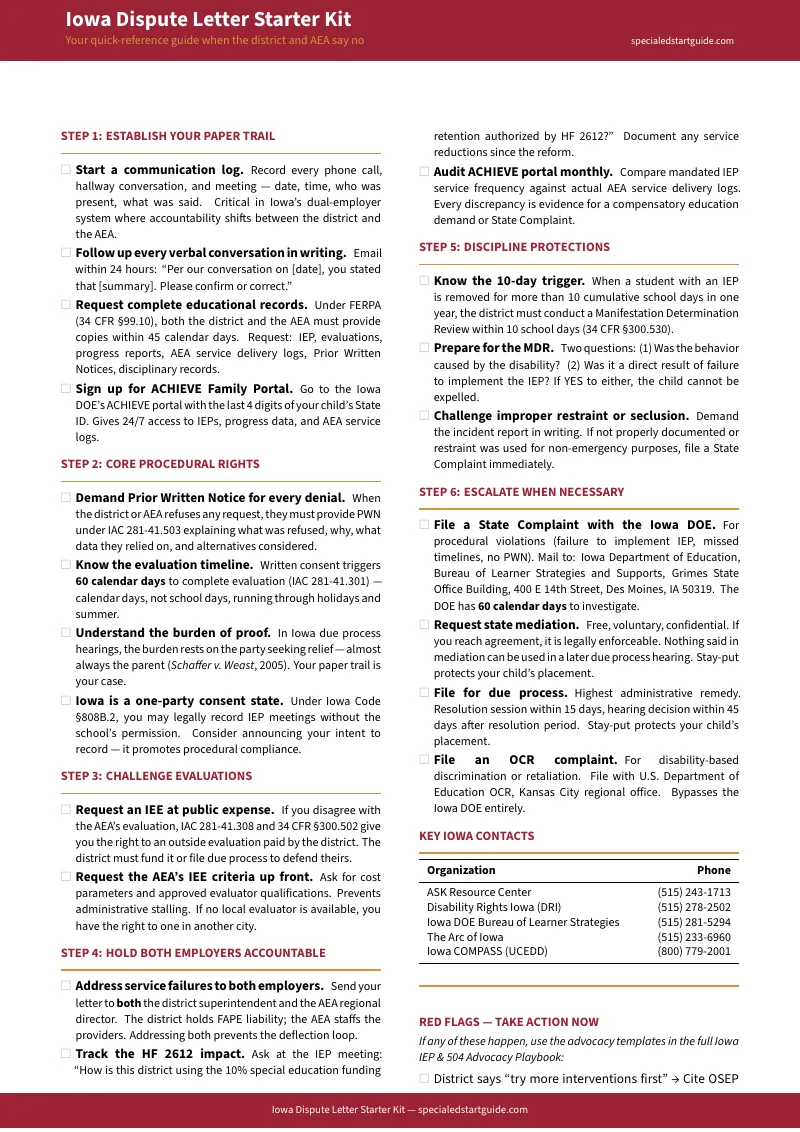
- Iowa Dispute Letter Starter Kit — the quick-reference checklist covering paper trail setup, core procedural rights, evaluation challenges, district-AEA accountability, discipline protections, service tracking, and escalation procedures with key Iowa timelines and IAC Chapter 41 citations
- Advocacy Letter Templates — fill-in-the-blank letters citing exact IAC 281-41 regulations for IEE demands, Prior Written Notice requests, service non-delivery documentation, AEA staffing demands, and formal disagreements
- State Complaint Template — structured Iowa DOE complaint filing template with required elements, evidence attachment guide, and filing instructions
- Communication Log — printable documentation tracker for every call, meeting, and conversation — the systematic paper trail that wins cases
- MDR Preparation Checklist — step-by-step Manifestation Determination Review preparation including the two legal questions, FBA demand templates, and restraint/seclusion reporting
- Dispute Escalation Ladder — visual roadmap from IEP table disagreement through state complaint, mediation, due process, and OCR complaint — with Iowa-specific timelines at every stage
- AEA Accountability Map — the dual-employer accountability chain showing district vs. AEA responsibilities under the post-HF 2612 fee-for-service model
Instant PDF download. Print the dispute letter that matches your situation tonight. Send it tomorrow morning.
Money-back guarantee, no time limit. If the Playbook doesn't change how you handle disputes with the district and AEA, email us for a full refund. No questions asked.
Not ready for the full Playbook? Download the free Iowa Dispute Letter Starter Kit — a printable quick-reference guide covering paper trail setup, core procedural rights, evaluation challenges, district-AEA accountability, discipline protections, service tracking, and escalation steps with key Iowa timelines and IAC Chapter 41 citations. It's enough to start building your case tonight, and it's free.
Your child's education is a legal right — and when the district and AEA violate it, Iowa law gives you the tools to fight back. This Playbook puts those tools in your hands.