The School Knows Article 7. After Tonight, So Will You.
You walked into that Case Conference Committee meeting as prepared as you could be. You downloaded the IDOE's 100-page Navigating the Course companion guide. You printed the Procedural Safeguards notice. You even called IN*SOURCE's helpline — and they were kind, and knowledgeable, and unable to call you back before your meeting because their regional liaisons are stretched across the entire state.
So you sat across from six school corporation employees — the Teacher of Record, the Teacher of Service, the school psychologist, the general education teacher, the LEA representative, and the speech-language pathologist — and they used Indiana acronyms you'd never heard before. CCC. MTSS. PLAAFP. Article 7. They smiled. They said your child was "making progress." They recommended keeping everything the same because the data "supports current services." And you didn't know enough to challenge a single word of it.
You left with the same IEP your child walked in with. No additional minutes. No new evaluations. No Prior Written Notice explaining why they refused your requests — because you didn't know to demand one.
The problem isn't that you lack effort. The problem is that Indiana's special education system is engineered for professionals, not parents. More than 289 school corporations — from the gatekeeping-prone affluent suburbs of Carmel Clay, Hamilton Southeastern, and Zionsville, to the resource-strained IPS schools in Indianapolis, to the rural cooperatives where a single speech therapist covers five buildings — and not a single one publishes fill-in-the-blank templates for the parent sitting alone at the table.
The Indiana IEP & 504 Blueprint is the Article 7 enforcement toolkit that bridges the gap between knowing your rights exist and actually exercising them — with every template, script, and checklist grounded in Indiana's 511 IAC Article 7 and state statute.
What's Inside the Blueprint
The Copy-Paste Advocacy Letter Library
Every letter cites the exact Indiana statute. Request an evaluation under 511 IAC 7-40-5 and start the school corporation's 50-instructional-day clock. Demand Prior Written Notice when the CCC refuses anything — because without it, their refusal isn't documented and your paper trail has a hole. Request an Independent Educational Evaluation at public expense when you disagree with the school psychologist's assessment. These aren't generic IDEA samples — they're Indiana-specific enforcement tools that reference Article 7 by section number and create a legally binding record the moment you hit send.
The 50-Instructional-Day Timeline Decoder
Indiana's evaluation timeline is unique in the nation — and schools exploit the ambiguity constantly. Fifty instructional days means any day students are expected to attend. Weekends don't count. Snow days don't count. Winter break, spring break, and summer recess don't count. A referral submitted in late November may not result in a completed evaluation until February or March. The Blueprint maps every deadline, explains exactly which days are excluded, and gives you the exact language to send when the school corporation blows past the 50-day limit — or tries to stretch it by starting the clock late.
The Voucher Trap Warning — School Choice and the CSEP
Indiana's universal Choice Scholarship program lets families send their child to a participating private school with a state-funded voucher. What nobody tells you: when a student with an IEP accepts a voucher, they forfeit federal IDEA protections. No more Free Appropriate Public Education guarantee. No more federal due process rights. The legally binding IEP is replaced by a skeletal Choice Scholarship Education Plan (CSEP) that the private school can modify unilaterally. The Blueprint is the only low-cost resource that explicitly breaks down what you lose, what you keep, and how to make an informed decision before your child's rights disappear.
The MTSS/RTI Bypass Strategy
Schools across Indiana use the Multi-Tiered System of Supports as a legitimate framework — and as a delay tactic. "Let's finish Tier 2 first." "We need to see more data." "Interventions take time." Here's what they're not telling you: under Indiana law, a parent's written evaluation request triggers the 50-instructional-day clock regardless of where the child sits in the MTSS tiers. The school corporation cannot use MTSS to delay or deny an evaluation. The Blueprint gives you the exact letter to send that forces the clock to start — citing 511 IAC 7-40-5 — and explains your options when the school tries to run the clock anyway.
CCC Meeting Scripts and Checklists
What to say when the team tells you your child is "making progress" but the data shows otherwise. What to say when they offer a 504 instead of an IEP. What to say when the LEA representative claims the school corporation "doesn't have the resources" for the services your child needs. Each script cites the Indiana statute or Article 7 rule that proves them wrong — so you're not arguing opinions, you're citing law. The pre-meeting checklist covers Indiana's one-party recording consent law (IC 35-33.5-5-5), CCC team composition verification under Article 7, and the specific documents to bring.
The Behavioral Crisis Toolkit
When a child faces suspension for behavior caused by their disability, Article 7 triggers specific protections. The Blueprint covers Functional Behavioral Assessment requirements, Behavior Intervention Plans, the Manifestation Determination Review process when suspensions exceed 10 cumulative days, Indiana's restraint and seclusion reporting mandates, and your rights when the school attempts shadow-suspensions — sending children home without documentation to avoid triggering an MDR.
Transition Planning — Starting at Age 14 in Indiana
Indiana requires transition services beginning no later than the first CCC meeting after a student turns 14 — earlier than the federal age-16 minimum. The Blueprint maps the exact Indiana requirements, explains what should be in the transition IEP, and gives you the language to demand age-appropriate transition assessments, post-secondary goal development, and community agency referrals.
Goal-Tracking Worksheets
IEP goals are legally required to be measurable — with baselines, targets, and mastery criteria meeting the Endrew F. standard. But many goals are written so vaguely that progress is impossible to track. The worksheets give you a structured format to log data between meetings, compare school-reported progress against your own observations, and arrive at the annual review with documentation that either confirms the program is working or proves it isn't.
The Dispute Resolution Roadmap
When advocacy fails, you have three formal options in Indiana: filing a formal complaint with the IDOE, requesting mediation through the IDOE, or filing for a due process hearing. The Blueprint explains when each option is appropriate, the timeline and costs involved, and how the paper trail you've been building with the advocacy templates becomes the evidence that wins your case — or convinces the school corporation to settle before you ever reach a hearing.
Who This Blueprint Is For
- Parents preparing for their first Case Conference Committee meeting who don't want to walk in blind against a table of administrators who do this every day
- Parents whose child has been stuck in MTSS "interventions" for months with no formal evaluation — and who need the legal language to force the 50-instructional-day clock to start
- Parents in Carmel, Fishers, HSE, Zionsville, or other affluent suburban corporations dealing with well-resourced districts that deploy aggressive gatekeeping on eligibility and services
- IPS parents navigating a system plagued by staff turnover, outsourced behavioral programs, and institutional instability — who need documentation templates to force compliance
- Rural parents who depend on special education cooperatives where a single specialist serves five buildings and evaluations are stretched to their statutory limits
- Parents considering the Indiana Choice Scholarship who need to understand exactly what federal rights their child loses when moving from an IEP to a CSEP
- Parents whose child was suspended and facing alternative placement — but the behavior is clearly tied to the disability and nobody mentioned a Manifestation Determination Review
- Parents navigating the 504-to-IEP question — unsure whether their child's current plan is legally sufficient or whether they should push for a full special education evaluation
Why Not Just Use the Free Resources?
Indiana has legitimate free special education resources. The IDOE publishes Navigating the Course. IN*SOURCE operates a statewide helpline. About Special Kids provides peer support. Here's why parents still struggle after consulting all of them:
- IDOE's Navigating the Course protects the state, not you. It is over 100 pages of dense bureaucratic prose written to explain Article 7 rules without telling you how to enforce them. It tells you that you have procedural rights. It does not give you the pre-written email to send tonight citing those rights. For a parent in crisis, the gap between understanding a right and exercising it is the gap between winning and losing at the CCC table.
- IN*SOURCE is structurally neutral. As Indiana's federally funded Parent Training and Information Center, IN*SOURCE provides warm support and process flowcharts. Their mandate is to bridge the gap between parents and schools — not to arm you with adversarial legal templates. They can educate. They cannot give you the aggressive letter to send when the school refuses to evaluate.
- About Special Kids supports — they don't enforce. ASK is a peer support network, not a legal advocacy toolkit. When your CCC meeting is tomorrow morning, a community support group doesn't give you the Article 7 citation you need to demand Prior Written Notice.
- Etsy and TPT planners organize paperwork — they don't enforce rights. A pastel IEP binder helps you sort documents. It won't explain the 50-instructional-day evaluation timeline, the CSEP voucher trap, or why Indiana says "Case Conference Committee" instead of "IEP Team." Generic federal templates miss every Indiana nuance that actually determines your outcome.
The free resources explain what the law says. The Blueprint gives you the tools to make the school corporation follow it.
— Less Than 3 Minutes of a Special Education Advocate
Special education advocates in Indiana charge $100–$300 per hour. Attorneys require retainers starting at $5,000 and bill $250–$500 per hour. Even if you eventually need professional help, the meticulous paper trail you build with this Blueprint saves thousands in billable hours — because you're handing your advocate an organized case, not a shoebox of unsigned IEP copies and half-remembered conversations.
Your download includes the complete Blueprint guide plus standalone printable PDFs — every template, worksheet, script, and reference card, ready to print and bring to your next meeting.
- Complete Blueprint Guide — 14 chapters covering the Indiana special education landscape, IEP vs. 504 decisions, the evaluation process and 50-instructional-day timeline, CCC meeting preparation and advocacy, writing strong IEP goals, services and accommodations, MTSS bypass strategies, behavioral supports and discipline protections, transition planning at age 14, the school choice voucher trap, dispute resolution, copy-paste advocacy letter templates, documentation strategies, and an Indiana resource directory
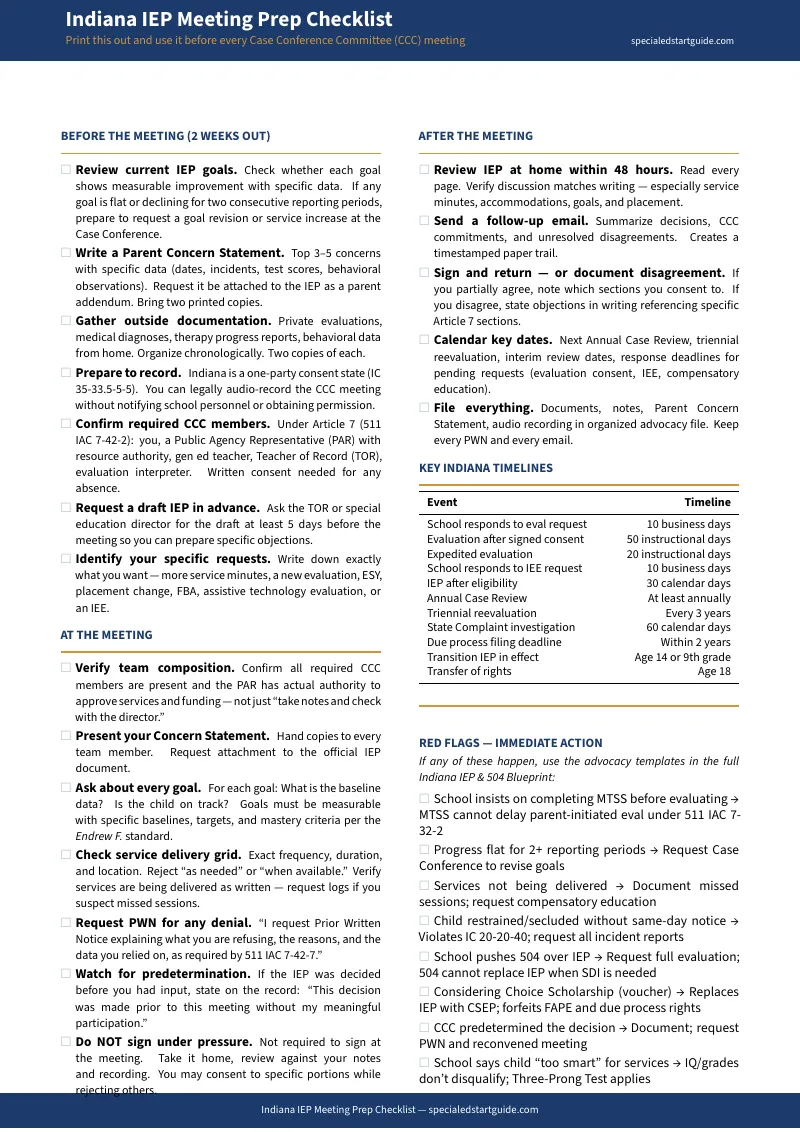
- IEP Meeting Prep Checklist — the before/during/after checklist with Indiana timelines, CCC team composition requirements under Article 7, one-party recording consent law, and red flags that require immediate action
- Advocacy Letter Templates — copy-paste letters citing exact Article 7 provisions for evaluation requests, IEEs, Prior Written Notice demands, service delivery log requests, FBA requests, and addendum meetings
- Goal-Tracking Worksheet — structured fillable worksheet for measurable progress monitoring between annual reviews
- Indiana Timeline Cheat Sheet — every legal deadline on one page: 50-instructional-day evaluation, 10-school-day response, annual reviews, triennial reevaluation, and due process filing windows
- CCC Meeting Scripts — word-for-word responses to common school corporation pushback tactics, each citing the specific Article 7 rule or Indiana statute
- Accommodation Reference Card — classroom accommodations table plus the ILEARN statewide testing accessibility checklist
- Dispute Resolution Roadmap — your three formal options when advocacy fails: IDOE formal complaint, mediation, and due process hearing — with a side-by-side comparison table
Instant PDF download. Print the templates tonight. Walk into tomorrow's CCC meeting with Article 7 on your side.
Money-back guarantee, no time limit. If the Blueprint doesn't change how you approach Case Conference Committee meetings in Indiana, email us for a full refund. No questions asked.
Not ready for the full Blueprint? Download the free Indiana IEP Meeting Prep Checklist — a printable pre-meeting checklist with Indiana timelines, CCC team composition requirements, and the red flags that require immediate action. It's enough to walk into your next meeting prepared, and it's free.
Your child's education is a legal right, not a favor the school corporation grants. The school knows Article 7. After tonight, so will you.