
115 School Districts. An $82 Million Funding Gap. Zero Generic Guides That Work Here.
You walked into that IEP meeting prepared — or you thought you did. You read the procedural safeguards notice from the Idaho SDE. You printed the IPUL workshop handout. You wrote down your concerns. And then the team smiled, used acronyms you'd never heard before, and told you your child "doesn't qualify" or that services "aren't available in our district."
You left the meeting with the same IEP your child walked in with. No additional minutes. No new evaluations. No Prior Written Notice explaining why they refused your requests — because you didn't know to ask for one.
The problem isn't that you're uninformed. The problem is that Idaho's special education system operates under pressures that no national guide can prepare you for. A state with an estimated $82.2 million funding gap in special education — where the funding formula assumes 6% of students need services when the real number is 11%. Where 115 school districts range from the state's largest — West Ada, with reports of 40% teacher turnover at some schools — to frontier districts where a single school psychologist covers multiple counties. Where over 1,005 teachers operate on alternative authorizations and 172 hold emergency provisional certificates, meaning your child's special education teacher may not have a special education degree. Where the 2024/2025 update to Idaho's Specific Learning Disability criteria fundamentally changed who qualifies for an IEP — and most parents don't know it happened.
The Idaho IEP & 504 Blueprint is the tactical enforcement toolkit that bridges the gap between knowing your rights and actually exercising them — with every template, script, and checklist grounded in IDAPA 08.02.03, the Idaho Special Education Manual, and Idaho Code Title 33 Chapter 20.
What's Inside the Blueprint
The Copy-Paste Advocacy Letter Library
Every letter cites the exact Idaho regulation or federal provision. Request a comprehensive evaluation and start the district's 60-calendar-day clock. Demand an Independent Educational Evaluation at public expense when you disagree with the school's assessment. File a formal State Administrative Complaint with the Idaho SDE when services aren't being delivered. Challenge a denial based on outdated eligibility criteria using the 2024/2025 SLD rule changes. These aren't generic samples — they're Idaho-specific enforcement tools that create a legally binding paper trail the moment you hit send.
The 2024/2025 SLD Criteria Translator
Idaho recently changed how students qualify for Specific Learning Disability services. The old severe discrepancy model — requiring a gap between IQ and achievement — can no longer be the sole basis for denial. Students now qualify by showing insufficient progress to evidence-based instruction OR a pattern of strengths and weaknesses in psychological processing. If your child was denied an IEP in the past, the rules have changed. The Blueprint translates the new criteria into plain English and gives you the re-evaluation request letter to send tonight.
The 60-Calendar-Day Timeline Enforcer
Once you sign consent for evaluation, Idaho's 60-calendar-day clock starts running — continuously, including summer and school breaks. Districts that miss this deadline are in violation. The Blueprint maps every milestone within that timeline, provides deadline-tracking tools, and includes the letter template for when the school misses the clock — because a deadline that exists only in regulation doesn't enforce itself.
IEP Meeting Scripts and Checklists
What to say when the team tells you your child is "doing fine" but the data shows otherwise. What to say when they offer a 504 instead of an IEP. What to say when the district claims staffing shortages prevent service delivery. What to say when they insist RTI must be completed before they'll evaluate. Each script cites the Idaho regulation or federal provision that proves them wrong — so you're not arguing opinions, you're citing law. The pre-meeting checklist covers Idaho's one-party consent recording rights under Idaho Code § 18-6702(2)(d), team composition verification, and the specific documents to bring.
The Three-Prong Test Navigator
Idaho uses a strict Three-Prong Test for IEP eligibility: (1) the student meets criteria for one of Idaho's 13 disability categories, (2) the disability has an adverse effect on educational performance, and (3) the student requires specially designed instruction. Schools frequently weaponize prong two — claiming the child is "doing fine" based on inflated grades while ignoring assessment data that tells a different story. The Blueprint breaks down each prong with the exact questions to ask and the data to demand.
Goal-Tracking Worksheets
Structured fillable worksheets that track progress on every IEP goal between annual reviews. Compare school-reported data against your own observations. Idaho schools report progress concurrent with report cards — typically every nine weeks. Arrive at the next meeting with documentation that either confirms the program is working or proves it isn't — and feeds directly into your compensatory education argument.
The Dispute Resolution Roadmap
When informal advocacy fails, you have three formal options in Idaho: filing a State Administrative Complaint with the Idaho SDE (60-day investigation timeline), requesting mediation or facilitation through the SDE at no cost, or filing for a due process hearing before an impartial hearing officer. The Blueprint explains when each option is appropriate, the timeline and procedures involved, how to prepare your evidence, and how the paper trail you've been building with the advocacy templates becomes the evidence that wins your case.
Who This Blueprint Is For
- Parents preparing for their first IEP meeting who need to understand Idaho's Three-Prong Test, the 60-calendar-day evaluation timeline, and what to demand at the table
- Parents whose child was denied an IEP under the old SLD criteria — and who need to request a re-evaluation under Idaho's 2024/2025 rule changes
- Parents in rural and frontier districts where staffing shortages mean services are delivered by uncertified substitutes, itinerant therapists, or not delivered at all
- Parents whose child is missing mandated services — and who need to document the gap and pursue compensatory education
- Families in the Boise metro and West Ada navigating constant teacher turnover and having to re-explain their child's complex IEP to a rotating cast of new staff
- Military families at Mountain Home Air Force Base navigating IEP transfers under Idaho's 5-school-day intrastate determination timeline
- Parents navigating charter school or virtual school IEP obligations — and who need to understand proportionate share funding and Child Find duties
- Parents navigating the 504-to-IEP question — unsure whether their child's current plan is legally sufficient or whether they should push for a full evaluation
- Parents transitioning a child from Part C early intervention to Part B preschool services at age 3
Why Not Just Use the Free Resources?
Idaho has useful free special education resources. Idaho Parents Unlimited (IPUL) runs workshops. The SDE publishes the Idaho Special Education Manual. Disability Rights Idaho handles severe cases. Here's why parents still struggle after consulting all of them:
- IPUL provides training, not tools for the table. IPUL is Idaho's federally funded Parent Training and Information Center and they do valuable work — workshops, webinars, quarterly training sessions. But IPUL's advocacy philosophy is grounded in "collaborative advocacy" — relationship-strengthening strategies designed for well-functioning teams. When the school has already decided to deny your child services, when the district is managing special education with a "business mindset" to protect test scores, or when your child is being threatened with SRO involvement for disability-related behavior — collaboration has already failed. And IPUL's sample letters are provided as locked, non-editable PDFs. You cannot copy, paste, customize, and email them to a principal without retyping the entire document.
- The SDE Manual protects the district, not you. The Idaho Special Education Manual exceeds 300 pages. The state's official tip for finding information in it is to "hit Ctrl+F." It is written by compliance officers for compliance officers — not for a parent sitting at the kitchen table at 11 PM trying to figure out how to respond to a denial. There are no downloadable parent templates, no referral letter samples, no compensatory education tracking tools. It tells you what the law requires. It does not tell you what to do when the school ignores the law.
- Disability Rights Idaho handles catastrophic cases, not everyday advocacy. DRI is Idaho's protection and advocacy system — they investigate abuse, pursue systemic litigation, and provide direct representation in severe civil rights violations. Their website carries heavy disclaimers that nothing constitutes legal advice and no attorney-client relationship exists without formal retainers. DRI is a critical safety net, but they are not an accessible toolkit for a parent who needs to draft a legally compliant email before tomorrow's meeting.
- Etsy and TPT planners organize paperwork — they don't enforce rights. A pastel IEP binder helps you keep documents in order. It won't tell you how to counter Idaho's specific Three-Prong Test denial, how to challenge a district using the updated SLD criteria, or how to document compensatory education evidence. Generic federal templates miss every Idaho nuance that actually determines your outcome.
The free resources explain what the law says. The Blueprint gives you the tools to make the school follow it.
— Less Than 6 Minutes of an Idaho Special Education Advocate
Special education advocates in Idaho charge $150 per hour, typically requiring 10 to 15 hours of work — a total cost of $1,500 to $3,000. Attorneys charge $250 to $500 per hour, with due process cases running into the thousands. Even if you eventually need professional help, the meticulous paper trail you build with this Blueprint saves hundreds in billable hours — because you're handing your advocate or attorney an organized case, not a shoebox of unsigned IEP copies and half-remembered meeting conversations.
Your download includes the complete Blueprint guide plus 7 standalone printable PDFs — every template, worksheet, script, and reference card, ready to print and bring to your next meeting.
- Complete Blueprint Guide — 18 chapters covering Idaho's special education landscape, IEP vs. 504 plans, the 60-calendar-day evaluation timeline, Idaho's 13 eligibility categories, IEP meeting strategy, the IEP document, goals and progress monitoring, Independent Educational Evaluations, related services and ESY, 504 plans, school discipline and manifestation determinations, behavioral supports, transition planning, transfer students and military families, charter and virtual schools, parent rights, dispute resolution, and Idaho advocacy resources
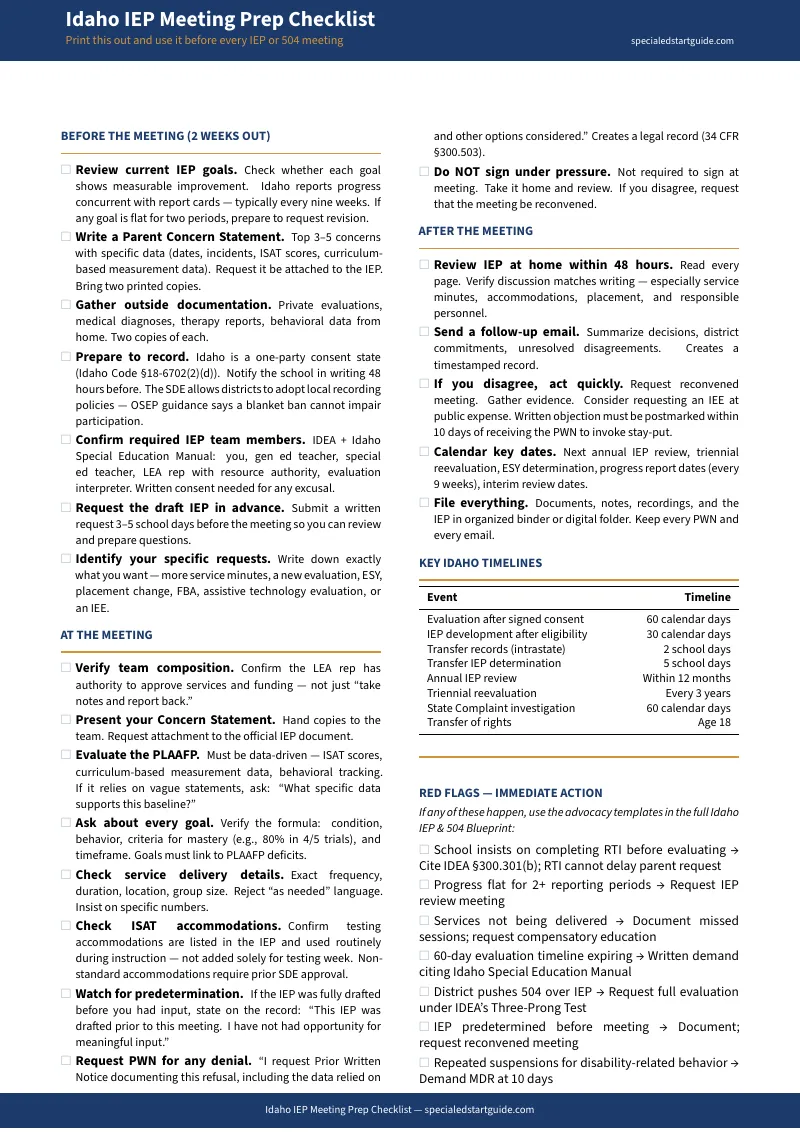
- IEP Meeting Prep Checklist — the before/during/after checklist with Idaho timelines, one-party consent recording rights under Idaho Code § 18-6702(2)(d), and IDAPA citations for every step
- Advocacy Letter Templates — copy-paste letters citing exact Idaho regulations and federal provisions for evaluations, IEEs, SLD re-evaluations under the 2024/2025 criteria, service delivery complaints, and compensatory education requests
- Goal-Tracking Worksheet — structured fillable worksheet for measurable progress monitoring between annual reviews
- Service Delivery Tracking Log — fillable log to document every scheduled session, missed minutes, and cancellation reasons — the quantitative foundation for compensatory education claims
- Idaho Timeline Cheat Sheet — every legal deadline on one page: 60-day evaluation, 30-day IEP development, annual reviews, triennial reevaluations, transition planning, and dispute resolution windows
- IEP Meeting Scripts — word-for-word responses to common district pushback, each citing the specific IDAPA section or federal regulation
- Dispute Resolution Roadmap — your formal options when advocacy fails: SDE State Complaint, mediation, facilitation, due process hearing, and OCR complaint — with a comparison table
Instant PDF download. Print the templates tonight. Walk into tomorrow's IEP meeting with the law on your side.
Money-back guarantee, no time limit. If the Blueprint doesn't change how you approach IEP meetings in Idaho, email us for a full refund. No questions asked.
Not ready for the full Blueprint? Download the free Idaho IEP Meeting Prep Checklist — a printable pre-meeting checklist with Idaho timelines, team composition requirements, one-party consent recording rights, and red flags that require immediate action. It's enough to walk into your next meeting prepared, and it's free.
Your child's education is a legal right, not a favor. The district has administrators and compliance officers. After tonight, you'll have the same playbook.