Your Child Struggles at School. The State Tells You to Trust the Process. In Hawaii, That Process Has No Local School Board.
You've been asking the teacher for help since the start of the year. Your child is falling behind — maybe they can't focus, maybe they're melting down every afternoon, maybe the reading scores keep dropping. The school says they need to go through HMTSS first. Weeks pass. Months pass. You finally get an evaluation, but the team says your child doesn't qualify — they're "too smart," their grades are "fine," a 504 Plan will be "enough." Or they do qualify, but the IEP meeting feels like it was decided before you walked in. The goals are vague. The services are minimal. And the person across the table has the authority to say no to everything you ask for.
Here's what makes Hawaii different from every other state: the Hawaii Department of Education is both the State Education Agency and the only Local Education Agency. There is no local school board. No independent district superintendent to escalate to. When the school denies your request, you're fighting the same system at every level — from the Principal to the Complex Area Superintendent to the state office in Honolulu. And if your family lives on Maui, the Big Island, Kauai, Molokai, or Lanai, you face an additional reality: chronic shortages of speech therapists, occupational therapists, and behavior analysts mean the services written into your child's IEP may go undelivered for months because there is literally no one on the island to provide them.
If you've been told to "trust the process" but the process keeps failing your child, you need the tools to hold HIDOE accountable.
The Hawaii IEP & 504 Blueprint is the Single-District Navigation System — the tactical toolkit that gives Hawaii parents the exact evaluation timelines, meeting scripts, advocacy letters, and escalation strategies grounded in HAR Chapter 60 to secure and enforce the special education services their children are legally guaranteed.
What's Inside the Blueprint
The Evaluation Roadmap — Timelines, Rights, and the HMTSS Trap
The school must respond to your written evaluation request within 15 calendar days — and once you sign consent, they have 60 calendar days to complete the evaluation. Not school days. Calendar days. The Blueprint includes the exact email template to request an evaluation citing HAR §8-60-31, explains the Three-Prong Test for eligibility so you know what to expect, and shows you how to challenge a school that insists on completing HMTSS tiers before accepting your referral — because federal law is clear that HMTSS cannot delay a parent-initiated evaluation request.
The IEP Meeting Playbook
Every IEP meeting in Hawaii requires specific team members — and the HIDOE representative at the table must have authority to commit resources, not just "take notes and check with the DES." The Blueprint walks you through pre-meeting preparation, what to bring, how to present a Parent Concern Statement, how to challenge vague or unmeasurable goals under the Endrew F. standard, and how to demand Prior Written Notice under HAR §8-60-46 when the team refuses any request. Hawaii is a one-party consent state — you can audio record every meeting without permission, and the Blueprint explains exactly how.
The Single-District Escalation Map
When the Principal says no and you don't know who to call next, the Blueprint maps the exact escalation path: Principal → District Educational Specialist (DES) → Complex Area Superintendent (CAS) → State Special Education Section → Superintendent of Education. Each level includes who has authority, what they can do, and how to write the escalation email that forces a response. In a state with no local school board, knowing this chain is the difference between getting heard and getting ignored.
The Neighbor Island Service Gap Strategy
When the school on Maui, the Big Island, Kauai, Molokai, or Lanai says the speech therapist position is vacant and there's nothing they can do — federal law still requires the service. The Blueprint covers how to demand compensatory education for missed sessions, request private provider funding when HIDOE cannot staff the position, push for telehealth service delivery, and pursue inter-island travel reimbursement for specialized evaluations not available on your island.
The Military PCS & EFMP Continuity Guide
If your family PCS'd to Joint Base Pearl Harbor-Hickam, Schofield Barracks, or Marine Corps Base Hawaii, your child's mainland IEP should transfer seamlessly. It often doesn't. The Blueprint explains the Interstate Compact on Educational Opportunity for Military Children, the 30-day comparable services requirement, and exactly how to prevent HIDOE from downgrading your child's services while they conduct a new evaluation. It also covers EFMP screening — what to do if your family travel is denied because the screener assumes Hawaii can't support your child's IEP.
The IEP vs. 504 Decision Guide
Schools frequently push families toward 504 Plans because they're cheaper to implement and carry fewer legal protections. The Blueprint explains the real differences — IEPs require specially designed instruction, measurable goals, and specific service minutes; 504 Plans provide accommodations only. It shows you how to determine which plan your child actually needs and how to push back when the school steers you toward a 504 to avoid IEP costs.
The Documentation and Advocacy File System
In Hawaii, the burden of proof in a due process hearing rests on the parent. If you can't document it, it didn't happen. The Blueprint includes a complete filing system for organizing evaluations, IEPs, progress reports, communication logs, and service delivery records — plus follow-up email templates that convert every verbal conversation into timestamped, admissible evidence.
Who This Blueprint Is For
- Parents preparing for their first IEP or 504 meeting in Hawaii — who want to walk in prepared, not reactive
- Parents on Oahu dealing with pre-written IEPs, denied evaluations, vague goals, or revolving-door staff
- Parents on Maui, the Big Island, Kauai, Molokai, or Lanai whose children's IEP services go undelivered because the island lacks providers
- Military families at Pearl Harbor-Hickam, Schofield Barracks, or MCBH Kaneohe Bay whose child's mainland IEP isn't being honored during transition
- Parents told their child is "too smart" for services or that a 504 Plan is "enough" when an IEP is warranted
- Parents navigating the HMTSS process who want to know their right to request an evaluation at any time
- Native Hawaiian, Japanese, Filipino, and Pacific Islander families who want to advocate firmly while maintaining respectful relationships with educators
- Parents who can't afford $200/hour for a private advocate and need to handle meetings themselves
Why Not Just Use the Free Resources?
Hawaii has solid free resources. SPIN publishes the "Parent's Guide to Partnership in Special Education." HIDOE provides Procedural Safeguards notices. LDAH runs parent training. Here's why parents still walk out of IEP meetings feeling steamrolled:
- SPIN's guide is informational, not tactical. It expertly explains what the law says and emphasizes "partnership" with the school. When partnership works, that's sufficient. When the school presents a pre-written IEP with predetermined services and gives you 20 minutes to sign, SPIN does not provide the meeting scripts, the Parent Concern Statement format, or the specific HAR Chapter 60 citations to demand Prior Written Notice for every denial.
- HIDOE's own materials are dense and bureaucratic. The Procedural Safeguards notice and HAR Chapter 60 are the definitive legal rules — and they're written in language most parents cannot parse into action. They tell you a right exists but not how to exercise it at the IEP table.
- LDAH supports but cannot advocate. LDAH sends trained parents to IEP meetings for moral support and note-taking. They cannot challenge evaluations, draft formal requests, or represent you in dispute resolution. When the meeting ends and nothing changes, you need preparation tools they don't provide.
- Wrightslaw covers federal IDEA — not HAR Chapter 60. Wrightslaw is the gold standard for federal special education law. It doesn't address Hawaii's single-district escalation chain, the Complex Area system, the HMTSS trap, one-party consent recording, or how Hawaii hearing officers weigh evidence.
- Etsy and TPT templates are generic. Pastel binder covers and contact sheets designed by mainland teachers for classroom organization — not Hawaii-specific meeting scripts, evaluation timelines, or escalation letters citing HAR §8-60.
The free resources explain what Hawaii law says. This Blueprint gives you the meeting preparation, advocacy scripts, and escalation strategies to make HIDOE follow it.
— Less Than One Hour of a Special Education Advocate
Private special education advocates in Hawaii charge $100–$300 per hour. Educational attorneys run $300–$500. A single consultation to review your child's IEP costs more than this entire Blueprint. The Blueprint gives you the same evaluation timelines, meeting scripts, escalation strategies, and documentation system that advocates use — so you walk into the IEP meeting prepared instead of reactive.
Your download includes the complete Blueprint guide plus 7 standalone printable tools:
- Complete Blueprint Guide (14 chapters) — Covers the Hawaii special education landscape, IEP vs. 504 decision guide, evaluation timelines and the HMTSS trap, IEP components and what to watch for, meeting preparation and recording rights, single-district escalation strategies, neighbor island service gap tactics, military PCS and EFMP protections, Independent Educational Evaluations, dispute resolution options, 504 Plans, charter schools and cultural advocacy, building your advocacy file, and the Hawaii resource directory
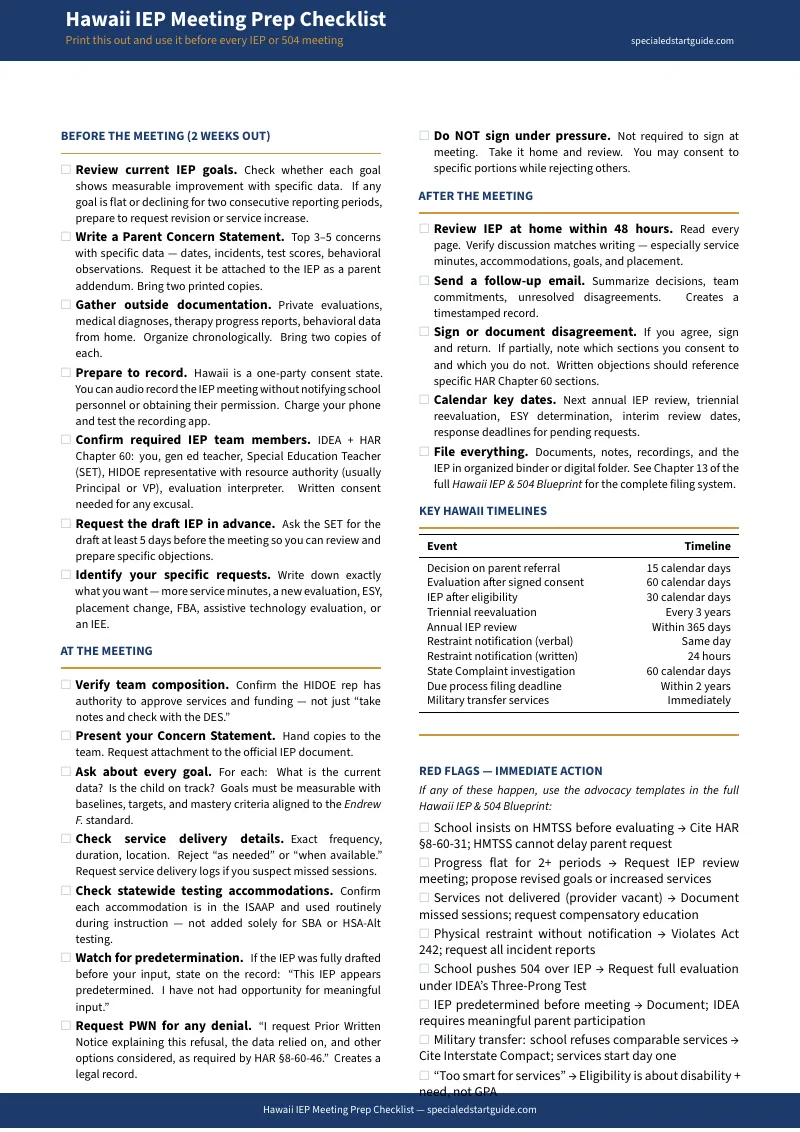
- Hawaii IEP Meeting Prep Checklist — printable pre-meeting checklist covering what to bring, questions to ask, accommodation requests, key Hawaii timelines, and red flags requiring immediate action — with HAR Chapter 60 citations throughout
- Advocacy Letter Templates — 8 copy-paste letters citing HAR Chapter 60: evaluation requests, HMTSS bypass, Prior Written Notice demands, DES/CAS escalation, IEE requests, neighbor island service restoration, military PCS transfer, and meeting follow-ups
- Hawaii Timeline Cheat Sheet — every legal deadline on one page: evaluation timelines, IEP meeting deadlines, military transfer windows, discipline triggers, and dispute resolution clocks
- IEP Meeting Scripts — word-for-word responses for 10 common school pushbacks, each citing the specific HAR or IDEA section that supports your position
- Dispute Resolution Roadmap — when to amend, mediate through the Mediation Center of the Pacific, file a state complaint, or pursue due process — with the Reid compensatory education standard explained
- Goal-Tracking Worksheet — printable log to monitor IEP goal progress between annual reviews, with red flags that trigger immediate escalation
- Service Delivery Tracking Log — weekly session log that builds the quantitative foundation for compensatory education claims when services go undelivered
Instant PDF download. Print the checklist tonight and walk into your next IEP meeting prepared.
Money-back guarantee, no time limit. If the Blueprint doesn't change how you prepare for and navigate IEP meetings, email us for a full refund. No questions asked.
Not ready for the full Blueprint? Download the free Hawaii IEP Meeting Prep Checklist — a printable quick-reference guide covering what to bring, questions to ask, accommodation requests, key Hawaii timelines with HAR Chapter 60 citations, and red flags requiring immediate action. It's enough to prepare for your next meeting, and it's free.
Your child's education is a legal right — and when HIDOE isn't meeting it, Hawaii law gives you the tools to make them. This Blueprint puts those tools in your hands.