
Your Child's IEP Services Were Denied. In Hawaii, There's No Local School Board to Appeal To.
You already know something is wrong. The IEP says 30 minutes of speech therapy twice a week, but the speech-language pathologist left your island six months ago and nobody replaced her. The district evaluated your child in four months instead of the 60 calendar days required by law and declared them ineligible — even though your child struggles through every school day. You asked for an Independent Educational Evaluation and they said no. You pushed back at the IEP meeting and the meeting ended. Your child was suspended for behavior caused by the disability the district refuses to address — and nobody mentioned a Manifestation Determination Review before it happened.
Hawaii is the only state in the nation that operates as a single, unified school district. The Hawaii Department of Education (HIDOE) is simultaneously the State Education Agency and the sole Local Education Agency. There is no local school board. No district superintendent to call. When something goes wrong with your child's IEP, the entity responsible for fixing it is the same entity that broke it. And across the state — especially on Maui, the Big Island, Kauai, Molokai, and Lanai — chronic shortages of speech therapists, occupational therapists, and behavior analysts mean IEP services go undelivered for months while parents are told "we don't have the staff."
If you can't afford a special education attorney at $200–$400 per hour and the free resources haven't solved your problem, you need the tools to fight this yourself.
The Hawaii IEP & 504 Advocacy Playbook is the Dispute Escalation System — the tactical toolkit that turns overwhelmed parents into effective advocates by providing the exact dispute letters, escalation procedures, and paper trail protocols grounded in Hawaii Administrative Rules (HAR) Chapter 60, IDEA, and Section 504 that force HIDOE to respond on the record.
What's Inside the Playbook
The Fill-in-the-Blank Dispute Letter Library
Every letter cites the exact Hawaii regulation. Demand an Independent Educational Evaluation at public expense — using the specific legal language under HAR §8-60 and 34 CFR §300.502 that triggers HIDOE's obligation to either fund the IEE or file for due process to defend their evaluation. Request Prior Written Notice for every denial — because HIDOE is required under HAR §8-60-41 to explain in writing what they refused, why, what data they relied on, and what alternatives they considered. Document service non-delivery with the specific timeline citations that prove the district violated the IEP. These aren't generic federal templates — they cite the HAR Chapter 60 provisions that HIDOE compliance investigators check during state complaint investigations.
The HIDOE Escalation Map
In every other state, parents can appeal to a local school board. In Hawaii, the escalation path is: School Principal → District Educational Specialist (DES) → Complex Area Superintendent (CAS) → State Special Education Section → Superintendent of Education. Most parents don't know this hierarchy exists. The Playbook maps it, explains who has authority at each level, and provides escalation letter templates for each step — so your complaint goes to the person who can actually act on it.
The Neighbor Island Service Gap Strategy
When your child's school on Maui, the Big Island, Kauai, Molokai, or Lanai says there is no speech therapist, OT, or BCBA available — federal law still requires the service. The Playbook includes demand letters for compensatory education, private provider funding, telehealth authorization, and inter-island travel reimbursement when HIDOE cannot staff the services your child's IEP requires. A school that "doesn't have the staff" is still legally obligated to provide the service — and this Playbook teaches you exactly how to force compliance.
The Military PCS Continuity Kit
If your family PCS'd to Joint Base Pearl Harbor-Hickam, Schofield Barracks, or Marine Corps Base Hawaii, your child's existing IEP didn't travel with you — it evaporated on arrival. The Playbook includes Interstate Compact enforcement letters that demand immediate comparable services while HIDOE conducts its own evaluation. Your child should not go months without support because the military moved your family.
The Paper Trail System
In Hawaii, the burden of proof in a due process hearing rests on the parent. You must prove by a "preponderance of the evidence" that HIDOE denied your child a Free Appropriate Public Education. Without a documented paper trail, you lose. The Playbook includes communication logs, follow-up email templates for every verbal conversation, and a systematic documentation protocol that builds the evidence Hawaii hearing officers require.
The Manifestation Determination Prep Kit
When a student with a disability is removed from placement for more than 10 cumulative school days, the district must conduct a Manifestation Determination Review within 10 school days. Under Act 242 (HRS §302A-1141.4), seclusion is entirely prohibited in all Hawaii public and charter schools. Physical restraint is restricted to emergency situations only. The Playbook walks you through MDR preparation, FBA demand templates, and how to report illegal restraint or seclusion incidents.
The State Complaint Filing Guide
An HIDOE State Complaint is free, does not require an attorney, and frequently produces faster results than due process. You file with the HIDOE Special Education Section, P.O. Box 2360, Honolulu, HI 96804, with a copy to your Complex Area Superintendent. HIDOE has 60 calendar days to investigate. The Playbook explains which violations are best suited for state complaints versus mediation versus due process, how to frame the complaint for maximum impact, and the common mistakes that result in dismissed complaints.
The Charter School Advocacy Chapter
Hawaii's 38 charter schools must follow the same IDEA and HAR Chapter 60 requirements as traditional public schools — but many operate as if they don't. The Playbook covers the specific accountability frameworks for charter school IEP compliance and the escalation paths that differ from traditional HIDOE schools.
Who This Playbook Is For
- Parents on Oahu dealing with HIDOE bureaucracy — pre-written IEPs, denied evaluations, revolving-door staff, and IEP meetings that feel like ambushes
- Parents on Maui, the Big Island, Kauai, Molokai, or Lanai whose children's IEP services go undelivered because the island simply lacks speech therapists, OTs, or behavior analysts
- Military families at Pearl Harbor-Hickam, Schofield Barracks, or MCBH Kaneohe Bay whose child's IEP evaporated during PCS and who need immediate comparable services
- Parents whose child was denied special education eligibility despite clear struggles — and who need to challenge the evaluation or request an IEE at public expense
- Parents facing disciplinary action — suspensions, alternative placements, restraint incidents — who need to understand Manifestation Determination Reviews and Act 242 protections
- Parents at Hawaii charter schools where IEP compliance is inconsistent and accountability is unclear
- Native Hawaiian, Japanese, Filipino, and Pacific Islander families who want to advocate firmly for their child while maintaining respectful relationships with educators
- Parents who earn too much for free legal aid and not nearly enough for a $200/hour advocate — the massive middle market that current resources leave behind
Why Not Just Use the Free Resources?
Hawaii has valuable free advocacy resources. SPIN publishes the "Parent's Guide to Partnership in Special Education." HDRC provides legal advocacy. LDAH offers parent training. Here's why parents still lose disputes after consulting all of them:
- SPIN's guide is collaborative, not tactical. It expertly explains what the law says and emphasizes "partnership" with the school. That's the right approach when partnership works. When partnership fails — when the district presents a pre-written IEP and gives you 20 minutes to sign — SPIN does not provide the fill-in-the-blank dispute letter that cites HAR §8-60-41 to demand Prior Written Notice. Its format is informational, not operational.
- HDRC triages by severity. As the state's Protection and Advocacy agency, HDRC must prioritize the most severe cases — abuse, expulsion, systemic failures. If your child's services are being quietly eroded rather than dramatically denied, you may wait months for individualized help. You cannot afford to wait while the statute of limitations runs.
- LDAH can attend your meeting but cannot represent you. They send trained parents to IEP meetings for support and note-taking — a valuable service. But they cannot file a state complaint, draft a dispute letter, or represent you in due process. When the meeting ends and nothing changes, you need escalation tools they cannot provide.
- Wrightslaw covers federal IDEA — not HAR Chapter 60. Wrightslaw is the gold standard for federal special education law. It does not address Hawaii's single-district escalation hierarchy, the Complex Area system, Act 242 restraint protections, or how Hawaii hearing officers interpret burden of proof. Federal citations are useful; Hawaii-specific citations tell HIDOE you know their playbook.
- Private advocates cost $150–$250 per hour. Special education attorneys charge $200–$400. A due process case can exceed $25,000. Most Hawaii families cannot afford this — especially on neighbor islands where you'd also pay for an advocate to fly in from Oahu.
The free resources explain what Hawaii law says. This Playbook gives you the dispute tools to make HIDOE comply.
— Less Than One Hour of a Special Education Advocate
Private advocates in Hawaii charge $150–$250 per hour. Educational attorneys run $200–$400. A single consultation to review your situation costs more than this entire Playbook. The Playbook gives you the dispute letters, escalation procedures, and documentation system that advocates use — so you can either handle the dispute yourself or arrive at a paid consultation with an organized case file that saves hundreds in billable hours.
Your download includes the complete Advocacy Playbook guide plus standalone printable PDFs — every dispute letter template, escalation checklist, and reference card, ready to print and use tonight.
- Complete Advocacy Playbook Guide — 14 chapters covering your legal foundation and procedural safeguards, building a bulletproof paper trail, evaluation battles and IEEs, IEP enforcement, neighbor island service gap strategies, military PCS continuity, Section 504, discipline protections and Act 242, charter school advocacy, dispute resolution and the HIDOE escalation ladder, compensatory education, transition planning, cultural advocacy, and Hawaii support organizations
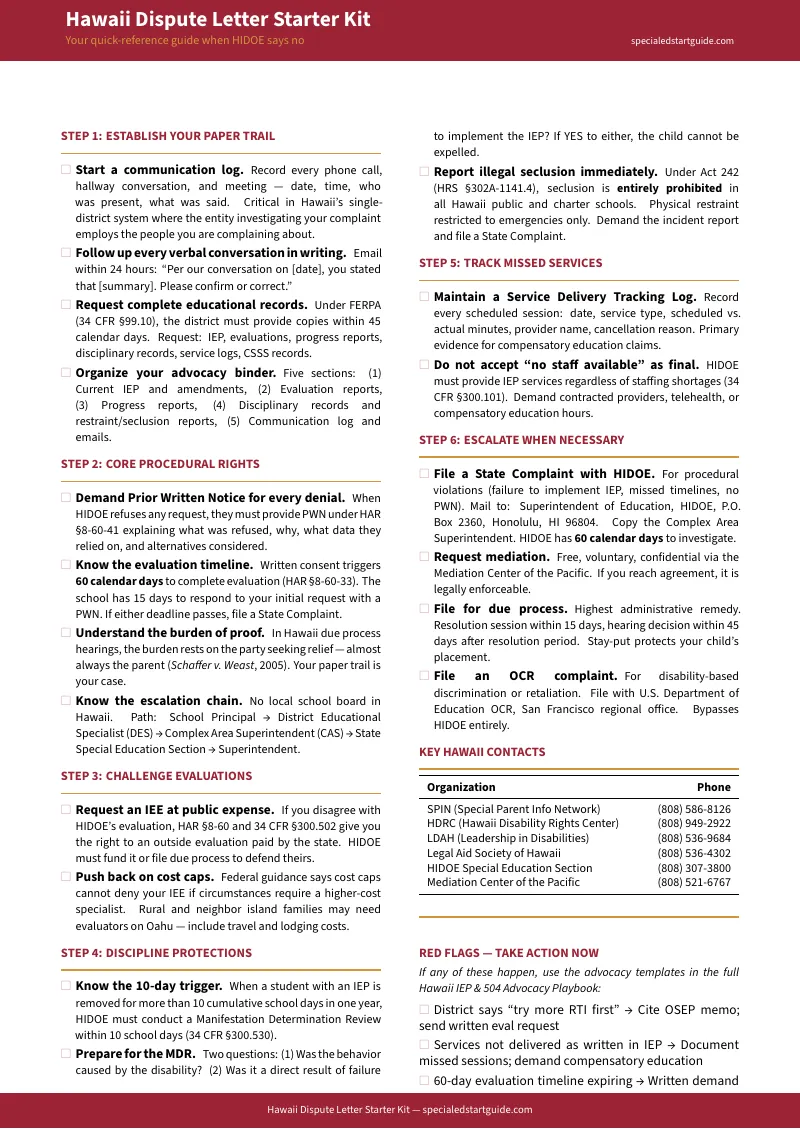
- Dispute Letter Starter Kit — the quick-reference checklist covering paper trail setup, core procedural rights, evaluation challenges, discipline protections, service tracking, and escalation procedures with key Hawaii timelines and HAR Chapter 60 citations
- Advocacy Letter Templates — fill-in-the-blank letters citing exact HAR §8-60 regulations for IEE demands, Prior Written Notice requests, service non-delivery documentation, and formal disagreements
- State Complaint Template — structured HIDOE complaint filing template with required elements, evidence attachment guide, and filing instructions
- Communication Log — printable documentation tracker for every call, meeting, and conversation — the systematic paper trail that wins cases
- MDR Preparation Checklist — step-by-step Manifestation Determination Review preparation including the two legal questions, FBA demand templates, and Act 242 restraint/seclusion reporting
- Dispute Escalation Ladder — visual roadmap from informal advocacy through state complaint, mediation, due process, and OCR complaint — with Hawaii-specific timelines at every stage
- HIDOE Hierarchy Map — the single-district escalation chain from Principal to DES to CAS to State Special Education Section with contact protocols at each level
Instant PDF download. Print the dispute letter that matches your situation tonight. Send it tomorrow morning.
Money-back guarantee, no time limit. If the Playbook doesn't change how you handle disputes with HIDOE, email us for a full refund. No questions asked.
Not ready for the full Playbook? Download the free Hawaii Dispute Letter Starter Kit — a printable quick-reference guide covering paper trail setup, core procedural rights, evaluation challenges, discipline protections, service tracking, and escalation steps with key Hawaii timelines and HAR Chapter 60 citations. It's enough to start building your case tonight, and it's free.
Your child's education is a legal right — and when HIDOE violates it, Hawaii law gives you the tools to fight back. This Playbook puts those tools in your hands.