The District Knows Georgia's Special Education Rules. After Tonight, So Will You.
You walked into that IEP meeting as prepared as you could be. You called Parent to Parent of Georgia. You downloaded the GaDOE Procedural Safeguards notice. You even reached out to your district's Parent Mentor — and she was kind, and empathetic, and a direct employee of the school district who cannot provide legal advice or fight the special education director on your behalf.
So you sat across from the SST chair, the school psychologist, the special education teacher, the LEA representative, and the general ed teacher — and they used Georgia acronyms you'd never heard before. GaMTSS. QBE funding weight. Category V. GNETS. They smiled. They said your child was "responding to Tier 2 interventions" and the Student Support Team needed "more data" before they could consider a referral. And you didn't know enough to tell them that Georgia law allows you to bypass the SST entirely when reasonable cause exists.
You left with no evaluation timeline, no formal referral, and no written explanation of why they refused your request — because you didn't know to demand Prior Written Notice.
The problem isn't that you lack effort. The problem is that Georgia's special education system is engineered for compliance officers, not parents. One hundred eighty districts across 159 counties, each with different capacity and different interpretations of the same rules. A Student Support Team process that the state designed for early intervention but that districts routinely weaponize as an indefinite delay tactic. A GNETS program that the U.S. Department of Justice found illegally segregates students with behavioral disabilities. And a state classified by the federal Office of Special Education Programs as "Needs Assistance" in meeting IDEA requirements — meaning Georgia itself acknowledges its districts aren't consistently following the law.
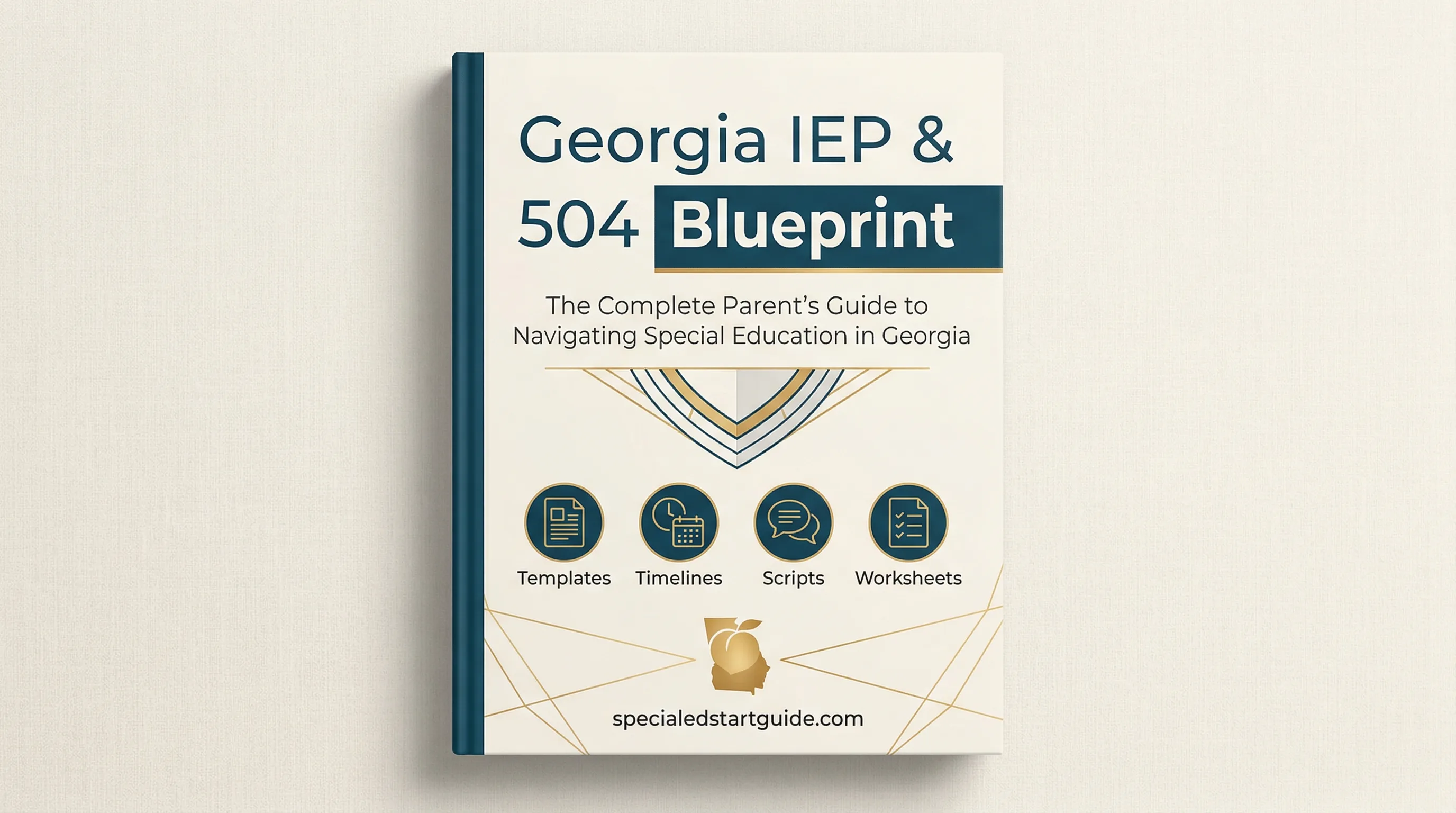
The Georgia IEP & 504 Blueprint is the tactical enforcement toolkit that bridges the gap between knowing your rights exist and actually exercising them — with every template, script, and checklist grounded in O.C.G.A. Title 20 and the Georgia State Board of Education Rules.
What's Inside the Blueprint
The SST Bypass Protocol
Georgia's Student Support Team process is a six-step framework that schools are supposed to use for early intervention. In practice, districts use it to delay formal special education evaluations for months — sometimes years — while they "collect data" and "monitor Tier 2 interventions." But Georgia Rule 160-4-2-.32 allows school personnel and parents to bypass the SST entirely when there is reasonable cause to suspect a disability. The Blueprint provides the pre-written template letter citing the exact Georgia rule to force a bypass and start the 60-calendar-day evaluation clock immediately. No existing free resource provides this template.
The Copy-Paste Advocacy Letter Library
Every letter cites the exact Georgia statute or State Board Rule. Request an evaluation under Rule 160-4-7-.04 and start the district's 60-calendar-day clock. Demand Prior Written Notice when the team refuses anything — because without it, their refusal isn't documented and your paper trail has a hole. Request an Independent Educational Evaluation at public expense when you disagree with the district's assessment. Formally request service delivery logs to verify whether the therapy minutes written in the IEP are actually being delivered. These aren't generic national samples — they're Georgia-specific enforcement tools that create a legally binding record the moment you hit send.
The GNETS Defense Toolkit
The Georgia Network for Educational and Therapeutic Support is a system of segregated programs for students with behavioral disabilities. The U.S. Department of Justice found that GNETS illegally and unnecessarily segregates students, sometimes spending their entire school day — including meals — exclusively with other disabled students, without access to general education teachers. The Blueprint explains early GNETS referral red flags, how to demand inclusive Behavioral Intervention Plans within the mainstream school, and your rights to prevent forced segregation into a GNETS placement.
The Babies Can't Wait Transition Survival Guide
When your child turns three, Babies Can't Wait stops providing therapies and the school district takes over — often with dramatically reduced services or an outright denial of special education eligibility. Parents describe this as falling off a cliff. The Blueprint maps the exact transition timeline, explains why school-based eligibility criteria differ from medical diagnoses, and provides specific arguments for demonstrating that therapies your child received under Part C remain educationally necessary under IDEA.
IEP Meeting Scripts and Checklists
What to say when the team tells you your child is "making progress" but the data shows otherwise. What to say when they offer a 504 instead of an IEP. What to say when the LEA representative claims the district "doesn't have the resources" for your requested services. Each script cites the Georgia statute or State Board Rule that proves them wrong — so you're not arguing opinions, you're citing law. The pre-meeting checklist covers one-party recording consent (O.C.G.A. § 16-11-66), team composition verification under the Rules 160-4-7 series, and the specific documents to bring.
The Georgia Milestones Accommodation Guide
Georgia's statewide assessments carry high stakes — promotion decisions, school accountability ratings, and graduation requirements. Accommodations on Georgia Milestones must be documented in the IEP or 504 Plan AND used routinely during instruction. The Blueprint explains the difference between Standard and Conditional accommodations, how they interact with the EOC components, and your right to ensure every accommodation is explicitly listed before testing season — not added under pressure the week before.
The Behavior Crisis Toolkit
When a child faces suspension for behavior caused by their disability, Georgia law triggers specific protections. The Blueprint covers Functional Behavioral Assessment requirements, Behavior Intervention Plans, the Manifestation Determination Review process when suspensions exceed 10 cumulative days, and Georgia's restraint rules under Rule 160-5-1-.35 — including the fact that seclusion is prohibited entirely in Georgia. It also addresses shadow suspensions — schools sending children home without documentation to avoid triggering an MDR.
Goal-Tracking Worksheets
IEP goals are legally required to be measurable — with baselines, targets, and mastery criteria meeting the Endrew F. standard. But many goals are written so vaguely that progress is impossible to track. The worksheets give you a structured format to log data between meetings, compare school-reported progress against your own observations, and arrive at the annual review with documentation that either confirms the program is working or proves it isn't.
The OSAH Dispute Resolution Roadmap
When advocacy fails, you have three formal options in Georgia: filing a state complaint with GaDOE's Division for Special Education Services and Supports, requesting mediation, or filing for a due process hearing before the Office of State Administrative Hearings (OSAH). The Blueprint explains when each option is appropriate, the timeline and costs involved, and how the paper trail you've been building with the advocacy templates becomes the evidence that wins your case — or convinces the district to settle before you ever reach a hearing.
Who This Blueprint Is For
- Parents whose child is turning three and Babies Can't Wait is ending — and who need to know exactly how to prevent therapy gaps when the school district takes over
- Parents trapped in the SST data-collection loop for months while their child falls further behind — and who need the legal citation to force a formal evaluation immediately
- Parents in Gwinnett, Fulton, Cobb, DeKalb, or any large metro Atlanta district where evaluations are backlogged and meetings keep getting rescheduled
- Parents in rural Georgia — Telfair, Appling, Crisp, Lowndes — where the nearest diagnostic provider is a two-hour drive and the district claims they "don't have staff" for your child's services
- Parents who've been told their child "doesn't qualify" despite holding a medical diagnosis — and who need the legal language to challenge that determination under Rule 160-4-7-.04
- Parents navigating the 504-to-IEP question — unsure whether their child's current plan is legally sufficient or whether they should push for a full special education evaluation
- Parents whose child was suspended and facing alternative placement or GNETS referral — but the behavior is clearly tied to the disability and nobody mentioned a Manifestation Determination Review
- Military families at Fort Stewart, Robins AFB, Fort Eisenhower, or Hunter Army Airfield navigating Georgia's system after a PCS move from another state
- Parents preparing for their first IEP meeting who don't want to walk in blind against a team that does this every day
Why Not Just Use the Free Resources?
Georgia has legitimate free special education resources. Parent to Parent of Georgia runs a helpline. The Georgia Parent Mentor Partnership provides emotional support. GaDOE publishes implementation manuals. Here's why parents still struggle after consulting all of them:
- Parent Mentors work for the district, not you. Georgia's Parent Mentor Partnership places parents of children with disabilities inside each district as guides and emotional support. They are empathetic, knowledgeable, and directly employed by the school district. They are explicitly trained to honor professional boundaries — they cannot provide legal advice, cannot write binding advocacy letters, and cannot fight the special education director on your behalf. When the district says no, your Parent Mentor cannot say "you're wrong."
- Parent to Parent of Georgia educates — it doesn't advocate. P2P provides comprehensive fact sheets, training calendars, and a 1-800 helpline. Their materials are designed for broad parental education and fundamentally lack adversarial "what to do when the school says no" templates. The institutional tone prioritizes mediation and systemic peace over individual legal leverage.
- GaDOE publications protect the state, not you. The official implementation manuals — Rule 160-4-7-.04 and its companion rules — are written in dense bureaucratic prose for compliance officers. They tell you the rules exist. They provide absolutely zero tactical instruction on how to enforce them when a school is non-compliant. A stressed parent does not need to decipher a 100-page administrative code — they need the exact phrasing to put in an email tonight.
- Etsy and TPT planners organize paperwork — they don't enforce rights. A pastel IEP binder helps you sort documents. It won't tell you what the SST bypass provision is, how to cite Rule 160-4-2-.32 to force an evaluation, or what GNETS is and why you should fight a referral. Generic federal templates miss every Georgia nuance that actually determines your outcome.
The free resources explain what the law says. The Blueprint gives you the tools to make the district follow it.
— Less Than 3 Minutes of a Special Education Attorney
Special education attorneys in Georgia charge $300–$500 per hour. A private advocate runs $150–$300 per meeting. Even if you eventually need professional help, the meticulous paper trail you build with this Blueprint saves thousands in billable hours — because you're handing your attorney an organized case, not a shoebox of unsigned IEP copies and half-remembered conversations.
Your download includes the complete Blueprint guide plus standalone printable PDFs — every template, worksheet, script, and reference card, ready to print and bring to your next meeting.
- Complete Blueprint Guide — 17 chapters covering the SST process, evaluations, IEP development, 504 plans, Georgia Milestones accommodations, the Babies Can't Wait transition, related services, ESY, behavior crisis protocols, GNETS defense, IEEs, school choice (GSNS), transition planning, discipline and SRO interactions, military family transfers, dispute resolution, and a Georgia resources directory
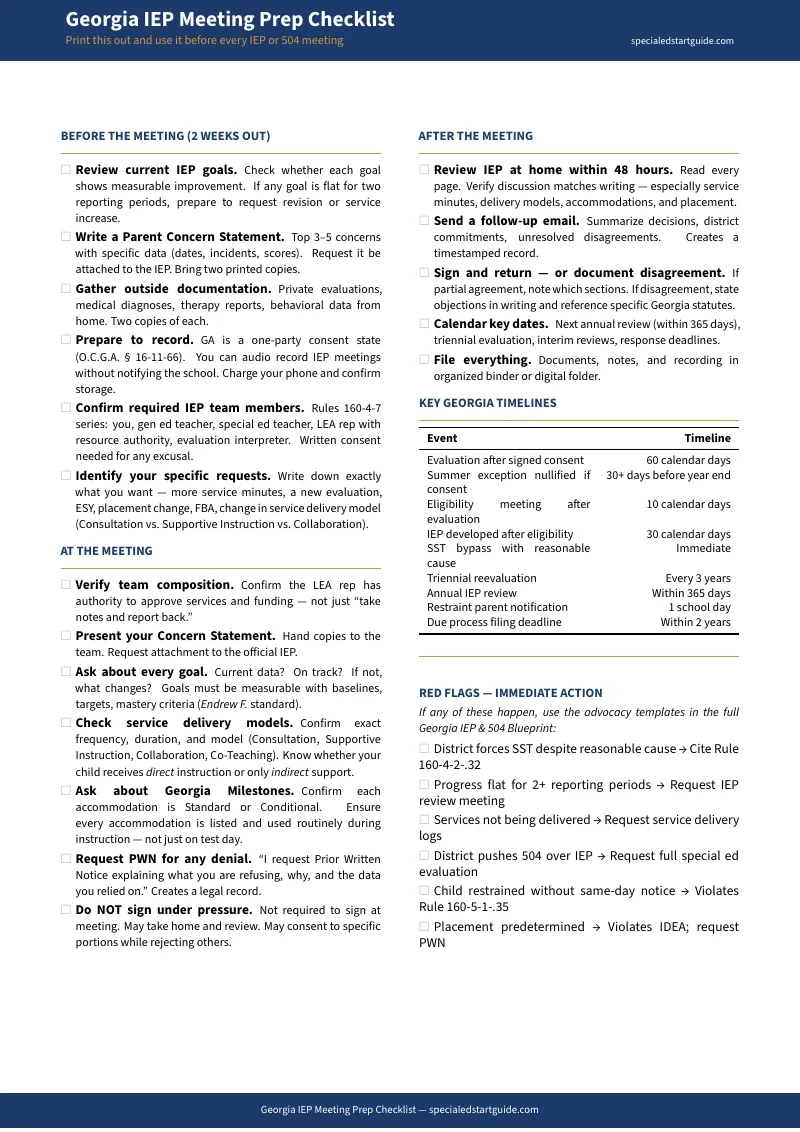
- IEP Meeting Prep Checklist — the before/during/after checklist with Georgia timelines, team composition requirements, and red flags that require immediate action
- Advocacy Letter Templates — copy-paste letters citing exact O.C.G.A. statutes and State Board Rules for SST bypass, evaluations, IEEs, Prior Written Notice demands, service delivery log requests, FBA requests, and addendum meetings
- Goal-Tracking Worksheet — structured fillable worksheet for measurable progress monitoring between annual reviews
- Georgia Milestones Accommodation Checklist — classroom accommodations table plus Standard vs. Conditional testing accommodations and a pre-meeting audit checklist
- Georgia Timeline Cheat Sheet — every legal deadline on one page: 60-calendar-day evaluation, annual reviews, triennial reevaluation, restraint notification, and due process filing windows
- IEP Meeting Scripts — word-for-word responses to common district pushback tactics, each citing the specific Georgia statute or State Board Rule
- SST Bypass Template — the pre-written letter citing Rule 160-4-2-.32 to skip the SST data-collection loop and force a formal evaluation referral
- Dispute Resolution Roadmap — your three formal options when advocacy fails: GaDOE state complaint, mediation, and OSAH due process hearing — with a side-by-side comparison table
Instant PDF download. Print the templates tonight. Walk into tomorrow's meeting with the law on your side.
Money-back guarantee, no time limit. If the Blueprint doesn't change how you approach IEP meetings in Georgia, email us for a full refund. No questions asked.
Not ready for the full Blueprint? Download the free Georgia IEP Meeting Prep Checklist — a printable pre-meeting checklist with Georgia timelines, team composition requirements, and the red flags that require immediate action. It's enough to walk into your next meeting prepared, and it's free.
Your child's education is a legal right, not a favor the district grants. The district knows Georgia law. After tonight, so will you.