The District Knows Florida's ESE Rules. After Tonight, So Will You.
You walked into that IEP meeting as prepared as you could be. You read the BEESS parent handbook. You printed the Procedural Safeguards notice. You even called the Family Network on Disabilities — and they were kind, and knowledgeable, and legally unable to attend your meeting or tell you what to say at the table.
So you sat across from five district employees — the ESE coordinator, the school psychologist, the general ed teacher, the LEA rep, and the speech-language pathologist — and they used Florida acronyms you'd never heard before. MTSS. Matrix of Services. Access Points. B.E.S.T. Standards. They smiled. They said your child was "making progress." They recommended reducing therapy minutes because the Matrix score "doesn't support" the current level of service. And you didn't know enough to challenge a single word of it.
You left with the same IEP your child walked in with. No additional minutes. No new evaluations. No Prior Written Notice explaining why they refused your requests — because you didn't know to demand one.
The problem isn't that you lack effort. The problem is that Florida's Exceptional Student Education system is engineered for professionals, not parents. Sixty-seven county-wide districts, each with different capacity. A funding formula — the Matrix of Services — that directly controls how much money the district receives for your child, but that most parents never see. A scholarship pathway (FES-UA) that promises freedom but requires you to waive your child's right to FAPE. And a state that publishes administrative theory for compliance officers but zero fill-in-the-blank templates for the parent sitting alone at the table.
The Florida IEP & 504 Blueprint is the tactical enforcement toolkit that bridges the gap between knowing your rights exist and actually exercising them — with every template, script, and checklist grounded in Florida Statutes and the Florida Administrative Code.
What's Inside the Blueprint
The Copy-Paste Advocacy Letter Library
Every letter cites the exact Florida statute. Request an evaluation under F.A.C. 6A-6.0331 and start the district's 60-school-day clock. Demand Prior Written Notice when the team refuses anything — because without it, their refusal isn't documented and your paper trail has a hole. Request an Independent Educational Evaluation at public expense when you disagree with the district's assessment. Formally request the district's internal service delivery logs to verify whether the therapy minutes written in the IEP are actually being delivered. These aren't generic samples — they're Florida-specific enforcement tools that create a legally binding record the moment you hit send.
The Matrix of Services Decoder
Florida funds ESE through a point-based Matrix of Services system — Levels 251 through 255. A student at Level 253 generates roughly $10,000 in ESE funding. A student at Level 255 generates over $35,000. Most parents have never seen their child's Matrix score, let alone understood that it directly controls the resources their district receives. The Blueprint explains how points are calculated across the five domains, how to request an interim IEP review to force a Matrix recalculation when services are added, and why the district has a financial disincentive to accurately document your child's needs at the higher levels.
The FES-UA Decision Framework
The Family Empowerment Scholarship for Students with Unique Abilities replaced the McKay and Gardiner Scholarships. It offers flexible spending through an Education Savings Account — private school tuition, contracted therapists, instructional materials. But accepting it requires waiving your child's right to FAPE and IDEA protections within the public system. Parents on forums report reimbursement delays of 60+ days and accounts suspended without warning during school transitions. The Blueprint provides a rigorous side-by-side analysis — financial, legal, educational — so you can make that decision with full information, not out of frustration with a broken district.
The Part C-to-Part B Transition Survival Guide
When your child turns three, Early Steps stops providing therapies and the school district takes over — often with dramatically reduced services or an outright denial of ESE eligibility. Parents describe this as falling off a cliff. The Blueprint maps the exact timeline, explains why school-based eligibility criteria differ from medical diagnoses, and provides specific arguments for demonstrating that therapies your child received under Early Steps remain educationally necessary under IDEA.
IEP Meeting Scripts and Checklists
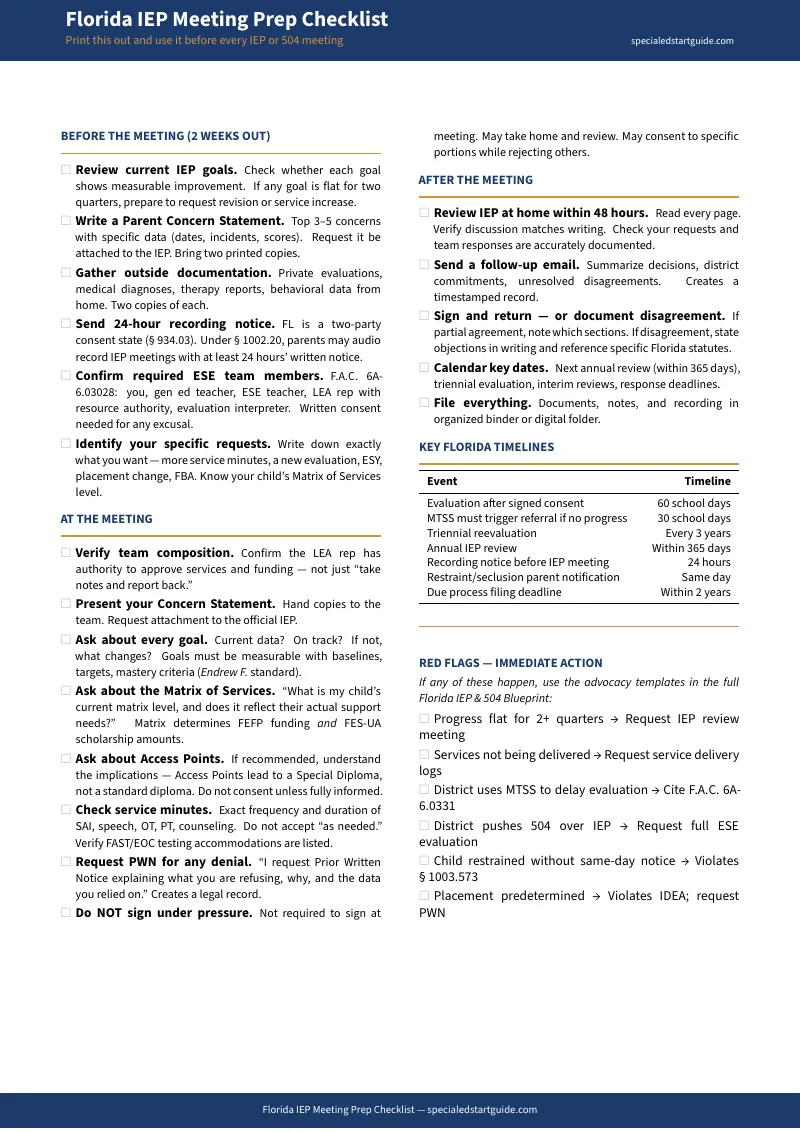
What to say when the team tells you your child is "making progress" but the data shows otherwise. What to say when they offer a 504 instead of an IEP. What to say when the LEA representative claims the Matrix doesn't justify more service hours. Each script cites the Florida statute or F.A.C. rule that proves them wrong — so you're not arguing opinions, you're citing law. The pre-meeting checklist covers the 24-hour recording notice (§1002.20, Florida Statutes), team composition verification under F.A.C. 6A-6.03028, and the specific documents to bring.
The B.E.S.T. Standards and Access Points Guide
When the district proposes placing your child on "Access Points" — reduced-complexity academic standards for students with significant cognitive disabilities — the stakes are enormous. Access Points change the graduation track from a standard diploma to a special diploma. The Blueprint explains what Access Points are, how they interact with the FAST assessment system, and your right to grant or deny consent. This is not a decision to make at the meeting table under pressure.
The Behavior Crisis Toolkit
When a child faces suspension for behavior caused by their disability, Florida law triggers specific protections. The Blueprint covers Functional Behavioral Assessment requirements, Behavior Intervention Plans, the Manifestation Determination Review process when suspensions exceed 10 cumulative days, and your rights under §1003.573 when the school uses restraint or seclusion. It also addresses the shadow-suspension problem — schools sending children home without documentation to avoid triggering an MDR.
Goal-Tracking Worksheets
IEP goals are legally required to be measurable — with baselines, targets, and mastery criteria meeting the Endrew F. standard. But many goals are written so vaguely that progress is impossible to track. The worksheets give you a structured format to log data between meetings, compare school-reported progress against your own observations, and arrive at the annual review with documentation that either confirms the program is working or proves it isn't.
The DOAH Dispute Resolution Roadmap
When advocacy fails, you have three formal options in Florida: filing a state complaint with BEESS, requesting mediation, or filing for a due process hearing before the Division of Administrative Hearings (DOAH). The Blueprint explains when each option is appropriate, the timeline and costs involved, and how the paper trail you've been building with the advocacy templates becomes the evidence that wins your case — or convinces the district to settle before you ever reach a hearing.
Who This Blueprint Is For
- Parents whose child is turning three and Early Steps is ending — and who need to know exactly how to prevent therapy gaps when funding responsibility shifts to the school district
- Parents who've been told their child "doesn't qualify" for ESE despite holding a medical diagnosis — and who need the legal language to challenge that determination under F.A.C. 6A-6.0331
- Parents in Miami-Dade, Broward, Orange County, or any large Florida district where evaluations are backlogged months and meetings keep getting rescheduled
- Parents who suspect the district isn't delivering the therapy minutes listed in the IEP but have no documentation to prove it
- Parents navigating the 504-to-IEP question — unsure whether their child's current plan is legally sufficient or whether they should push for a full ESE evaluation
- Parents whose child was suspended and facing alternative placement — but the behavior is clearly tied to the disability and nobody mentioned a Manifestation Determination Review
- Parents considering the FES-UA scholarship but terrified of waiving FAPE rights without understanding the full trade-offs
- Parents preparing for their first IEP meeting who don't want to walk in blind against a team that does this every day
Why Not Just Use the Free Resources?
Florida has legitimate free special education resources. The BEESS parent handbook defines your rights. The Family Network on Disabilities runs workshops. FDLRS centers provide diagnostic support. Here's why parents still struggle after consulting all of them:
- The BEESS handbook protects the state, not you. It explicitly disclaims that it is for "basic information only" and does not cover specific situations. It tells you that you have procedural rights. It does not give you the pre-written email to send tonight citing those rights. For a parent in crisis, the gap between understanding a right and exercising it is the gap between winning and losing at the IEP table.
- The Family Network on Disabilities cannot attend your meeting. FND logs over 15,000 calls a year and their staff are parents of children with disabilities. They are empathetic, knowledgeable, and structurally prohibited from giving legal advice or sitting at the table next to you. They can educate — they cannot advocate.
- FDLRS is funded by the districts it serves. The Florida Diagnostic and Learning Resources System provides valuable diagnostic and instructional support through 19 centers statewide. But parents often feel that FDLRS personnel function as extensions of the district — because they are funded by the state to serve the districts, not to challenge them.
- Etsy and TPT planners organize paperwork — they don't enforce rights. A pastel IEP binder helps you sort documents. It won't tell you what the Matrix of Services is, why the district is hiding your child's score, or how to cite F.A.C. 6A-6.0331 to force an evaluation. Generic federal templates miss every Florida nuance that actually determines your outcome.
The free resources explain what the law says. The Blueprint gives you the tools to make the district follow it.
— Less Than 3 Minutes of a Special Education Attorney
Special education attorneys in Florida charge $250–$500 per hour. A private advocate runs $150–$300 per meeting. Even if you eventually need professional help, the meticulous paper trail you build with this Blueprint saves thousands in billable hours — because you're handing your attorney an organized case, not a shoebox of unsigned IEP copies and half-remembered conversations.
Your download includes the complete Blueprint guide plus standalone printable PDFs — every template, worksheet, script, and reference card, ready to print and bring to your next meeting.
- Complete Blueprint Guide — 16 chapters covering evaluation, IEP development, 504 plans, the Matrix of Services, B.E.S.T. Standards, FAST testing, the Part C transition, behavior crisis protocols, school choice, transition planning, dispute resolution, and a Florida resources directory
- IEP Meeting Prep Checklist — the before/during/after checklist with Florida timelines, team composition requirements, and red flags that require immediate action
- Advocacy Letter Templates — copy-paste letters citing exact Florida Statutes and F.A.C. rules for evaluations, IEEs, Prior Written Notice demands, service delivery log requests, FBA requests, and addendum meetings
- Goal-Tracking Worksheet — structured fillable worksheet for measurable progress monitoring between annual reviews
- FAST Accommodation Checklist — classroom accommodations table plus the statewide testing accessibility matrix and pre-meeting audit checklist
- Florida Timeline Cheat Sheet — every legal deadline on one page: 60-school-day evaluation, annual reviews, triennial reevaluation, recording notice, restraint notification, and due process filing windows
- IEP Meeting Scripts — word-for-word responses to common district pushback tactics, each citing the specific Florida statute or F.A.C. rule
- Matrix of Services Reference Card — Levels 251–255 explained with the five funding domains and instructions for requesting a recalculation
- Dispute Resolution Roadmap — your four formal options when advocacy fails: IEP facilitation, mediation, BEESS state complaint, and DOAH due process hearing — with a side-by-side comparison table
Instant PDF download. Print the templates tonight. Walk into tomorrow's meeting with the law on your side.
Money-back guarantee, no time limit. If the Blueprint doesn't change how you approach IEP meetings in Florida, email us for a full refund. No questions asked.
Not ready for the full Blueprint? Download the free Florida IEP Meeting Prep Checklist — a printable pre-meeting checklist with Florida timelines, team composition requirements, and the red flags that require immediate action. It's enough to walk into your next meeting prepared, and it's free.
Your child's education is a legal right, not a favor the district grants. The district knows Florida law. After tonight, so will you.