The District Knows Florida ESE Law. Now You Will Too.
You walked into that IEP meeting prepared — or you thought you did. You read the FLDOE Procedural Safeguards notice. You printed the evaluations. You wrote down your concerns. And then the team smiled, used acronyms you'd never heard before, and told you your child "doesn't qualify" or that certain services "aren't available at this school."
You left the meeting with the same IEP your child walked in with. No additional minutes. No new assessments. No Prior Written Notice explaining why they refused your requests — because you didn't know to ask for one.
The problem isn't that you're uninformed. The problem is that Florida's Exceptional Student Education system is specifically designed to be navigated by professionals, not parents. Sixty-seven county districts, each with different unwritten rules. A Matrix of Services scoring system that quietly determines whether your child gets $10,000 or $35,000 in FES-UA scholarship funding — and nobody at the school explains how it works. A state that publishes 50 pages of legal theory but zero fill-in-the-blank templates.
The Florida IEP & 504 Advocacy Playbook is the tactical dispute toolkit that bridges the gap between knowing your rights and actually enforcing them — with every template, script, and checklist grounded in the Florida Administrative Code.
What's Inside the Playbook
The Copy-Paste Dispute Letter Library
Every letter cites the exact Florida statute. Request an ESE evaluation under F.A.C. Rule 6A-6.0331 and start the district's 60-school-day clock. Demand an Independent Educational Evaluation at public expense when the district's assessment doesn't capture your child's needs. File a formal state complaint with FLDOE BEESS when the district violates the IEP. Request Prior Written Notice under F.A.C. Rule 6A-6.03311 when the team refuses anything. These aren't generic samples — they're Florida-specific enforcement tools that create a legally binding paper trail the moment you hit send.
The Matrix of Services Decoder
Florida uses a Matrix of Services assessment to score your child's support needs across five domains — and that score (Levels 251–255) determines everything. A base Level 251–253 yields approximately $10,000 in FES-UA funding. A Level 254 jumps to over $21,000. A Level 255 exceeds $35,000. The Playbook breaks down exactly how each domain is scored, which services drive the score higher, and how to ensure the district accurately documents the intensity of your child's needs — because an inaccurate Matrix score can cost your family tens of thousands of dollars in private education funding.
The FES-UA Decision Framework
Should you stay in the public school and fight for the IEP, or withdraw to the Family Empowerment Scholarship? Most parents don't realize that leaving the public system means losing IDEA protections — no more legally binding IEP, no due process rights, no compensatory education claims. The Playbook provides a strategic decision tree covering both paths: how to maximize your Matrix score before withdrawing, what you're giving up, what you're gaining, and how to avoid the funding trap that costs families thousands when they leave without an ironclad IEP.
The DOAH Due Process Guide
When mediation fails and the district won't comply, the Division of Administrative Hearings is where disputes get resolved. The Playbook walks you through every step: filing the complaint, meeting the two-year statute of limitations, preparing your evidence binder, understanding what the Administrative Law Judge can and cannot order, and the resolution session requirements. Whether you file pro se or hire an attorney later, the organized case file you build with this Playbook saves thousands in billable hours.
District-Specific Advocacy Intelligence
Miami-Dade's bureaucratic inertia. Broward's internal inconsistencies across zip codes. Orange County's systemic resistance to paraprofessional requests. Hillsborough's gap between high identification rates and actual service delivery. Duval's therapy deserts and transportation nightmares. The Playbook maps the advocacy landscape across Florida's largest districts so you know what to expect in your county — and what to demand.
Restraint, Seclusion & Discipline Protections
When your child is physically restrained, placed in seclusion, or suspended for behavior that is a manifestation of their disability, you need to act immediately — and you need the exact Florida statutes to cite. The Playbook covers restraint reporting requirements under F.S. §1003.573, the manifestation determination process, FBA and BIP demand sequences, and the specific protections that prevent districts from disciplining children for disability-related behaviors.
IEP Meeting Scripts and Checklists
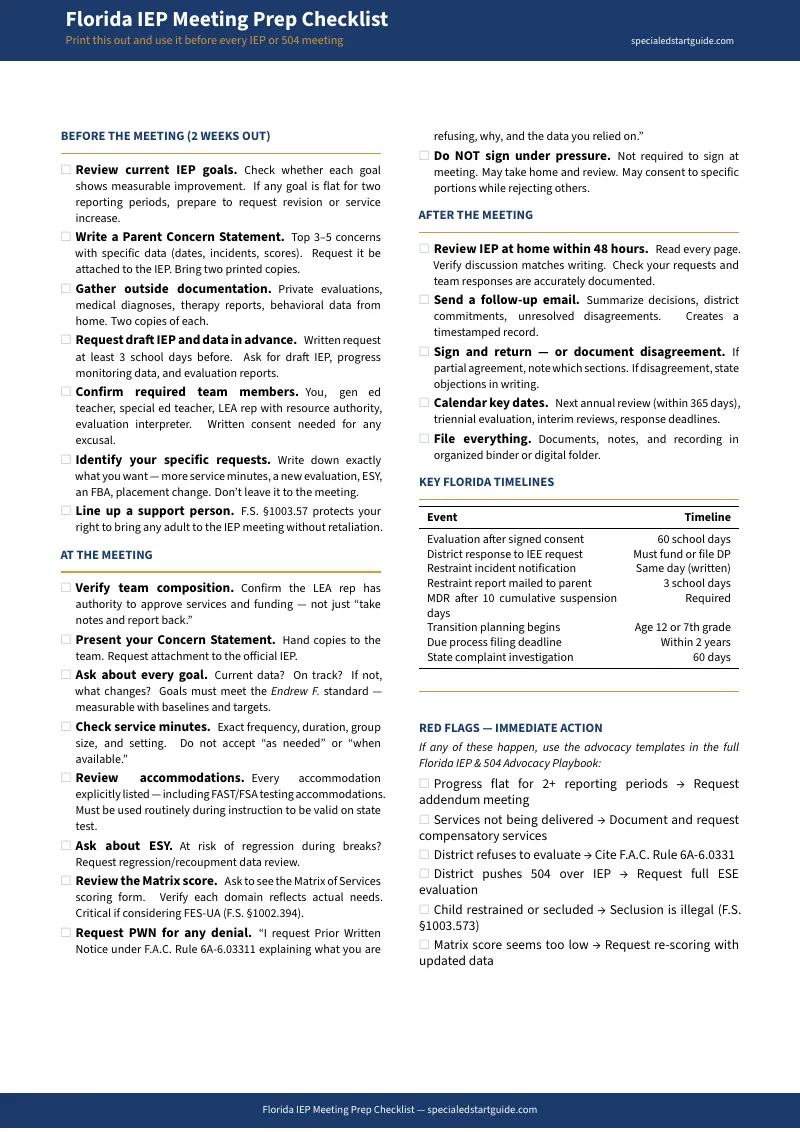
What to say when the team tells you your child is "doing fine" but melts down every night at home. What to say when they offer a 504 instead of an IEP. What to say when the administrator claims they don't have funding for a requested service. Each script cites the Florida Statute or F.A.C. rule that proves them wrong — so you're not arguing opinions, you're citing law. The pre-meeting checklist covers team composition verification, document requests, and the specific items to bring.
Goal-Tracking and Documentation Worksheets
IEP goals are legally required to be measurable — with baselines, targets, and mastery criteria that meet the Endrew F. standard. But many goals are written so vaguely that progress is impossible to track. The worksheets give you a structured format to log data between meetings, compare school-reported progress against your own observations, and arrive at the annual review with documentation that either confirms the program is working or proves it isn't.
Who This Playbook Is For
- Parents whose child was denied an ESE evaluation or pushed into MTSS "wait and see" instead of receiving the comprehensive assessment they requested — and who need the legal language to force the district's hand within 60 school days
- Parents navigating the FES-UA scholarship decision who need to understand how the Matrix of Services score determines their funding tier — and how to ensure it's accurate before they withdraw
- Parents whose child has been subjected to restraint, seclusion, or repeated suspensions for disability-related behavior — and who need immediate procedural protections
- Parents in Miami-Dade, Broward, Orange, Hillsborough, Duval, or any Florida district where IEP services are chronically underdelivered and meetings feel adversarial
- Parents who've been told their child is "too high-functioning" for services despite clinical diagnoses — and who need the statutes that prove educational impact, not academic grades, is the standard
- Parents preparing for a due process hearing or state complaint who want to build their case file before hiring an attorney
- Parents who moved to Florida from another state and discovered their child's out-of-state IEP is being ignored or gutted
Why Not Just Use the Free Resources?
Florida has state-funded support systems for ESE parents. FDLRS provides diagnostic support and workshops. Family Network on Disabilities runs peer networks. FLDOE publishes procedural safeguards. Here's why parents still struggle after consulting all of them:
- FDLRS is funded by the system you're fighting. The Florida Diagnostic and Learning Resources System operates in direct partnership with local school districts. When you're in a bitter dispute over costly out-of-district placements or 1:1 paraprofessional support, FDLRS cannot aggressively advocate against the very district that houses and funds it. The Playbook is independent — it works for you, not the district.
- FND workshops don't help at 10 PM before tomorrow's meeting. Family Network on Disabilities runs excellent foundational advocacy workshops — on their schedule. When the district emails an inadequate IEP amendment on a Thursday afternoon and the meeting is Friday morning, you cannot wait for next month's training session. The Playbook is available the moment the crisis hits.
- The FLDOE Procedural Safeguards notice is 50 pages of legal theory. It tells you that you can file a state complaint. It does not give you the pre-written complaint template to file tonight. The gap between knowing a right exists and exercising that right is the difference between winning and losing at the IEP table.
- Etsy and TPT planners organize paperwork — they don't enforce rights. A pastel IEP binder helps you keep documents in order. It won't explain how the Matrix of Services determines FES-UA funding, how to demand Prior Written Notice under F.A.C. Rule 6A-6.03311, or how to file for due process with DOAH. Generic federal templates miss every Florida nuance that actually determines your outcome.
The free resources explain what the law says. The Playbook gives you the tools to make the district follow it.
— Less Than 5 Minutes of a Florida Special Ed Advocate
Special education advocates in Florida charge $150–$300 per hour. A special education attorney runs $300–$700 per hour. Even if you eventually need professional help, the meticulous paper trail you build with this Playbook saves thousands in billable hours — because you're handing your advocate an organized case, not a shoebox of unsigned IEP copies and half-remembered conversations.
Your download includes the complete Advocacy Playbook guide plus standalone printable PDFs — every template, worksheet, script, and reference card, ready to print and bring to your next meeting.
- Complete Advocacy Playbook Guide — 18 chapters covering evaluations, IEP development, 504 plans, the Matrix of Services, FES-UA scholarship strategy, dispute resolution, restraint/seclusion protections, charter school rights, ESY, transition planning, and district-specific advocacy intelligence
- IEP Meeting Prep Checklist — the before/during/after checklist with Florida-specific timelines and statute citations for every step
- Advocacy Letter Templates — copy-paste dispute letters citing exact Florida Statutes and F.A.C. rules for evaluations, IEEs, PWN demands, FBA requests, FLDOE state complaints, and DOAH due process filings
- Goal-Tracking Worksheet — structured fillable worksheet for measurable progress monitoring between annual reviews
- Florida Timeline Cheat Sheet — every legal deadline on one page: 60-school-day evaluation, annual reviews, triennial evaluations, complaint windows, and DOAH filing deadlines
- IEP Meeting Scripts — word-for-word responses to common district pushback tactics, each citing the specific Florida Statute or F.A.C. rule
- Matrix of Services Reference Card — the five domains, scoring levels, and their direct correlation to FES-UA scholarship funding tiers
- Dispute Resolution Roadmap — your formal options when advocacy fails: FLDOE state complaint, mediation, and DOAH due process — with a comparison table
Instant PDF download. Print the templates tonight. Walk into tomorrow's meeting with Florida law on your side.
Money-back guarantee, no time limit. If the Playbook doesn't change how you approach ESE disputes in Florida, email us for a full refund. No questions asked.
Not ready for the full Playbook? Download the free Florida Dispute Letter Starter Kit — a sample dispute letter template and parent rights one-pager for special education disagreements in Florida. It's enough to send your first legally grounded email, and it's free.
Your child's education is a legal right, not a favor. The district knows Florida ESE law. After tonight, so will you.