60+ Independent School Districts. One City. Zero Generic Guides That Work Here.
You walked into that IEP meeting prepared — or you thought you did. You read the OSSE procedural safeguards notice. You printed the AJE workshop handout. You wrote down your concerns. And then the team smiled, used phrases you'd never heard before, and told you your child "doesn't qualify" or that services "aren't available at this location."
You left the meeting with the same IEP your child walked in with. No additional minutes. No new assessments. No Prior Written Notice explaining why they refused your requests — because you didn't know to ask for one.
The problem isn't that you're uninformed. The problem is that Washington, D.C.'s special education system is unlike any other jurisdiction in America. A city where nearly every public charter school operates as its own independent Local Education Agency — legally responsible for providing FAPE but often lacking the staffing and programs to deliver it. A system where OSSE handles state-level oversight and specialized transportation, DCPS handles neighborhood placements, charter LEAs handle their own services independently, and the DC Public Charter School Board provides separate oversight for charters. A system where the critical legal distinction between "Placement" and "Location of Services" determines whether your child attends a school around the corner or rides a bus across the city. And a system where the D.C. Circuit's Reid standard for compensatory education rejects the simple hour-for-hour calculation that works everywhere else — demanding qualitative evidence of educational deficit that most parents don't know how to document.
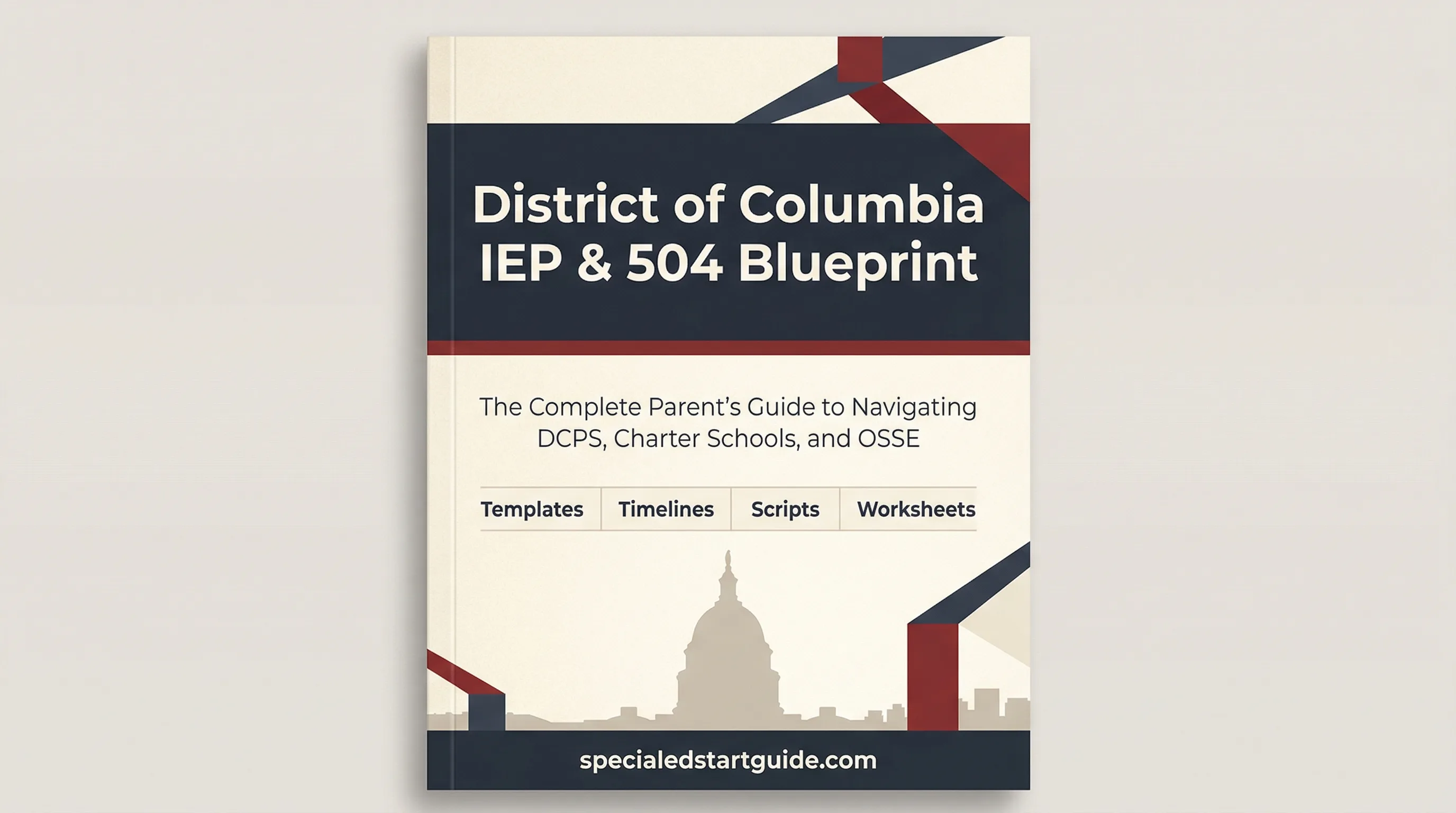
The District of Columbia IEP & 504 Blueprint is the tactical enforcement toolkit that bridges the gap between knowing your rights and actually exercising them — with every template, script, and checklist grounded in DC Municipal Regulations, OSSE procedures, and D.C. Circuit precedent.
What's Inside the Blueprint
The Copy-Paste Advocacy Letter Library
Every letter cites the exact DC Municipal Regulation or federal provision. Request an initial evaluation and start the district's 120-calendar-day clock. Demand an Independent Educational Evaluation at public expense when you disagree with the school's assessment. File a formal State Complaint with the OSSE State Complaint Office when services aren't being delivered. Escalate a charter school's refusal to implement the IEP directly to the DC Public Charter School Board. These aren't generic samples — they're DC-specific enforcement tools that create a legally binding paper trail the moment you hit send.
The DCPS vs. Charter LEA Navigation System
Washington, D.C. is the only jurisdiction in the country where a parent must understand two entirely different escalation pathways depending on whether their child attends a DCPS school or a public charter school. DCPS parents fight bureaucratic inertia within a massive central office that controls Location of Services assignments and specialized program access. Charter parents face a different threat: resource scarcity arguments from schools that accepted the child through the My School DC lottery but later claim they "cannot accommodate" the severity of the IEP. The Blueprint maps both pathways — from the initial conversation with the school through the OSSE State Complaint Office and the DC PCSB grievance process — with specific counter-arguments to the most common deflections each system uses.
The Location of Services Decision Tool
DC uniquely separates "Placement" (the type of classroom — inclusion, resource room, self-contained) from "Location of Services" (the specific physical school building). When your neighborhood school doesn't have the specialized program your child needs, DCPS assigns an LOS across the city — triggering reliance on OSSE's specialized transportation system, which has been the subject of a class-action lawsuit for chronic unreliability. The Blueprint explains your right to challenge an LOS assignment, how to demand that OSSE DOT specialized transportation be written into the IEP as a related service, and what to do when the bus doesn't show up — because every late arrival is a lost hour of FAPE that compounds your compensatory education claim.
The Reid Standard Compensatory Education Tracker
When a school fails to deliver mandated IEP services, parents are entitled to compensatory education. But the D.C. Circuit uses the Reid standard, which explicitly rejects the simple hour-for-hour calculation that works in most jurisdictions. Instead, DC hearing officers demand a qualitative, fact-specific showing of the educational deficit created by the denial of FAPE — and what remedies are needed to place the student where they would have been. Parents routinely lose due process hearings because they ask for "120 missed speech therapy hours" without documenting the qualitative regression in their child's communication skills. The Blueprint provides a structured tracking framework designed specifically for the Reid standard — documenting both the quantitative service gaps and the qualitative skill losses that DC hearing officers actually require.
IEP Meeting Scripts and Checklists
What to say when the team tells you your child is "making progress" but the data shows otherwise. What to say when they offer a 504 instead of an IEP. What to say when the charter school administrator claims staffing shortages prevent service delivery. What to say when DCPS proposes an LOS assignment at a school 45 minutes away. Each script cites the DC Municipal Regulation or federal provision that proves them wrong — so you're not arguing opinions, you're citing law. The pre-meeting checklist covers DC's one-party consent recording rights under D.C. Code §23-542, team composition verification, and the specific documents to bring.
Goal-Tracking Worksheets
Structured fillable worksheets that track progress on every IEP goal between annual reviews. Compare school-reported data against your own observations. Arrive at the next meeting with documentation that either confirms the program is working or proves it isn't — and feeds directly into your compensatory education documentation under the Reid standard.
The Dispute Resolution Roadmap
When informal advocacy fails, you have three formal options in DC: filing a State Complaint with the OSSE State Complaint Office (60-day investigation and corrective action), requesting mediation through ODR, or filing for a due process hearing at the Office of Dispute Resolution. The Blueprint explains when each option is appropriate, the timeline and costs involved, how to prepare for an ODR hearing, and how the paper trail you've been building with the advocacy templates becomes the evidence that wins your case.
Who This Blueprint Is For
- Parents navigating DCPS who need to understand Location of Services assignments, challenge cross-city reassignments, and demand reliable OSSE DOT transportation
- Charter school parents whose LEA says it "cannot accommodate" the IEP — and who need the legal leverage to prevent push-out or escalate to the DC PCSB
- Parents whose child is missing mandated services due to staffing shortages — and who need to document the Reid standard's qualitative evidence for compensatory education
- Parents navigating Early Stages evaluations for children aged 3-5 who need to understand the 120-day timeline and eligibility categories
- Families transitioning between DCPS and charter schools through the My School DC lottery who need to ensure IEP services transfer without gaps
- Military families stationed in DC navigating IEP transfers under the Chancellor's open enrollment directive
- Parents in Wards 7 and 8 fighting for equitable access to specialized programs concentrated in other parts of the city
- Parents navigating the 504-to-IEP question — unsure whether their child's current plan is legally sufficient or whether they should push for a full evaluation
Why Not Just Use the Free Resources?
Washington, D.C. has strong free special education resources. Advocates for Justice and Education (AJE) runs workshops. The Children's Law Center publishes legal toolkits. OSSE issues a Special Education Process Handbook. Here's why parents still struggle after consulting all of them:
- AJE provides education, not tools for the table. AJE is the District's federally mandated Parent Training and Information Center and they do excellent work — free workshops, one-on-one consultations, deep institutional knowledge of OSSE and DCPS. But AJE's extended individual legal representation is gatekept by strict income eligibility requirements: your gross monthly household income must not exceed 300% of the federal poverty level. Middle- and upper-income families in Wards 3 or 6 experiencing severe IEP struggles cannot access AJE's direct representation. And for everyone, intake responses take 1-2 business days — too slow when your IEP meeting is tomorrow morning.
- The Children's Law Center writes for lawyers, not parents. CLC's "Special Education Pro Bono Attorney Training Manual" and "Education Toolkit" are exhaustively detailed — and exhaustively legalistic. They include mock cross-examination scripts for psychologists, formal due process complaint drafting instructions, and dense statutory citations. These materials are designed for the 500+ pro bono attorneys in CLC's network, not for a stressed parent in Ward 4 who needs to draft a legally compliant email tonight. CLC also has strict intake criteria — low-income only, no walk-ins, and a 5-business-day helpline response window.
- OSSE's handbook protects the district, not you. The OSSE Special Education Process Handbook is comprehensive and accurate. It was also explicitly designed to ensure LEA compliance with federal law — not to help you hold those LEAs accountable. It reads entirely like a regulatory manual for school administrators. There are no downloadable parent templates, no referral letter samples, no compensatory education tracking sheets. It tells you what the law requires. It does not tell you what to do when the school ignores the law.
- Etsy and TPT planners organize paperwork — they don't enforce rights. A pastel IEP binder helps you keep documents in order. It won't tell you how to navigate the DCPS vs. charter LEA distinction, how to challenge a Location of Services assignment, or how to document qualitative evidence under the Reid standard. Generic federal templates miss every DC nuance that actually determines your outcome.
The free resources explain what the law says. The Blueprint gives you the tools to make the school follow it.
— Less Than 2 Minutes of a DC Special Education Advocate
Private special education advocates in the DMV charge $100–$300 per hour. Retainers routinely start at $1,500–$2,500. Attorneys require $5,000+ non-refundable retainers and bill up to $700 an hour. Even if you eventually need professional help, the meticulous paper trail you build with this Blueprint saves thousands in billable hours — because you're handing your advocate or attorney an organized case, not a shoebox of unsigned IEP copies and half-remembered meeting conversations.
Your download includes the complete Blueprint guide plus 7 standalone printable PDFs — every template, worksheet, script, and reference card, ready to print and bring to your next meeting.
- Complete Blueprint Guide — 16 chapters covering evaluations, the 120-day timeline, IEP vs. 504 plans, Placement vs. Location of Services, IEP meeting strategy, the IEP document, charter school LEA obligations, OSSE transportation, compensatory education under the Reid standard, school discipline and manifestation determinations, dispute resolution through ODR, transition planning, non-public placements, military family provisions, DC advocacy resources, and letter templates
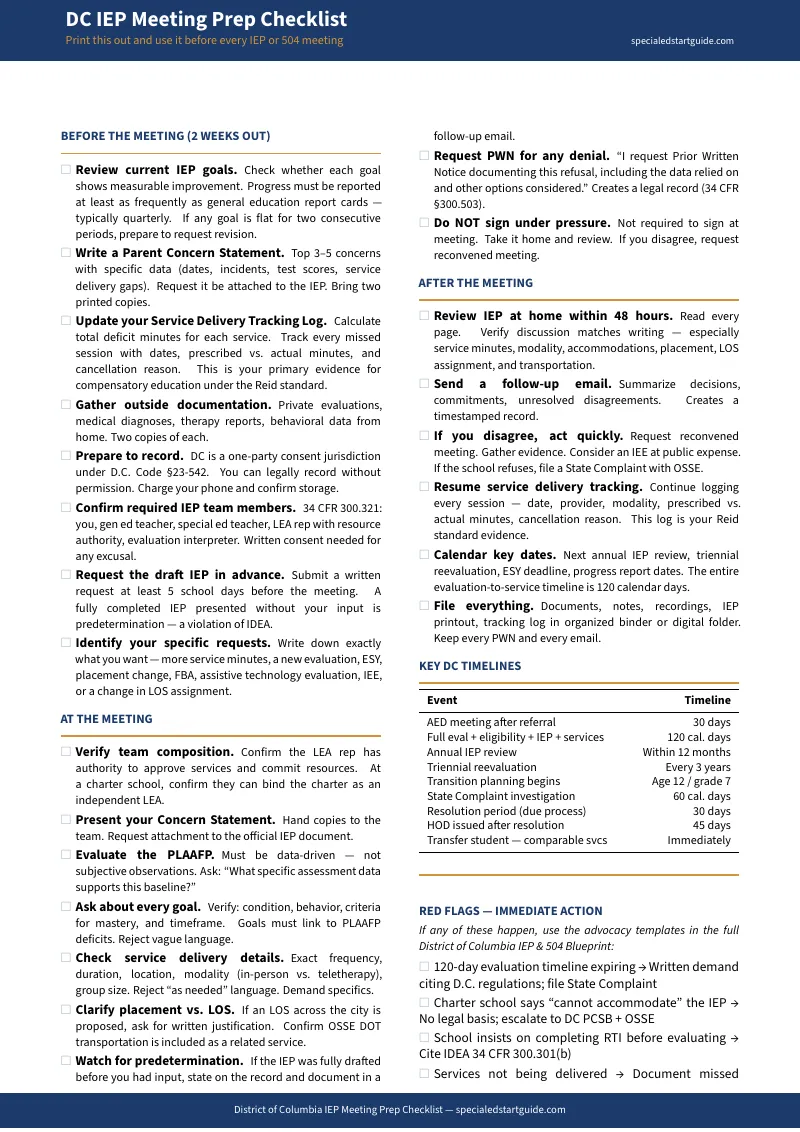
- IEP Meeting Prep Checklist — the before/during/after checklist with DC timelines, one-party consent recording rights, and DCMR citations for every step
- Advocacy Letter Templates — copy-paste letters citing exact DC Municipal Regulations and federal provisions for evaluations, IEEs, charter school service failure complaints, OSSE-DOT transportation complaints, and compensatory education requests
- Goal-Tracking Worksheet — structured fillable worksheet for measurable progress monitoring between annual reviews, feeding directly into Reid standard documentation
- Service Delivery Tracking Log — fillable log to document every scheduled session, missed minutes, and cancellation reasons — the quantitative foundation for compensatory education claims under the Reid standard
- DC Timeline Cheat Sheet — every legal deadline on one page: 120-day evaluation, annual reviews, triennial reevaluations, transition at age 12, and dispute resolution windows
- IEP Meeting Scripts — word-for-word responses to common DCPS and charter school pushback, each citing the specific DCMR section or federal regulation
- Dispute Resolution Roadmap — your formal options when advocacy fails: OSSE State Complaint, ODR mediation, due process hearing, DC PCSB complaint, and OCR complaint — with a comparison table
Instant PDF download. Print the templates tonight. Walk into tomorrow's IEP meeting with the law on your side.
Money-back guarantee, no time limit. If the Blueprint doesn't change how you approach IEP meetings in DC, email us for a full refund. No questions asked.
Not ready for the full Blueprint? Download the free District of Columbia IEP Meeting Prep Checklist — a printable pre-meeting checklist with DC timelines, team composition requirements, one-party consent recording rights, and red flags that require immediate action. It's enough to walk into your next meeting prepared, and it's free.
Your child's education is a legal right, not a favor. The district has teams of lawyers. After tonight, you'll have the same playbook.