The District Knows Connecticut Law. Now You Will Too.
You walked into that PPT meeting prepared — or you thought you did. You read the CPAC brochure. You printed the 35-page Procedural Safeguards notice. You wrote down your concerns. And then the team smiled, used phrases you'd never heard before, and told you your child "doesn't qualify" or that services "aren't available in this district."
You left the meeting with the same IEP your child walked in with. No additional minutes. No new assessments. No Prior Written Notice explaining why they refused your requests — because you didn't know to ask for one.
The problem isn't that you're uninformed. The problem is that Connecticut's special education system is specifically designed to be navigated by professionals, not parents. A Planning and Placement Team structure where you sit across from a table of specialists with clipboards and data. A 45-school-day evaluation timeline that national resources don't even mention — because they quote the federal 60-day rule that Connecticut doesn't follow. A CT-SEDS Parent Portal that times out after 60 minutes, requires you to sign authorization before you can fully view IEP amendments, and can't accept your own document uploads. And two-party consent recording laws that most parents assume mean they can't record the meeting at all — when Connecticut case law says otherwise.
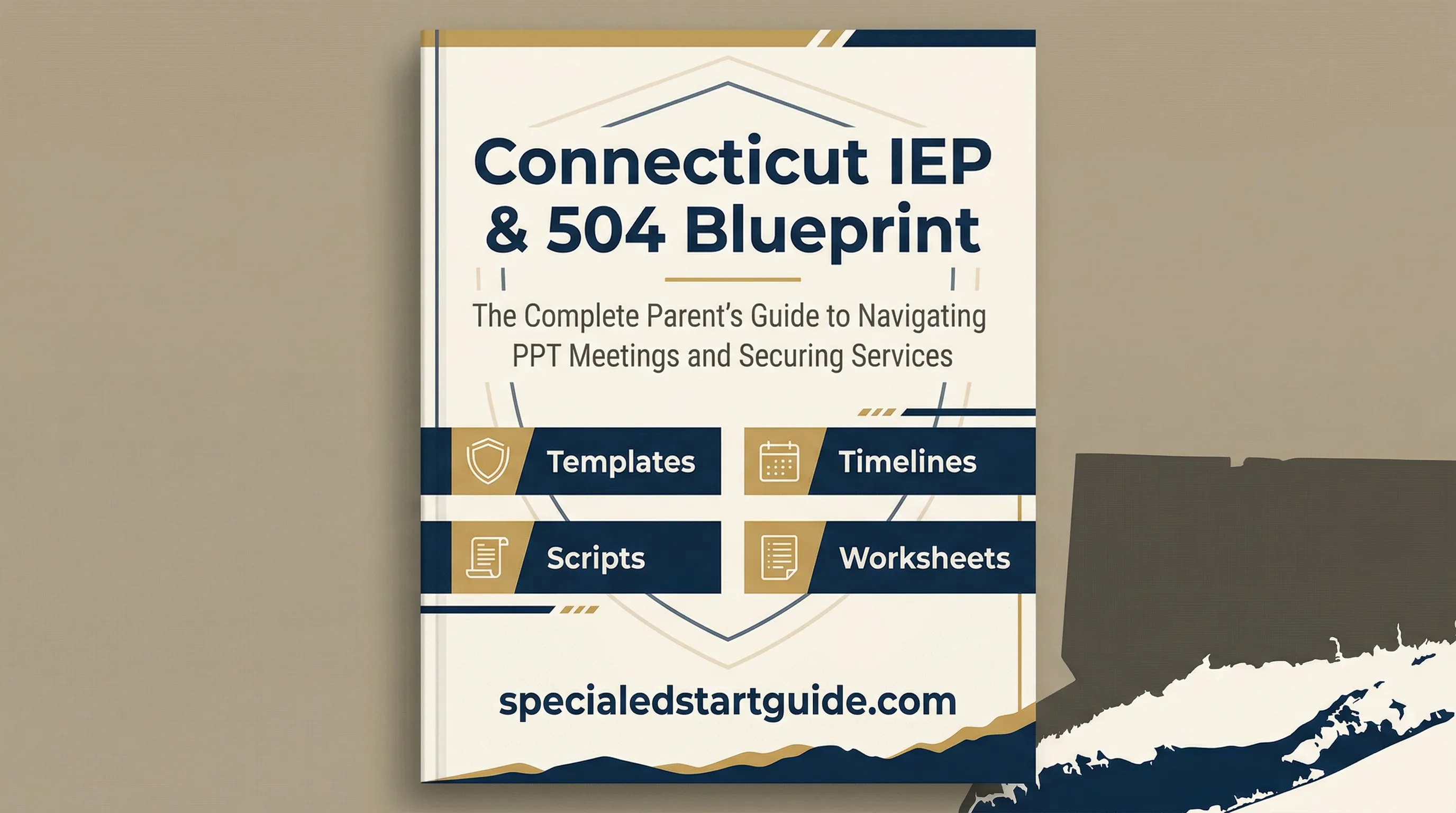
The Connecticut IEP & 504 Blueprint is the tactical enforcement toolkit that bridges the gap between knowing your rights and actually exercising them — with every template, script, and checklist grounded in Connecticut General Statutes, RCSA regulations, and CSDE guidance.
What's Inside the Blueprint
The Copy-Paste Advocacy Letter Library
Every letter cites the exact Connecticut General Statute or RCSA regulation. Request an initial evaluation and start the district's 45-school-day clock under RCSA § 10-76d-13. Demand an Independent Educational Evaluation at public expense when you disagree with the district's assessment. Formally request Prior Written Notice when the PPT refuses any service or placement you've proposed. Submit a two-party consent recording request citing both CGS § 52-570d and the E.H. v. Tirozzi exception. These aren't generic samples — they're Connecticut-specific enforcement tools that create a legally binding paper trail the moment you hit send.
The CT-SEDS Portal Decoder
Connecticut mandated that every district use the CT-SEDS platform for all IEPs and 504 Plans — and the system has been universally criticized. Teachers report it takes up to 10 hours to write a single IEP because service grids get deleted and goals get duplicated. The Parent Portal times out after 60 minutes, access codes expire after five hours, and you can't upload your own evaluations. Worst of all, the system requires you to sign authorization before you can fully view amendment changes. The Blueprint teaches you how to spot deleted service hours, how to verify goal integrity before signing, and how to formally demand hard copies when the portal fails — so you never digitally approve a document you haven't fully reviewed.
The 45-School-Day Timeline Enforcer
Every national IEP resource quotes the federal 60-calendar-day evaluation timeline. Connecticut doesn't follow it. Under RCSA § 10-76d-13, the clock is 45 school days from referral to IEP implementation — and the CSDE rescinded the option to use the federal timeline in January 2020. Parents relying on national guides are giving their district an extra month of delay they're not legally entitled to. The Blueprint maps every milestone within the 45-school-day window, tells you exactly which days count and which don't, and provides the letter template to send when the district misses the deadline.
The Two-Party Consent Recording Kit
Connecticut is a two-party consent state (CGS § 52-570d) — you generally cannot record a conversation without everyone's permission. Most parents stop there. But federal case law specific to Connecticut (E.H. v. Tirozzi, D. Conn. 1990, and V.W. v. Favolise) established that parents have the right to record PPT meetings when necessary for meaningful participation — even over the district's objection. The Blueprint includes a pre-written request letter that cites both authorities and establishes your intent professionally. If the district still refuses, the template creates a documented refusal that becomes evidence in any future complaint.
The Outplacement Architecture
Connecticut places 6.2% of students with IEPs in separate out-of-district facilities — more than 2.5 times the national average. Securing an Approved Private Special Education Program (APSEP) placement requires demonstrating that the district cannot provide FAPE in the least restrictive environment. The Blueprint maps the multi-year documentation strategy: tracking Tier 1, 2, and 3 intervention failures, building behavioral evidence, gathering independent evaluations, and drafting the request that legally corners the district into acknowledging the current placement isn't working.
PPT Meeting Scripts and Checklists
What to say when the team tells you your child is "making progress" but the data shows otherwise. What to say when they offer a 504 instead of an IEP. What to say when the administrator claims staffing shortages prevent service delivery. Each script cites the Connecticut General Statute or RCSA regulation that proves them wrong — so you're not arguing opinions, you're citing law. The pre-meeting checklist covers two-party consent recording, team composition verification under 34 CFR 300.321, and the specific documents to bring.
Goal-Tracking Worksheets
Connecticut is stricter than federal IDEA on IEP goals: RCSA § 10-76d-11 mandates that short-term objectives be included for every student with an IEP — not just students taking alternate assessments. The worksheets give you a structured format to log progress on every goal and objective between PPT meetings, compare school-reported data against your own observations, and arrive at the annual review with documentation that either confirms the program is working or proves it isn't.
The Dispute Resolution Roadmap
When informal advocacy fails, you have three formal options in Connecticut: filing a State Complaint with the CSDE Bureau of Special Education (60-day investigation), requesting mediation through the BSE, or filing for a due process hearing (2-year statute of limitations). The 2026 WestEd report confirmed deep parental frustration with each pathway — bottlenecked investigations, delayed corrective actions, and a system that favors families who can afford attorneys. The Blueprint explains when each option is appropriate, the timeline and costs involved, and how the paper trail you've been building with the advocacy templates becomes the evidence that wins your case.
Who This Blueprint Is For
- Parents navigating the CT-SEDS Parent Portal who need to know how to verify IEP accuracy before signing — and what to do when the system glitches, times out, or won't display amendment changes
- Parents whose district is using the federal 60-day timeline instead of Connecticut's stricter 45-school-day rule — and who need the exact RCSA citation to force compliance
- Parents who want to record PPT meetings but were told they can't because of Connecticut's two-party consent law — and who need the E.H. v. Tirozzi exception to override that refusal
- Parents in Alliance Districts — Bridgeport, Hartford, New Haven, Waterbury, Ansonia — where chronic staffing shortages delay evaluations and reduce service minutes
- Parents in affluent DRG A districts — Greenwich, Avon, Westport, Fairfield — fighting for expensive outplacements against districts with the resources to resist
- Military families at Naval Submarine Base New London navigating IEP transfers into Connecticut's PPT system
- Families transitioning from the Birth to Three System to preschool special education who need to understand how an IFSP translates into a district IEP before their child's third birthday
- Parents navigating the 504-to-IEP question — unsure whether their child's current plan is legally sufficient or whether they should push for a full evaluation
Why Not Just Use the Free Resources?
Connecticut has strong free special education resources. CPAC runs training workshops. Disability Rights Connecticut publishes rights manuals. The CSDE issues procedural safeguards notices. Here's why parents still struggle after consulting all of them:
- CPAC provides education, not tools. CPAC is the state's federally mandated Parent Training and Information Center and they do excellent work — free workshops, individual consultations, Spanish-language resources. But CPAC operates under an empowerment model: they teach you to advocate rather than providing direct representation. Critically, CPAC Parent Consultants generally do not attend PPT meetings with families. The guide you need at the PPT table at 9 AM doesn't exist in their toolkit — because CPAC isn't designed to be at the table with you.
- The state's own procedural safeguards notice is a liability shield, not an advocacy tool. The Procedural Safeguards Notice Required Under IDEA Part B is a 35-page document of dense statutory language covering attorney's fees, manifestation determinations, and civil action filing timelines. It was written to satisfy federal compliance requirements — not to help you negotiate an extra hour of speech therapy. The Parent's Guide to Special Education was last updated in 2021, entirely predating the CT-SEDS rollout that has fundamentally changed how IEPs are written and reviewed.
- DRCT and CCA fight systemic battles, not individual PPTs. Disability Rights Connecticut and the Center for Children's Advocacy are powerhouses in systemic reform — filing complaints about disproportionate discipline and IDEA violations in juvenile justice settings. But their materials are dense legal manuals designed for attorneys and advocates working on civil rights cases, not for a parent in Stamford who needs to know what to say when the PPT chair denies ESY services.
- Etsy and TPT planners organize paperwork — they don't enforce rights. A pastel IEP binder helps you keep documents in order. It won't tell you how to invoke the E.H. v. Tirozzi recording exception, how to calculate the 45-school-day timeline, or how to cite RCSA § 10-76d-11 when the district writes IEP goals without the short-term objectives Connecticut requires. Generic federal templates miss every Connecticut nuance that actually determines your outcome.
The free resources explain what the law says. The Blueprint gives you the tools to make the district follow it.
— Less Than 3 Minutes of a Special Education Attorney
Special education attorneys in Connecticut charge $250–$500 per hour. Retainers routinely start at $3,000–$5,000. Even if you eventually need professional help, the meticulous paper trail you build with this Blueprint saves thousands in billable hours — because you're handing your attorney an organized case, not a shoebox of unsigned IEP copies and half-remembered PPT conversations.
Your download includes the complete Blueprint guide plus standalone printable PDFs — every template, worksheet, script, and reference card, ready to print and bring to your next meeting.
- Complete Blueprint Guide — 17 chapters covering evaluations, the 45-school-day timeline, CT-SEDS navigation, IEP development, PPT meeting strategy, two-party consent recording, ESY services, transition planning, Birth to Three transition, outplacement to APSEPs, 504 plans, school discipline, progress monitoring, state assessment accommodations, magnet and charter school issues, dispute resolution, and Connecticut advocacy resources
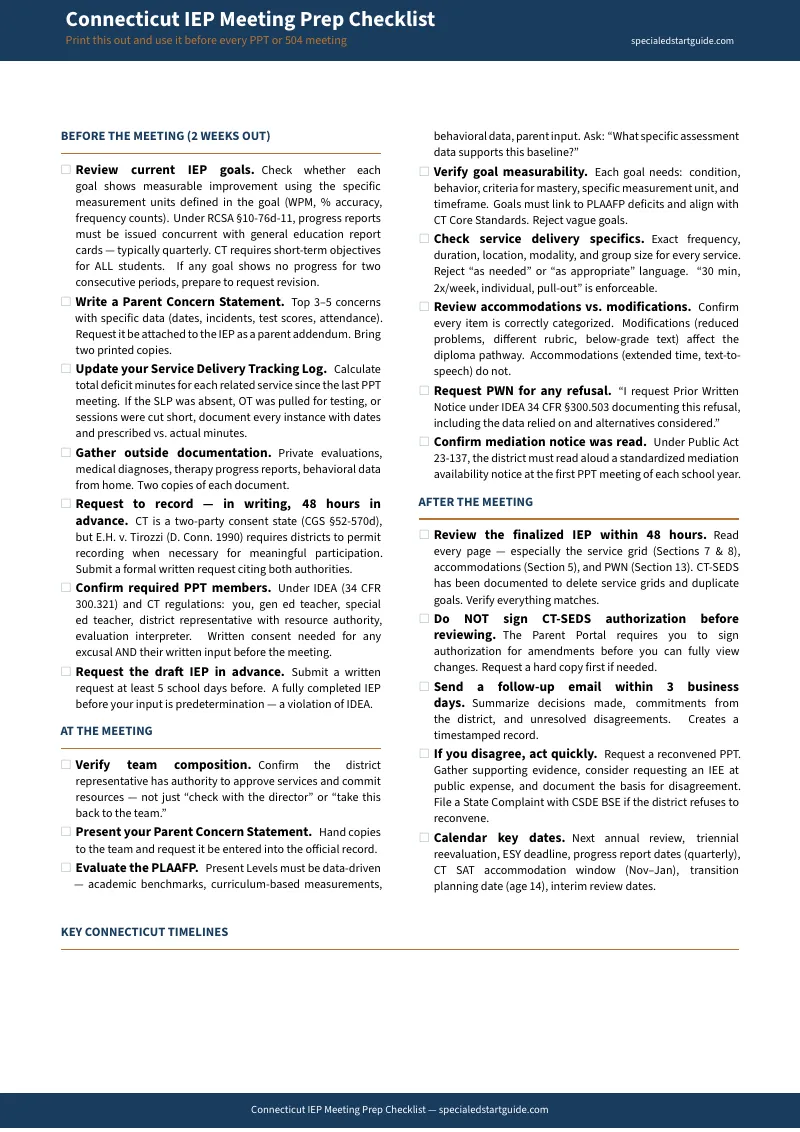
- IEP Meeting Prep Checklist — the before/during/after checklist with Connecticut timelines and CGS/RCSA citations for every step
- Advocacy Letter Templates — copy-paste letters citing exact Connecticut statutes and RCSA regulations for evaluations, IEEs, Prior Written Notice requests, two-party consent recording requests, and compensatory education claims
- Goal-Tracking Worksheet — structured fillable worksheet for measurable progress monitoring between annual reviews, covering both goals and Connecticut's mandatory short-term objectives
- CT-SEDS Review Checklist — step-by-step verification process for spotting deleted service hours, duplicated goals, and missing objectives before you sign anything on the Parent Portal
- Connecticut Timeline Cheat Sheet — every legal deadline on one page: 45-school-day evaluation, annual reviews, triennial reevaluations, transition planning at age 14, Birth to Three transition, and dispute resolution windows
- PPT Meeting Scripts — word-for-word responses to common district pushback tactics, each citing the specific CGS section or RCSA regulation
- Two-Party Consent Recording Request — template letter citing CGS § 52-570d and the E.H. v. Tirozzi exception for requesting permission to record PPT meetings
- Dispute Resolution Roadmap — your three formal options when advocacy fails: State Complaint, BSE mediation, and due process hearing — with a comparison table
Instant PDF download. Print the templates tonight. Walk into tomorrow's PPT meeting with the law on your side.
Money-back guarantee, no time limit. If the Blueprint doesn't change how you approach PPT meetings in Connecticut, email us for a full refund. No questions asked.
Not ready for the full Blueprint? Download the free Connecticut IEP Meeting Prep Checklist — a printable pre-meeting checklist with the Connecticut timelines, team composition requirements, two-party consent recording guidance, and red flags that require immediate action. It's enough to walk into your next meeting prepared, and it's free.
Your child's education is a legal right, not a favor. The district knows Connecticut law. After tonight, so will you.