The District Said No. Now What?
You've been through the meetings. You've read the procedural safeguards. You even brought a typed list of concerns. And the team listened politely, used acronyms you'd never heard before, and sent you home with the same IEP your child walked in with — or worse, no IEP at all.
Maybe the BOCES told you they don't have staff for the services your child needs. Maybe the charter school said "we don't do that here." Maybe the district verbally denied your request but never put it in writing — so you have nothing to escalate. Maybe you were told your twice-exceptional child is "too smart" to qualify for an IEP, even though they're melting down every night after school.
You're not imagining the problem. Colorado's special education system is structured in ways that systematically disadvantage parents who don't know the procedural rules. Administrative Units where the BOCES — not your school — holds IDEA compliance responsibility. A staffing crisis so severe that itinerant providers miss sessions for months while rural parents are told "we simply don't have anyone." And a federal OSEP determination that Colorado "Needs Assistance" in implementing IDEA Part B — meaning the system is officially underperforming at a measurable level.
The Colorado IEP & 504 Advocacy Playbook is the tactical escalation toolkit for parents who've already tried being polite. Every template, every script, and every dispute strategy is built on Colorado's Exceptional Children's Educational Act (ECEA) and the specific statutes that force districts to respond — not because they want to, but because the law requires it.
What's Inside the Playbook
The ECEA Dispute Letter Library
Sixteen fill-in-the-blank advocacy letters, each citing the exact ECEA rule or Colorado Revised Statute that creates a legally binding obligation. Request an initial evaluation and start the AU's 60-calendar-day clock under ECEA Rule 4.02(3)(c)(ii). Demand an Independent Educational Evaluation at public expense when you disagree with the district's assessment. File a Prior Written Notice demand that forces the district to document every verbal "no" in writing. Notify a charter school that claiming "we don't do that here" violates C.R.S. §22-30.5-104(3)(a). Send a compensatory education demand when your child has missed months of mandated services. These letters aren't suggestions — they trigger specific legal timelines the moment you hit send.
The CDE State Complaint Blueprint
When informal advocacy fails, filing a State Complaint with the Colorado Department of Education's Exceptional Student Services Unit starts a 60-day investigation that the district cannot ignore. The Playbook walks you through exactly how to structure the complaint — which violations to allege, how to cite the specific ECEA rules, how to attach the paper trail you've built with the advocacy letters, and what corrective actions to request. This isn't a generic overview of the complaint process — it's a fill-in-the-blank complaint strategy that turns your documentation into evidence.
The BOCES Escalation System
Colorado is one of the few states where special education often runs through regional cooperatives — Boards of Cooperative Educational Services — rather than individual districts. Most parents waste months arguing with local principals who don't actually control the special education budget. The Playbook maps out exactly how to identify your child's Administrative Unit, escalate past local gatekeepers, and direct your legal demands to the BOCES Special Education Director who actually has the authority to authorize services, fund evaluations, and approve out-of-district placements.
The Due Process Preparation Guide
Due process is the nuclear option — a formal hearing before an administrative law judge. It's intimidating, but it's also the mechanism with the most enforcement power. The Playbook explains the 2-year statute of limitations, the resolution session requirement, the standard of proof, and how to decide whether to proceed with or without an attorney. It shows you how to organize the paper trail you've been building into a timeline of violations that speaks for itself.
The Twice-Exceptional Advocacy Framework
Colorado formally recognizes 2e students under ECEA Section 12.01 — but school teams routinely use a child's high cognitive ability to deny IEP services. "They're passing their classes" becomes the justification for ignoring executive functioning deficits, emotional dysregulation, and social skill gaps. The Playbook provides the specific framework to force evaluation beyond academic performance and to demand ALP/IEP integration so your child's disability needs aren't masked by their intellectual strengths.
The Mediation Strategy Guide
Colorado offers free mediation through the ESSU — a less adversarial alternative to due process that can resolve disputes in weeks rather than months. The Playbook covers how to request mediation, what to prepare, how to structure your opening statement, and the critical rule that mediation agreements are legally binding and enforceable in court. It also explains when mediation is the wrong choice — because some districts use it to delay rather than resolve.
IEP Meeting Confrontation Scripts
What to say when the team refuses your request but won't put it in writing. What to say when the administrator claims staffing shortages excuse service reductions. What to say when the district offers a 504 instead of an IEP to avoid providing specialized instruction. Each script cites the ECEA rule or Colorado statute that proves the district wrong — so you're not arguing opinions, you're citing law that triggers mandatory action.
The Compensatory Education Calculator
When your child has missed mandated services — speech therapy sessions that didn't happen, a paraprofessional who was never hired, an itinerant provider who stopped showing up — the district owes compensatory education. The Playbook provides a structured tracking system to document every missed minute and a demand letter template that quantifies the debt in specific service hours the district must repay.
Who This Playbook Is For
- Parents whose IEP requests have been denied, delayed, or ignored — and who need the exact legal language to force the district to respond in writing
- Parents in rural Colorado whose BOCES itinerant provider hasn't shown up in weeks — and who need to document the gap and demand compensatory education
- Parents of twice-exceptional children who've been told their child is "too smart" for an IEP — and who need the ECEA framework to force evaluation beyond academic performance
- Parents whose charter school said "we don't do that here" — and who need the specific statute to prove that charter schools are bound by the same special education laws as any public school
- Parents preparing to file a CDE State Complaint or request mediation — and who need to know exactly how to structure the filing
- Parents considering due process who want to understand the timeline, the costs, and whether the paper trail they've built is strong enough
- Parents in Denver, Jefferson County, Cherry Creek, Douglas County, or Colorado Springs districts where IEP services are chronically underdelivered and meetings produce no results
Why Not Just Use the Free Resources?
Colorado has excellent free special education resources — but none of them are designed to help you escalate a dispute. Here's the gap:
- PEAK Parent Center teaches you about the process — not how to fight it. PEAK's federally funded mandate is collaborative. They explain your rights and foster positive relationships with schools. They don't provide pre-written dispute letters, complaint filing strategies, or confrontation scripts for hostile IEP meetings. And their one-on-one advising has waitlists that don't help when your child's services were cut last Tuesday.
- Disability Law Colorado publishes fact sheets — but rejects most individual cases. DLC's guides are legally rigorous and accurate. But their capacity is limited to systemic, class-action-potential cases. When you contact them about your child's specific IEP dispute, you're almost always directed back to the self-advocacy materials on their website — scattered across dozens of PDFs with no chronological strategy.
- The CDE provides the rules — not the strategy. The Procedural Safeguards Notice tells you that you can file a State Complaint. It does not tell you how to write one that wins. The CDE website has the complaint form. It does not have the tactical framework for building the evidence package that forces corrective action.
- Etsy and TPT planners organize your paperwork — they don't enforce your rights. A pastel IEP binder won't tell you how to demand Prior Written Notice, how to structure a compensatory education claim, or how to cite ECEA Rule 3.01 when the BOCES says "we don't have staff." Generic federal templates miss every Colorado nuance that determines your outcome.
The free resources explain what the law says. The Playbook gives you the tools to force the district to follow it.
— Less Than 4 Minutes of a Special Education Advocate
Special education advocates in Colorado charge $100–$300 per hour. Retainers start at $600–$1,500 just to review your file. Even if you eventually need professional help, the meticulous paper trail you build with this Playbook saves hundreds in billable hours — because you're handing your advocate an organized case file, not a shoebox of unsigned IEP copies and half-remembered conversations from meetings where nothing was recorded.
Your download includes the complete Playbook guide plus standalone printable PDFs — every template, script, and reference card, ready to print and use immediately.
- Complete Advocacy Playbook — 16 chapters covering the Colorado advocacy landscape, your legal arsenal of ECEA statutes, Administrative Unit and BOCES navigation, evaluation enforcement, Independent Educational Evaluations, IEP meeting tactics, fill-in-the-blank advocacy letters, dispute resolution (state complaints, mediation, due process), discipline protections, twice-exceptional advocacy, bullying and FAPE denial, special populations, Extended School Year, transition planning, documentation standards, and a Colorado resources directory
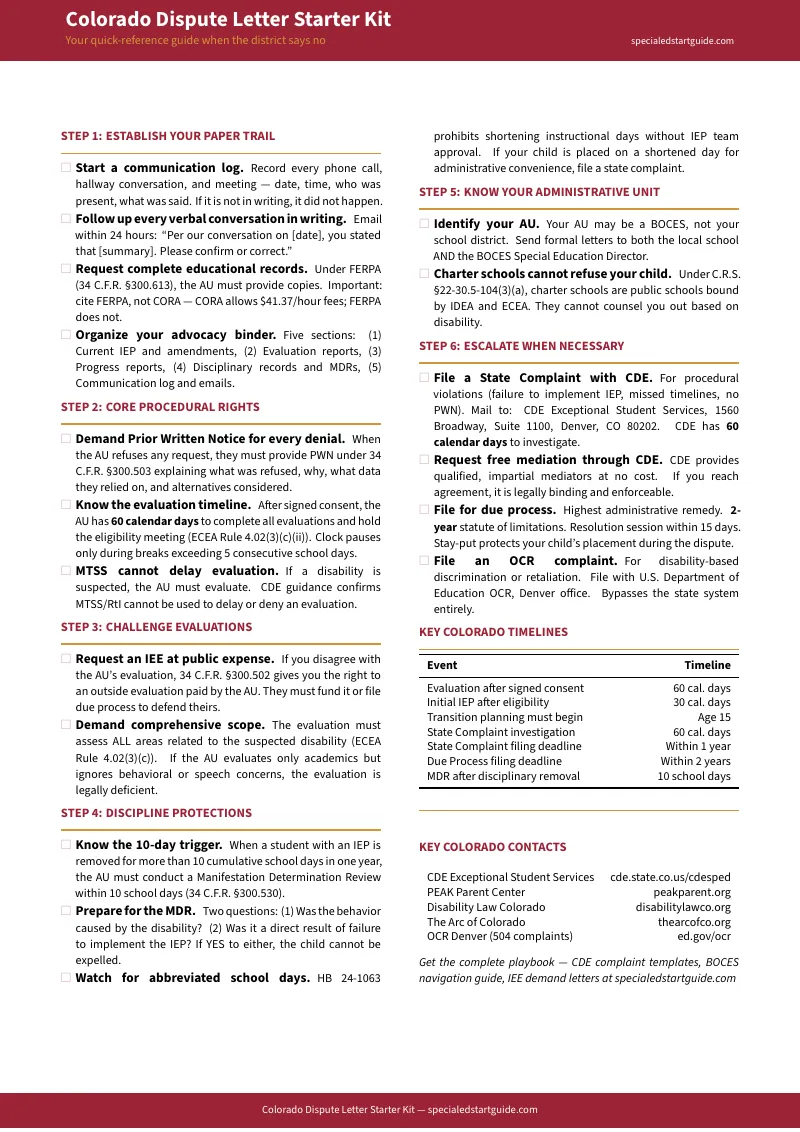
- Dispute Letter Starter Kit — copy-paste letter templates citing exact ECEA rules and Colorado statutes for evaluation requests, Prior Written Notice demands, IEE requests, charter school non-compliance notices, compensatory education claims, and one-party consent recording notices
- CDE State Complaint Template — structured fill-in-the-blank complaint framework with violation categories, evidence attachment guide, and corrective action requests
- Due Process Decision Checklist — a structured analysis of whether your case warrants due process, including timeline, costs, evidence strength assessment, and attorney consultation questions
- Compensatory Education Tracker — fillable worksheet for documenting missed service minutes with dates, provider names, and cumulative totals for your demand letter
- Mediation Preparation Guide — opening statement framework, key evidence checklist, and negotiation strategies for Colorado ESSU mediation sessions
- Colorado Dispute Timeline Cheat Sheet — every dispute deadline on one page: 60-day state complaint investigation, 2-year due process statute of limitations, 180-day OCR window, resolution session timelines, and mediation scheduling
Instant PDF download. Print the templates tonight. Send your first advocacy letter tomorrow morning.
Money-back guarantee, no time limit. If the Playbook doesn't change how you handle IEP disputes in Colorado, email us for a full refund. No questions asked.
Not ready for the full Playbook? Download the free Colorado Dispute Letter Starter Kit — a sample dispute letter template and parent rights one-pager for special education disagreements in Colorado. It's enough to send your first formal request, and it's free.
Your child's education is a legal right — and the district knows it. After tonight, you'll know how to prove it.