Free Guides Tell You What the Law Says. This Playbook Shows You How to Use It Against the District.
You've read the SERR manual. You've called your Family Empowerment Center. You've spent three weeks learning what "Prior Written Notice" means — and then the district refused your request anyway, without putting a single reason in writing.
You didn't fail at advocacy. The free resources failed you. Disability Rights California publishes a 16-chapter legal encyclopedia. Family Empowerment Centers run workshops on basic rights. SELPA handbooks explain procedures. But none of them will tell you what to write when the district violates the 15-day assessment timeline, how to respond when they deny an Independent Educational Evaluation, or exactly which statute to cite when the SELPA coordinator claims a service "isn't available in your area."
That's the gap between knowing your rights and enforcing them. And the district profits from that gap every single day.
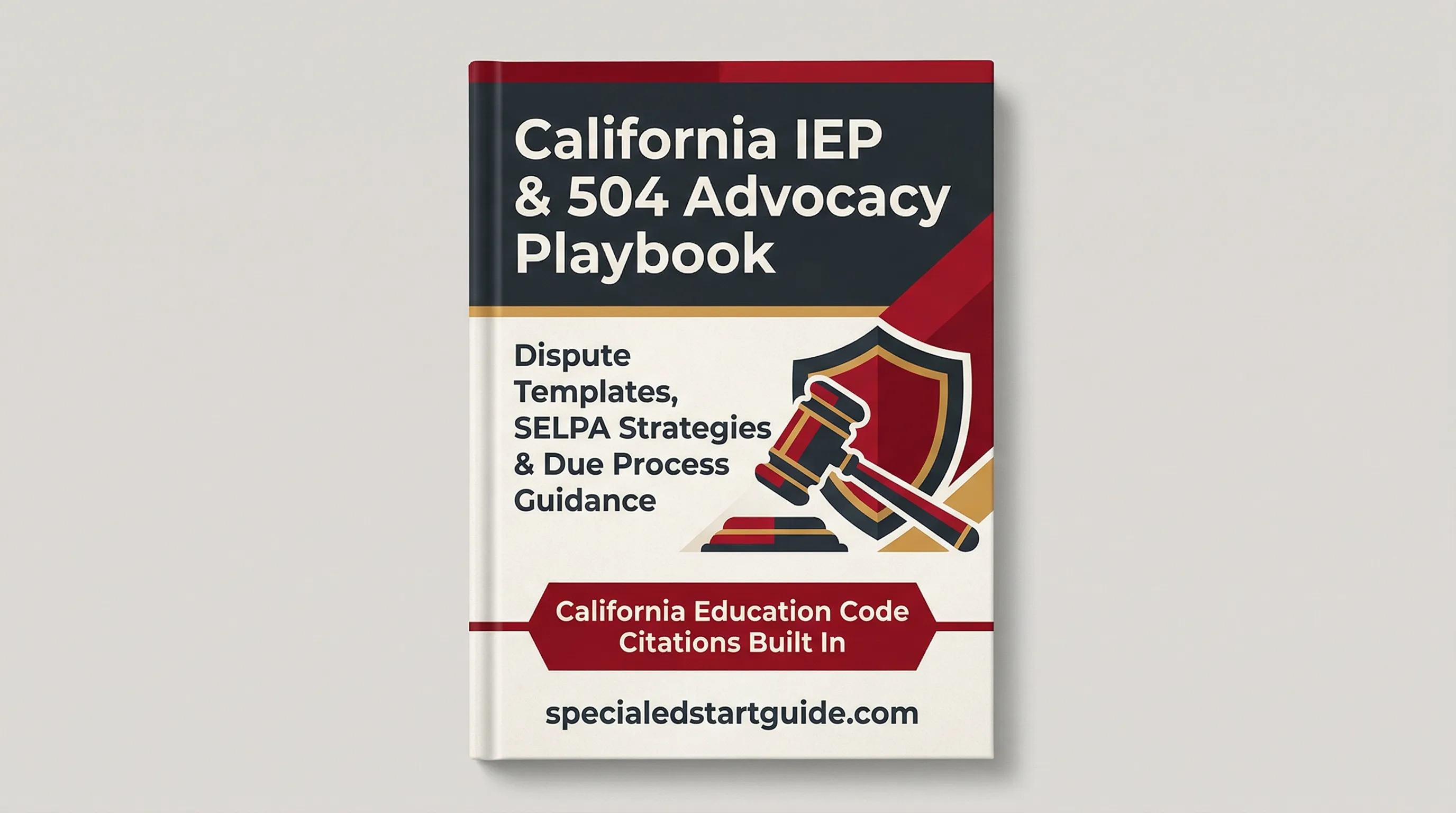
The California IEP & 504 Advocacy Playbook is a tactical enforcement system — fill-in-the-blank templates, dispute strategies, and meeting scripts, each pre-loaded with the California Education Code citations that legally command a response.
What's Inside the Playbook
The Dispute Letter Arsenal
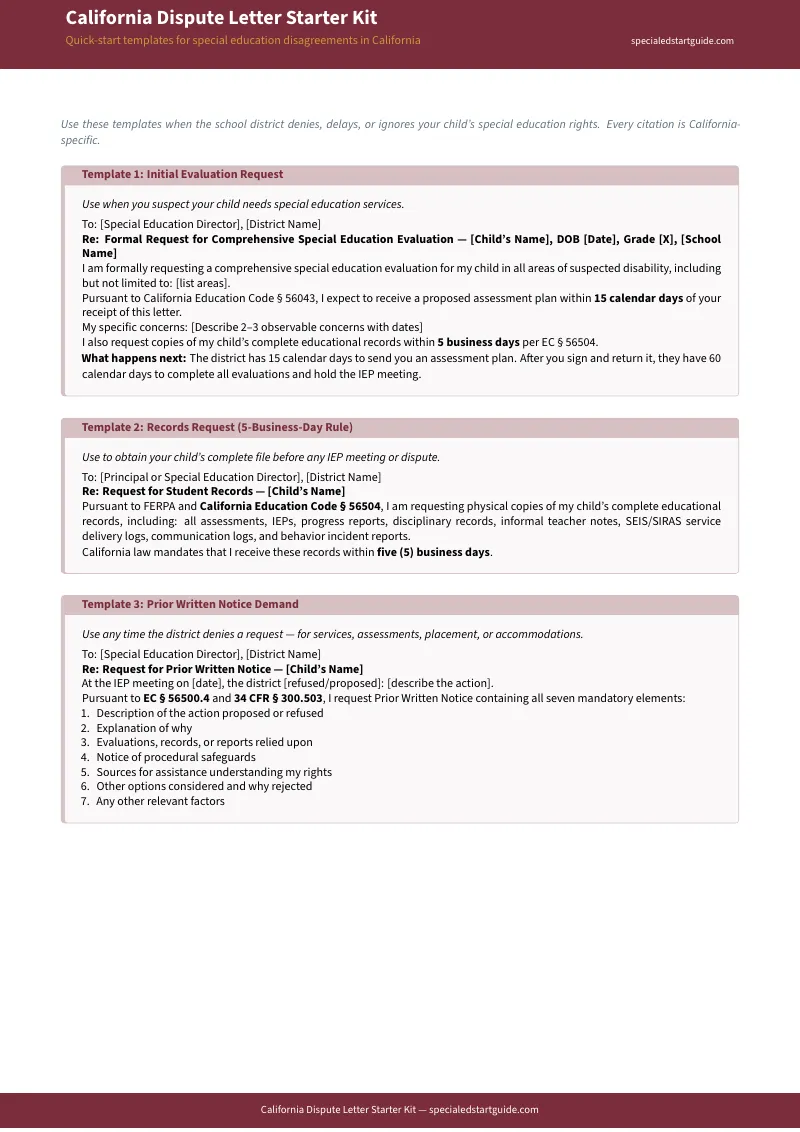
Every letter cites the exact California statute that triggers a legal obligation. Demand an assessment plan within 15 calendar days under EC § 56043. Request an IEE at public expense citing 34 CFR § 300.502 and EC § 56329 — with language that blocks the district from imposing unapproved cost caps or restricting your choice of evaluator. File a Prior Written Notice demand under EC § 56500.4 that forces the district to explain every refusal with all seven mandatory elements. These aren't polite requests — they're legally binding enforcement tools that create a timestamped paper trail the moment you hit send.
The SELPA Navigation Map
California is the only state where nearly 140 regional consortiums — not individual schools — control special education funding and placement options. When the principal says "we don't have the resources," they're telling the truth about their building but lying by omission about your SELPA's obligation to provide a full continuum of services across the region. The Playbook explains how SELPAs work, how to request the SELPA's Local Plan, and how to escalate when the district claims a service doesn't exist — because somewhere in your SELPA, it does.
The OAH Dispute Resolution Strategy
When letters and meetings don't work, you have three formal options in California: filing a compliance complaint with the CDE, requesting mediation through the Office of Administrative Hearings, or filing for due process. Most parents never learn how these options actually work because the SELPA handbook is designed to steer you toward informal resolution — which protects the district's budget, not your child's rights. The Playbook explains when each option is appropriate, how to file, what evidence to gather, and how the paper trail you've been building becomes the case that wins — or forces the district to settle before you ever reach a hearing.
Manifestation Determination Defense
When a student with a disability is suspended for more than 10 cumulative school days, the district must hold a Manifestation Determination Review to determine whether the behavior was caused by the disability. Districts routinely botch this process — failing to consider all relevant information, ignoring the relationship between the disability and the behavior, or pressuring parents to waive their rights. The Playbook gives you the preparation checklist, the questions to ask, and the specific legal arguments that protect your child from being punished for symptoms of their disability.
Compensatory Education Claims
If the district denied, delayed, or failed to deliver services your child was legally entitled to, your child may be owed compensatory education — additional services to make up for what was lost. The Playbook explains how to calculate the deficit, document the violation, and present the claim at an IEP meeting or through formal dispute resolution. This is where the service delivery logs, timeline violations, and Prior Written Notice demands you've been collecting become financially quantifiable leverage.
The ERMHS Mental Health Battle Plan
After AB 114 shifted mental health funding responsibility back to school districts, districts became financially incentivized to deny or minimize Educationally Related Mental Health Services. The Playbook explains the difference between school counseling and ERMHS, how to request an ERMHS assessment citing the correct Government Code provisions, and what to do when the district claims your child's anxiety "doesn't affect educational performance" — because in California, the definition of educational performance extends far beyond grades.
Nonpublic School Placement Guidance
When the public school cannot provide FAPE — when the SDC is overcrowded, the behavioral supports are absent, or the program is simply not designed for your child's needs — you have the right to request a district-funded Nonpublic School placement. The Playbook explains the legal standard, the evidence needed, how to invoke California's "stay put" protection to keep your child in their current placement during the dispute, and how to navigate the NPS referral process when the district would rather spend $1 million fighting you than fund the $50,000 placement your child needs.
Who This Playbook Is For
- Parents whose district is violating California Education Code timelines — ignoring assessment requests, delaying IEP meetings, or failing to deliver services written in the IEP
- Parents who've been told "we don't offer that service" by a school that's hiding behind SELPA funding structures the parent doesn't understand
- Parents whose child was suspended or threatened with expulsion and who need to understand manifestation determination protections before the school pushes for removal
- Parents preparing to file a CDE compliance complaint, request OAH mediation, or explore due process — who need the filing strategy without the $3,000 attorney retainer
- Parents whose child needs mental health services but the district is gatekeeping the ERMHS assessment to avoid the cost
- Parents pursuing an Independent Educational Evaluation at district expense after the school's evaluation missed critical areas of need
- Parents in LAUSD, Bay Area districts, Central Valley, or rural California who've exhausted informal advocacy and need the legal tools to escalate
Why Not Just Use the Free Resources?
California has exceptional free special education resources. Disability Rights California, Family Empowerment Centers, SELPA handbooks, and the CDE all provide information. Here's why parents still lose at the IEP table after consulting all of them:
- The SERR manual is a legal encyclopedia, not an operational playbook. Sixteen chapters of FAQ-formatted legal analysis explain what the law says. They do not give you the pre-written letter to send tonight citing that law. For a parent whose 15-day assessment deadline was just violated, the gap between understanding a right and exercising it is the difference between winning and losing.
- Family Empowerment Centers cannot give strategic advice. They're state-funded to provide peer support and basic rights education. They cannot tell you whether to reject the district's offer, whether to file for due process, or how to counter the district's arguments at the IEP table. When you need tactical direction — not emotional support — FECs are legally prohibited from providing it.
- SELPA handbooks are written by the district, for the district. They explain procedures in compliance-friendly language and steer you toward informal dispute resolution. They do not explain how to use those procedures as leverage against the district that wrote the handbook.
- National resources miss every California nuance. Wrightslaw and Understood.org cover federal IDEA law. But if you quote a vague federal statute when a stricter California Education Code section applies, the district immediately knows you're operating blind — and they will exploit it.
Free guides tell you what the law says. This Playbook gives you the exact scripts to use the law as a weapon.
— Less Than 5 Minutes with a Special Education Attorney
A special education attorney in California charges $300–$500 per hour. A professional advocate charges $150–$250 per meeting, plus a $600+ retainer to even look at your IEP. Even if you eventually need professional representation, the meticulous paper trail you build with this Playbook saves thousands in billable hours — because you're handing your attorney an organized case built on California Education Code violations, not a stack of unsigned IEP copies and half-remembered conversations.
Your download includes the complete Playbook guide plus 5 standalone printable PDFs — every template, script, and reference card, ready to print and use immediately.
- Complete Advocacy Playbook — 16 chapters covering evaluation enforcement, IEE demands, SELPA navigation, IEP meeting tactics, Prior Written Notice, dispute resolution (CDE complaints, OAH mediation, due process), discipline protections, ERMHS mental health services, Nonpublic School placements, compensatory education, and a California resources directory
- Dispute Letter Templates — 5 fill-in-the-blank letters citing exact California Education Code sections for initial evaluations, records requests, Prior Written Notice demands, IEE requests, and assessment timeline violations
- IEP Meeting Scripts — word-for-word responses for 8 common district pushbacks, each citing the California statute that supports your position — print and bring to every meeting
- SELPA Navigation Reference — how California's 140 SELPAs work, your escalation path, and the key questions to ask — on one printable sheet
- Dispute Resolution Roadmap — CDE compliance complaints, OAH mediation, due process hearings, and OCR complaints compared side by side with filing deadlines, costs, and remedies
- California Parent Rights One-Pager — every critical timeline, your core rights as checkboxes, red flags requiring immediate action, and where to get help — included in the Dispute Letter Starter Kit
Instant PDF download. Fill in the first template tonight. Send it before the district's next deadline expires.
Money-back guarantee, no time limit. If the Playbook doesn't change how you handle disputes with your California school district, email us for a full refund. No questions asked.
Not ready for the full Playbook? Download the free California Dispute Letter Starter Kit — 4 fill-in-the-blank templates with California Education Code citations for evaluations, records requests, Prior Written Notice demands, and IEE requests. Enough to start building your paper trail tonight, and it's free.
The district is counting on you not knowing the law. After tonight, they'll have to deal with someone who does.