
The School Says Your Child "Tests Too Well" for an IEP. Arkansas Law Says That's Not the Standard.
Your child has autism. The school psychologist confirmed the diagnosis. But at the eligibility meeting, the special education coordinator pulled up your child's ACT Aspire scores, pointed to the "ready" benchmark in reading, and told you that because the scores are adequate, your child doesn't need an IEP — a 504 Plan with some accommodations should be "sufficient." You know your child melts down every afternoon after holding it together all day at school. You know the social isolation is getting worse. You know the homework battles aren't about laziness. But the 24-page document they handed you is filled with acronyms you don't recognize, and the meeting lasted 12 minutes. You signed because you didn't know what else to do.
Arkansas serves 73,087 school-age students with IEPs — 15.70% of the state's enrollment. The state reimburses districts for special education costs only after per-student spending exceeds $15,000, creating a direct financial incentive to minimize services. Teachers in Arkansas report being told by administrators not to recommend additional services during IEP meetings — and some quietly call parents before the meeting to say, "You should ask for this, because I can't." The rural divide stretches from the booming suburbs of Northwest Arkansas — where Bentonville and Rogers have full-time school psychologists and autism specialists — to the Delta counties where a single special education teacher may serve multiple campuses and the nearest speech-language pathologist is contracted on a biweekly rotation. The law guarantees the same FAPE everywhere. The reality doesn't match.
Special education attorneys in Arkansas charge $250 to $450 per hour. Disability Rights Arkansas provides free legal advocacy but serves the entire state with limited staff. The Center for Exceptional Families — Arkansas's federally designated Parent Training and Information center — offers workshops and webinars but cannot sit next to you at the IEP table and push back when the district proposes cutting therapy minutes. If you earn too much for free legal aid but not enough for a retainer, you are navigating this system alone.
The Arkansas IEP & 504 Blueprint is the Meeting-Ready Advocacy System — the tactical toolkit that bridges the gap between knowing your rights under Arkansas law and actually enforcing them at the IEP table, with every template, tracking tool, and advocacy letter grounded in Arkansas DESE special education regulations and IDEA.
What's Inside the Blueprint
The "If This, Say That" Script Bank
This is the tool that changes everything for Arkansas families. When the team says your child doesn't qualify because ACT Aspire scores are adequate, you have the exact words to respond — citing that academic performance is not the sole standard for IDEA eligibility and that adverse effect on educational performance includes functional performance, social skills, behavior, and executive functioning. When the coordinator says "We don't have the budget for a paraprofessional," you have the citation proving that lack of resources cannot legally justify denying FAPE. When the school pushes a 504 instead of an IEP, you know the critical difference — a 504 is an unfunded mandate with weaker discipline protections, and you have the script to demand a full IDEA evaluation instead.
The 60-Calendar-Day Timeline Tracker
The moment you consent to an evaluation, Arkansas DESE rules give the district 60 calendar days to complete it — running continuously through weekends and summer, with no pauses. Districts exploit these timelines by initiating evaluations in April knowing summer staffing gaps will create delays they blame on circumstances. The Blueprint maps every milestone — 7 days for the referral conference, 21 days for the referral conference after receipt, 60 days for the evaluation, 30 days for IEP development — with the specific regulation reference, follow-up language at each checkpoint, and the escalation template when deadlines pass without action.
The Copy-Paste Advocacy Letter Library
Every letter cites the exact Arkansas DESE regulation. Request a formal evaluation and start the district's 60-calendar-day clock. Demand an Independent Educational Evaluation at public expense using the specific legal phrase that triggers the district's obligation to either pay or file for due process. Request a Functional Behavioral Assessment. Document service non-delivery with your tracking data. Formally disagree with an IEP proposal and demand Prior Written Notice under 34 CFR §300.503. These aren't generic federal templates — they're Arkansas enforcement tools that create a legally binding paper trail the moment you hit send.
The Service Delivery Tracking Log
When the IEP says "speech therapy 3x per week, 20 minutes per session" and the therapist position has been vacant since October, the district owes your child compensatory education for every missed minute. But you have to prove the minutes were missed. This printable tracking matrix lets you log every scheduled session, mark attended or missed, calculate the cumulative deficit, and present the data at the next IEP meeting or in a State Complaint. Without documentation, the district will claim services were delivered. With this log, they can't.
IEP Meeting Scripts and Checklists
What to say when the team tells you your child doesn't qualify because grades are passing. What to say when they push a 504 instead of an IEP — and why the unfunded mandate problem makes that dangerous in Arkansas. What to say when someone claims the district doesn't have the staff for a service written into the IEP. What to say when the IEP arrives fully drafted before you've had input — predetermination violates IDEA. Each script is grounded in federal law and Arkansas DESE rules. The pre-meeting checklist covers one-party consent recording under Ark. Code §5-60-120, required IEP team composition, and the specific documents to bring.
Goal-Tracking Worksheets
IEP goals in Arkansas must be measurable — with baselines, targets, and mastery criteria. But many goals are written so vaguely that progress is impossible to track. "Student will improve reading comprehension" is not a goal — it's a wish. The worksheets give you a structured format to log data between meetings, compare school-reported progress against your own observations, and arrive at the annual review with documentation that either confirms the program is working or proves it isn't. Arkansas reports progress concurrent with report cards every nine weeks — use that schedule to your advantage.
The Dispute Resolution Escalation Ladder
When informal advocacy fails, Arkansas offers formal options: State Complaints to the DESE Dispute Resolution Section (triggering a 60-day investigation), mediation through DESE, and due process hearings. The Blueprint explains when each option is appropriate, the timeline and costs involved, and how to build the paper trail that wins — including the fact that State Complaints are free, don't require an attorney, and frequently produce faster results than due process.
Who This Blueprint Is For
- Parents preparing for their first IEP meeting who don't want to walk in blind against a team that does this every day — and who need to understand the IEP document before it's discussed at the table
- Parents whose child was told they "test too well" for an IEP and was steered toward a 504 Plan — even though the disability clearly affects functional performance, behavior, or social skills beyond what ACT Aspire scores measure
- Parents in Little Rock, Pulaski County, Bentonville, Springdale, Jonesboro, or Fayetteville navigating districts where caseloads are crushing, evaluations are backlogged, and IEP teams pressure parents to sign at the table
- Parents in rural Arkansas or Delta communities where provider shortages mean the school psychologist covers three buildings and the SLP is contracted on a biweekly rotation — and FAPE is still the legal standard
- Military families at Little Rock Air Force Base navigating a mid-year IEP transfer and being told the district needs to "re-evaluate" before providing comparable services
- Parents whose child has ADHD, autism, dyslexia, or anxiety and whose services are being reduced at the annual review — suspecting the cuts are driven by the $15,000 funding threshold, not by the child's actual progress
- Parents whose child is being suspended repeatedly for disability-related behavior and who need to understand Manifestation Determination Reviews and the 10-day rule
- Grandparents, foster parents, and other caregivers who have educational decision-making authority and need to understand their standing in the IEP process
Why Not Just Use the Free Resources?
Arkansas has strong free special education resources. The Center for Exceptional Families is the federally funded Parent Training and Information center. Disability Rights Arkansas (DRA) publishes legally sound advocacy guides. DESE provides procedural safeguards and a family guide. Here's why parents still struggle after consulting all of them:
- The Center for Exceptional Families trades money for time. Accessing their deepest value requires navigating intake, waiting for callbacks, and attending scheduled webinars and workshops. Their best tools are heavily skewed toward transition planning for students ages 16 to 21. When you have a surprise IEP meeting in three days and need to prepare tonight, you need tools you can download and use at midnight — not an 8-week course.
- DRA's publications are legally accurate and practically impenetrable. The Parent's Guide to Special Education translates IDEA into readable English — but it's a static informational booklet. It doesn't contain fillable templates, meeting scripts, or pre-written advocacy letters. It tells you what should happen but doesn't give you the tools to enforce it when things go wrong.
- DESE's Procedural Safeguards are written to protect the district, not to help you. The document explains your rights in language designed for legal compliance, not for a parent who just received a diagnosis and needs to understand basic meeting prep tonight. It tells you that you have the right to participate in the IEP meeting but doesn't teach you how to participate effectively.
- National guides like Wrightslaw don't address Arkansas-specific implementation. They won't explain the $15,000 per-student funding threshold that drives district behavior, Arkansas's 12 eligibility categories (consolidated from the federal 13), the specific DESE IEP form layout, or the 7-day and 21-day referral timelines unique to Arkansas. Federal law is the floor — Arkansas implementation is where parents get lost.
- Etsy and TPT planners organize paperwork — they don't enforce rights. A pastel IEP binder keeps documents in order. It won't explain why the district is legally wrong to deny services based on adequate test scores, how to calculate compensatory service debt, or how to demand Prior Written Notice for a refusal.
- Private advocates cost $100–$300 per hour. Attorneys run $250–$450. If you hand them a disorganized pile of papers, you'll spend hundreds just for the file review. The Blueprint teaches you how to build the binder, decode the IEP, track services, and draft the initial requests — either empowering you to advocate alone or saving hundreds in billable hours if you do hire someone.
The free resources explain what Arkansas law says. The Blueprint gives you the tools to make the district follow it.
— Less Than One Hour of a Special Education Advocate
Private advocates in Arkansas charge $100–$300 per hour when you can find one. Special education attorneys run $250–$450. A comprehensive advocacy package — record review, meeting prep, and IEP attendance — costs $1,500 to $5,000. The Blueprint teaches you how to build the binder, decode the IEP document, track missed services, draft the initial requests, and hold the district accountable with Arkansas-specific citations — either empowering you to advocate effectively without professional help, or saving hundreds in billable hours if you do hire someone.
Your download includes the complete Blueprint guide plus standalone printable PDFs — every template, worksheet, script, and reference card, ready to print and bring to your next IEP meeting.
- Complete Blueprint Guide — 16 chapters covering the Arkansas special education landscape, IEP vs. 504, referral and evaluation timelines (60-calendar-day evaluation under Arkansas DESE rules), Arkansas's 12 eligibility categories, IEP meeting strategies, the IEP document walkthrough, goals and progress monitoring, Independent Educational Evaluations, related services and ESY, the 504 Plan process, school discipline protections, transition planning from early childhood through post-secondary, diploma pathways, transfer students and military families, dispute resolution, and Arkansas advocacy resources
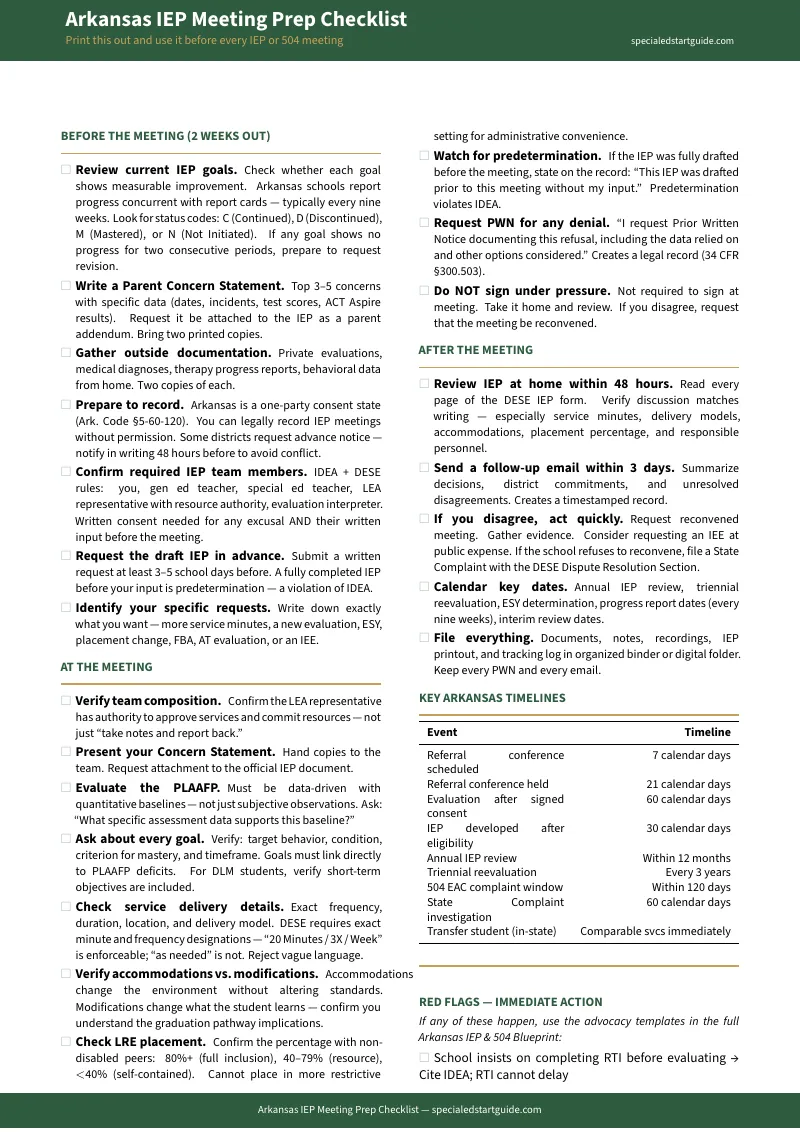
- IEP Meeting Prep Checklist — the before/during/after checklist with Arkansas timelines, one-party consent recording rules under Ark. Code §5-60-120, and DESE regulation citations for every step
- Advocacy Letter Templates — copy-paste letters citing exact Arkansas DESE regulations for evaluation requests, IEEs, FBA demands, service non-delivery, compensatory education demands, and formal disagreements
- Service Delivery Tracking Log — printable matrix for logging every therapy session, calculating deficit minutes, and building your compensatory education case
- Goal-Tracking Worksheet — structured fillable worksheet for measurable progress monitoring between annual IEP reviews
- Arkansas Timeline Cheat Sheet — every legal deadline on one page: 7-day referral conference, 21-day referral meeting, 60-calendar-day evaluation, 30-day IEP development, annual reviews, triennial reevaluations
- IEP Meeting Scripts — word-for-word responses to common IEP team pushback tactics, each grounded in Arkansas DESE rules and IDEA
- Dispute Resolution Roadmap — your formal options: DESE State Complaint, mediation, and due process — with Arkansas-specific filing procedures
- 504 vs. IEP Decision Matrix — side-by-side comparison of protections with Arkansas-specific qualification criteria and the critical unfunded mandate distinction
Instant PDF download. Print the templates tonight. Walk into tomorrow's IEP meeting with Arkansas law on your side.
Money-back guarantee, no time limit. If the Blueprint doesn't change how you approach IEP meetings in Arkansas, email us for a full refund. No questions asked.
Not ready for the full Blueprint? Download the free Arkansas IEP Meeting Prep Checklist — a printable pre-meeting checklist with Arkansas timelines, IEP team composition requirements, one-party consent recording rules under Ark. Code §5-60-120, red flags that require immediate action, and the specific questions that force the team to put refusals in writing. It's enough to walk into your next meeting prepared, and it's free.
Your child's education is a legal right — not a budget line item the district trims when spending approaches $15,000. The advocacy letter you send tonight is the first step toward making them prove it.