The School Said "We'll Handle the Transition." Then Your Child Turned 16.
The Annual Review said your child would "explore career interests" and "develop independent living skills." It did not say that Disability Living Allowance stops at 16 and must be replaced by PIP before your child can qualify for Universal Credit. It did not mention that the LCWRA assessment must be completed before a full-time course starts — not after — or your child is permanently disqualified. It did not warn you that supported housing waitlists stretch for years, that adult social care will not refer itself, or that in Northern Ireland, Statements of SEN cease absolutely at 19 with no extension, no tribunal, no safety net.
Parents call it the cliff edge. Parliamentary committees call it the cliff edge. Ofsted calls it a "serious weakness." The Social Mobility Commission calls it a "perfect storm." Only 4.8% of adults with SEND known to local authorities secure permanent paid employment. The post-16 support system is not broken — it was never designed to hold your child. It was designed to hand them to a fragmented adult landscape where education, health, social care, benefits, and employment sit in separate departments that do not talk to each other, do not make automatic referrals, and do not assign anyone to hold the whole picture together.
That person is you. And the system assumes you already know how it works.
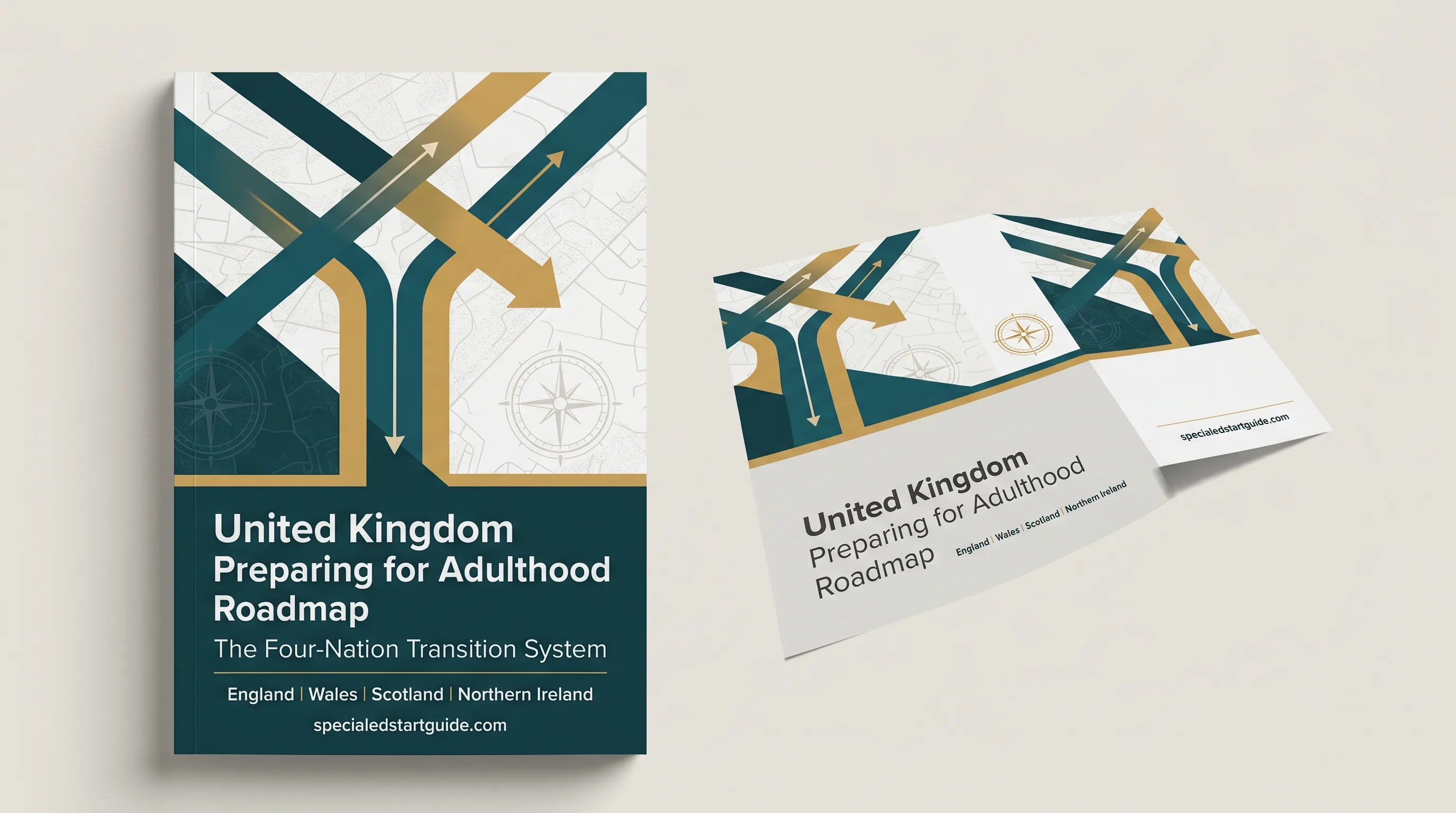
The United Kingdom Preparing for Adulthood Roadmap is the Four-Nation Transition System — the 12-chapter guide that integrates education pathways, welfare benefits, adult social care, housing, employment, and legal decision-making across England, Wales, Scotland, and Northern Ireland into a single year-by-year action plan. It gives you the sequencing the school never explains, the benefits bridge the DWP never clarifies, and the cross-border decoder that no free charity can provide — because every charity stops at its own border.
What's Inside the Roadmap
The Four-Nations Decoder
An equivalence matrix mapping EHCP (England), IDP (Wales), CSP (Scotland), and Statement (Northern Ireland) across governing legislation, statutory age limits, transition triggers, post-16 responsibility, dispute resolution bodies, and key advocacy organisations. The reference table that stops you acting on advice written for the wrong nation — because the parent forum advice about "demanding PfA outcomes" is meaningless if you live in Scotland, and the EHCP-to-25 extension does not exist in Northern Ireland.
The Benefits Bridge — The Money Side Nobody Explains Clearly
DLA to PIP at 16 (or Adult Disability Payment in Scotland). Child Benefit continuation rules tied to specific educational pathways. Universal Credit with the LCWRA assessment that must be sequenced correctly or your child is permanently locked out. Employment and Support Allowance. Carer's Allowance. How each benefit interacts with every other benefit, and how each one interacts with post-16 study choices. Missing the DLA-to-PIP window can cost your family hundreds of pounds per month. Getting the UC sequencing wrong can disqualify your child from living costs support for the entire duration of their course. The free government websites tell you each benefit exists. This chapter tells you the order in which to apply and what happens if you get it wrong.
Post-16 and Post-19 Pathways Across All Four Nations
Further Education colleges with the questions to ask before accepting a place. Specialist post-16 institutions and how to fight for LA funding when they push the cheapest mainstream option. Supported internships — DFN Project SEARCH reports up to 70% employment outcomes, delivering £9 return for every £1 invested, yet your school may never mention them because they do not have a local provider. Apprenticeships with EHCP flexibilities. Traineeships. Activity Agreements (Scotland). Skills for Life and Work (Northern Ireland, with extended age eligibility to 22 that most families are never told about). Day opportunities. Specific eligibility criteria, funding mechanisms, and application routes for each nation — not vague encouragement to "explore options."
University DSA and the GDPR Shock
You have managed every Annual Review, every meeting, every decision for a decade. Then your child turns 18 and enters university, and UK-GDPR legally prohibits the university from discussing their DSA application, support arrangements, or academic progress with you — unless your child formally authorises contact before freshers' week. Most parents discover this after the term starts. The guide walks you through the DSA application via Student Finance England, SAAS, Student Finance Wales, or SFNI, the Study Needs Assessment, and the trusted contact permissions that keep you involved without violating the law your child did not know existed.
The Adult Social Care Transition
The Care Act 2014 assessment (England). Self-directed Support (Scotland). HSC Trust referral (Northern Ireland). The Social Services and Well-being Act (Wales). When to trigger each assessment, what the eligibility thresholds look like, and how to prevent the catastrophic gap between children's services ending at 18 and adult services starting — which, without your intervention, can stretch for months. Direct payments, personal budgets, and how to commission your own care rather than accepting whatever the local authority offers.
Housing and Independent Living
Supported living versus residential care versus Shared Lives — the funding mechanisms, tenancy rights, and quality differences between each model. Why supported living preserves your child's autonomy while residential care does not. Why housing waitlists must be joined years before your child actually needs to move. And the legal reality of the Mental Capacity Act: when parental authority transfers to the young person at 16 or 18, what "capacity" actually means (it is decision-specific, not all-or-nothing), and when you need a Lasting Power of Attorney, a Guardianship Order, or supported decision-making arrangements.
Employment Pathways by Nation
The cross-nation employment matrix mapping supported internships, apprenticeships, pre-vocational bridging programs, and long-term employment support across all four nations. Access to Work — the UK government program that funds workplace adaptations, specialist equipment, travel assistance, and job coaching — which is separate from the EHCP, has no upper age limit, and is so poorly advertised that most employers and young people have never heard of it. The supported employment model that consistently outperforms the old "train then place" approach. How to mention Access to Work in every employment-related transition meeting, because nobody else will.
Fighting EHCP Cessation
Local authorities routinely attempt to cease EHCPs at 19. They are often acting unlawfully. The Children and Families Act 2014 permits EHCPs to continue to 25, and an LA cannot cease one simply because a young person has reached a particular age. The guide explains exactly what the law requires, what evidence wins a cessation appeal, and where to get the free, legally verified template letters from IPSEA that cite the correct statutory provisions — so you do not weaken your case by writing from scratch.
The Master Year-by-Year Timeline
Year 9 to age 25. When to demand PfA outcomes in the Annual Review. When to apply for PIP. When to trigger adult social care assessments. When to name specific post-16 provision in the EHCP, IDP, or CSP. When to apply for DSA. When to challenge cessation notices. When to join supported housing waitlists. Every action dated, every deadline nation-specific, every step sequenced so the benefits chain does not break and the referrals do not arrive too late.
Who This Roadmap Is For
- Parents whose child's transition plan says they will "develop independence" but does not name a specific college, does not mention supported internships, does not trigger an adult social care referral, and does not explain the benefits sequencing that determines whether your child qualifies for Universal Credit or is permanently locked out
- Parents who just discovered that PIP must be in place before the LCWRA assessment, and the LCWRA must be completed before the course starts — and their child turns 16 in four months
- Parents approaching the age-18 handover who have not yet requested an adult social care transition assessment because the school never mentioned it was their responsibility to initiate
- Parents in Northern Ireland whose child's Statement expires at 19 — no extension, no tribunal, no equivalent of England's EHCP-to-25 provision — who need to connect their child to HSC Trust adult services before that date
- Parents in Scotland who searched online for transition guidance and found advice about "demanding PfA outcomes" — which does not apply under the ASL Act
- Military families and families relocating across UK national borders who need to understand that an EHCP has no legal force in Scotland, an IDP does not transfer to Northern Ireland, and no free resource explains what happens to your child's support when the governing legislation changes completely
- Parents whose academically capable child is heading to university — who have just discovered that UK-GDPR blocks the university from discussing their child's DSA application or academic progress without formal authorisation they did not know to set up
- Parents with 30 browser tabs open across Gov.uk, Education Scotland, the Welsh Government, SENAC, IPSEA, Mencap, and Disability Rights UK — who need one document that tells them what applies in their nation, in what order, starting now
Why Not Just Use the Free Resources?
IPSEA, SNAP Cymru, Enquire, SENAC, Contact, Mencap, and Disability Rights UK provide outstanding guidance. Here is why families still fall through the cracks after consulting all of them:
- Every charity stops at its own border. IPSEA covers EHCP law in England but cannot advise on the Scottish ASL framework. SNAP Cymru covers the Welsh ALN system but does not explain how PIP interacts with Universal Credit. Enquire covers Scottish ASL provisions but cannot help with cross-border placements into English specialist colleges. There is no free resource anywhere that integrates all four nations into one transition plan.
- Education and finance are kept in separate silos. Educational guides discuss college pathways. Benefits guides discuss welfare entitlements. But for your family, these are inseparable — the post-16 course your child chooses determines whether Child Benefit continues, whether UC is available, and whether the LCWRA timing works. No free resource maps these interdependencies across all the decision points where getting the sequence wrong has permanent consequences.
- Government websites explain policy, not survival. Gov.uk details the EHCP process across fifty pages. It never explains that your strongest leverage often comes from the Equality Act 2010, that "appropriate further education" in Section I of the EHCP is legally unenforceable, or that the SENCO's vague transition plan can be challenged at tribunal. Government guidance informs you of the bureaucratic process. It omits what to do when that process fails.
- Private SEN advocates charge £75 to £200 per hour. A comprehensive transition planning package from a specialist consultant costs £1,500 to £3,000. This Roadmap covers the foundational knowledge — the four-nations decoder, the benefits sequencing, the adult social care timeline, the post-16 pathway matrix, and the year-by-year action plan — for a fraction of a single consultation. And when you do need professional representation, you arrive already understanding the landscape, saving hours of expensive orientation time.
— Less Than Ten Minutes of a SEN Advocate
SEN advocates charge £75 to £200 per hour. SEN solicitors charge £150 to £350 per hour. A missed PIP deadline costs your family hundreds of pounds per month. A botched UC application permanently disqualifies your child from living costs support for their entire course. A transition plan that does not name a specific post-16 provider is legally unenforceable. This entire Roadmap costs less than a brief phone call with any professional — and covers ground that no single professional appointment will: all four UK nations, education, benefits, social care, housing, and employment integrated into one action plan.
Your download includes the complete 12-chapter Roadmap, 8 standalone printable reference sheets, and a Transition Planning Checklist — 10 PDFs in total:
- United Kingdom Preparing for Adulthood Roadmap — 12 chapters covering the cliff edge reality, the Four-Nations Decoder (EHCP, IDP, CSP, Statement equivalence matrix), the complete benefits bridge (DLA to PIP, Universal Credit, ESA, Carer's Allowance), post-16 and post-19 education pathways, university DSA and the GDPR parental lockout, adult social care transition, housing and independent living, employment pathways and Access to Work, fighting EHCP cessation, legal decision-making and the Mental Capacity Act, advocacy tools with escalation pathways, and the master year-by-year timeline from Year 9 to age 25
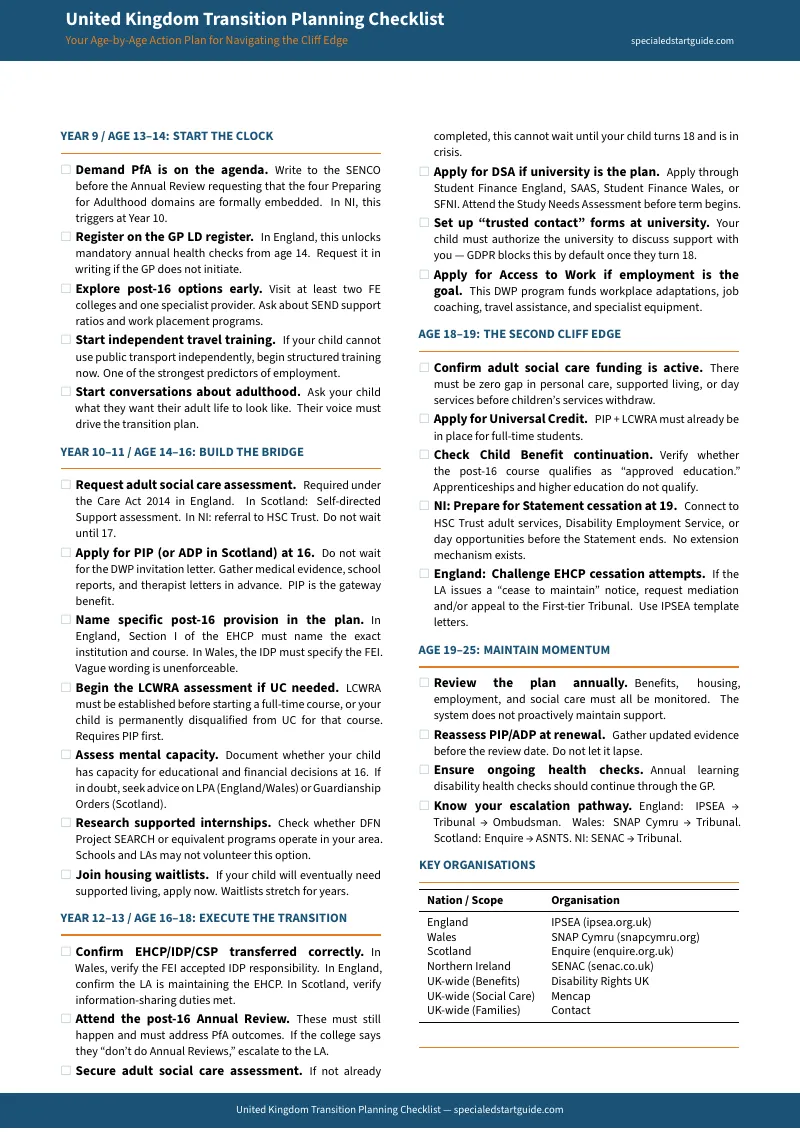
- United Kingdom Transition Planning Checklist — the standalone age-by-age action plan covering Year 9 through age 25, benefits application sequencing, nation-specific escalation contacts, and the deadlines families miss most often
- Four-Nations Decoder — printable equivalence matrix mapping EHCP, IDP, CSP, and Statement across all key dimensions, plus nation-specific critical details and cross-border warnings
- Benefits Timeline — the integrated age-by-age benefits sequencing table with the LCWRA trap warning and Scotland ADP differences
- PfA Review Preparation Sheet — the four Preparing for Adulthood domains with good vs poor planning indicators and 6 critical questions to ask at every transition review
- Post-16 Pathways Reference — every pathway option (FE colleges, SPIs, supported internships, apprenticeships, traineeships, Activity Agreements, Skills for Life and Work) with nation-specific eligibility and red flags
- Employment Matrix — cross-nation employment pathways, Access to Work details, and the supported employment model
- University DSA Guide — the Disabled Students' Allowance application process and the GDPR shock with trusted contact setup instructions
- EHCP Cessation Defence — the law, the cessation notice process, evidence needed to win an appeal, and IPSEA template letter sources (England only)
- Escalation Pathways — template letter sources and the four-step escalation ladder for each UK nation, plus the key organisations reference table
Instant PDF download. Identify where your child is on the timeline tonight. Execute the next step tomorrow morning.
Money-back guarantee, no time limit. If the Roadmap does not change how you navigate your child's transition, email us for a full refund. No questions asked.
Not ready for the full Roadmap? Download the free United Kingdom Transition Planning Checklist — a printable age-by-age action plan covering the critical milestones from Year 9 to age 25, the benefits application sequence, nation-specific escalation contacts, and the deadlines families miss most often. It gives you the structure. The full Roadmap gives you the strategy behind every step.
The school's job ends when your child leaves. Your child's future does not end with it — but the window to secure it is closing. The cliff edge is real. The benefits sequencing is unforgiving. The adult social care referral will not make itself. Start now.