The School Promised an IEP. The Council Says Your Child Doesn't Qualify for a CSP. This Toolkit Shows You Exactly What Scottish Law Requires Them to Do Anyway.
You've sat through meetings where the school promised Pupil Support Assistant hours that never appeared. You've read a two-page IEP full of targets like "improve literacy" with no measurable criteria, no timeline, and no named person responsible. You've asked about a Co-ordinated Support Plan and been told your child "doesn't meet the threshold." And when you searched for help online, every guide you found was written for English parents navigating EHCPs — a legal framework that does not exist in Scotland.
Here's what nobody told you at that meeting: an IEP in Scotland is not a legally binding document. The school can abandon every target in it without breaching a single statutory duty. But that doesn't mean your child has no legal protection. The Education (Additional Support for Learning) (Scotland) Act 2004 places duties on the education authority to identify and provide "adequate and efficient" support for your child's learning — regardless of whether they hold a CSP, a Child's Plan, or just an IEP. The law is on your side. You just haven't been given the tools to use it.
You've read Enquire's 109-page parent guide. You've decoded your council's Staged Intervention handbook. You've posted on Facebook groups and received well-meaning advice from parents in England telling you to "request an EHCP" — which doesn't exist in Scotland. And your child is still on a part-time timetable, still school-refusing, still being managed instead of supported.
The Scotland CSP & Additional Support Blueprint is the tactical toolkit that bridges the gap between knowing your rights exist and actually enforcing them — with every template, checklist, and meeting script grounded in the ASL Act 2004 and the GIRFEC framework that Scottish schools are required to follow.
What's Inside the Blueprint
The ASN Rights Enforcement System
Most Scottish parents believe they need a Co-ordinated Support Plan to have legal protection. They don't. Less than 0.4% of ASN pupils hold a CSP, yet every child with Additional Support Needs has statutory rights under the ASL Act — rights your school and education authority must honour whether the support is recorded in a CSP, a Child's Plan, or a school-level IEP. This system shows you exactly which duties apply at each level, with template letters citing the specific sections of the Act that compel the authority to act.
The SHANARRI Translation Matrix
Scottish schools speak GIRFEC. When you say "my child is anxious and refusing to attend," the school hears a parenting concern. When you write "my child's wellbeing indicators for being Safe, Achieving, and Included are currently failing due to unmet sensory processing needs," you trigger the school's statutory GIRFEC obligations. This matrix converts your everyday concerns into the exact language schools must respond to — turning a complaint they can deflect into a formal trigger they cannot ignore.
The "No Diagnosis Required" Demand Letters
If your child is on a multi-year NHS waiting list for an autism, ADHD, or dyslexia assessment, you do not have to wait for a diagnosis before the school provides support. Scotland's ASN system is entirely needs-led. If your child faces a barrier to learning — for whatever reason — they are legally entitled to additional support today. These template letters give you the exact phrasing to bypass the "we need a diagnosis first" excuse, citing the sections of the ASL Act that prove the school wrong.
The IEP Accountability Framework
An IEP is the most common support document in Scottish schools — and the least enforceable. It is a non-statutory promise. When the school fails to deliver what the IEP promises, most parents feel powerless because they've been told "an IEP isn't legally binding." This framework shows you how to hold the school accountable anyway: how to demand SMART targets, how to audit whether provision was actually delivered, and how to escalate failures to the education authority using the statutory duties of the ASL Act — because even though the IEP isn't binding, the authority's duty to provide adequate support is.
The CSP Request Toolkit
If your child has complex or multiple needs requiring support from education and at least one other agency for more than a year, they may qualify for Scotland's only legally binding education plan — the Co-ordinated Support Plan. This toolkit walks you through the strict eligibility criteria, the statutory timelines (8 weeks for the authority's decision, 16 weeks to draft the plan), and what to do when the authority misses deadlines or refuses to assess. It includes the request letter, the appeal pathway, and the evidence checklist for the Additional Support Needs Tribunal.
Copy-Paste Letter Library
Every letter cites the exact section of the ASL Act 2004 or the Code of Practice. Request a Child's Plan meeting and start the school's obligation to coordinate. Escalate a failing IEP to the Quality Improvement Officer. Demand that the education authority explain why PSA hours were cut mid-term. Request a post-school transition planning meeting at age 14. File a formal complaint when the staged intervention process stalls. These are Scotland-specific enforcement tools — not English EHCP templates repackaged with a tartan cover.
Meeting Scripts and Checklists
What to say when the school tells you "we can't provide a PSA because of budget cuts" — the budget is the authority's problem, not yours. What to say when the Educational Psychologist recommends support but the school claims they "don't have the resources." What to say when the school suggests a part-time timetable as a permanent solution. Each script cites the legal provision that proves them wrong. The pre-meeting checklist covers your right to bring a supporter or advocate, recording consent, document requests, and the exact questions to ask before anyone sits down.
Transition Planning Checklists
The move from primary to secondary — and from school to adult life — is where Scottish ASN support most often collapses. Education authorities have a statutory duty to plan transitions for pupils with CSPs or those at risk of not making a successful transition, starting no later than 12 months before. These checklists give you the timeline, the agencies that must be involved, and the demand letters to force planning meetings when the school lets deadlines drift.
Who This Blueprint Is For
- Parents whose child has an IEP that the school treats as optional — targets aren't met, support hours disappear, and nobody is held accountable
- Parents who've been told their child "doesn't meet the threshold" for a Co-ordinated Support Plan and don't know what to do next
- Parents stuck on a multi-year NHS waiting list for a diagnosis, being told the school "can't provide support without one" — which is not what the law says
- Parents navigating the 32-council postcode lottery who need to know what the national law requires, regardless of their local authority's interpretation
- Families who've moved from England and discovered that their child's EHCP holds no legal weight in Scotland
- Parents approaching primary-to-secondary transition or the post-16 "cliff edge" who need to force the authority into planning meetings before it's too late
- Parents drowning in Scottish jargon — GIRFEC, SHANARRI, SfL, ASL Act, CSP, IEP, TAC — who need a translator, not another 100-page policy document
- Parents who are exhausted from cross-referencing Enquire factsheets, council handbooks, and Mumsnet threads — and need everything in one actionable toolkit
Why Not Just Use Enquire and the Free Resources?
Scotland has outstanding free ASN resources. Enquire provides gold-standard legal information. The Scottish Government's Code of Practice is comprehensive. Let's Talk ASN offers legal advocacy. Here's why parents still struggle after consulting all of them:
- Enquire tells you the law — it doesn't write your emails. Their parent guide is brilliant and exhaustive. It is also 109 pages long. When you're sitting at the kitchen table at 10 PM and need to email the Headteacher before tomorrow's meeting, you don't have time to cross-reference six factsheets and the Code of Practice. You need a template letter ready to send. Enquire provides the legal framework. This Blueprint turns it into fill-in-the-blank tools you can use tonight.
- Your council's handbook is written to manage you, not empower you. Local authority parent guides focus heavily on the limits of what the council will provide — citing "reasonable public expenditure" caveats and staged intervention frameworks. They rarely tell you how to hold the council legally accountable when it fails to deliver. This Blueprint does.
- Let's Talk ASN is capacity-limited and intervenes at crisis point. Govan Law Centre's Education Law Unit provides excellent legal representation — for Tribunal cases. There's a vast middle ground of parents who simply need to escalate a failing IEP, request a Child's Plan meeting, or demand proper transition planning. You don't need a solicitor for that. You need the right template letter and the confidence to send it.
- English advice will actively harm you. Every Mumsnet thread, Facebook group, and TikTok video about "getting an EHCP" is wrong for Scotland. EHCPs don't exist here. SEND Tribunals don't exist here. OFSTED doesn't inspect Scottish schools. Using English terminology in your emails signals to the school that you don't understand the system — and gives them permission to dismiss you. This Blueprint uses exclusively Scottish law, Scottish terminology, and Scottish enforcement mechanisms.
The free resources explain what the law says. This Blueprint gives you the tools to make the education authority follow it.
— Less Than 15 Minutes With a Private Educational Solicitor
A private educational solicitor charges £200–£350 per hour. An independent advocate costs £50–£100 per session. Even Enquire's helpline, when you can get through, gives you information — not the template letter you need to send by morning. The paper trail you build with this Blueprint saves hours of professional fees if you do eventually need legal support, because you're handing your solicitor an organised case, not a box of unsigned IEPs and half-remembered meeting notes.
Your download includes 8 printable PDFs — the complete Blueprint guide plus 7 standalone reference tools, each designed to be printed separately and brought to your next meeting.
- Complete Blueprint Guide — 12 chapters covering how the Scottish ASN system works, the IEP vs Child's Plan vs CSP distinction, your statutory rights without a CSP, needs-led support without diagnosis, the SHANARRI framework, meeting preparation, template letters, the dispute resolution hierarchy, transition planning, and a complete directory of Scottish support organisations
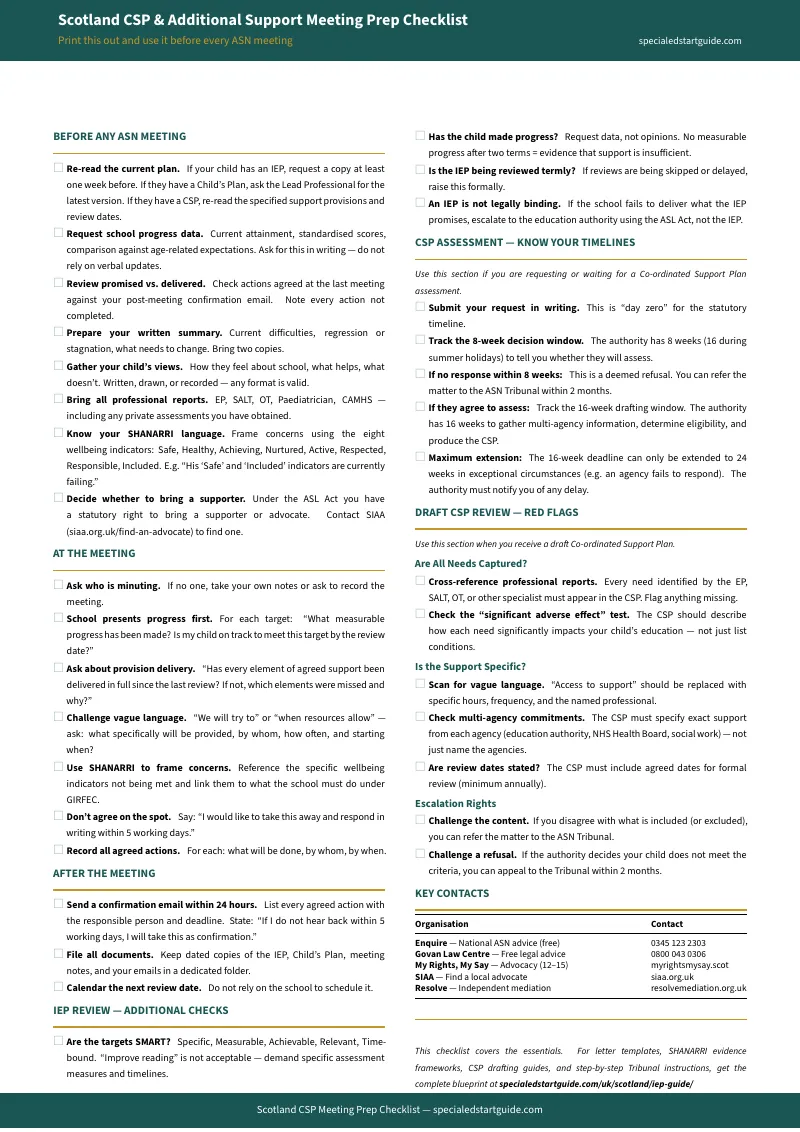
- Meeting Prep Checklist — before/during/after checklists for IEP reviews, Child's Plan meetings, CSP assessments, and draft CSP reviews, with SHANARRI prompts and red-flag questions for every meeting type
- SHANARRI Translation Matrix — a 2-page reference card showing how to convert your everyday concerns into the GIRFEC wellbeing language that triggers the school's statutory obligations
- Template Letter Library — all 5 copy-paste letters citing the exact ASL Act sections: requesting assessments, challenging the "no diagnosis" excuse, escalating to the education authority, requesting a CSP assessment, and confirming post-meeting actions
- Statutory Timelines — every legal deadline on one page: CSP assessment windows, placing request deadlines, Tribunal appeal limits, and transition planning requirements
- Scotland ASN Glossary — a 2-page quick reference translating every Scottish term (GIRFEC, SHANARRI, SfL, PSA, ASL Act, CSP) with the English equivalents you must stop using
- Transition Planning Checklist — primary-to-secondary and post-16 checklists with statutory timelines, demand letters, and the agencies that must be involved
- Support Directory — every key organisation on one page: Enquire, Govan Law Centre, My Rights My Say, SIAA, Resolve Mediation, and condition-specific helplines
Instant PDF download. Print what you need tonight. Walk into tomorrow's meeting with Scottish law on your side.
Money-back guarantee, no time limit. If the Blueprint doesn't change how you approach ASN meetings, email us for a full refund. No questions asked.
Not ready for the full Blueprint? Download the free Scotland CSP & Additional Support Meeting Prep Checklist — a printable pre-meeting checklist covering what to review before ASN meetings, red flags in draft CSPs, and key questions for IEP and Child's Plan reviews. It's enough to walk into your next meeting prepared, and it's free.
Your child's support is a legal right under the ASL Act — not a favour the council grants when the budget allows. The system is counting on you not knowing the law. After tonight, you will.