The Internet Told You About EHCPs. Your Child Lives in Scotland.
You searched for "how to get support for my child with special needs UK" and spent three hours reading about Education, Health and Care Plans. You learned about the 20-week timeline, the SEND Code of Practice, and the First-tier Tribunal. You even drafted a letter to your Local Authority citing Section 36 of the Children and Families Act 2014. Then you mentioned this to the school's support for learning teacher and she looked at you blankly. Because you live in Scotland. And none of what you just read applies here.
Or perhaps you do live in England and have an EHCP — but your partner just accepted a job in Cardiff. You called IPSEA to ask what happens to the plan when you move. They told you their advice "relates to the law as it applies in England." You called SNAP Cymru, but they cannot advise on how an English EHCP is treated upon arrival in Wales. You are left holding a legally enforceable document that becomes legally meaningless the moment you cross the Severn Bridge.
This is the reality of special education in the United Kingdom. Four nations. Four statutory frameworks. Four sets of terminology. Four different tribunals. And an internet that treats them as interchangeable. The parent who quotes English law to a Scottish education authority does not just get the wrong answer — they lose credibility at the exact moment they need it most.
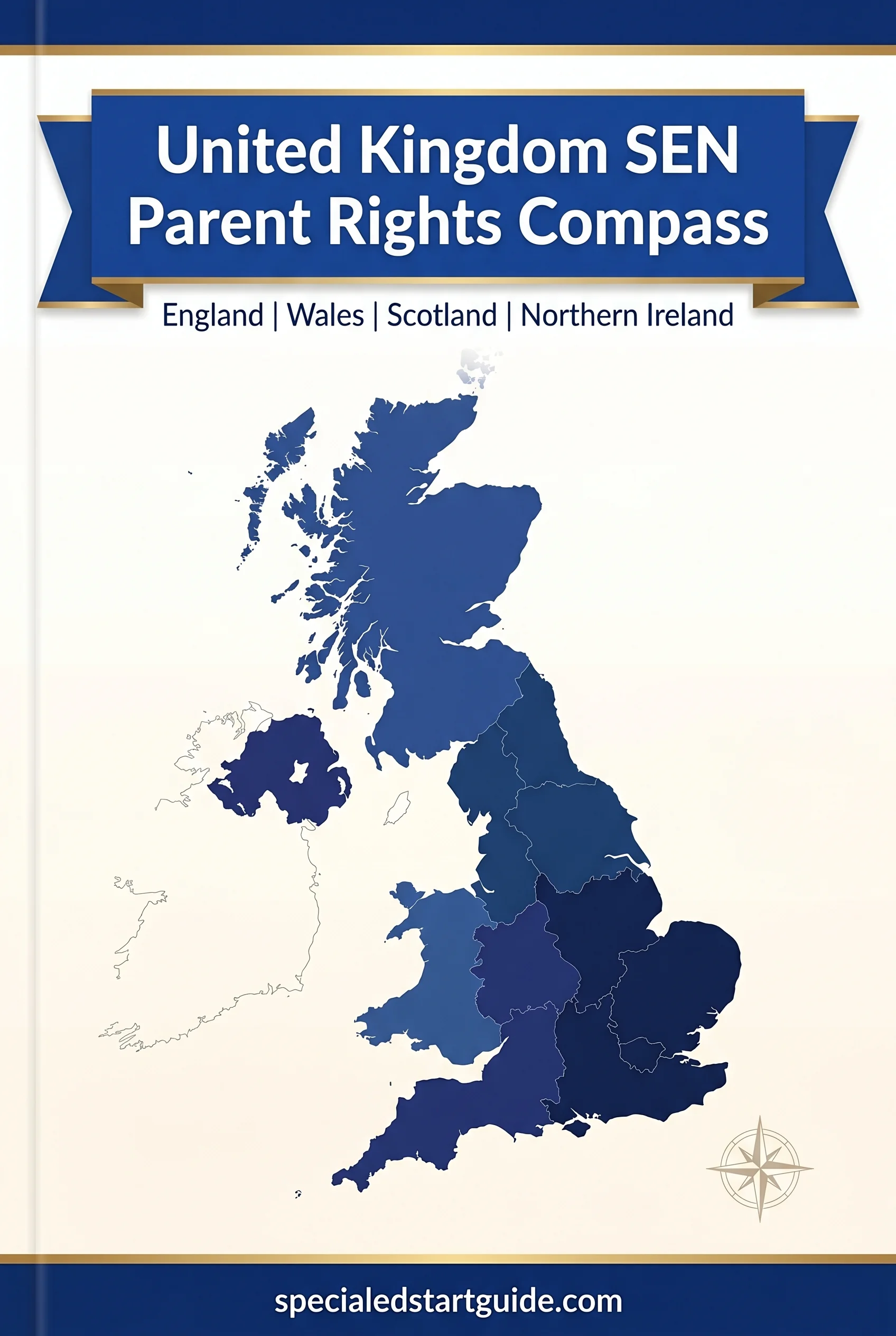
The United Kingdom SEN Parent Rights Compass is the Four-Nation Navigation System — the only guide that maps England's EHCP, Wales's IDP, Scotland's CSP, and Northern Ireland's Statement side by side, giving you the cross-border translation matrix, nation-specific advocacy templates, and statutory frameworks that let you fight the right fight under the right law, regardless of which nation your child's school is in.
What's Inside the Compass
The Four-Nation Comparison Matrix
A definitive reference table mapping every equivalent concept across all four systems. What England calls an EHCP, Wales calls an IDP, Scotland calls a CSP, and Northern Ireland calls a Statement. What England calls a SENCo, Wales calls an ALNCo. What England calls SEN Support, Scotland calls Staged Intervention. The matrix covers terminology, governing legislation, assessment timelines, eligibility thresholds, tribunal routes, and key advice organisations — so you never confuse the system you are reading about online with the system that actually governs your child's rights.
The Equality Act 2010 as Your Overarching Weapon
Most parents prepare for school meetings armed with knowledge of their local education system. That gives you a baseline. The Equality Act 2010 sits above all three Great Britain systems and is the legal authority school administrators rarely volunteer. Schools have a proactive, anticipatory duty to make reasonable adjustments — they cannot wait until your child enrols and then scramble. "We don't have the staffing" and "we don't have the budget" are not legal defences. The Guide breaks down direct discrimination, indirect discrimination, harassment, victimisation, and the failure to make reasonable adjustments, including what remedies each nation's tribunal can actually order. Northern Ireland operates under the Disability Discrimination Act 1995 instead — the Compass covers both.
The Scottish Diagnosis Myth — Debunked
If you have been researching English SEND law, you have been conditioned to believe that a medical diagnosis is the price of admission to statutory support. Scotland rejects this entirely. Under the Education (Additional Support for Learning) (Scotland) Act 2004, a child has an Additional Support Need if "for whatever reason" they face a barrier to learning. That is why 43% of Scottish pupils are registered as having an Additional Support Need — the definition captures any barrier, not just medical ones. Do not waste money on private diagnoses before requesting support in Scotland. The Compass explains the difference and shows you how to frame your request around demonstrated barriers rather than diagnostic labels.
The Welsh ALN Transition — Decoded
Wales has abandoned the term "Special Educational Needs" entirely. The ALNET Act 2018 replaced the entire framework with Additional Learning Needs, and legacy SEN Statements are being converted to Individual Development Plans by the end of the 2025/2026 academic year. Wales made a radical choice that England did not: every child identified as having ALN is legally entitled to a statutory IDP, regardless of severity. A child who would only receive non-statutory SEN Support in England gets a legally enforceable plan in Wales. The Compass explains what this means for your rights, how the transition affects existing Statements, and what to do if your new IDP offers less protection than your old Statement.
The Cross-Border Transfer Playbook
Statutory plans are strictly territorial. When you move from England to Scotland, your EHCP ceases to have legal effect. The same applies in every direction. The Compass includes the complete transition portfolio checklist — every document to compile before you move — plus nation-by-nation re-entry steps and specific guidance for Armed Forces families, who face mandatory postings that the Army Families Federation explicitly warns cannot transfer EHCPs across borders. Whether you are relocating for work, following a military posting, or considering a school across a national border for your child, the playbook prevents the catastrophic gap in provision that most families discover only after they arrive.
The Advocacy Letter Templates
Fill-in-the-blank templates using the correct legal references for each nation. Statutory assessment requests citing the Children and Families Act 2014 (England), the ALNET Act 2018 (Wales), the ASL Act 2004 (Scotland), and the Education (Northern Ireland) Order 1996. Refusal appeal letters. Soft exclusion documentation letters that frame "we sent your child home early because we don't have staff" as a discriminatory denial of educational access under the Equality Act 2010. You insert your child's name, the specific issue, and the relevant facts. The statutory language that commands a response is already built in.
The Exclusion Rights Breakdown
England operates the most punitive discipline system in the UK — and the weakest reinstatement rights. The Independent Review Panel cannot force a school to reinstate an excluded pupil, even if the exclusion was unlawful. A disability discrimination claim to the First-tier Tribunal is often more effective. Scotland treats poor behaviour as unmet need, not wilful defiance, and has effectively eradicated permanent exclusions. Wales and Northern Ireland give appeal panels the power to direct reinstatement. The Compass maps these differences so you know which remedy actually works in your nation.
The Transition to Adulthood — Age Cliff Edges
England and Wales maintain statutory support up to age 25. Scotland mandates transition planning from age 14, with support expected to age 26 — but with weaker legal enforceability. Northern Ireland faces the most severe cliff edge: Statements legally lapse at age 19, leaving young people with complex needs facing fragmented adult services with no single planning mechanism. The Compass explains the timeline for each nation and what to do before your child hits the deadline.
Who This Compass Is For
- Parents who have spent hours reading about EHCPs, only to discover their child lives under a completely different statutory framework — and who need to know exactly which laws, terminology, and tribunal routes actually apply
- Armed Forces families facing another mandatory posting across a UK national border, who know from experience that their child's statutory plan becomes legally worthless upon arrival — and who need the transfer playbook before they load the moving van
- Families relocating for work from England to Scotland, from Wales to Northern Ireland, or in any direction — who need to understand the receiving nation's system before they arrive, not after their child has lost a term of school
- Parents living near the English-Welsh border, the English-Scottish border, or in Northern Ireland, who are considering schooling options across a national boundary and need to understand which nation's law governs
- Parents whose school told them "we don't have the budget" for a teaching assistant, reduced support hours, or refused to assess — who do not know that the Equality Act 2010 imposes a proactive duty to accommodate regardless of budget constraints
- Parents in Scotland spending thousands on private diagnoses before requesting school support — unaware that Scotland explicitly does not require a diagnosis, and that their strongest argument is demonstrated barriers to learning, not a medical label
- Parents in Wales confused about whether their child's old SEN Statement is still valid, whether the new IDP is equivalent, and what rights they have if the transition reduces their child's provision
- Parents whose child is being routinely sent home early, put on a reduced timetable, or excluded from activities — soft exclusions that constitute discriminatory denial of educational access, not accommodation
- Parents who called IPSEA and were told "our advice relates to the law as it applies in England" — and who need the resource that covers what IPSEA explicitly does not
Why Not Just Use the Free Resources?
The UK has excellent free advocacy organisations. IPSEA provides tribunal representation. SNAP Cymru offers dispute resolution. Enquire runs Scotland's national advice service. SENAC and the Children's Law Centre cover Northern Ireland. Here is why parents still use the wrong law after consulting all of them:
- Every charity stops at its own border. IPSEA explicitly states that their advice "relates to the law as it applies in England." A parent moving from London to Glasgow cannot ask IPSEA how the Scottish system works. They cannot ask Enquire how their English EHCP will be treated upon arrival. There is no free resource anywhere that places all four systems side by side and explains how rights translate when you cross a border.
- Government websites explain policy, not leverage. GOV.UK details the EHCP process across fifty pages and never mentions that your strongest protection often comes from the Equality Act 2010, which overrides the school's education policies. Government guidance informs parents of the bureaucratic process. It deliberately omits the legal leverage parents hold when that process fails.
- The internet is jurisdictionally reckless. Search for "how to get a 1:1 teaching assistant UK" and Google serves results spanning English SEND law, Scottish ASN guidelines, and American IEP advice in a single page. Parents routinely apply the wrong nation's framework to their case. This guide trains you to instantly identify which online advice applies to your child and which will sabotage your case at tribunal.
- SEN solicitors charge £142 to £319 per hour. IPSEA's entry-level online course costs £99. SOS!SEN charges £300 to draft a single assessment request letter. For the majority of disputes, the issue resolves at the school level when the parent demonstrates knowledge of the correct legal framework for their nation. This Compass gives you that knowledge for a fraction of a single consultation — and if you do need legal counsel, it saves significant billable hours by handing the solicitor an organised case under the correct legislation.
The free resources explain what the law says within one nation. This Compass translates your rights across all four — and gives you the advocacy tools to enforce them.
— Less Than Ten Minutes of a SEN Solicitor
SEN solicitors in the UK charge £142 to £319 per hour. IPSEA's basic online course costs £99. SOS!SEN charges £300 to draft a single statutory assessment request. This entire Compass costs less than a brief phone call with any of them — and covers what none of them do: all four UK nations in one reference.
Your download includes the complete 14-chapter Compass plus 6 standalone printable tools — ready to print and use tonight.
- Complete Rights Compass Guide — 14 chapters covering the Equality Act 2010, England's EHCP system, the Welsh ALN transition, Scotland's ASN framework and the diagnosis myth, Northern Ireland's five-stage process, the four-nation comparison matrix, cross-border relocation and the transfer playbook, school exclusion rights, home education and deregistration, transition to adulthood and age cliff edges, advocacy letter templates for all four nations, and the documentation system
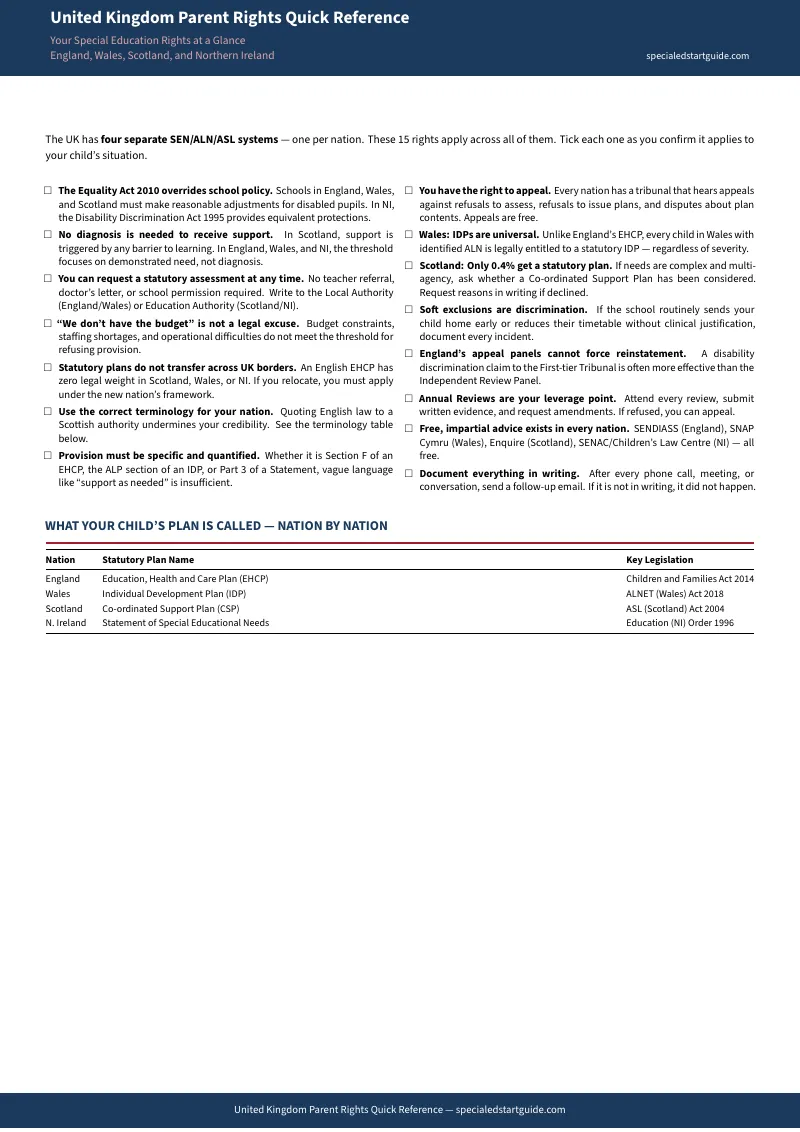
- United Kingdom Parent Rights Quick Reference — the printable checklist covering your 15 core rights at a glance, the nation-by-nation plan terminology chart, a sample dispute letter with statutory language built in, and key contacts for IPSEA, SENDIASS, SNAP Cymru, Enquire, SENAC, and the Children's Law Centre
- Four-Nation Comparison Matrix — the side-by-side reference table mapping terminology, legislation, timelines, and tribunal routes across England, Wales, Scotland, and Northern Ireland
- Cross-Border Transition Portfolio Checklist — the document compilation checklist and advocacy strategy for families relocating between UK nations, with specific guidance for Armed Forces families
- Advocacy Letter Templates — six fill-in-the-blank letters citing the correct legislation for each nation — statutory assessment requests, refusal appeals, and soft exclusion documentation
- Paper Trail Template — the follow-up email template and advocacy binder system for building documentation that holds up at tribunal
- Key Contacts Reference Card — the one-page fridge sheet with phone numbers and websites for every free advice organisation across the UK
Instant PDF download. Print the advocacy letter that matches your nation tonight. Send it tomorrow morning.
Money-back guarantee, no time limit. If the Compass does not change how you advocate for your child's education, email us for a full refund. No questions asked.
Not ready for the full Compass? Download the free United Kingdom Parent Rights Quick Reference — a printable guide covering your core rights under the Equality Act 2010 and each nation's education law, the four-nation terminology chart, a sample dispute letter, and key contacts for free advocacy organisations across the UK. It is enough to walk into your next school meeting with more statutory knowledge than most headteachers expect you to have, and it is free.
Your child has a legal right to education with appropriate support. The Equality Act says so. The Children and Families Act says so. The ALNET Act says so. The ASL Act says so. The Education (Northern Ireland) Order says so. This Compass makes sure you are citing the right one.