The Education Authority Drafted Your Child's Statement in Vague Language on Purpose. This Toolkit Shows You Exactly How to Fix It.
You sat through the meeting. You listened to the Learning Support Coordinator explain that your child is "making progress at Stage 2." You nodded at the EA officer who said the Proposed Statement provides "access to additional support" and "opportunities for small group work." You went home, read the document again, and felt in your gut that something was wrong — but you couldn't articulate what.
Here's what was wrong: those phrases are legally meaningless. "Access to" commits the EA to nothing. "Opportunities for" is aspirational language dressed up as provision. "As required" means nobody has to provide anything unless they feel like it. The Northern Ireland Code of Practice requires Part 3 to specify the type of support, the hours and frequency, and the level of expertise of the person delivering it. The High Court ruling in Re C, McD and McG confirmed that "vague statements which do not specify provision appropriate to the identified special needs of the child will not comply with the law." Your Proposed Statement contains none of that — and the EA is counting on you not knowing the difference.
You've read the SENAC factsheets. You've scrolled Mumsnet at midnight looking for Northern Ireland-specific advice and found page after page about EHCPs that don't apply here. You've called the SENAC advice line and been told they're at capacity. And your school's LSC, however well-meaning, is managing dozens of children on a budget that shrinks every year and cannot fight the EA on your behalf.
The Northern Ireland SEN Statement Blueprint is the tactical toolkit that bridges the gap between knowing your rights exist and actually enforcing them — with every template, script, and checklist grounded in the Education (Northern Ireland) Order 1996 and the SEND Act (NI) 2016. Not English law. Not Scottish law. Northern Ireland statute only.
What's Inside the Blueprint
The Part 3 Vague Wording Checker
The Education Authority saves millions every year by using language in Part 3 that sounds like provision but commits them to nothing. This side-by-side reference lists the most common vague phrases — "access to," "opportunities for," "regular input," "as appropriate," "support with" — next to their legally enforceable, quantified replacements. Open your Proposed Statement, scan Part 3 against the checker, and highlight every phrase that fails the specificity test set by the Code of Practice and confirmed by Re C, McD and McG. Then use the template letter to demand the EA rewrite each one with the type, hours, frequency, and expertise level the law requires — all within your 15-day response window.
The SEN Support Audit Framework
Most guides skip the phase where the real damage happens: Stages 1 and 2. Your child has been on the SEN register with a Personal Learning Plan for months — maybe years. The school insists they're "meeting needs" through differentiated teaching and the graduated response. But when you ask for PLP reviews showing measurable progress, they don't exist. When you ask what specific interventions are being delivered, you get generalities. This framework gives you a structured tool to audit exactly what the school is providing: which interventions, how many minutes per week, who delivers them, and whether there's any documented improvement. When the audit reveals that Stage 2 support has been exhausted — and it almost certainly will — you have the evidence base to request a statutory assessment, with a template letter citing the Education (Northern Ireland) Order 1996.
The EA Letter Templates
Every letter cites the exact provision of NI legislation. Request a statutory assessment and start the EA's 6-week decision clock. Respond to a Proposed Statement with specific, legally grounded challenges to Part 3 wording. Demand that missing professional report recommendations are added to Part 2. Request amendments at the Annual Review when provision has failed to deliver progress. These aren't generic samples adapted from English EHCP templates — they're Northern Ireland enforcement tools that reference the 1996 Order, the SEND Act 2016, and the NI Code of Practice. Every letter creates a paper trail the moment you hit send.
Meeting Scripts and Checklists
What to say when the school tells you "we need more time at Stage 2 before we can request an assessment" — you have the independent right to request one yourself, regardless of what the school says. What to say when the LSC claims "we're meeting needs" but your child melts down every evening. What to say when the EA officer tells you the provision in Part 3 "needs to be flexible" rather than quantified. Each script cites the legal provision that proves them wrong — so you're referencing statute, not arguing opinions. The pre-meeting checklist covers document requests, team composition, recording consent, and the questions to ask before anyone sits down.
Post-16 Transition Planning Module
Young people with SEN in Northern Ireland are five times more likely to become NEET after leaving school. Under Section 5 of the Disabled Persons (NI) Act 1989, the EA must commence formal transition planning at the first Annual Review after your child turns 14. A named Transition Coordinator must be appointed. The Health and Social Care Trust must be consulted about adult services. Yet parents are frequently unaware these duties exist, and schools rarely enforce them without pressure. This module gives you a checklist of legal demands for the Year 10 Transition Review — covering further education, employment, accommodation, transport, and adult social care — so your child's post-school pathway is planned with the statutory backing the law requires.
Provision Mapping Templates
A compliant provision map details the intervention, frequency, duration, staffing, and target outcomes. Any gap between what Part 3 specifies and what the school actually delivers is a failure of the EA's statutory duty to arrange the provision. These templates let you track delivery between Annual Reviews so you walk into the meeting with documented evidence — not suspicions — of what has and hasn't been provided. When the school says "we've been delivering everything," you can point to the exact weeks and hours that are missing.
Statement Section-by-Section Analysis Tools
A systematic walkthrough of Parts 1 through 6 showing what each part must contain, what legal weight it carries, and how to cross-reference professional reports against the draft. Part 2 must capture every need identified by the Educational Psychologist, SLT, OT, and paediatrician — miss one, and the matching provision in Part 3 won't exist. Part 4 must be blank in the Proposed Statement — if a school has been pre-filled, the EA has acted improperly. Parts 5 and 6 are not enforceable through SENDIST — if therapy has been placed there instead of Part 3, the EA has no legal liability to deliver it. The analysis tools turn a complex Statement from an impenetrable document into a structured checklist you can work through in an evening.
Goal-Tracking Worksheets
Statement provision is reviewed annually — but a year is a long time to go without data. These worksheets give you a structured format to log your child's progress against Part 3 targets between reviews. Compare school-reported progress against your own observations. Document regression. Arrive at the Annual Review with evidence that either confirms the programme is working or proves it needs to change.
Who This Blueprint Is For
- Parents whose child is at Stage 1 or Stage 2 but nothing is changing — the school says they're "meeting needs" while your child falls further behind or refuses to attend
- Parents whose statutory assessment request was refused by the EA, and who need to know what evidence to gather and how to appeal to SENDIST
- Parents who've received a Proposed Statement filled with phrases like "access to" and "opportunities for" — and need to know exactly why those words fail the legal test and what to demand instead
- Parents who've been told the school must exhaust all Stage 2 options before requesting an assessment — and suspect that's not quite right (you can request one yourself at any time)
- Parents whose child's Statement provision has never been properly quantified, and the Enhanced Support Model has made classroom assistant allocation even less transparent
- Parents approaching the Year 10 Transition Review who need the EA to appoint a Transition Coordinator and produce a lawful Transition Plan
- Parents who've spent hundreds on private Educational Psychologist or SLT reports and need every recommendation reflected in Part 2 and Part 3
- Parents preparing for an Annual Review who suspect the EA intends to cease maintaining the Statement or reduce provision
- Parents who are simply exhausted from reading English EHCP advice that doesn't apply in Northern Ireland — and need everything in one place, under NI law
Why Not Just Use the Free Resources?
Northern Ireland has dedicated SEN support organisations. SENAC provides legally accurate factsheets. The Children's Law Centre offers crisis-level advocacy. The EA publishes its own process guides. Here's why parents still struggle after consulting all of them:
- SENAC tells you the law — it doesn't write your letters. Their twelve factsheets are legally accurate and NI-specific. But when you're staring at a Proposed Statement at 11 PM with a 15-day deadline, you don't need to synthesise six factsheets into a coherent challenge letter from scratch. You need a Part 3 checker that flags the weak phrases and a template letter ready to fill in and send. SENAC provides the legal framework. This Blueprint turns it into fill-in-the-blank tools you can use tonight.
- The Children's Law Centre handles crisis-level cases. The CLC and their CHALKY advice line are invaluable — but they operate as a legal crisis centre, with SEND law accounting for over 70% of all education queries. They prioritise SENDIST tribunal representation and systemic challenges, not early-stage letter drafting for parents who need to respond to a Proposed Statement by next Tuesday. This Blueprint makes you your own prepared advocate who doesn't depend on a stretched charity's availability.
- The EA writes the rules to protect its budget, not to help you. The EA's parent guides accurately describe the administrative steps. They do not instruct you on how to construct a compelling argument against the EA's own resource-rationing decisions. They provide the rules of the system but omit the adversarial strategy required to win the game.
- Etsy SEN planners are written for English law. They'll tell you to fill out "Section F" of an EHCP. If you send an EA officer a letter demanding EHCP rights under the Children and Families Act 2014, your request will be dismissed as legally irrelevant. Northern Ireland uses Statements, not EHCPs. Part 3, not Section F. The Education Authority, not a Local Authority. This is the only toolkit built exclusively for the Northern Ireland statutory framework.
The free resources explain what the law says. This Blueprint gives you the tools to make the EA follow it.
— Less Than One Private EP Consultation Call
Private Educational Psychologists in Northern Ireland charge £500–£800 for a full assessment. Even a brief telephone consultation costs £50–£75. Parents report spending upwards of £950 in a single month on private appointments, equipment, and therapies that statutory funding should cover. If you eventually need professional help, the paper trail you build with this Blueprint saves hours of billable time — because you're handing your advocate an organised case, not a folder of unsigned draft Statements and half-remembered meeting notes.
Your download includes the complete Blueprint guide plus standalone printable PDFs — every template, worksheet, script, and reference card, ready to print and bring to your next meeting.
- Complete Blueprint Guide — 13 chapters covering the NI SEN framework, Statement structure, the 26-week assessment process, draft review strategy, Part 3 analysis, provision mapping, Annual Reviews, Transition Planning, appeals and SENDIST, and a complete glossary of NI-specific terminology
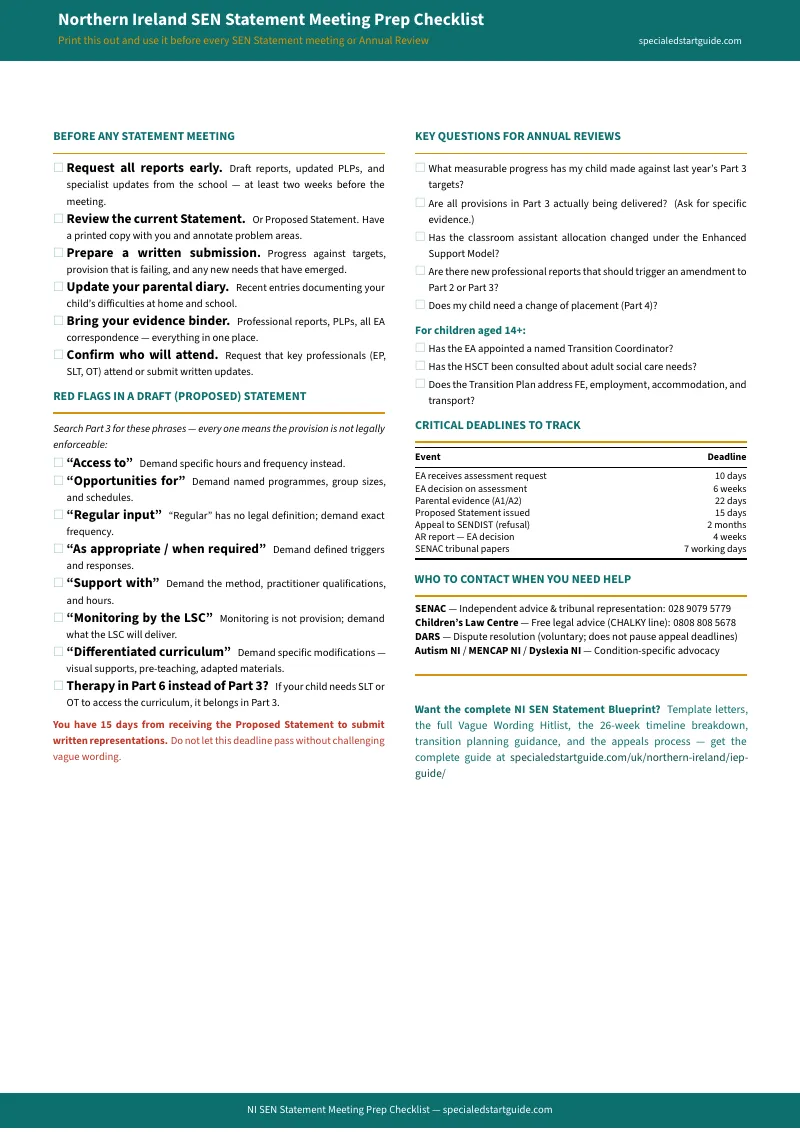
- Meeting Prep Checklist — before/during/after checklists for Statement meetings, Annual Reviews, and draft response meetings, with the Part 3 vague wording checker and red flags for every Statement section
- Part 3 Vague Wording Checker — one-page reference card listing the most common vague EA phrases next to their legally enforceable replacements
- SEN Support Audit Worksheet — structured framework to evaluate whether Stage 1 and Stage 2 support is genuinely meeting your child's needs, with a red flags checklist
- Advocacy Letter Templates — copy-paste letters for requesting a statutory assessment, challenging a Proposed Statement, and requesting amendments at Annual Review
- SEN Meeting Scripts — word-for-word responses for common pushback scenarios at Statement meetings, each citing the relevant NI statutory provision
- Provision Map Worksheet — track what the school delivers against what Part 3 requires so gaps are documented before reviews
- Goal-Tracking Worksheet — log your child's progress against Part 3 targets between Annual Reviews, term by term
- Statement Section-by-Section Analysis — reference card showing what each part (1–6) must contain, with a draft review checklist
- Statutory Timeline Reference — every NI legal deadline mapped: 6-week assessment decision, 26-week completion, 15-day draft window, Annual Review timelines, Transition Review dates, and appeal windows
Instant PDF download. Print the checklists tonight. Walk into tomorrow's meeting with Northern Ireland law on your side.
Money-back guarantee, no time limit. If the Blueprint doesn't change how you approach SEN meetings, email us for a full refund. No questions asked.
Not ready for the full Blueprint? Download the free Northern Ireland SEN Statement Meeting Prep Checklist — a printable pre-meeting checklist covering what to review before Statement meetings, red flags in Proposed Statements, and key questions for Annual Reviews. It's enough to walk into your next meeting prepared, and it's free.
Your child's provision is a legal right, not a favour the EA grants. The system is counting on you not knowing the law. After tonight, you will.