The School Just Mentioned an AO-SF Procedure. The Letter Is in Administrative German. You Have One Month to Object.
You moved to Düsseldorf for the corporate posting — a Henkel transfer, a Vodafone rotation, a UN assignment in Bonn, your spouse's position at one of the pharmaceutical companies along the Rhine. You enrolled your child in the local Grundschule because the relocation package didn't cover international school. The school seemed fine. Then a meeting happened. The Rektorin sat down with a sonderpädagogische Lehrkraft and used a phrase you'd never heard before: Verfahren zur Feststellung eines sonderpädagogischen Förderbedarfs. They want to assess your child. They produced forms — in German. They mentioned something about an AO-SF-Gutachten and a possible placement in a Förderschule. They said you have options. They did not explain what those options actually are.
You went home and opened Google Translate. You typed in sonderpädagogischer Förderbedarf. It gave you "special educational need." You typed in zieldifferenter Unterricht. It gave you "goal-differentiated teaching." You typed in Gemeinsames Lernen. It gave you "learning together." None of these translations told you that NRW has more students with formally recognized special needs than any other German state — 144,290 students — and that more than half still attend segregated Förderschulen despite the 9th School Law Amendment that was supposed to make mainstream inclusion the norm. None of them told you that the AO-SF procedure is the legal process that can mandate your child's transfer to a Förderschule. None of them told you that the distinction between zielgleich and zieldifferent instruction determines whether your child graduates with a standard diploma or a modified certificate that is not recognized for university admission anywhere in the world. And none of them told you that the objection deadline is one month from delivery of the Bescheid — and missing it makes the decision permanent.
You searched for "special education NRW English." You found a Ministry brochure celebrating Gemeinsames Lernen — inclusive learning together — that presented the system as welcoming and supportive. You found Reddit threads from parents in Bavaria and Berlin whose advice does not apply because education in Germany is federalized. You found an American education consultant who charges $100 per hour and has never heard of the LVR or an Inklusionspauschale. You found nothing that explained how the AO-SF procedure actually works in NRW, step by step, in English, for a parent who needs to make decisions this month.
The problem is not that NRW's special education system is broken. It contains genuine legal protections — including a statutory right to inclusive education under the 9th School Law Amendment. The problem is that the entire system is documented in dense administrative German, designed for native speakers who grew up inside the bureaucracy, and runs on a structural tension between an inclusive mandate and an active reinvestment in segregated schooling — with the state building at least 30 new Förderschulen across Essen, Dortmund, and Cologne even as it promotes inclusion.
The North Rhine-Westphalia Special Education & Inclusion Blueprint is the AO-SF Defence System that translates NRW's assessment procedures, Schulamt and Bezirksregierung decision-making, LVR/LWL funding pathways, and parental advocacy rights from institutional German into the plain-English roadmap, bilingual meeting preparation tools, and template library that give you equal footing at the school table — without paying a consultant €150 per hour to explain what the teacher just said.
What's Inside the Blueprint
The Legal Foundation — What NRW Law Actually Guarantees You
The SchulG NRW, the AO-SF regulation, the 9th School Law Amendment, the Grundgesetz Article 3, and the UN Convention on the Rights of Persons with Disabilities — translated from legislative German into plain-language leverage. When the school tells you "we recommend Förderschule placement," this chapter tells you exactly which statute guarantees your right to demand Gemeinsames Lernen at a mainstream school instead. When you arrive from the US expecting your IEP to transfer, or from the UK expecting your EHCP to carry weight, this chapter explains precisely why neither applies in NRW — and what replaces them. The 9th School Law Amendment is your legal right to inclusive education. The Ressourcenvorbehalt is the clause the Schulamt uses to override it. You need to understand both before you walk into the meeting.
The AO-SF Procedure — The Most Consequential Assessment Your Child Will Face
How the formal assessment process works in practice, from initiation through Gutachten to binding Bescheid. Who triggers it (school or parent). The critical difference between an informal support consultation and a full AO-SF procedure — and why controlling which path the school takes is the single most important advocacy decision you will make. How to prepare your child for evaluation when every assessment tool is calibrated for German-speaking children. The exact template letter to request accommodations while explicitly pushing back against premature Förderschule recommendations. And the fact most expat families never learn: the Schulamt's placement decision is an administrative act (Verwaltungsakt), subject to formal Widerspruch within one month.
Zielgleich vs. Zieldifferent — The Distinction That Shapes Everything
When the AO-SF procedure concludes, the outcome determines not just where your child learns but what they can achieve. Zielgleich instruction follows the standard curriculum with support — your child earns the same qualifications as their peers. Zieldifferent instruction follows an individualized curriculum — your child receives a Lernentwicklungsbericht instead of standard grades, cannot earn a standard Hauptschulabschluss, and their academic records become effectively non-transferable to international systems. For an expatriate family, misunderstanding this distinction during the assessment can permanently alter your child's academic trajectory.
The Seven Förderschwerpunkte — How NRW Categorizes Your Child
NRW assigns children to one of seven support categories: Lernen, Sprache, Emotionale und soziale Entwicklung, Geistige Entwicklung, Körperliche und motorische Entwicklung, Hören und Kommunikation, and Sehen. The assigned category determines which Förderschule type handles your child, what curriculum access they receive, and whether they follow a zielgleich or zieldifferent track. Autism is not a standalone category — it gets mapped onto one of the seven, which creates dangerous misclassification risk. This chapter explains what each category means in practice and why the Lernen and Geistige Entwicklung designations carry the most severe consequences.
The Förderplan — Holding the School Accountable
The Förderplan is NRW's equivalent of an IEP — except it is pedagogical, not legally binding in the same way, and schools often treat it as a formality. This chapter shows you how to demand SMART goals (Specific, Measurable, Achievable, Relevant, Time-bound) with named responsible parties and fixed review dates. How to use the annual Klassenkonferenz review to build documented evidence. And how to leverage Förderplan review meetings if you later need to file an appeal against the school's continued placement recommendation.
The Schulbegleitung Application — Navigating the LVR/LWL vs. Jugendamt Split
Applying for an inclusion assistant (Schulbegleitung or Integrationshelfer) is the single most bureaucratically fragmented process in the system. Whether your application goes to the LVR or LWL (regional welfare associations) under SGB IX/XII or to the local Jugendamt under SGB VIII § 35a depends entirely on your child's specific diagnosis — and both agencies routinely reject applications by claiming the other one is responsible. Meanwhile, the state has implemented an Inklusionspauschale pooling model where schools receive a lump sum instead of individual allocations. This chapter maps the exact decision tree based on diagnostic codes, provides the complete application pathway for each agency, and includes the documentation requirements that prevent months of back-and-forth rejection.
The Widerspruch — How to Appeal When the System Gets It Wrong
The appeal deadline is one month from delivery of the Bescheid. Miss it and the decision becomes legally binding. This chapter provides the exact procedure for filing a Widerspruch, the required format and content, what happens after you file, how the Bezirksregierung reviews the objection, and what escalation pathways exist — including the Verwaltungsgericht (administrative court). It includes a template letter with the legal grounds you need to cite.
Nachteilsausgleich — Accommodations Without Lowering the Bar
Nachteilsausgleich provides exam accommodations — extra time, oral exams, assistive technology — without modifying the curriculum and without any negative notation on your child's report card. It should always be explored before any discussion of the AO-SF procedure. This chapter explains what accommodations are available, how to request them, and why securing Nachteilsausgleich early can prevent the school from escalating to a full AO-SF assessment.
The Complete German-English Glossary
Not just translated — functionally explained. The glossary doesn't just tell you that Gemeinsames Lernen means "learning together." It tells you that Gemeinsames Lernen is the legally preferred educational setting established by the 9th School Law Amendment, that it requires your child's school to have designated GL places and allocated sonderpädagogische Lehrkräfte, and that the Ressourcenvorbehalt allows the Schulamt to deny it based on resource limitations. Every term includes its operational meaning, its legal weight, and what it means for your child in practice.
Who This Blueprint Is For
- Corporate assignees and trailing spouses in Düsseldorf, Cologne, Bonn, Essen, and the Ruhr area whose child has been flagged for an AO-SF procedure — and who received German-language documentation they cannot fully understand
- Japanese and Korean corporate families in Düsseldorf-Oberkassel whose child requires special education support beyond what the Japanese International School or Korean community schools can provide — and who need to navigate the German state system in English
- UN, diplomatic, and NGO families in Bonn who discovered that their international posting does not shield them from German educational bureaucracy when their child needs support
- Parents whose school just recommended Förderschule placement and who need to understand their legal right to demand Gemeinsames Lernen at a mainstream school under the 9th School Law Amendment
- Parents who arrived from the US, UK, Australia, or Canada expecting their existing IEP, EHCP, or equivalent to transfer — and discovered that NRW's system operates on entirely different legal and pedagogical principles
- Parents whose child struggles in school primarily because they are still acquiring German — and who need to ensure the school distinguishes a language acquisition issue from a cognitive disability before the AO-SF Gutachten is finalized
- Parents caught in the LVR/LWL-vs-Jugendamt ping-pong on a Schulbegleitung application — with multiple agencies claiming the other is responsible
- German-speaking parents in NRW who understand the system exists but need tactical clarity on deadlines, template language, and administrative procedures when things go wrong
Why Not Just Use the Free Resources?
The NRW Ministry of School and Education publishes information brochures. The Schulamt offers consultations. Advocacy organizations like mittendrin e.V. run free counselling. Here's why expatriate parents still arrive at meetings unable to advocate effectively:
- State brochures present the system — they don't teach you how to challenge it. The Ministry publishes a basic overview flyer in English, Ukrainian, and Arabic. It describes the AO-SF process as a supportive, collaborative procedure. It does not provide step-by-step instructions for what to do when the Schulamt aggressively recommends Förderschule placement, how to file a formal Widerspruch against the Bezirksregierung, or what grounds to cite in an appeal. The legally binding AO-SF regulation, the deep-dive assessment handbooks, and the appeals procedures are exclusively in German.
- mittendrin e.V. fights for policy reform — in German. Cologne-based mittendrin e.V. is the most powerful inclusion lobby in NRW. They have established critical legal precedents — including confirming that schools cannot legally exclude a child from lessons or OGS when their Schulbegleiter calls in sick. But their materials are published entirely in German, focus on systemic legislative reform rather than individual parent tactics, and their comprehensive English guidance is limited to basic conversational courses for teenagers.
- The LVR/LWL "Beratungskompass" dead-ends in German. The LVR's English-language portal has an English toggle. When you attempt to access critical tools — the guided search for benefits or specific Eingliederungshilfe forms — the system displays: "Please be aware of the fact that these information are only available in German." The application procedures for Schulbegleitung funding remain impenetrable without a dedicated guide.
- Expat forums mix advice from different German states. Reddit threads and Facebook groups regularly conflate NRW, Bavaria, and Berlin advice. Education in Germany is federalized. Bavaria's system uses different terminology (Feststellungsverfahren vs. AO-SF), different legal frameworks (BayEUG vs. SchulG NRW), and different procedural structures. Applying advice from another state in NRW can lead to missed deadlines and dangerous assumptions about your rights.
- Relocation agencies don't cover special education. Düsseldorf, Cologne, and Bonn host numerous relocation agencies targeting corporate expats and the Japanese community — ProExpat, Hello Düsseldorf, PROGEDO, ADM Japan Consulting. They process visas, negotiate rental agreements, and register you at the Grundschule. They do not attend AO-SF meetings, draft Widerspruch appeals, or navigate SGB VIII/IX applications for Schulbegleitung. The standard €1,500–€3,500 relocation package leaves you completely exposed.
The government publishes the regulations. NGOs campaign for policy reform. The Blueprint gives you the operational playbook.
— Less Than One Hour of a €150/Hour Consultant
A single session with a bilingual educational consultant in Düsseldorf costs €150 or more. An American special education advocate charges $100 just to review one report — and cannot advise on German law. International school tuition — the escape route many families consider — starts at €22,740 annually at ISD, with SEN surcharges adding up to €12,000. Even if you eventually need a consultant for a specific dispute, the systemic preparation you build with this Blueprint saves hundreds — because you arrive understanding the framework, speaking the right terminology, and asking specific questions instead of paying someone to explain the basics.
Your download includes the complete guide, two standalone reference sheets, and a meeting prep checklist:
- Complete Blueprint Guide (guide.pdf) — 17 chapters covering the legal foundation (SchulG NRW, 9th School Law Amendment, AO-SF), the full AO-SF procedure, zielgleich vs. zieldifferent instruction, the seven Förderschwerpunkte, Förderplan development, Nachteilsausgleich, Schulbegleitung applications (LVR/LWL vs. Jugendamt), Widerspruch appeals, the bilingual assessment trap, international school alternatives, post-secondary transitions, template letters, and the complete German-English glossary
- German-English Glossary Quick Reference (german-english-glossary.pdf) — 48 NRW special education terms organized by category, each with the German term, English translation, and what it means in practice — print and bring to every meeting
- Schulbegleitung Decision Tree (schulbegleitung-decision-tree.pdf) — which office to apply to (Jugendamt vs. LVR vs. LWL), the 8-step application process, what the aide can and cannot do, NRW-specific pitfalls (Pool-Modell, OGS funding gap), and what to do when denied
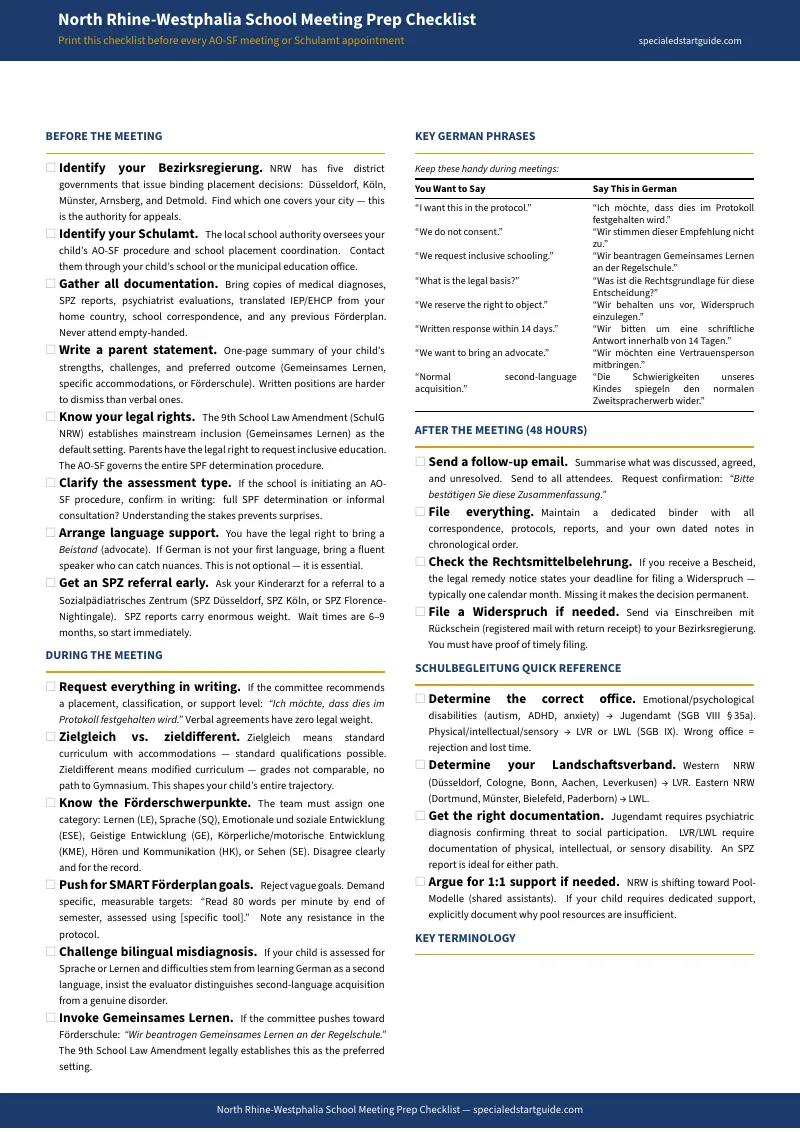
- NRW School Meeting Prep Checklist (checklist.pdf) — printable quick-reference with essential German phrases, legal rights under the 9th School Law Amendment, assessment preparation tactics, and post-meeting documentation procedures
Instant PDF download. Print the checklist tonight — bring it to your next school meeting.
Money-back guarantee, no time limit. If the Blueprint doesn't change how you navigate your child's education in NRW, email us for a full refund. No questions asked.
Not ready for the full Blueprint? Download the free North Rhine-Westphalia School Meeting Prep Checklist — a structured quick-reference covering the AO-SF procedure basics, Förderschule vs. Gemeinsames Lernen options, essential questions in German, and post-meeting documentation. It's enough to walk into your next meeting prepared, and it's free.
Your child has a right to inclusive education in NRW. The 9th School Law Amendment guarantees it. The school knows the system. After tonight, so will you.