The School Just Mentioned Sonderpädagogischer Förderbedarf. The Documents Are in Behördendeutsch. You Have 14 Days to Request a Förderkommission.
You moved to Hannover for the VW contract. Or to Braunschweig for a TU position. Or to Göttingen for a Max Planck fellowship. You enrolled your child in the local Grundschule because the international school waitlist was full, or because you wanted immersion, or because the relocation package didn't cover €20,000 in annual tuition. The school seemed fine. Then a meeting happened. The Schulleitung brought in a Förderschullehrkraft and used a phrase you'd never heard before: Feststellungsverfahren. They want to formally assess your child for special educational needs. They produced a stack of documents — in German. They mentioned a Fördergutachten and a possible transfer to a Förderschule Lernen. They said you have rights. They did not explain what those rights actually are.
You went home and opened Google Translate. You typed in sonderpädagogischer Förderbedarf. It returned "special pedagogical support need." You typed in zieldifferenter Unterricht. It returned "goal-differentiated teaching." You typed in Nachteilsausgleich. It returned "disadvantage compensation." None of these translations told you that Lower Saxony's inclusion rate has risen to 65.1% — but that schools are operating at only 93.2% of required special education teacher capacity, meaning the inclusive placement your child is legally guaranteed may come with almost no actual specialist support. None of them told you that the Fördergutachten is the diagnostic report that triggers a binding decision by the RLSB. None of them told you that § 59 Abs. 1 NSchG gives you a legal right to choose mainstream inclusion. And none of them told you that you have exactly 14 days after receiving the Fördergutachten to request a Förderkommission — and missing that deadline lets the school principal forward the report directly to the RLSB without your input.
You searched for "special education Lower Saxony English." You found a Ministry brochure in simplified German celebrating Inklusive Schule as a legislative achievement. You found Reddit threads from parents in Berlin and Bavaria whose advice does not apply because education in Germany is federalised under the Kulturhoheit der Länder. You found an American education consultant who charges $100 per hour and has never heard of an RZI. You found nothing that explained how Lower Saxony's system actually works, step by step, in English, for a parent who needs to make decisions this week.
The problem is not that Lower Saxony's special education system is broken. It has genuine legal protections — including parental choice between Förderschule and mainstream as a statutory right. The problem is that the entire system is documented in dense administrative German, designed for native speakers who grew up inside the bureaucracy, and runs on a chronic shortage of Förderschullehrkräfte that forces parents to fight for support the law already guarantees.
The Lower Saxony Special Education & Inclusion Blueprint is the Feststellungsverfahren Navigation System that translates Lower Saxony's assessment procedures, RLSB decision-making, RZI support structures, and parental advocacy rights from institutional German into the plain-English roadmap, bilingual meeting tools, and template library that give you equal footing at the school table — without paying a consultant €150 per hour to explain what the teacher just said.
What's Inside the Blueprint
The Legal Foundation — What Lower Saxony Law Actually Guarantees You
The NSchG, the Grundgesetz Article 3, and the UN Convention on the Rights of Persons with Disabilities — translated from legislative German into plain-language leverage. When the school tells you "we recommend Förderschule placement," this chapter tells you exactly which statute guarantees your right to refuse. § 4 NSchG declares all public schools inklusive Schulen by law. § 14 NSchG preserves the existence of Förderschulen. § 59 Abs. 1 NSchG is your Elternwahlrecht — the parental right of choice. When you arrive from the US expecting your IEP to transfer, or from the UK expecting your EHCP to carry weight, this chapter explains precisely why neither applies — and what replaces them.
The Feststellungsverfahren — The Assessment That Determines Everything
How the formal assessment process works in practice. Who triggers it, who conducts the Fördergutachten, and why the 14-day window to request a Förderkommission is the highest-stakes deadline you will face. This chapter explains what happens at each stage: the school's initial request, the assignment of a Förderschullehrkraft to evaluate your child, the production of the diagnostic report, and the binding decision by the RLSB. It covers what to do when every assessment tool is calibrated for German-speaking children and your child's bilingualism is being confused with a learning disability.
The Seven Förderschwerpunkte — How Lower Saxony Categorises Your Child
Lower Saxony assigns children to one of seven support focus areas: Lernen, Geistige Entwicklung, Emotionale und Soziale Entwicklung, Sprache, Hören, Sehen, and Körperliche und Motorische Entwicklung. The assigned category determines curriculum access, graduation prospects, and the critical divide between zielgleicher and zieldifferenter Unterricht. Autism is not a standalone category — it gets mapped onto one of the seven. This chapter explains what each category means in practice and why the Lernen and Geistige Entwicklung designations carry the most severe consequences for your child's academic trajectory.
The Förderkommission — Your 14-Day Window
After the Fördergutachten is completed, you have exactly 14 days to request a Förderkommission — a formal hearing where you, the school, and the evaluators sit down to discuss the findings before any binding decision is made. Miss this deadline and the school principal forwards the report directly to the RLSB. This chapter covers how the Förderkommission works, who attends, how to prepare your parent statement, and how to ensure your dissent is recorded in the official protocol.
The Förderplan — Holding the School Accountable
The Förderplan is Lower Saxony's equivalent of an IEP — except it is pedagogical, reviewed semi-annually, and schools often treat it as a formality. This chapter shows you how to demand SMART goals with named responsible parties and fixed review dates. How to distinguish zielgleich (standard curriculum with support) from zieldifferent (modified goals that permanently limit graduation options). And how to use Förderplan reviews as documented evidence if you later need to escalate.
Schulbegleitung — Navigating the Jugendamt vs. Sozialamt Split
Applying for an integration aide is the most bureaucratically fragmented process in the system. Whether your application goes to the Jugendamt (youth welfare, SGB VIII § 35a) or the Sozialamt (social welfare, SGB IX) depends entirely on your child's specific diagnosis — and both agencies routinely reject applications by claiming the other one is responsible. This chapter maps the exact decision tree, provides the documentation requirements, and explains how Lower Saxony's new Pool Models (Poolbildung) may affect whether your child receives dedicated 1:1 support or shares an aide with multiple students.
The RZI and Mobile Dienste — Your Escalation Path
Lower Saxony's Regionale Beratungs- und Unterstützungszentren Inklusive Schule (RZI) are the state's unique infrastructure for deploying specialist support into mainstream schools. When the school claims it has no resources to implement your child's Förderplan, the RZI is where you escalate. This chapter explains how to request Mobile Dienste for visual, auditory, motor, and socio-emotional support, what the RZI can and cannot do, and how to use the escalation path when the school stalls.
The Widerspruch — How to Appeal When the RLSB Gets It Wrong
The appeal deadline is stated in the Rechtsmittelbelehrung — typically one month from delivery of the Feststellungsbescheid. Miss it and the decision becomes legally binding. This chapter provides the exact procedure for filing a Widerspruch, the required format and content, what happens after you file, and what escalation pathways exist — including the Verwaltungsgericht (administrative court).
The Complete German-English Terminology Guide
Not just translated — functionally explained. The glossary doesn't just tell you that Feststellungsverfahren means "assessment procedure." It tells you that it is the formal process that determines whether your child receives a sonderpädagogischer Förderbedarf diagnosis, that it triggers a 14-day window you cannot miss, and that your behaviour during the process shapes the outcome. Every term includes its operational meaning, its legal weight, and what it means for your child in practice.
Who This Blueprint Is For
- Corporate assignees and trailing spouses in Hannover, Wolfsburg, Braunschweig, and Göttingen whose child has been flagged for a Feststellungsverfahren — and who received German-language documentation they cannot fully understand
- Parents whose school just recommended Förderschule placement and who need to understand their legal right to refuse it and choose mainstream inclusion under § 59 Abs. 1 NSchG instead
- Parents who arrived from the US, UK, Australia, or Canada expecting their existing IEP, EHCP, or equivalent to transfer — and discovered that Lower Saxony's system operates on entirely different legal and pedagogical principles
- Parents whose child struggles in school primarily because they are still acquiring German — and who need to ensure the school distinguishes a language acquisition issue from a cognitive disability before the Fördergutachten is finalised
- Parents caught in the Jugendamt-vs-Sozialamt ping-pong on a Schulbegleitung application — with both agencies claiming the other is responsible
- Parents whose child's school claims it cannot support inclusion because it has no Förderschullehrkräfte available — and who need to know how to escalate through the RZI
- German-speaking parents in Lower Saxony who understand the system exists but need tactical clarity on deadlines, template language, and administrative procedures when things go wrong
Why Not Just Use the Free Resources?
The Niedersächsisches Kultusministerium publishes brochures. The RZI offers free consultation. Mobile Dienste are state-funded. Here's why expatriate parents still arrive at meetings unable to advocate effectively:
- State publications present the system — they don't teach you how to challenge it. The Ministry's multilingual orientation flyers explain that inclusive education is a statutory right under § 4 NSchG. They do not provide step-by-step instructions for what to do when a school principal actively discourages inclusive placement, how to file a formal Widerspruch against an RLSB decision, or how to phrase a Schulbegleitung application to prevent months of bureaucratic ping-pong. The simplified-language leaflets are designed to maintain administrative order, not to equip you for institutional conflict.
- The RZI works for the state. Lower Saxony's Regional Advice and Support Centres are staffed by employees of the same system that issues placement decisions. The RZI facilitates support deployment — it does not advocate for parents against the system's own recommendations. All consultations are in German, and the RZI's mandate is to manage the scarce supply of Förderschullehrkräfte across the region, not to ensure your specific child receives the support the Förderplan promises.
- NGO resources are in German and focus on policy reform. Organisations like Lebenshilfe Niedersachsen, Gemeinsam leben — Gemeinsam lernen, and Elternvereine produce valuable advocacy materials. They are published entirely in German, often run dozens of pages of academic and legislative analysis, and target systemic reform rather than individual parent tactics. They assume familiarity with German administrative law that no expatriate family could reasonably possess.
- Expat forums mix advice from different German states. Reddit threads and Facebook groups regularly conflate Lower Saxony, Bavaria, and Berlin advice. Education in Germany is federalised. Bavaria uses Art. 41 BayEUG and the MSD. Baden-Württemberg uses the Bildungswegekonferenz. Lower Saxony uses the RZI, the RLSB, and the Förderkommission — none of which exist in any other state. Applying advice from another Land in Niedersachsen leads to missed deadlines and dangerous assumptions about your rights.
- International education consultants don't know Lower Saxony law. US-based special education advocates are experts in IDEA and 504 plans. They have never navigated an RLSB hearing, decoded a Fördergutachten, or attended a Förderkommission. At €130 per hour, you're paying for expertise in the wrong jurisdiction.
The government publishes the regulations. NGOs campaign for policy reform. The Blueprint gives you the operational playbook.
— Less Than One Hour of a €130/Hour Consultant
A single session with a bilingual educational consultant in Hannover costs €130 or more. An American special education advocate charges $100 just to review one report — and cannot advise on German law. International school tuition at IS Hannover Region starts at nearly €12,000 annually, and the school's learning enrichment programme is explicitly limited to students with mild learning needs. Even if you eventually need a consultant for a specific dispute, the systemic preparation you build with this Blueprint saves hundreds — because you arrive understanding the framework, speaking the right terminology, and asking specific questions instead of paying someone to explain the basics.
Your download includes 8 PDFs — the complete guide, a meeting prep checklist, and 6 standalone printable tools:
- Complete Blueprint Guide (guide.pdf) — 19 chapters covering the legal foundation (NSchG §4, §14, §59), the Feststellungsverfahren process, the seven Förderschwerpunkte, the 14-day Förderkommission deadline, Förderplan development, Schulbegleitung applications through Jugendamt and Sozialamt, RZI escalation, Nachteilsausgleich accommodations, Widerspruch appeals, bilingual misdiagnosis protection, and more
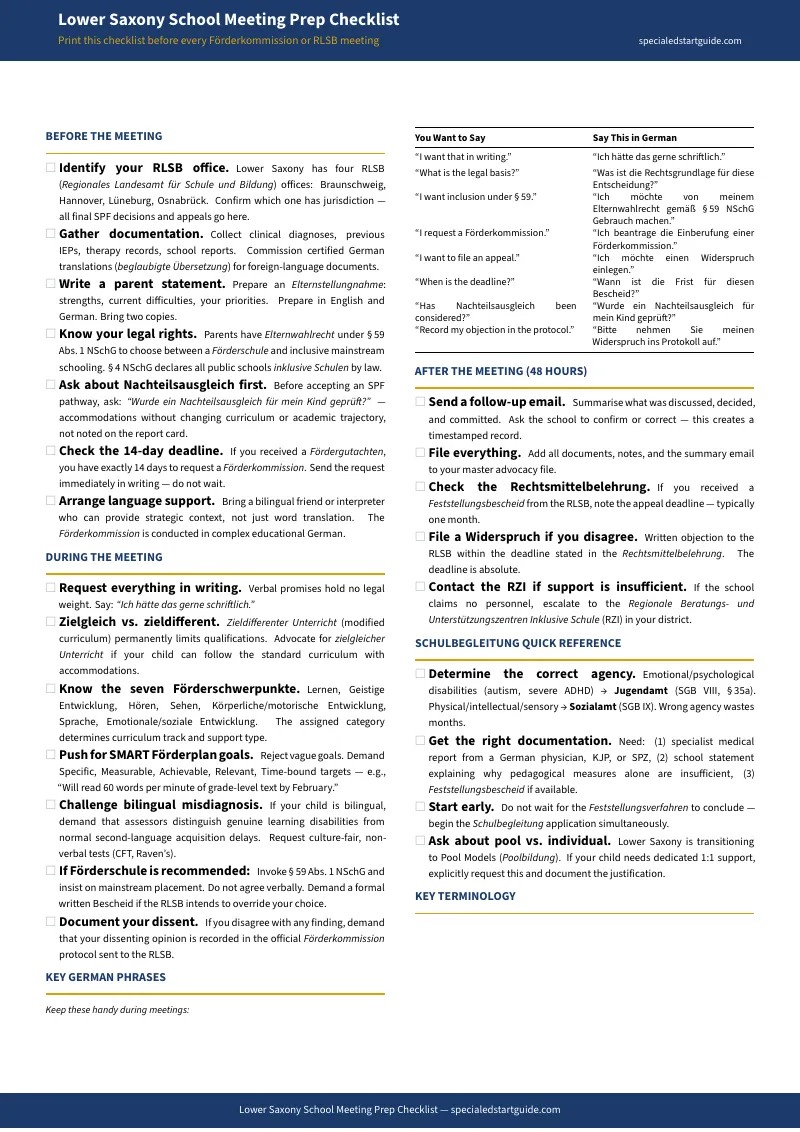
- Lower Saxony School Meeting Prep Checklist (checklist.pdf) — printable quick-reference with essential German phrases, legal rights under § 59 NSchG, Schulbegleitung agency decision tree, and post-meeting documentation procedures
- Förderkommission Request Template (foerderkommission-request-template.pdf) — the German-language letter you send within 14 days of receiving the Fördergutachten to secure your hearing, with delivery instructions and preparation checklist
- Schulbegleitung Decision Tree (schulbegleitung-decision-tree.pdf) — visual pathway showing whether your application goes to the Jugendamt or Sozialamt based on your child's diagnosis, plus the 5-step application checklist and Pool Model guidance
- Widerspruch Template (widerspruch-template.pdf) — formal appeal letter against an RLSB Feststellungsbescheid citing § 59 NSchG, with common objection grounds and all four RLSB office addresses
- German-English Glossary (german-english-glossary.pdf) — 60+ Lower Saxony special education terms with practical explanations, grouped by category — print and bring to every meeting
- Förderschwerpunkte Reference Card (foerderschwerpunkte-reference.pdf) — the seven support categories colour-coded by curriculum impact (zielgleich vs. zieldifferent), showing exactly what each classification means for your child's qualifications
- Documentation Tracker (documentation-tracker.pdf) — fillable incident log worksheet with the 48-hour follow-up rule, meeting record table, and master file checklist
Instant PDF download. Print the checklist tonight — bring it to your next school meeting.
Money-back guarantee, no time limit. If the Blueprint doesn't change how you navigate your child's education in Lower Saxony, email us for a full refund. No questions asked.
Not ready for the full Blueprint? Download the free Lower Saxony School Meeting Prep Checklist — a structured quick-reference covering the Feststellungsverfahren basics, Förderschule vs. inclusion options, essential questions in German, and post-meeting documentation. It's enough to walk into your next meeting prepared, and it's free.
Your child has a right to inclusive education in Lower Saxony. § 59 NSchG guarantees it. The school knows the system. After tonight, so will you.