The School Just Mentioned a Feststellungsverfahren. The Letter Is in Bavarian Administrative German. You Have One Month to Appeal.
You moved to Munich for the job — a BMW transfer, a Siemens rotation, a Max Planck position, your spouse's career at one of the tech companies clustered along the Isar. You enrolled your child in the local Grundschule because the relocation package didn't cover international school. The school seemed fine. Then a meeting happened. The Rektorin sat down with someone from the Mobiler Sonderpädagogischer Dienst and used a phrase you'd never heard before: Feststellungsverfahren. They want to assess your child. They produced forms — in German. They mentioned something about a Sonderpädagogisches Gutachten and a possible placement in a Förderzentrum. They said you have options. They did not explain what those options actually are.
You went home and opened Google Translate. You typed in Sonderpädagogisches Förderzentrum. It gave you "special education support centre." You typed in lernzieldifferenter Unterricht. It gave you "learning-goal-differentiated teaching." You typed in Nachteilsausgleich. It gave you "disadvantage compensation." None of these translations told you that Bavaria has the lowest inclusion rate and the highest exclusion rate of all sixteen German states — with 60-70% of students with special educational needs educated in segregated Förderzentren. None of them told you that the Sonderpädagogisches Gutachten is the legal document that triggers a Schulamt decision to mandate Förderschule attendance. None of them told you that Article 41 of the Bavarian Education Act gives you a legal right to choose mainstream inclusion. And none of them told you that the appeal deadline is one month — and missing it makes the decision permanent.
You searched for "special education Bavaria English." You found a glossy Ministry brochure celebrating "Inklusion durch eine Vielfalt schulischer Angebote" — inclusion through a variety of school offerings — that presented the Förderzentrum as a benign, equal pathway. You found Reddit threads from parents in Berlin and Baden-Württemberg whose advice does not apply because education in Germany is federalised. You found an American education consultant who charges $100 per hour and has never heard of a Bezirk Oberbayern Schulbegleitung application. You found nothing that explained how the Bavarian system actually works, step by step, in English, for a parent who needs to make decisions this month.
The problem is not that Bavaria's special education system is broken. It has genuine legal protections — including a constitutionally grounded parental right to choose between mainstream and Förderschule. The problem is that the entire system is documented in dense administrative German, designed for native speakers who grew up inside the bureaucracy, and runs on a cultural assumption that separating children by ability into specialised tracks is optimal — an assumption that directly contradicts what most expatriate families understand about inclusive education.
The Bavaria Special Education & Inclusion Blueprint is the Feststellungsverfahren Defence System that translates Bavaria's assessment procedures, Schulamt decision-making, MSD evaluation dynamics, and parental advocacy rights from institutional German into the plain-English roadmap, bilingual meeting preparation tools, and template library that give you equal footing at the school table — without paying a consultant €150 per hour to explain what the teacher just said.
What's Inside the Blueprint
The Legal Foundation — What Bavarian Law Actually Guarantees You
The BayEUG, the BaySchO, the VSO-F, the Grundgesetz Article 3, and the UN Convention on the Rights of Persons with Disabilities — translated from legislative German into plain-language leverage. When the school tells you "the MSD recommends Förderzentrum placement," this chapter tells you exactly which statute guarantees your right to refuse. When you arrive from the US expecting your IEP to transfer, or from the UK expecting your EHCP to carry weight, this chapter explains precisely why neither applies in Bavaria — and what replaces them. Article 41 Abs. 1 BayEUG is your Wahlrecht (right of choice). Article 41 Abs. 5 is the clause the Schulamt uses to override it. You need to understand both before you walk into the meeting.
The Feststellungsverfahren — The Most Consequential Assessment Your Child Will Face
How the formal assessment process works in practice. Who triggers it (school or parent). The critical fork between a Förderdiagnostischer Bericht (which keeps your child in mainstream) and a Sonderpädagogisches Gutachten (which builds the legal case for Förderschule transfer) — and why controlling which document is produced is the single most important advocacy decision you will make. How to prepare your child for MSD evaluation when every assessment tool is calibrated for German-speaking children. The exact template letter to request MSD consultation while explicitly blocking a Gutachten. And the fact most expat families never learn: the Schulamt's placement decision is an administrative act (Verwaltungsakt), subject to formal objection.
The Seven Förderschwerpunkte — How Bavaria Categorises Your Child
Bavaria assigns children to one of seven support focus areas: Lernen, Sprache, Emotionale und Soziale Entwicklung, Geistige Entwicklung, Körperliche und Motorische Entwicklung, Hören, and Sehen. The assigned category determines which Förderzentrum type handles your child, what curriculum access they receive, and whether they graduate with a standard or modified certificate. Autism is not a standalone category — it gets mapped onto one of the seven, which creates dangerous misclassification risk. This chapter explains what each category means in practice and why the Lernen and Geistige Entwicklung designations carry the most severe consequences for academic trajectory.
The Förderplan — Holding the School Accountable
The Förderplan is the Bavarian equivalent of an IEP — except it is pedagogical, not legally binding, and schools often treat it as a formality. This chapter shows you how to demand SMART goals (Specific, Measurable, Achievable, Relevant, Time-bound) with named responsible parties and fixed review dates. How to distinguish lernzielgleich (standard curriculum with support) from lernzieldifferent (modified goals that permanently limit graduation options). And how to use Förderplan review meetings as documented evidence if you later need to file an appeal.
Bavaria's Inclusion Models — What Each One Actually Delivers
Einzelinklusion, Schulprofil Inklusion, Kooperationsklassen, Partnerklassen, Tandemklassen — the state promotes these as inclusive pathways, but the practical differences between them are enormous. This chapter explains what each model actually provides versus what the brochure promises, which models offer genuine daily inclusion versus periodic joint activities, and how to evaluate which model genuinely serves your child versus which models exist primarily as political window dressing.
The Schulbegleitung Application — Navigating the Bezirk vs. Jugendamt Split
Applying for a school companion (Schulbegleitung or Integrationshelfer) is the single most bureaucratically fragmented process in the system. Whether your application goes to the regional district (one of seven Bezirke — Oberbayern, Niederbayern, Oberpfalz, Oberfranken, Mittelfranken, Unterfranken, Schwaben) under SGB IX/XII or to the local Jugendamt under SGB VIII § 35a depends entirely on your child's specific diagnosis — and both agencies routinely reject applications by claiming the other one is responsible. This chapter maps the exact decision tree based on diagnostic codes, provides the complete application pathway for each agency, and includes the documentation requirements that prevent months of back-and-forth rejection.
The Widerspruch — How to Appeal When the Schulamt Gets It Wrong
The appeal deadline is one month from delivery of the Bescheid. Miss it and the decision becomes legally binding — there are no extensions, no exceptions, no late submissions. This chapter provides the exact procedure for filing a Widerspruch, the required format and content, what happens after you file, how the Schulamt reviews the objection, and what escalation pathways exist — including the Regierungspräsidium and the Verwaltungsgericht (administrative court).
Nachteilsausgleich vs. Notenschutz — The Distinction That Protects Your Child's Diploma
Nachteilsausgleich (§ 33 BaySchO) provides exam accommodations — extra time, oral exams, assistive technology — without changing the curriculum and without any remark on the report card. Notenschutz (§ 34 BaySchO) modifies grading criteria but stamps a permanent note on every certificate your child receives. Choosing the wrong one has consequences that follow your child into employment applications. This chapter explains when each applies, how to request Nachteilsausgleich before the school pushes toward a Feststellungsverfahren, and why this accommodation should always be explored first.
The Complete German-English Terminology Guide
Not just translated — functionally explained. The glossary doesn't just tell you that Feststellungsverfahren means "assessment procedure." It tells you that the Feststellungsverfahren is the formal process that determines whether your child receives a sonderpädagogischer Förderbedarf diagnosis, that it can produce two fundamentally different documents with opposite consequences, and that your behaviour during the process shapes which document is produced. Every term includes its operational meaning, its legal weight, and what it means for your child in practice.
Who This Blueprint Is For
- Corporate assignees and trailing spouses in Munich, Nuremberg, Augsburg, and Regensburg whose child has been flagged for a Feststellungsverfahren — and who received German-language documentation they cannot fully understand
- U.S. military families stationed at USAG Bavaria (Grafenwöhr, Vilseck, Hohenfels, Garmisch) who discovered that EFMP screening, DoDEA school placement, and IDEA protections end the moment their child steps into the German school system
- Parents whose school just recommended Förderzentrum placement and who need to understand their legal right to refuse it and choose mainstream inclusion under Art. 41 BayEUG instead
- Parents who arrived from the US, UK, Australia, or Canada expecting their existing IEP, EHCP, or equivalent to transfer — and discovered that Bavaria's system operates on entirely different legal and pedagogical principles
- Parents whose child struggles in school primarily because they are still acquiring German — and who need to ensure the school distinguishes a language acquisition issue from a cognitive disability before the Sonderpädagogisches Gutachten is finalised
- Parents caught in the Bezirk-vs-Jugendamt ping-pong on a Schulbegleitung application — with both agencies claiming the other is responsible
- German-speaking parents in Bavaria who understand the system exists but need tactical clarity on deadlines, template language, and administrative procedures when things go wrong
Why Not Just Use the Free Resources?
The Bavarian Ministry of Education publishes brochures. The Staatliche Schulberatung offers free counselling. The Mobiler Sonderpädagogischer Dienst is free. Here's why expatriate parents still arrive at meetings unable to advocate effectively:
- State brochures present the system — they don't teach you how to challenge it. The Ministry's "Inklusion durch eine Vielfalt schulischer Angebote" brochure describes the Förderzentrum as a supportive, specialised option and emphasises "vertrauensvolle Zusammenarbeit" (trustful cooperation). It does not provide step-by-step instructions for what to do when the MSD aggressively recommends segregated placement, how to file a formal Widerspruch against the Schulamt, or what grounds to cite in an appeal. The law exists. The operational instructions for using it do not — at least not in English.
- The Staatliche Schulberatung works for the state. Bavaria's counselling service is free, professional, and often well-intentioned. It is also staffed by employees of the same system that issues the placement decisions. Relying on a state-employed counsellor to advocate aggressively against the state's own administrative recommendation is not a viable strategy. All consultations are conducted in German, and the counsellor's mandate is to facilitate smooth placement within the system — not to equip you to fight it.
- NGO resources are in German and built for policy reform. Organisations like Lebenshilfe Bayern, Inklusion Bayern e.V., and Gemeinsam leben – gemeinsam lernen produce vital advocacy materials. They are published entirely in German, often run 60+ pages of academic analysis, focus on systemic legislative reform rather than individual parent tactics, and assume familiarity with German administrative law that no expatriate family could reasonably possess.
- Expat forums mix advice from different German states. Reddit threads and Facebook groups regularly conflate Bavaria, Baden-Württemberg, and Berlin advice. Education in Germany is federalised under the Kulturhoheit der Länder. Baden-Württemberg's system uses different terminology, different legal frameworks (SchG vs. BayEUG), and different procedural structures (Bildungswegekonferenz vs. Runder Tisch). Applying advice from another state in Bavaria can lead to missed deadlines and dangerous assumptions about your rights.
- International education consultants don't know Bavarian law. US-based special education advocates operate under IDEA and are experts in 504 plans. They have never navigated a Staatliches Schulamt hearing, decoded a Sonderpädagogisches Gutachten, or attended a meeting with the Mobiler Sonderpädagogischer Dienst. At €130 per hour, you're paying for expertise in the wrong jurisdiction.
The government publishes the regulations. NGOs campaign for policy reform. The Blueprint gives you the operational playbook.
— Less Than One Hour of a €130/Hour Consultant
A single session with a bilingual educational consultant in Munich costs €130 or more. An American special education advocate charges $100 just to review one report — and cannot advise on German law. International school tuition — the escape route many families consider — starts at €15,000 annually, and waitlists for schools that genuinely support special needs in Munich run 12 to 18 months. Even if you eventually need a consultant for a specific dispute, the systemic preparation you build with this Blueprint saves hundreds — because you arrive understanding the framework, speaking the right terminology, and asking specific questions instead of paying someone to explain the basics.
Your download includes the complete guide, a meeting prep checklist, and 8 standalone printable tools:
- Complete Blueprint Guide (guide.pdf) — 19 chapters covering the legal foundation (Art. 41 BayEUG, BaySchO, VSO-F), the Feststellungsverfahren process, the seven Förderschwerpunkte, Förderplan development, Bavaria's inclusion models, Schulbegleitung applications, Widerspruch appeals, Nachteilsausgleich vs. Notenschutz, USAG Bavaria military family guidance, and more
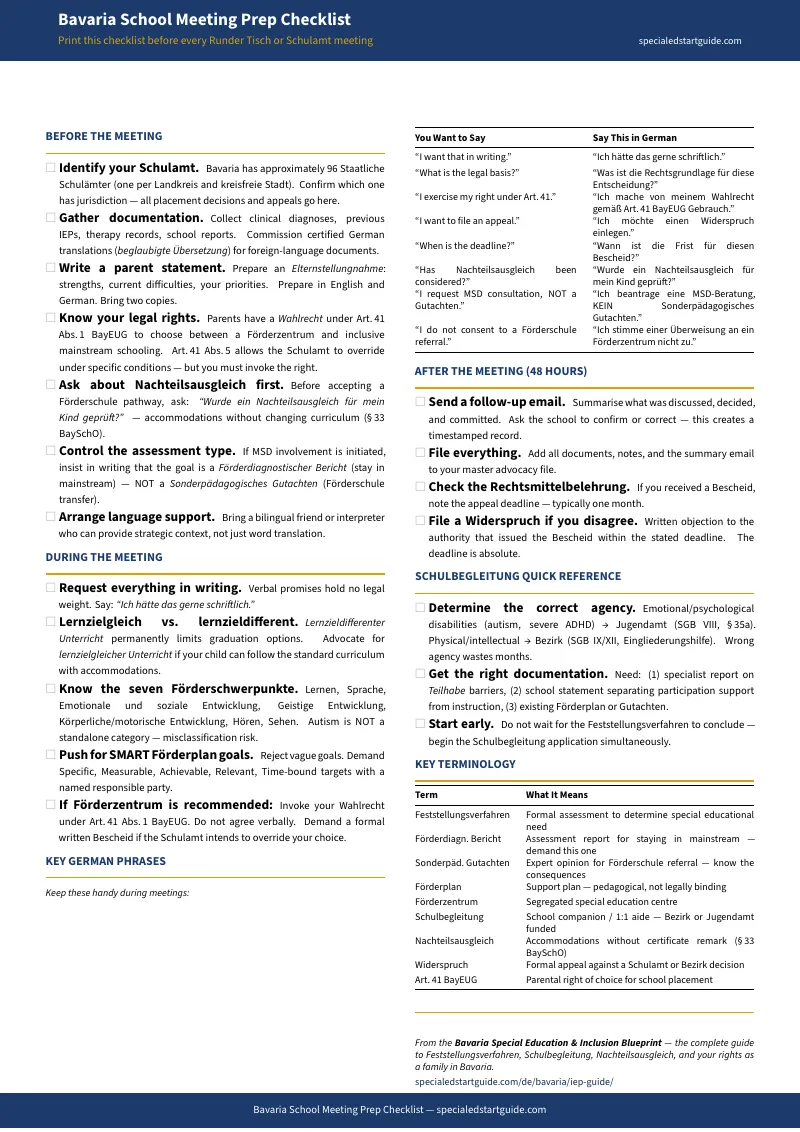
- Bavaria School Meeting Prep Checklist (checklist.pdf) — printable quick-reference with essential German phrases, legal rights under Art. 41 BayEUG, and post-meeting documentation procedures
- German-English Glossary (german-english-glossary.pdf) — 55 Bavarian special education terms functionally explained across 6 categories
- Widerspruch Appeal Templates (widerspruch-templates.pdf) — bilingual fill-in appeal letter with legal grounds, filing checklist, and escalation pathway
- Schulbegleitung Application Pathway (schulbegleitung-application.pdf) — Bezirk vs. Jugendamt decision tree, application checklist, and fill-in cover letter template
- Nachteilsausgleich Application (nachteilsausgleich-antrag.pdf) — § 33 vs. § 34 BaySchO comparison, fill-in application letter, and accommodations by disability type
- Förderschwerpunkte Quick Reference (foerderschwerpunkte-reference.pdf) — one-page card with all 7 categories, curriculum impact, and autism misclassification warning
- Parent Statement Template (parent-statement-template.pdf) — bilingual fill-in Elternbericht for assessment meetings
- Förderplan Goal Worksheet (foerderplan-worksheet.pdf) — SMART goal planning worksheet with pre-meeting checklist
- Documentation Tracker (documentation-tracker.pdf) — meeting log, correspondence log, incident log, and the 48-hour follow-up rule
Instant PDF download. Print the checklist, glossary, and parent statement tonight — bring them to your next school meeting.
Money-back guarantee, no time limit. If the Blueprint doesn't change how you navigate your child's education in Bavaria, email us for a full refund. No questions asked.
Not ready for the full Blueprint? Download the free Bavaria School Meeting Prep Checklist — a structured quick-reference covering the Feststellungsverfahren basics, Förderzentrum vs. inclusion options, essential questions in German, and post-meeting documentation. It's enough to walk into your next meeting prepared, and it's free.
Your child has a right to inclusive education in Bavaria. Article 41 BayEUG guarantees it. The school knows the system. After tonight, so will you.