
The School Handed You a Stack of German Forms. Your Child's Educational Future Depends on What You Sign.
You moved to Bern — the political capital, home to embassies, the University of Bern, international organizations. You enrolled your child in the local Volksschule because that's what Bern families do. And then a meeting happened. The teacher sat you down, mentioned the Erziehungsberatung, and produced a consent form for something called the Standardisiertes Abklärungsverfahren. They explained the process — in German. They used terms you'd never heard: sonderpädagogische Unterstützung, Integrative Förderung, Förderplanung. They want you to sign. They need you to sign. You have no idea what you're agreeing to.
You went home and opened Google Translate. You typed in Integrative Förderung. It gave you "integrative support." You typed in Integrative Sonderschulung. It gave you "integrative special schooling." Those sound similar. They are not. The first is managed locally by the school from a shared resource pool — fast, low-friction, no cantonal paperwork. The second triggers a formal cantonal process with SAV assessment, AKVB authorization, and dedicated specialist hours mandated individually for your child. Misunderstanding which one is being proposed — and signing the wrong consent form — can lock your child into a support tier that either undershoots their needs for the entire school year or launches an institutional process you didn't intend to start.
You searched for "special education Bern Switzerland English." You found a beautiful four-page English brochure from the Bildungs- und Kulturdirektion acknowledging that "simple special education measures" exist. You found a flyer from the Erziehungsberatung explaining their mission to provide "in-depth counseling sessions and assessments." You found ASK — All Special Kids — only to discover their resources focus almost entirely on Geneva's system, which operates under entirely different cantonal laws and different terminology. You found Reddit threads where expats in Zurich shared advice about a completely different canton with different tracking ages and different assessment services. You found a relocation consultant in Bern who charges CHF 190 per hour for generic settling-in advice but has never heard of the SAV. You found nothing that explained how Bern's system actually works, step by step, in English, for a parent who needs to make decisions this semester.
The problem is not that Bern lacks a good special education system. Canton Bern educates roughly 100,000 students, integrates approximately 80% into standard mainstream instruction without specialized support, and delivers simple measures — speech therapy, integrative support, psychomotor therapy — to another 15% within the regular classroom. The system is well-funded, staffed by highly trained professionals, and anchored in a clear legal framework. The problem is that the entire system is documented in complex administrative German, designed for Swiss-German speakers who grew up inside it, and operates on assumptions about parental knowledge that no expatriate family could reasonably meet.
The Bern Canton Special Education Blueprint is the Cantonal Navigation System that translates Bern's special education framework from institutional German into the plain-English roadmap, meeting preparation tools, and advocacy language that give you equal footing at the Standortgespräch table — without paying CHF 190 per hour for a consultant to explain what the school just said.
What's Inside the Blueprint
The Legal Framework Decoded — What the Law Actually Guarantees
The Intercantonal Concordat on Special Education, Canton Bern's own Volksschulgesetz (VSG), the BMV (Ordinance on Special Measures), and the federal Behindertengleichstellungsgesetz (BehiG) — translated from legislative German into plain-language leverage. When the school tells you "we need a formal assessment before anything can happen," this chapter tells you exactly what they can implement immediately from the school's resource pool while you wait months for the Erziehungsberatung evaluation. When you arrive from the US expecting your IEP to transfer, or from the UK expecting your EHCP to carry legal weight, this chapter explains precisely why neither applies in Canton Bern — and what replaces them.
The Two-Tier System — Understanding What Your Child Actually Qualifies For
Einfache sonderpädagogische Massnahmen (simple measures) vs. verstärkte Massnahmen / besonderes Volksschulangebot (enhanced measures). The first tier is school-managed, requires only the Schulleitung's authorization, and can start within weeks. The second tier requires Erziehungsberatung (EB) assessment, SAV evaluation, and cantonal approval from the AKVB — a process that takes months. Most expat families don't know which tier their child falls into, which means they either wait passively when the school could act immediately, or direct enhanced-measure requests at a principal who lacks the authority to approve them.
The Assessment Pipeline — From Suspicion to Formal Support
What happens when the school recommends an Erziehungsberatung referral. What the SAV (Standardisiertes Abklärungsverfahren) involves — the ICF-based functional assessment framework that determines your child's support level. What the EB report contains and recommends. How to prepare your child for the assessment. What to do with results you disagree with. The specific timeline in Bern — often several months to a full academic year — and how to ensure your child receives simple measures while waiting.
The Standortgespräch — Bern's Equivalent of an IEP Meeting
How the school meeting works in practice. Who attends — the Klassenlehrperson, the Speziallehrperson (SHP), possibly the EB psychologist, possibly the Schulleitung. What gets decided, what documentation is produced, what happens next. How to prepare a parent statement that actually shifts the conversation. How to review proposed Förderziele (support goals) for specificity and measurability — because "improve reading" is not a goal, and the school knows it. How to push back on vague objectives without damaging the collaborative relationship you depend on for results.
Förderplanung, Individuelle Lernziele, and Nachteilsausgleich — The Core Instruments
The Förderplan is the closest thing Bern has to an IEP — but it is a pedagogical document, not a legal contract. Individuelle Lernziele (ILZ) adapt the curriculum but alter the Zeugnis (report card) and can functionally exclude your child from the Sekundarschule track. Nachteilsausgleich provides accommodations — extended time, oral exams, assistive technology — without lowering academic standards. This chapter explains when each tool applies, who authorizes it, and why you should push for Nachteilsausgleich before the school proposes ILZ — because the tracking consequences of adapted goals are irreversible once the Zeugnis reflects them.
The Gesamtschulischer Prozess (GP) — Coordinating the Full Support Network
When your child receives enhanced measures, the GP becomes the coordination framework connecting the classroom teacher, the Speziallehrperson, the EB, external therapists, and the family. This chapter explains how the GP works, how decisions flow between the school and the canton, and how to ensure your voice is heard in a multi-professional process conducted in German.
Secondary School Tracking — What No One Tells You Until It's Too Late
Bern streams students at the transition to Sekundarstufe I into programs with different performance requirements — Realschule (basic) and Sekundarschule (advanced). The Sekundarschule is the primary route to Gymnasium (academic high school) and university. If your child has an undiagnosed learning difficulty, a language acquisition issue mistaken for a cognitive deficit, or adapted learning goals (ILZ) that were never necessary — the tracking decision can lock them out of the academic pathway before you understand what happened. This chapter explains exactly how tracking works, what factors influence the decision, and how to position your child correctly — including the critical distinction between a DaZ (German as a Second Language) issue and a genuine learning disability.
When Things Go Wrong — Appeals, Escalation, and Advocacy Organizations
Who to contact when the school refuses your requests, ignores the Förderplan, or proposes a placement you believe is inappropriate. The formal complaint pathway through the Schulinspektorat and the Bildungs- und Kulturdirektion (BKD). English-speaking advocacy organizations — ASK All Special Kids, Pro Infirmis, Procap, Inclusion Handicap — and what services they provide. Bilingual educational psychologists and therapists in the Bern region.
The Complete German-English Glossary — Every Term You'll Encounter, Explained
Not just translated — functionally explained. The glossary doesn't just tell you that Förderplanung means "support planning." It tells you that the Förderplan is a pedagogical document (not a legal contract), that it's reviewed semester by semester, and that your recourse if the school ignores it runs through the cantonal administrative process rather than a courtroom. Every term includes its operational meaning, its legal weight, and what it means for your child in practice.
Who This Blueprint Is For
- Expatriate families in Canton Bern — diplomatic staff, embassy personnel, university researchers, corporate professionals — whose child has been flagged by the school for learning, behavioral, or developmental concerns, and who received assessment paperwork in German that they cannot fully understand
- Parents whose school just recommended an Erziehungsberatung referral and who need to understand what they're consenting to, what the SAV assessment involves, and what the outcomes could mean for their child's school placement
- Parents who arrived from the US, UK, or Australia expecting their existing IEP, EHCP, or NDIS plan to transfer — and discovered that Bern's system operates on entirely different principles
- Parents on three-to-four-year diplomatic or corporate postings who cannot afford to lose a year of their child's critical developmental window navigating bureaucratic delays in a foreign language
- Parents whose child struggles in school primarily because they are still acquiring German as a second language (DaZ) — and who need to ensure the school distinguishes a language acquisition issue from a learning disability before tracking decisions are made
- Parents who have been told their child will receive Individuelle Lernziele (ILZ) without understanding that this alters the Zeugnis, changes the tracking calculation, and can limit access to the Sekundarschule — the academic secondary pathway
- Parents approaching the Sekundarstufe I transition who need to understand how Nachteilsausgleich, school assessments, and the Gesamtbeurteilung interact to determine which program their child enters
- Parents in the EB waiting period who need to know exactly what simple measures the school can implement immediately — without waiting for cantonal authorization
Why Not Just Use the Free Resources?
Canton Bern publishes special education information. The BKD website has policy documents. The Erziehungsberatung has a four-page English flyer. Here's why parents still arrive at Standortgespräch meetings unable to advocate effectively:
- The canton's English-language school brochure is four pages. It acknowledges that "simple special education measures" exist. It does not explain the two-tier system, the SAV assessment process, the Förderplanung cycle, or your right to appeal a placement decision. It mentions tracking into different secondary programs — it does not explain how special education interventions interact with that tracking decision or how to protect your child's academic trajectory.
- The EB's English flyer describes their mission, not the process. It says the EB offers "in-depth counseling sessions and assessments." It does not explain the SAV workflow, the ICF-based functional assessment, the consent forms you must sign, or what happens if you disagree with the results. The critical operational documents — the SAV forms, the Nachteilsausgleich applications, the cantonal Merkblätter — exist only in German and French.
- ASK (All Special Kids) focuses on Geneva. Their procedural guidance covers Geneva's Office Médico-Pédagogique and the Romandie-specific PES process. Because Swiss education is strictly cantonal, ASK's step-by-step workflows hold virtually no relevance for a family dealing with the EB in Bern. Their Bern-specific resources are limited to listing international schools and playgroups.
- Expat forums give you anecdotes from the wrong canton. Reddit threads and the English Forum Switzerland mix advice from Zurich, Basel, Bern, and Geneva interchangeably. Zurich tracks students at a different point, has different assessment services, different appeals structures, and different terminology. Applying Zurich advice in Bern is not just unhelpful — it is factually wrong on timelines that affect your child's academic future.
- Relocation consultants don't have special education expertise. They handle apartment leases, municipal registration, and generic school enrollment. They charge CHF 190 to CHF 600 for initial consultations. They cannot sit in an EB meeting, interpret a Förderplan, or advise on whether to accept Individuelle Lernziele or push for Nachteilsausgleich instead. They are logistics experts, not pedagogical advocates.
The canton publishes the regulations. Expat forums share anecdotes. The Blueprint gives you the operational roadmap.
— Less Than 15 Minutes of a CHF 190/Hour Consultant
A single session with a relocation consultant in Bern costs CHF 190 to CHF 600. Find My Swiss School charges CHF 195 per hour. The International School of Berne charges up to CHF 39,215 annually — and explicitly states it "cannot cater for moderate-to-severe learning needs." Even if you eventually need a consultant for a specific dispute, the systemic preparation you build with this Blueprint saves hundreds — because you arrive understanding the framework, speaking the right terminology, and asking specific questions instead of paying a consultant to explain basics.
Your download includes 7 PDFs — the complete guide, a meeting prep checklist, and 5 standalone printable tools:
- Complete Blueprint Guide (guide.pdf) — 12 chapters plus 3 appendices covering the legal framework, two-tier support system, EB assessment pipeline, Standortgespräch meetings and Förderplanung, Individuelle Lernziele vs. Nachteilsausgleich, the Gesamtschulischer Prozess (GP), secondary school tracking, expatriate-specific scenarios, bilingual canton navigation, early intervention and post-compulsory transitions, appeals and advocacy, support networks, and a complete German-English terminology glossary
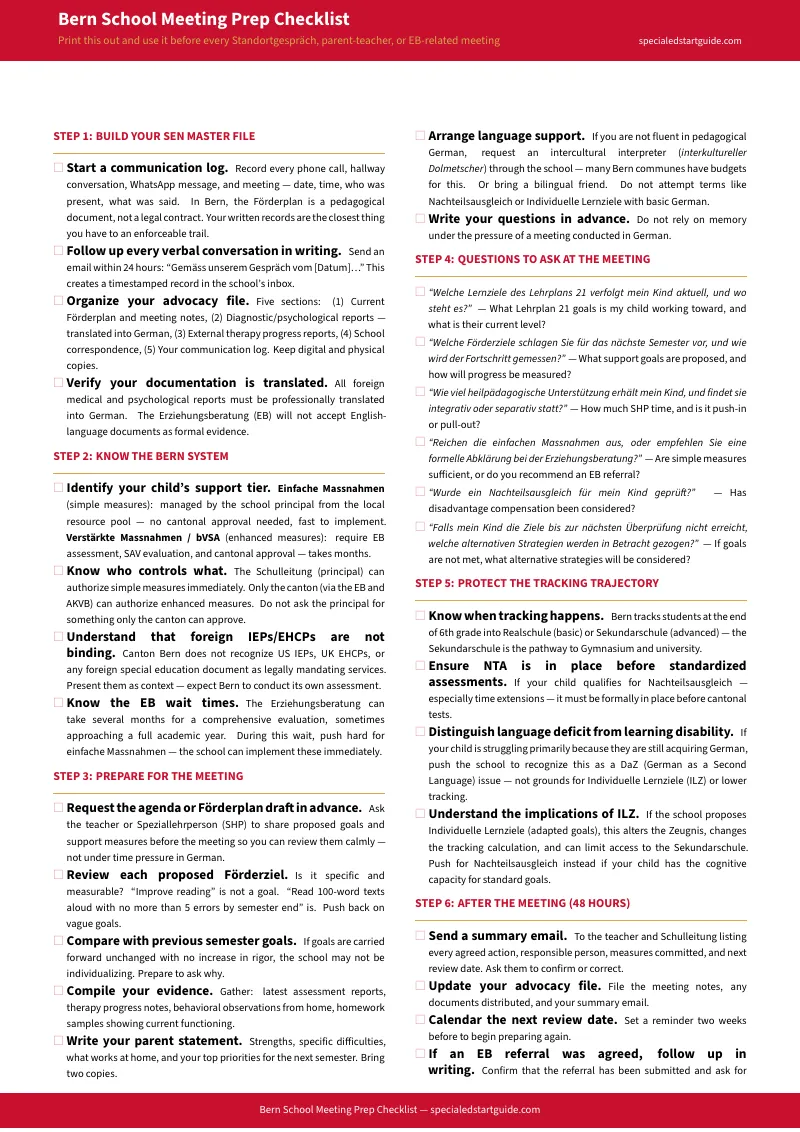
- Bern School Meeting Prep Checklist (checklist.pdf) — printable 7-step quick-reference covering SEN Master File setup, system orientation, Standortgespräch preparation, questions to ask (in German with English translations), tracking protection, post-meeting documentation, and essential German phrases for the meeting room
- German-English Glossary (german-english-glossary.pdf) — standalone 4-page reference card with all 51 German special education terms organized by category, each with its English translation and operational meaning
- Standortgespräch Meeting Questions (meeting-questions.pdf) — printable card with 6 essential questions in correct pedagogical German, English translations, and 9 key phrases to bring to the meeting
- Sample Letters & Templates (sample-letters.pdf) — 3 pre-written German-language letters: EB assessment request, Nachteilsausgleich application, and post-meeting summary email
- Two-Tier Support System Reference (two-tier-reference.pdf) — one-page visual showing what each tier includes, who authorizes it, and the key question to ask
- Tracking Protection Checklist (tracking-protection.pdf) — 5-step action plan for protecting your child's path to Sekundarschule and Gymnasium, with warning signs and critical German questions
Instant PDF download. Print the meeting questions card and glossary tonight — bring them to your next school meeting.
Money-back guarantee, no time limit. If the Blueprint doesn't change how you navigate your child's education in Canton Bern, email us for a full refund. No questions asked.
Not ready for the full Blueprint? Download the free Bern School Meeting Prep Checklist — a structured quick-reference covering the Bern two-tier system, Standortgespräch preparation, essential questions in German, and post-meeting documentation protocol. It's enough to walk into your next meeting prepared, and it's free.
Your child has a right to special education support in Canton Bern. The school knows the system. After tonight, so will you.