The Department Knows Yukon Policy. Now You Will Too.
You sat in that School-Based Team meeting ready — or you thought you were. You searched online, read everything, brought your child's report cards. And then the team smiled, referenced SBTs and SSPs and the Pyramid of Intervention, and told you your child "just needs more time" or "we don't have an EA available right now." You left the meeting with the same plan your child walked in with. No new supports. No assessment timeline. No written explanation of why they refused your requests — because you didn't know you could demand one.
The problem isn't that you're uninformed. The problem is that the Yukon's special education system is operating under severe strain — and nobody gives parents the map. The Auditor General of Canada audited the Department of Education and found that only 2 out of 82 IEPs reviewed had the required progress reports. There was virtually no evidence that recommended services and supports were ever delivered. Assessment waitlists stretch to three years. In 2020, the Department quietly moved 138 students off legally binding IEPs onto non-statutory Student Learning Plans — stripping away their legal protections without telling parents what they lost. And if you searched online for help, nearly everything you found references American law — IDEA, 504 Plans, due process hearings — none of which exist in the Yukon.
The Yukon IEP & Support Plan Blueprint is the territory-specific navigation toolkit that bridges the gap between knowing your child has rights and actually exercising them — with every template, script, and checklist grounded in the Yukon Education Act, the Yukon Human Rights Act, and the specific bureaucratic realities of the territory's 14 school communities.
What's Inside the Blueprint
The SLP Downgrade Defense System
In late 2020, the Department of Education moved 138 special needs students off legally binding IEPs and onto non-statutory Student Learning Plans. The Yukon Teachers' Association publicly condemned the move. An SLP strips away the statutory reporting obligations that force the Department to document, report, and update your child's plan. The Blueprint includes a clear comparison of IEPs vs. SLPs vs. SSPs, the exact reduction in legal protections, and copy-paste email scripts to formally refuse a downgrade and demand your child remains on a legally binding IEP.
The 2025-26 Competency-Based IEP Decoder
Starting in the 2025-2026 school year, all Yukon schools are mandating a shift to Competency-Based IEPs. Without proper navigation, competency-based frameworks become administrative loopholes for writing vaguer, less measurable goals that absolve the school of accountability. The Blueprint shows you how to translate traditional SMART goals into the new competency framework without losing the ability to track and enforce achievement — and the specific questions to ask at the first CB-IEP meeting that force accountability.
The Jordan's Principle Funding Bridge
When the territorial government says "we don't have the staff," your fight isn't over. For First Nations families, the Blueprint provides the complete step-by-step workflow showing how a documented, unfulfilled IEP becomes the primary evidentiary document for a federal Jordan's Principle application. Use the school's written refusal of service to hire private EAs, remote speech therapists, psychoeducational assessments, and specialized tutoring at federal expense.
The Copy-Paste Advocacy Email Library
Crisis-ready email templates pre-loaded with the exact Yukon Education Act section, Yukon Human Rights Act provision, or Charter citation that triggers a legal obligation. Request a formal IEP review. Challenge the removal of EA support. Demand raw assessment data. Refuse an SLP downgrade. Request an immediate referral to Student Support Services. These are Yukon-specific enforcement tools that create a legally binding paper trail the moment you hit send.
The Assessment Waitlist Survival Strategy
Public psychoeducational assessments carry wait times of up to three years. The Blueprint explains how to demand interim functional accommodations immediately — regardless of diagnosis — using the specific language that prevents the school from using "no diagnosis" as grounds to deny an IEP. It covers private assessment options ($4,000-$5,000), the Medical Expense Tax Credit, and how Jordan's Principle can fund assessments for First Nations children.
The IEP Meeting Prep System
The school tells parents to "share information about your child" at meetings. That advice is so passive it's designed to fail. The Blueprint's meeting system covers what documentation to bring, how to request the draft IEP in advance, how to verify the administrator present has decision-making authority, the exact questions to ask when the plan arrives pre-completed, and how to reject vague goals — because if the IEP was finished before you walked in, the school decided without you.
The Rural and Remote Advocacy Toolkit
Whitehorse houses 81% of students and virtually all specialist resources. If you're in Dawson City, Watson Lake, Haines Junction, or Carmacks, specialists visit periodically rather than reside locally. The Blueprint provides strategies for maximizing itinerant service visits, requesting territorial coverage for travel to Whitehorse for assessments, and maintaining IEP implementation between specialist visits.
The Grievance Escalation Map
The exact chain from School-Based Team to Principal to Area Superintendent to Director of Student Support Services to the Education Appeal Tribunal (Section 157 of the Education Act) to the Yukon Human Rights Commission — with template communications for each step so you escalate strategically, not blindly.
Who This Blueprint Is For
- Parents navigating Whitehorse schools or rural Yukon communities — from F.H. Collins to Jack Hulland to the smallest Watson Lake or Dawson City classroom
- Parents whose child was moved from an IEP to a Student Learning Plan and who need to understand what legal protections were stripped away — and how to reverse it
- Parents stuck on a multi-year public assessment waitlist who need to secure interim accommodations while their child waits years for a formal evaluation
- Yukon First Nation families who have heard about Jordan's Principle but don't know how to connect a failing school IEP to a federal funding application
- Parents of children with suspected FASD whose school insists nothing can happen without a formal medical diagnosis — while the diagnostic process itself requires travel to Whitehorse and carries its own barriers
- Parents preparing for the 2025-26 transition to Competency-Based IEPs who don't want vague competency language to replace their child's measurable goals
- Rural families where the speech therapist visits monthly, the school psychologist visits quarterly, and nobody offers continuous support between visits
- Parents preparing for an IEP or SBT meeting who don't want to walk in outgunned by a team that does this every day
Why Not Just Use the Free Resources?
The Yukon has dedicated organizations doing critical work. LDAY provides exceptional tutoring and meeting support. The Child Development Centre offers early intervention therapies. Autism Yukon provides community navigation. YFNED coordinates Jordan's Principle applications. Here's why parents still struggle after consulting all of them:
- The government's own handbook is stamped "Under Review" with a 2015 copyright date. It describes an idealized version of the system that the Auditor General found to be fundamentally broken. It does not address the SLP downgrade tactic, the CB-IEP transition, or what to do when the school refuses to implement the supports it wrote into the plan.
- LDAY and Autism Yukon provide in-person support — not a comprehensive written roadmap. They can attend your next meeting, but they don't offer a downloadable playbook you can work through at midnight when the anxiety hits and the next meeting is at 9 AM.
- The Child Development Centre's mandate ends at school entry. Their excellent early intervention therapies stop at age 5 — right when the formal K-12 IEP process begins and you need navigation most.
- YFNED's intensive services are prioritized for Indigenous students. Their work is critical, but a universally accessible written playbook that synthesizes traditional advocacy with Jordan's Principle navigation doesn't exist in a single, downloadable format.
- American and other-province IEP guides destroy your credibility. Walk into an SBT meeting referencing a "504 Plan," an "IPRC meeting," or your rights under "IDEA," and the administration immediately knows you don't understand the Yukon system. Your advocacy credibility evaporates before the meeting starts.
The free resources describe what the system should look like. The Blueprint gives you the tools to make the system actually work for your child.
— Less Than One Hour With an Out-of-Territory Advocate
Private educational advocates based in BC or Alberta charge $150 to $300 per hour. Private psychoeducational assessments cost $4,000 to $5,000 — and the nearest specialist is in Vancouver or Edmonton. For less than a single consultation, you gain immediate, lifetime access to the exact templates, checklists, and territory-specific knowledge required to hold the Department of Education accountable — starting tonight.
Your download includes the complete Blueprint guide plus 5 standalone printable tools:
- Complete Blueprint Guide (guide.pdf) — 14 chapters covering the Yukon crisis landscape, legal framework (Education Act, Human Rights Act, Charter rights), IEPs vs. SLPs vs. SSPs, the assessment and referral process, the 2025-26 CB-IEP transition, IEP meeting preparation and execution, Jordan's Principle funding bridge, First Nation School Board navigation, rural and remote community strategies, FASD-informed IEP strategies, dispute resolution and the Education Appeal Tribunal, post-secondary transitions, copy-paste communication templates, and the Yukon resources directory
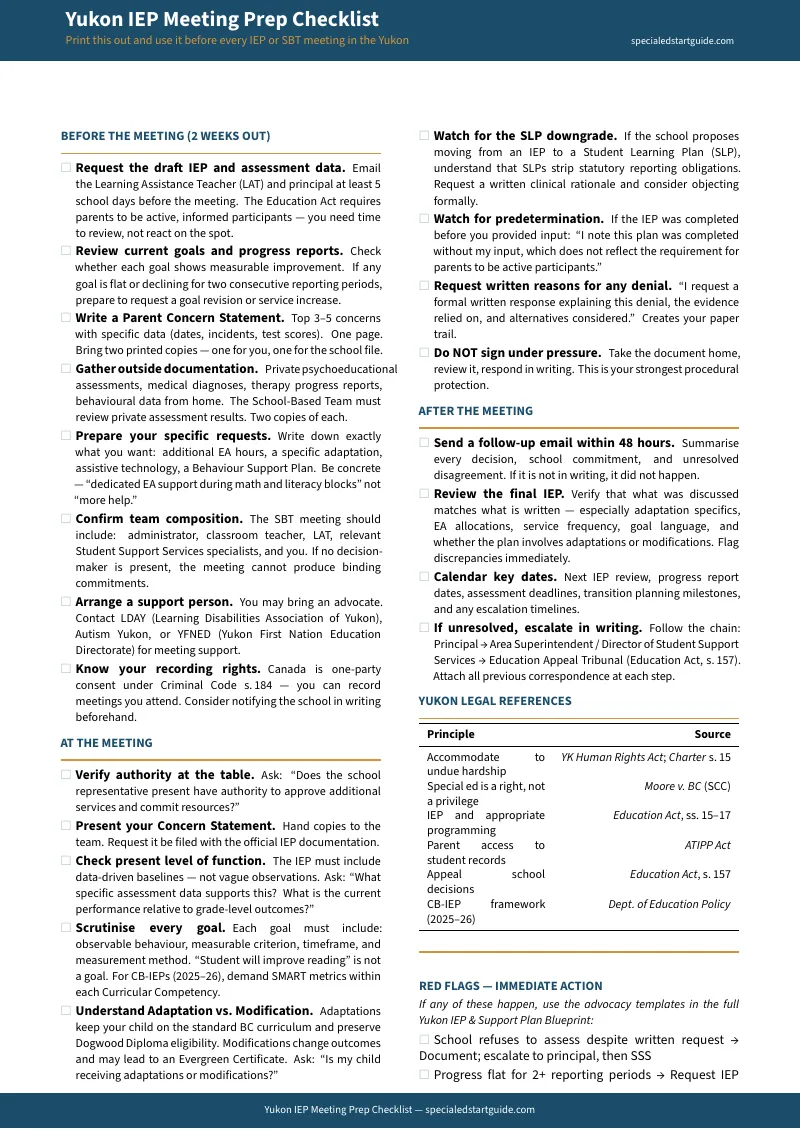
- IEP Meeting Prep Checklist (checklist.pdf) — the before/during/after checklist with Yukon law citations, red flags requiring immediate action, terminology decoder, and accommodation request prompts for every SBT meeting
- Letter Templates (letter-templates.pdf) — 5 copy-paste advocacy emails extracted from the guide: SLP downgrade refusal, SBT meeting request, Jordan's Principle service gap documentation, post-conversation summary, and functional accommodations without diagnosis — each pre-loaded with Yukon Education Act and Human Rights Act citations
- Escalation Pathway (escalation-pathway.pdf) — the complete visual escalation chain from School-Based Team to Principal to Superintendent to Education Appeal Tribunal to Yukon Human Rights Commission, with key contacts and preparation checklists for each level
- Terminology Cheat Sheet (terminology-cheat-sheet.pdf) — the Yukon terminology translation matrix, key acronyms quick reference, and a jurisdiction comparison showing how the Yukon differs from the US, Ontario, and BC — print it and bring it to every meeting
- IEP Goal Tracking Worksheet (goal-tracking-worksheet.pdf) — a fillable worksheet for tracking IEP goals across terms, monthly monitoring checklists, quarterly review prompts, and red flags requiring immediate action
Instant PDF download. Send your first advocacy email tonight. Walk into the next SBT meeting with Yukon law on your side.
Money-back guarantee, no time limit. If the Blueprint doesn't change how you approach IEP meetings in the Yukon, email us for a full refund. No questions asked.
Not ready for the full Blueprint? Download the free Yukon IEP Meeting Prep Checklist — a printable pre-meeting checklist with Yukon terminology, Education Act citations, and red flags that require immediate action. It's enough to walk into your next meeting prepared, and it's free.
Your child's education is a legal right, not a favour the Department grants when resources allow. The school knows Yukon policy. After tonight, so will you.