The School Promised Accommodations. Your Child Got a Verbal Apology and Nothing Changed. This Playbook Gives You the Paper Trail to Force It.
The IEP meeting went well — on paper. The Educational Assistant hours were documented. The speech referral was supposed to happen. The behaviour accommodations were agreed upon by everyone in the room. Then weeks passed and nothing materialized. You raised it at the next School-Based Team meeting. More nodding, more sympathetic faces, another promise to "follow up." Your child is still sitting without the support that was agreed upon, in writing, by the people now ignoring that document.
You tried the collaborative path. You attended every SBT meeting. You called the Learning Disabilities Association of Yukon and learned they're stretched thin. You downloaded the Department of Education's Guide to School-Based Supports — a booklet that meticulously explains how the system is designed to work when everyone cooperates, with nothing for the moment cooperation breaks down. You Googled "special education advocacy" and found dozens of American guides referencing IEPs, 504 Plans, IDEA, and due process hearings. None of those exist in Yukon. You checked education lawyers — there are virtually none in the territory. The few consultants available charge $100 to $300 per hour from British Columbia, often without knowing the difference between a Department of Education school and an FNSB school.
The Advocacy Escalation System fills the gap between free government resources that assume perfect collaboration and legal counsel that costs thousands. It gives you the exact dispute letters, escalation timelines, and territorial law citations that force Yukon schools to respond in writing — so verbal promises become documented obligations with legal weight.
What's Inside the Playbook
Fill-in-the-blank dispute letter templates pre-loaded with Yukon law — because asking nicely hasn't worked, and the school needs to see Education Act Section 15 and Yukon Human Rights Act citations in your correspondence before they treat your requests as legally binding obligations. Formal assessment request letters citing the statutory right to informed parental consent under Section 16. IEP non-compliance notices documenting specific accommodations being ignored by classroom staff. Emergency IEP review requests triggered by exclusions, seclusion incidents, or EA cancellations. Post-meeting follow-up confirmations that force the school to respond in writing. Each template creates the paper trail that Education Appeal Tribunal panels and human rights adjudicators require before they take your case seriously.
The Education Appeal Tribunal blueprint with the exact escalation path most parents never learn — the complete pathway from classroom teacher through principal, Director of Student Support Services, Superintendent, Assistant Deputy Minister, and finally the statutory Education Appeal Tribunal under Section 157 of the Education Act. Written templates and procedural steps for each stage, because skipping a level or failing to document gives the school grounds to dismiss your complaint.
The three-authority decoder that stops you from advocating to the wrong people — Yukon has three separate school authorities: the Department of Education, the First Nation School Board (FNSB), and the Commission scolaire francophone du Yukon (CSFY). Your escalation pathway depends entirely on which authority governs your child's school. This guide maps the specific administrative hierarchies and escalation contacts for all three, so you know exactly who to write to when support is denied — whether your child is in a Whitehorse public school, an FNSB school in Old Crow, or a CSFY francophone program.
Yukon Human Rights Commission complaint guidance — when the duty to accommodate has been breached, the 18-month filing deadline you cannot miss, what constitutes a prima facie case of discrimination based on disability in an educational setting, and the specific documentation that strengthens your complaint. The Yukon Human Rights Act requires accommodation to the point of undue hardship — and a school's internal budget constraints do not meet that legal threshold.
The paper trail system that wins disputes — the 24-hour follow-up rule, the advocacy file structure, email confirmation protocols, and student record access requests under Yukon's ATIPP Act. If it is not documented, it did not happen. This system ensures that everything the school promises — and everything they deny — exists in writing.
The waitlist workaround — how to formally demand interim classroom accommodations while your child languishes on the two-to-three-year psychoeducational assessment waitlist. The duty to accommodate does not depend on a completed diagnosis. Observable educational difficulties trigger the obligation. This chapter gives you the exact language to force the school to act now, not after a formal assessment that may be years away.
Jordan's Principle funding navigator — if your child is a citizen of a Yukon First Nation and the territorial system cannot provide a needed service — speech therapy, assistive technology, psychoeducational assessment, travel to out-of-territory specialists — Jordan's Principle can fund it directly. Step-by-step application guidance through the CYFN service coordinators, because the school will never tell you this option exists.
Exclusion and safety protections — what to do when the school calls you to pick up your child because their EA is absent, how to document seclusion and restraint incidents following the Jack Hulland revelations, and how to formally challenge discipline applied to disability-related behaviour the school failed to accommodate.
Who This Playbook Is For
- Parents whose child's IEP says one thing but the classroom reality looks nothing like it — accommodations on paper, not in practice — who need enforceable dispute letters, not another polite conversation
- Parents who were told their child "doesn't qualify" for an assessment, an Educational Assistant, or additional support, and who need the regulatory language to challenge that denial in writing
- Parents stuck on the two-to-three-year psychoeducational assessment waitlist who need to formally demand interim accommodations while the Department works through the backlog
- Parents whose child attends a First Nation School Board school and who need advocacy strategies that account for the FNSB's distinct administrative structure and cultural mandate
- Parents in rural communities — Watson Lake, Dawson City, Old Crow, Haines Junction — where a single EA resignation eliminates all specialized support and the school calls you to pick up your child
- Parents who moved to Yukon from a province with a more robust special education framework and need to adapt their advocacy to the territory's unique system
- Parents who bought an American IEP guide from Etsy and discovered that IDEA, 504 Plans, and due process hearings have zero legal standing in Yukon
Why Free Resources Aren't Enough When the School Stops Cooperating
The Department of Education's Guide to School-Based Supports is a legitimate resource — for understanding how the system is supposed to work. But search it for a dispute letter template, an Education Appeal Tribunal checklist, or guidance on filing a human rights complaint. They don't exist in that document. It was written to manage parental expectations within a collaborative framework, not to equip parents with adversarial tools when collaboration fails.
Inclusion Yukon is genuinely excellent at systemic advocacy — advancing rights, removing barriers, and supporting community inclusion. But their focus is on macro-level policy change and adult inclusion, not granular, classroom-level dispute resolution. They cannot draft your specific email to a dismissive principal at 10 PM on a Tuesday.
LDAY provides direct tutoring, dyslexia screening, and in-person advocacy support — but they operate from Whitehorse with limited staff capacity. A parent in Old Crow cannot walk into their office. Autism Yukon's Start Here guide is neurodiversity-affirming and well-written — for a generic North American audience. It does not reference the Yukon Education Act, the FNSB, or the Education Appeal Tribunal.
This playbook exists because the gap between "collaborative resources" and "hire a lawyer from Vancouver" is where most Yukon parents get stuck — and where their child's rights quietly evaporate.
What You Get
The Yukon Special Ed Advocacy Playbook — a 12-chapter guide plus standalone printable tools, all designed to work together as an advocacy system:
- The complete guide — your legal foundation, dispute strategies, human rights complaint guidance, assessment navigation, Jordan's Principle funding, transition planning, and Yukon resources directory
- Advocacy letter templates — all fill-in-the-blank dispute letters on their own, ready to print and send tonight
- Escalation ladder — the complete dispute pathway from teacher to Education Appeal Tribunal, covering all three school authorities, with every step on one sheet
- Communication log — the printable tracking worksheet that implements the 24-hour follow-up rule from the paper trail chapter
- Advocacy decision tree — match your situation to the right template and escalation step
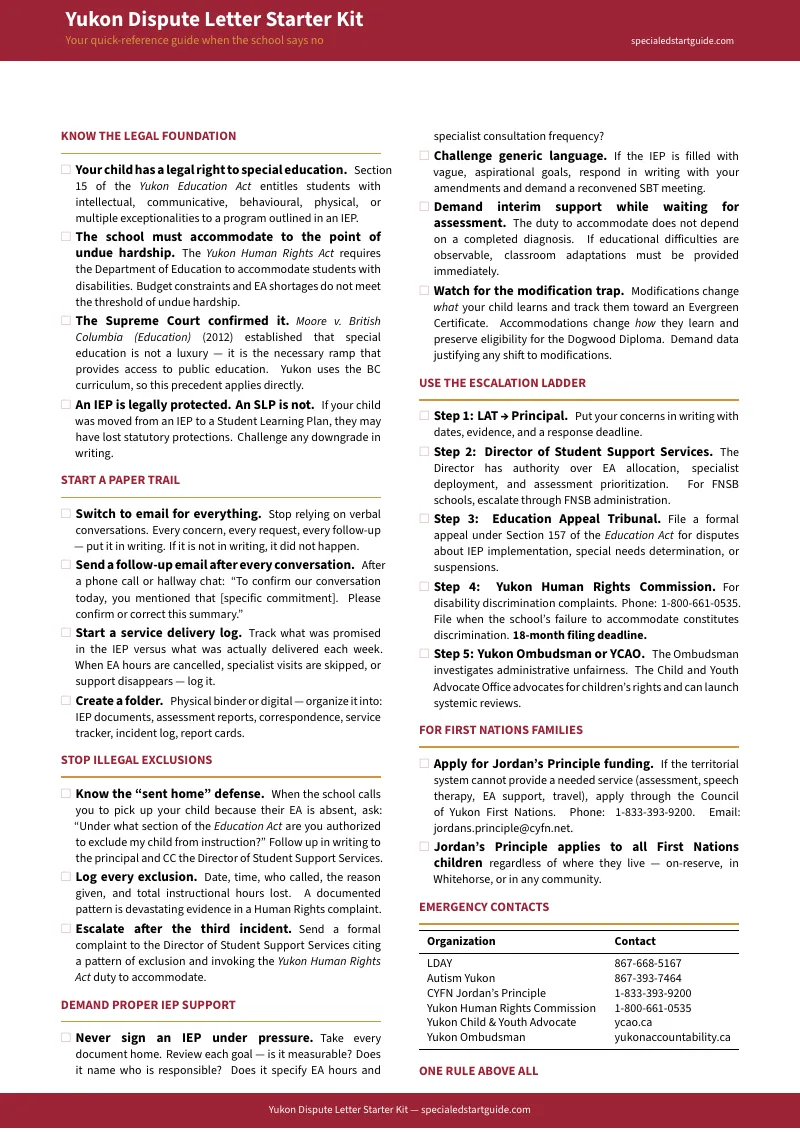
Plus the Yukon Dispute Letter Starter Kit — a standalone dispute letter template with your parent rights one-pager, ready to use tonight.
— less than 15 minutes of an out-of-territory education consultant's billing rate.
100% Satisfaction Guarantee
If the playbook doesn't give you the advocacy tools you need, email hello@specialedstartguide.com and we'll refund every cent. No forms, no hoops, no questions.
Your Child's Next SBT Meeting Doesn't Have to End the Same Way
Download the free Yukon Dispute Letter Starter Kit and send your first formally documented request tonight. When you're ready for the full escalation system — Education Appeal Tribunal blueprints, three-authority decoder, human rights complaint guidance, and the complete template library — upgrade to the full Playbook.