The School Calls It "Needs-Based." You Call It "Budget-Based." Here's How to Make Them Follow Their Own Rules.
You sat through the IIP meeting — the resource teacher, the principal, and a division consultant who joined by phone. They talked about "Actualizing a Learner-Centred Approach" like you should have memorized a Ministry framework document. They told you your child's Educational Assistant hours were being "redistributed" because another student has "more intensive needs." You asked what that meant for your child. They said the classroom teacher would "continue to use the Adaptive Dimension." You asked what happens if that isn't enough. They said to "monitor and revisit." You left with a plan your child never agreed to and a feeling that the decision was made before you sat down.
You were right. And you are not alone. During the 2024-2025 school year, an estimated 1,250 to 1,350 Saskatchewan students with intensive needs were excluded from full-time schooling — roughly one in every nine students flagged as requiring intensive support. The province committed $20 million for classroom complexity and announced 200 new specialized support classrooms. But those numbers haven't reached the school where your child sits without help. Educational Assistant shortages mean that when the EA calls in sick, it's your child who gets sent home. In rural and northern divisions, the educational psychologist visits once a month — if you're lucky. Private assessments cost $2,600 to $4,200. The public waitlist stretches past two years.
And here's the problem no one warns you about: nearly everything you've found searching online was written for the American system. IEP, 504 Plan, FAPE, IDEA, due process hearings — none of these exist in Saskatchewan. If you walk into a meeting referencing American special education law, the school immediately knows you don't understand this province's system, and your credibility as an advocate evaporates in the first sentence.
The Saskatchewan IEP & Support Plan Blueprint is the Provincial Advocacy System — the enforcement toolkit that translates Saskatchewan's Education Act, the Needs-Based Model, the eIIP process, and human rights framework into the exact meeting scripts, advocacy templates, and escalation strategies you need to secure your child's support. Every recommendation cites the applicable Saskatchewan regulation or legal principle.
What's Inside the Blueprint
The Saskatchewan Legal Framework Decoded
Saskatchewan's Education Act, 1995 mandates assessment upon formal written parental request. The Canadian Charter's Section 15 and the Saskatchewan Human Rights Code create a duty to accommodate up to the threshold of "undue hardship" — an exceptionally high legal bar that a school division's annual budget allocation does not meet. The Blueprint translates every critical statutory provision, the Supreme Court of Canada's Moore v. British Columbia decision, and the Ministry's policy framework into plain-language parental rights. When a school tells you they "don't have the budget," the duty to accommodate makes that legally irrelevant — and this guide teaches you exactly how to invoke it without a lawyer in the room.
The Needs-Based Assessment Framework
Saskatchewan doesn't strictly require a medical diagnosis to trigger educational support. Instead, support flows from demonstrated "educational impact." This sounds parent-friendly until you realize the school controls the definition of impact. The Blueprint gives you a step-by-step documentation system that frames your child's needs using the exact functional language the Ministry responds to — regardless of whether a formal diagnosis exists. You learn to prove impact in the system's own terms, not yours.
The High School Credit Decoder
The single most damaging gap in Saskatchewan's free resources: no one clearly explains how course coding affects your child's future. Regular courses (10, 20, 30) meet post-secondary entrance requirements. "Adapted" courses use the Adaptive Dimension without changing curriculum outcomes — safe and protective. "Modified" courses (11, 21, 31) contain only 50% of core curriculum and do not meet standard admission requirements for the University of Saskatchewan or Saskatchewan Polytechnic. "Alternative" courses (18, 28, 38) provide an Alternative Grade 12 that most employers and institutions do not recognize. The Blueprint includes a visual decision matrix so you understand exactly what you're agreeing to before a meeting, not after a transcript is printed.
Copy-Paste Advocacy Templates
Every template cites the exact Saskatchewan regulation. Formally request an assessment under the Education Act — because once the request is in writing, the Director of Education is legally obligated to direct that an assessment occurs. Object in writing to reduced EA hours. Demand a formal IIP revision when accommodations exist on paper but not in the classroom. Escalate to the superintendent with a letter that references the duty to accommodate. These aren't generic form letters — they're Saskatchewan enforcement tools that create a documented paper trail the moment you hit send.
IIP Meeting Scripts and Checklists
What to say when the team tells you "inclusion means the regular classroom" and refuses any additional supports. What to say when they reduce EA hours and call it a "reallocation." What to say when the principal tells you your child's needs are being met through the Adaptive Dimension alone — and you know they aren't. Each script cites the Saskatchewan regulation that proves them wrong. The pre-meeting checklist covers Canada's one-party consent recording rules and the specific documents you need to bring to every meeting.
Rural and Northern Saskatchewan Strategies
No existing guide addresses the realities of advocating outside Saskatoon and Regina. If your school division relies on an itinerant SLP who visits once a month, the Blueprint gives you specific escalation strategies: requesting telehealth support, leveraging the Ministry's virtual resources, documenting the impact of delayed services, and forcing the division to acknowledge that geographic isolation doesn't eliminate their legal obligations. A parent in Pelican Narrows or La Ronge deserves the same advocacy tools as a parent in Stonebridge.
The PPP-to-eIIP Translation Guide
Saskatchewan transitioned from Personal Program Plans to electronic Inclusion and Intervention Plans, but older documents, veteran teachers, and early learning settings still reference PPPs. The Blueprint maps the relationship between these documents, explains what changed and what didn't, and ensures you're never confused by terminology when it matters most — at the meeting table.
The Escalation Pathway Map
When informal advocacy fails, Saskatchewan offers escalation options — but they are not clearly documented for parents anywhere. The Blueprint maps the complete chain: classroom teacher to resource teacher to principal to superintendent to the Saskatchewan Human Rights Commission. It explains when to file a formal complaint, how to build the paper trail that wins, and how to trigger the Ministry's oversight mechanisms. In Saskatchewan, the paper trail IS the enforcement mechanism.
Who This Blueprint Is For
- Parents preparing for their first IIP meeting who don't want to walk in blind against a team that does this every day — and who need to understand how Saskatchewan's system actually works before they're asked to sign anything
- Parents whose child has been excluded, put on reduced hours, or told to stay home when the EA is absent — and who need the regulatory language to challenge that decision
- Parents in Saskatoon navigating overcrowded classrooms where high-needs students are triaged, or in Regina dealing with the "Intervention First" model that delays formal support
- Parents in rural, remote, or northern Saskatchewan where the educational psychologist visits quarterly, the SLP covers multiple school divisions, and "specialized support" means a specialist you've never met
- Parents whose child has autism, ADHD, a learning disability, ODD, or anxiety and was told the school would provide support "through the Adaptive Dimension" — but nothing has changed in the classroom
- Parents facing the assessment bottleneck — over 1,700 children on the public autism assessment waitlist alone — who need to force school-based accommodations while waiting for a diagnosis
- Parents of middle or high school students who need to understand the difference between adapted, modified, and alternative course codes before agreeing to changes that alter graduation pathways permanently
- Parents who bought an "IEP Planner" from Etsy built for the American system and discovered that IEP, 504 Plan, FAPE, and IDEA don't apply in Saskatchewan
- Parents who contacted Inclusion Saskatchewan for help but found high-level systemic advocacy rather than the tactical, step-by-step meeting preparation they needed
Why Not Just Use the Free Resources?
Saskatchewan has genuine free special education resources. The Ministry of Education publishes IIP Guidelines. Inclusion Saskatchewan offers the "Raising Your Voice Toolkit" and "Navigating the System" guide. School divisions publish parent handbooks. Here's why parents still struggle after consulting all of them:
- The Ministry's IIP Guidelines are a compliance manual for teachers. They instruct educators how to trigger the "Green Flag" logic boxes in the Student Data System software to register an IIP as complete. They explain bureaucratic requirements in detail. They provide zero tactical advice for parents on how to negotiate, what specific accommodations to request, or how to counter a school's claim of "no funding." The documents are written by the system, for the system.
- Inclusion Saskatchewan's toolkits excel at systemic advocacy, not meeting-table tactics. The "Navigating the System" guide explains the Canadian Human Rights Act, Supported Decision Making, and the SAID disability income program. These are essential for high-level understanding. They do not include word-for-word scripts for handling a resistant principal, objection-handling tactics for a resource teacher who claims your child "doesn't meet the threshold," or step-by-step IIP meeting preparation.
- School division handbooks are liability documents. They state that parents will be "involved" and describe their referral processes in neutral, institutional language. They do not empower you to lead or challenge the process. They do not explain the long-term consequences of agreeing to certain interventions. They do not arm you with accountability checklists to ensure the school follows through on what it documented.
- Etsy and TPT planners organize paperwork — they don't enforce rights. Every IEP binder on these platforms is built for the American IDEA framework. They track goals and meeting notes using terminology that has no legal standing in Saskatchewan. A pastel planner won't decode eIIP sections, explain modified credit codes, or teach you how to invoke the Education Act's mandatory assessment provision.
- Private advocates charge $200 per hour. Private psychoeducational assessments cost $2,600 to $4,200. Most Saskatchewan families can't absorb that — especially in rural communities where there's no local provider at any price. The Blueprint gives you the same procedural frameworks that professional advocates use, and if you do hire one later, a documented paper trail saves hundreds in billable hours they'd otherwise spend understanding your situation.
The free resources explain what Saskatchewan's system is. The Blueprint gives you the tools to make the system work for your child.
— Less Than Five Minutes of an Educational Consultant
Educational consultants in Saskatchewan bill $200 per hour. Private psychoeducational assessments run $2,600 to $4,200 — and the public waitlist exceeds two years. If you hand a consultant a disorganized pile of IIP documents and school emails, your first several billable hours go toward them understanding your situation. The Blueprint teaches you how to organize the paper trail, document functional impact in the Ministry's language, and draft the initial advocacy letters — either empowering you to win at the IIP table without a consultant, or saving hundreds in billable hours if you do hire one.
Your download includes a comprehensive 13-chapter Blueprint guide plus six standalone printable tools: an IIP Meeting Prep Checklist, Advocacy Letter Templates, IIP Meeting Scripts, a Credit Code Decoder, a Dispute Resolution Roadmap, and a Goal Tracking Worksheet. The guide covers the legal framework, assessment strategies, meeting advocacy, credit code protection, rural tactics, escalation pathways, and copy-paste advocacy templates — every recommendation citing the applicable Saskatchewan statute or policy.
Instant PDF download. Print the meeting scripts and checklist tonight. Walk into tomorrow's IIP meeting with Saskatchewan law on your side.
Money-back guarantee, no time limit. If the Blueprint doesn't change how you approach IIP meetings in Saskatchewan, email us for a full refund. No questions asked.
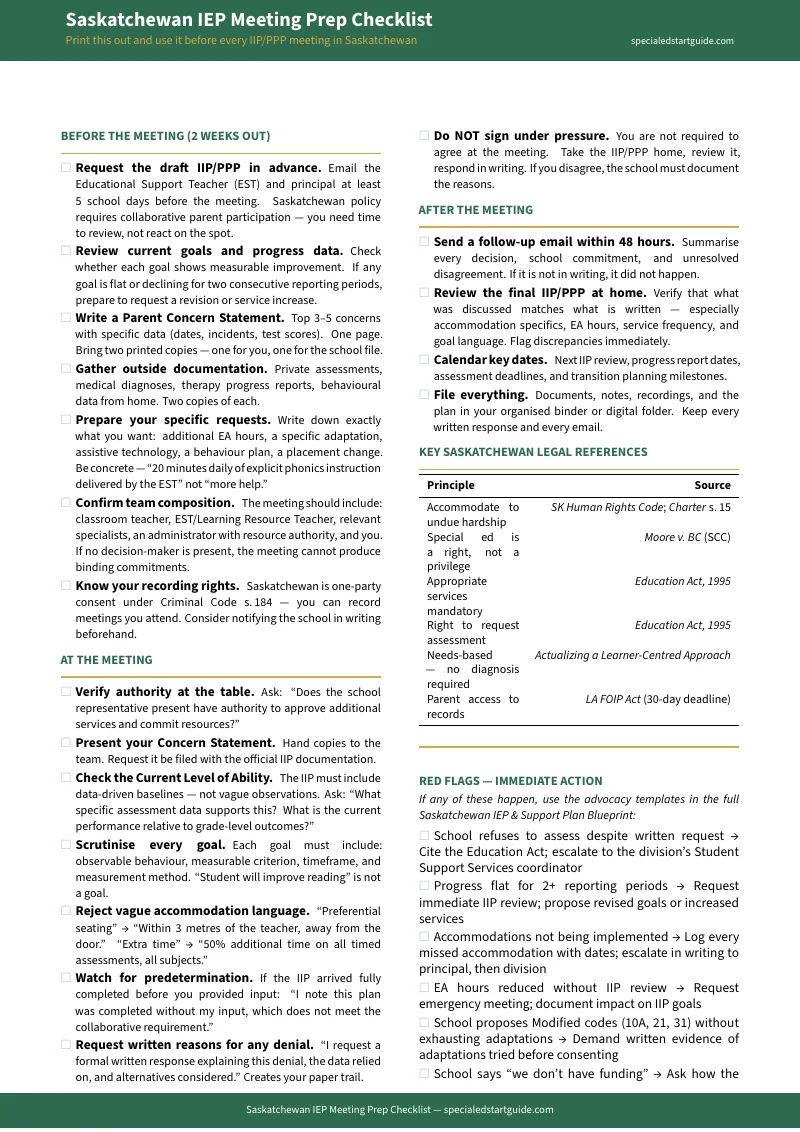
Not ready for the full Blueprint? Download the free Saskatchewan IEP Meeting Prep Checklist — a printable pre-meeting checklist covering what to bring, questions to ask, accommodation requests, and red flags that require immediate action. It's enough to walk into your next meeting prepared, and it's free.
Your child's education is a legal right under the Saskatchewan Human Rights Code and the Canadian Charter. The school knows the Education Act. After tonight, so will you.