The PI Meeting Was Over Before You Sat Down. Here's How to Change the Next One.
You walked into your child's Plan d'intervention meeting — the principal, the orthopédagogue, the psychoéducateur, and a classroom teacher juggling 30 other students. They referenced "mesures d'adaptation," cited Article 96.14, and mentioned your child's EHDAA classification like you should already know what it meant. You asked for more orthopédagogie hours. They said "resources are limited." You asked about assistive technology. They said they'd "look into it." You left with a signed PI that committed the school to vague objectives and no measurable timelines — and you weren't sure whether you had the right to push back.
You were right to feel uneasy. And you are not alone. Over 276,000 students — nearly one in four — are classified as EHDAA in Quebec's school system. Advocacy groups consistently report that this growth has not been matched by funding, staffing, or classroom support. Parents describe PI meetings where institutional jargon is wielded to deny costly services, where "concertation" means the school tells you what they've decided, and where you discover only later that agreeing to "modifications" instead of "adaptations" permanently disqualified your child from the standard high school diploma.
You live in a province where the closest thing to the American IEP — the one every Google result describes — doesn't exist the way Americans know it. Quebec doesn't use IDEA, 504 Plans, or due process hearings. The entire system runs on the Loi sur l'instruction publique (LIP), the MEQ disability coding system, and a collaborative PI process that grants you specific legal rights — but only if you know how to invoke them. Bringing American or Ontarian special education terminology into a meeting with a Quebec principal destroys your credibility in the first sentence.
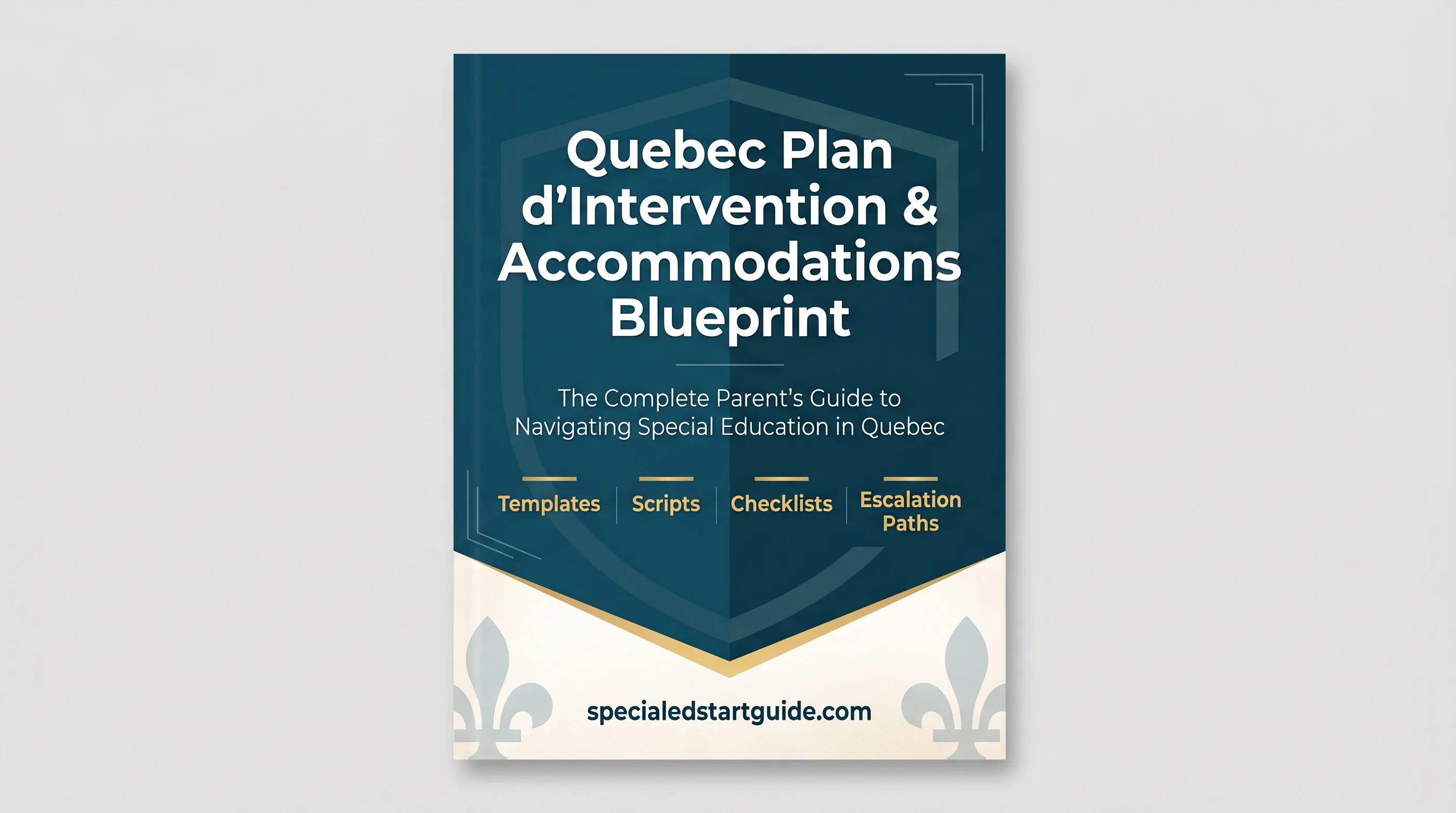
The Quebec Plan d'Intervention & Accommodations Blueprint is the LIP Enforcement System — the advocacy toolkit that translates Quebec's Education Act, MEQ policies, the Politique de l'adaptation scolaire, and the Protecteur national de l'élève complaint process into the exact meeting scripts, advocacy templates, and escalation strategies you need to secure your child's support. Every recommendation cites the applicable Quebec law or MEQ policy.
What's Inside the Blueprint
The Quebec Legal Framework Decoded
Article 96.14 of the LIP places the unequivocal legal responsibility for your child's PI on the school principal. Article 234 obligates the CSS to adapt educational services to EHDAA students. Article 235 mandates that every CSS adopt a local special education policy after consulting the parent advisory committee (CCSEHDAA). The Blueprint translates every critical article, the MEQ's Cadre de référence, and the Politique de l'adaptation scolaire into plain-language parental rights. When a school tells you they "don't have the budget" for a TES or orthopédagogue, this guide teaches you exactly how to invoke Article 234 and escalate to the Protecteur national de l'élève — without needing a lawyer in the room.
The MEQ Disability Coding System Explained
Quebec uses 12 disability codes that trigger specific per-pupil funding and class-size weighting. Code 50 for autism. Code 34 for severe language impairment. Code 14 for severe behavioural disorders. Code 99 — the critical temporary classification that allows funding to flow while your child waits for a formal diagnosis. Schools sometimes resist applying these codes because coding triggers obligations. The Blueprint breaks down every code in plain language — what triggers it, what funding it unlocks, and what to say when the school claims your child "doesn't meet the criteria."
Adaptations vs. Modifications — The Decision That Shapes Everything
This is the single most important distinction in Quebec special education. Adaptations change HOW your child learns without altering the curriculum. Modifications change WHAT they're expected to learn — and permanently disqualify them from the standard DES diploma. Schools sometimes blur this distinction during PI meetings. The Blueprint makes it unmistakable — with specific examples, the exact questions to ask, and the language to use if modifications are being proposed without your full understanding of the consequences.
Copy-Paste Advocacy Templates
Every template cites the exact Quebec law. Request that the principal initiate a PI under Article 96.14. Demand a psychoeducational assessment referral. Challenge the school when promised orthopédagogie hours are not being delivered. Escalate to your CSS when the principal claims "lack of resources." File a formal complaint with the Protecteur national de l'élève when internal mechanisms fail. These aren't generic form letters — they're Quebec enforcement tools that create a documented paper trail the moment you hit send.
Bill 96, Language Rights, and Anglophone Families
Bill 96 has fundamentally reshaped communication between non-francophone parents and school administrations. New provisions restrict the use of English in communications with parents who've lived in Quebec for more than six months. The Blueprint explains how to secure interpreters for sensitive PI evaluations, protect your English-speaking child's CEGEP eligibility under new French-language course requirements, and navigate the rights of anglophone and allophone families within the confines of Quebec's language laws. No other guide addresses this.
The Waitlist Survival Guide
Public psychoeducational assessment waitlists in Quebec stretch 12 to 24 months. Private assessments cost $1,500 to $2,500. Private speech therapy evaluations run $120 to $280 per session. The Blueprint teaches you how to secure a PI and classroom accommodations while your child is waiting — because under the Politique de l'adaptation scolaire, the school must act as soon as difficulties appear, regardless of whether a formal diagnosis has been issued. It also explains how to leverage Code 99 for interim funding.
The Complaint and Escalation Process
When the school principal fails to deliver on PI commitments, Quebec law provides a three-step complaint mechanism culminating in the Protecteur national de l'élève — the provincial ombudsman with binding authority. The law imposes fines ranging from $2,000 to $20,000 for individuals and up to $250,000 for institutions that retaliate against parents who file complaints. The Blueprint maps the complete escalation chain — school principal to CSS administrator (15-day deadline) to the Protecteur régional/national — with timelines, documentation requirements, and the exact language to use at each level.
Condition-Specific Accommodation Guide
Your child has ADHD, autism, dyslexia, or a language impairment. You need to know exactly which Quebec-recognized classroom tools, assistive technologies, and specialist services to request. The Blueprint provides a condition-by-condition accommodation matrix — Lexibar for dysorthographia, WordQ for writing support, specific orthopédagogie and psychoeducation service models — so you walk into the PI meeting with specific, enforceable requests instead of hoping the school suggests something adequate.
Who This Blueprint Is For
- Parents preparing for their first PI meeting who don't want to walk in blind against a team that does this every day — and who need to understand Quebec's EHDAA framework before it's discussed at the table
- Parents whose child has been told they "don't qualify" for specialist support, a formal assessment, or an MEQ disability code — and who need the legal language to challenge that decision
- Parents stuck on the 12-to-24-month public assessment waitlist who need interim accommodations now
- Anglophone and allophone parents navigating the francophone CSS system under Bill 96 restrictions — worried about language barriers during evaluations and their child's CEGEP eligibility
- Parents in Montreal navigating CSSDM, EMSB, or Lester B. Pearson — or parents in Montérégie, Laval, Laurentides, Abitibi-Témiscamingue, or any CSS across Quebec
- Parents whose child has ADHD, autism, dyslexia, or a behavioural challenge and was told they're "not severe enough" for a formal PI or disability code
- Parents whose child's PI says one thing but the classroom reality looks nothing like it — accommodations on paper, not in practice
- Parents who moved to Quebec from Ontario, another province, or the United States and discovered that IEP, IPRC, FAPE, and IDEA don't apply here
- Parents who agree a "modification" sounded fine at the time but now realize it may affect their child's path to the DES diploma
Why Not Just Use the Free Resources?
Quebec has genuine free special education resources. The MEQ publishes the Cadre de référence pour le plan d'intervention. The OPHQ provides a parent guide on the school journey for children with disabilities. Autisme Québec and AQETA offer diagnosis-specific guides. Here's why parents still struggle after consulting all of them:
- The MEQ's Cadre de référence is a 60+ page theoretical document written by the system, for the system. It accurately defines the PI process. It does not tell you what to do when the principal claims "lack of resources" to deny an accommodation. It assumes frictionless collaboration and infinite resources — the exact opposite of what Quebec parents experience.
- The OPHQ guide explicitly states that parental signature on the PI is not mandatory. The school can legally implement the plan without your consent. The guide notes this fact but fails to explain how you exert leverage or halt a detrimental plan when your consent is being systematically bypassed.
- CSS parent handbooks are risk-management documents. They define codes of conduct and outline parent committee structures. They are designed to dictate parental behaviour, not to empower parents to demand structural changes or secure costly accommodations.
- Diagnosis-specific guides from Autisme Québec and AQETA are highly fragmented. A parent dealing with a child presenting ADHD combined with dyslexia and oppositional tendencies will find the autism guide only partially relevant. They validate frustration but lack the granular negotiation scripts required for an adversarial PI meeting.
- Etsy and Amazon planners are built for the American or Ontario system. They reference IDEA, 504 Plans, IPRC committees, and Regulation 181/98. None of this applies in Quebec. Using American terminology in a meeting with a Quebec principal signals that you don't understand the system — and destroys your credibility immediately.
- Private educational consultants charge $90 to $180 per hour. Private orthopédagogue support costs $240 to $420 for a screening block. Most Quebec families can't absorb that on top of the $1,500 to $2,500 private assessment they may have already paid. The Blueprint gives you the same procedural frameworks and advocacy templates that professional consultants use.
The free resources explain what Quebec law says. The Blueprint gives you the tools to make the school follow it.
— Less Than One Hour of a Private Orthopédagogue
Private orthopédagogues in Quebec charge $60 to $105 per hour. A screening and evaluation block runs $240 to $420. Private psychoeducational assessments cost $1,500 to $2,500 — and the public waitlist stretches two years. If you hand a consultant a disorganized pile of PI documents and school emails, your first several billable hours go toward them understanding your situation. The Blueprint teaches you how to organize the paper trail, decode the MEQ disability codes, and draft the initial advocacy letters — either empowering you to secure accommodations without a consultant, or saving hundreds in billable hours if you do hire one.
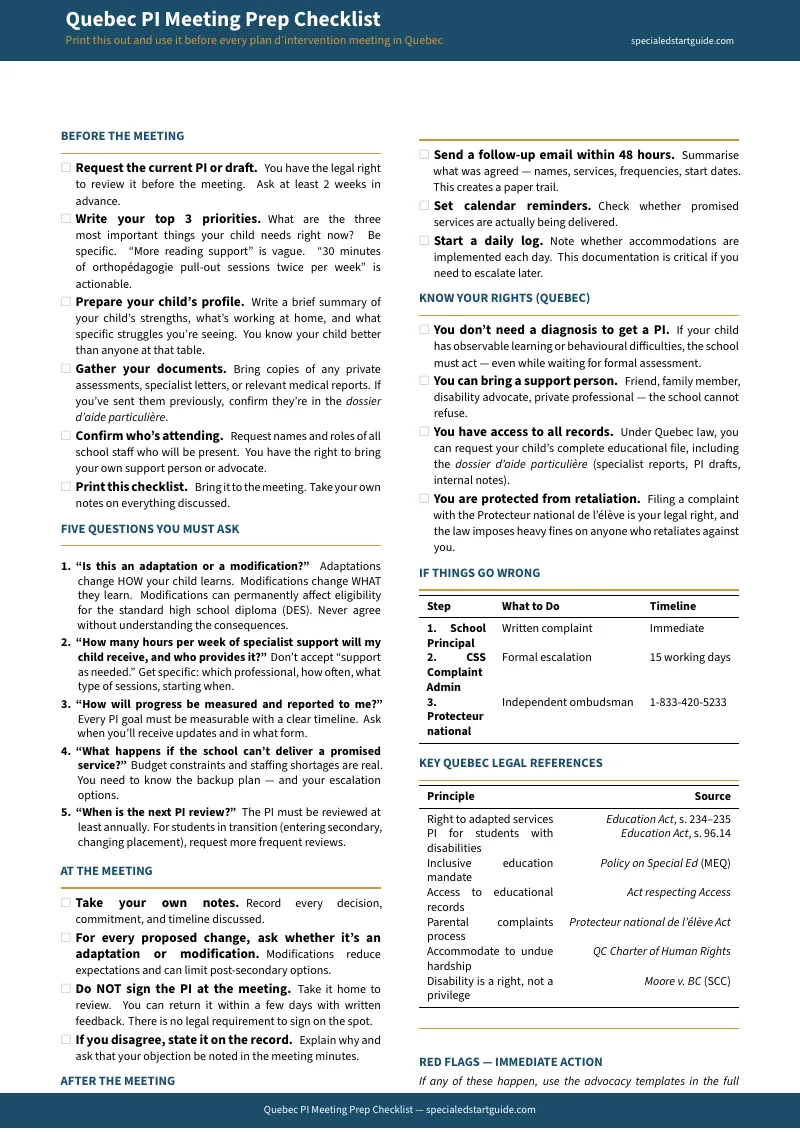
Your download includes 8 PDFs — a comprehensive 15-chapter Blueprint guide, 6 standalone printable tools (advocacy letter templates, PI meeting scripts, MEQ code decoder, complaint escalation roadmap, PI goal tracking worksheet, and adaptation-vs-modification reference card), plus a PI Meeting Prep Checklist. Every template is formatted so you can type directly into it or copy the text into an email, each citing the exact Quebec law that triggers a legal obligation.
Instant PDF download. Print the templates tonight. Walk into tomorrow's PI meeting with Article 96.14 on your side.
Money-back guarantee, no time limit. If the Blueprint doesn't change how you approach PI meetings in Quebec, email us for a full refund. No questions asked.
Not ready for the full Blueprint? Download the free Quebec PI Meeting Prep Checklist — a printable pre-meeting checklist with questions to ask, accommodation requests to prepare, red flags to watch for, and the critical adaptation-vs-modification distinction explained. It's enough to walk into your next meeting prepared, and it's free.
Your child's education is a legal right under the Loi sur l'instruction publique and the Canadian Charter. The school knows Article 96.14. After tonight, so will you.