The School Promised Accommodations in the Plan d'intervention. They Never Delivered. Now What?
You left the last PI review meeting with verbal assurances that your child's accommodations would be implemented "dès que possible." That was four months ago. The special education technician (TES) who was supposed to provide daily support appears three mornings a week — sometimes less. The orthopédagogue referral that was "in process" hasn't moved. The neuropsychological evaluation you requested has been on a public waitlist for over a year — and nobody offered interim services while your child falls further behind. You raised the issue at the next PI review and watched the school team nod sympathetically while writing nothing down. You sent a follow-up email. You received an acknowledgment. Nothing changed in the classroom.
You tried the collaborative approach — Quebec's system was built on it. You attended every meeting, signed every document, and trusted the school team. You downloaded the MEQ's Cadre de référence pour l'établissement des plans d'intervention and found dense bureaucratic language explaining how the PI process should work when everyone cooperates — but nothing for the moment cooperation breaks down. You consulted the OPHQ's guide and found broad explanations of your rights with a prominent disclaimer that the content cannot be interpreted as legal advice. You searched online and found excellent resources from Wrightslaw referencing IEPs, IDEA, FAPE, and 504 Plans — none of which exist in Quebec. You brought an American "IEP Binder" from Etsy to a meeting and watched the principal's expression change when they realized you didn't understand the provincial system.
You contacted COPHAN and found systemic policy advocacy — important work, but not help for your child's PI meeting next Thursday. You looked into private educational advocates at $150 to $300+ per hour. You checked education lawyers at retainers starting at $5,000. You earn too much for Legal Aid Quebec and not nearly enough for litigation.
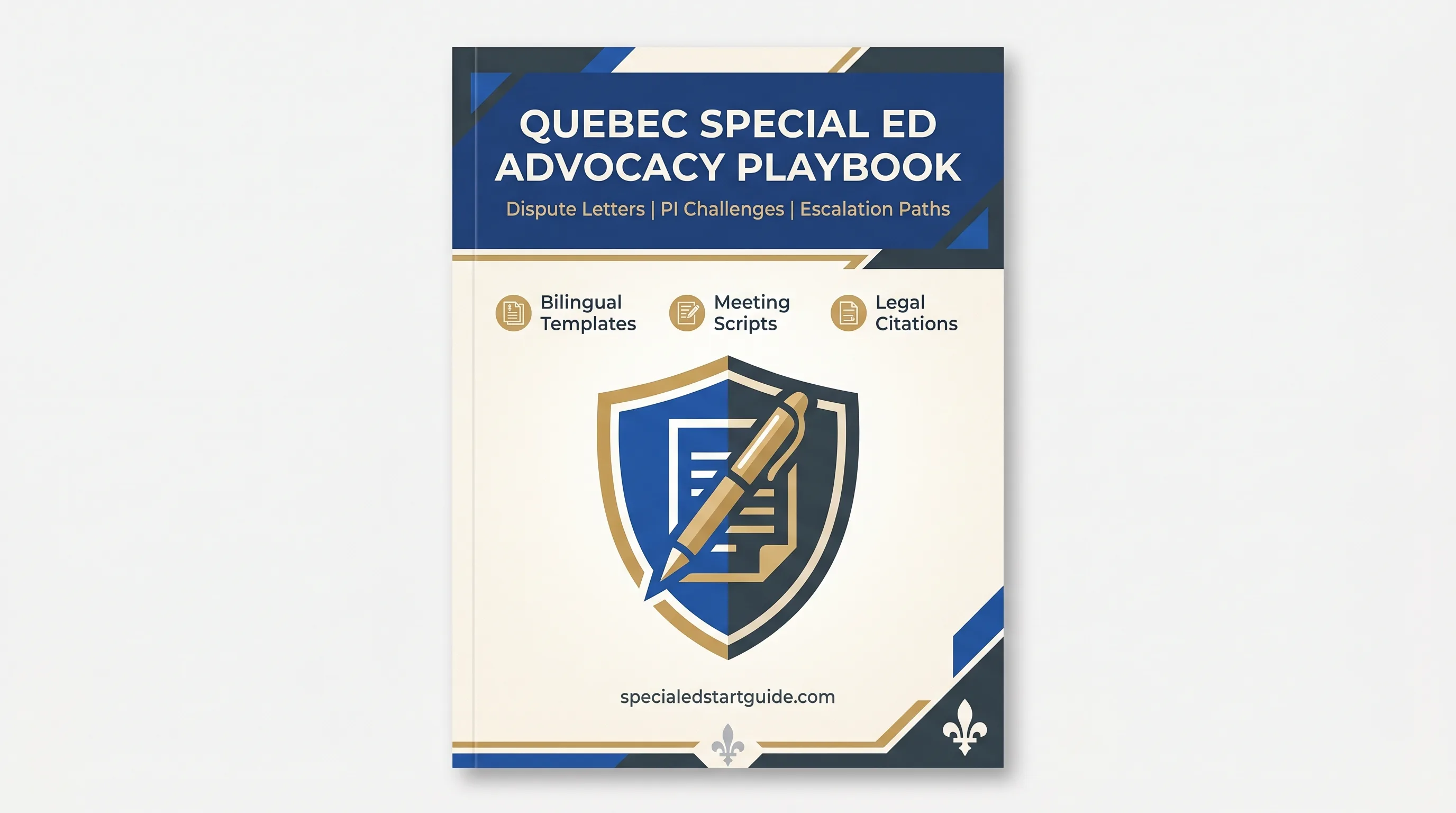
The Quebec Special Ed Advocacy Playbook is the PI Enforcement System — the tactical field manual that converts Quebec's Loi sur l'instruction publique (LIP), the Quebec Charter of Human Rights and Freedoms, and MEQ policy directives into the exact dispute letters, PI challenge procedures, and escalation strategies you need when collaboration has failed and your child's supports are disappearing. Every template is written in French — the language the system cannot procedurally dismiss — with full English explanations so you understand every word you're sending.
What's Inside the Playbook
Bilingual Dispute Letter Templates
Not generic form letters — Quebec enforcement tools pre-loaded with LIP and Charter citations. Evaluation demand letters citing Articles 96.14 and 234. PI non-compliance notices documenting specific accommodations being ignored. Post-meeting follow-up confirmations that force the school to respond in writing — because verbal promises made across a conference table have zero legal weight when you need to prove the school failed to act. Every letter written in French with English explanations so anglophone parents execute confidently without risking procedural dismissal.
The Protecteur de l'élève Escalation Ladder
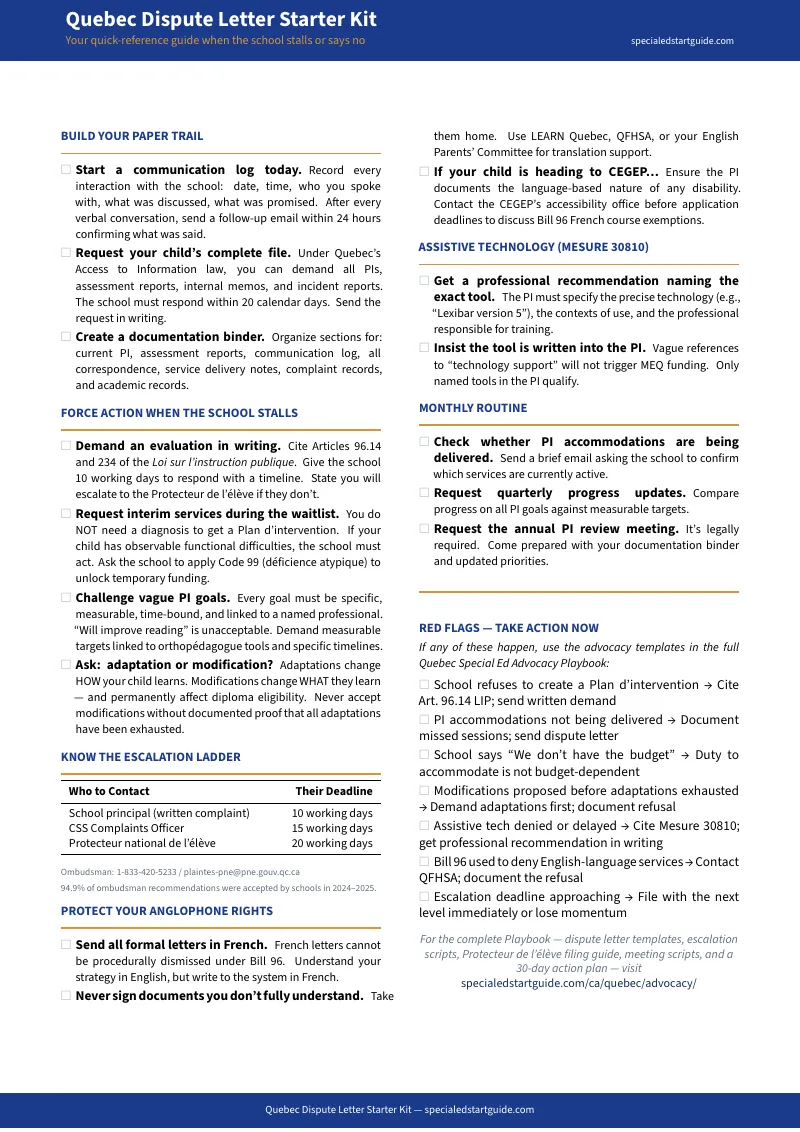
The three-step complaint process most Quebec parents never learn until their deadlines have passed. Step 1: principal (10 working days to respond). Step 2: CSS Complaints Officer (15 working days). Step 3: Regional Student Ombudsman (20 working days to issue binding recommendations). In 2024-2025, 94.9% of ombudsman recommendations were accepted by schools — making this the single most effective enforcement mechanism in your advocacy toolkit. The Playbook maps every step with the exact letter for each escalation.
CDPDJ Human Rights Complaint Strategy
When the school says "we don't have the resources" for your child's accommodations, the Quebec Charter of Human Rights and Freedoms says discrimination includes the failure to provide necessary accommodations for disabilities. Most parents never invoke this because they don't know how. The Playbook teaches you when a dispute crosses from education law into human rights territory, how to use the threat of a formal CDPDJ complaint as negotiating leverage during school-level discussions, and the pathway to the Tribunal des droits de la personne for cases involving systemic accommodation failure.
Meeting Scripts for the 7 Hardest Conversations
Exactly what to say when the principal claims an accommodation is "trop coûteux" — countering with LIP Article 234's legal obligation, which does not include a budget defence. What to say when the school suggests modifications that permanently alter diploma eligibility for a child who hasn't exhausted all adaptations. How to respond when the school says "on attend l'évaluation" — citing the school's obligation to accommodate demonstrated need regardless of diagnostic status. Plus scripts for TES reductions, PI goal disputes, placement challenges, and shortened school days.
The Documentation System That Wins Disputes
The 24-hour follow-up rule. The advocacy file structure. Email confirmation protocols. Formal file access requests under Quebec's Loi sur l'accès aux documents des organismes publics. The documentation standard that the Protecteur de l'élève, the CDPDJ, and the Tribunal des droits de la personne require before they take your case seriously. If you ever need a lawyer, this system means they can execute strategy immediately instead of doing administrative triage at premium hourly rates.
The Bill 96 CEGEP Transition Playbook
For anglophone and allophone families whose children face the requirement to pass the French exit exam or complete three core CEGEP courses in French — a near-insurmountable barrier for students with language processing disorders, dyslexia, or autism. How to document the language-based nature of a learning disability in the PI to support future exemption requests, when to contact the CEGEP accessibility office, and the advocacy groups fighting for accommodations under the new linguistic regime.
The Assessment Crisis Survival Guide
Public evaluation waitlists stretch 6 to 24 months across Quebec. Private speech-language evaluations cost $610 to $845. Neuropsychological evaluations run $710 to $1,750. In rural regions, vacancy rates for specialists exceed 40%. The Playbook teaches you how to formally demand an evaluation with LIP citations, secure interim accommodations during the waitlist, force the school to integrate private evaluation results into the PI, and use the Code 99 temporary classification to unlock services before a final diagnosis.
EMSB, CSS de Montréal & Rural Quebec Strategies
Navigating the EMSB and Lester B. Pearson under Bill 40 governance changes. CSS de Montréal's massive bureaucracy. The geographic lottery facing families in Côte-Nord, Abitibi-Témiscamingue, and Gaspésie where there are no private assessment options and vacancy rates for specialists exceed 40%. Each region requires different advocacy language — what works in Montreal's anglophone boards requires a completely different approach than a rural Centre de services scolaire that simply doesn't have the professionals to deliver what the PI promises.
30-Day Quick-Start Action Plan
Week-by-week implementation: Week 1 assess and document, Week 2 communicate in writing using the dispute letter templates, Week 3 prepare for the meeting with scripts, Week 4 execute and follow up. You are not reading a book cover to cover — you are executing a plan with deadlines that force the school to respond on the record.
Who This Playbook Is For
- Parents whose child's Plan d'intervention says one thing but the classroom reality looks nothing like it — accommodations on paper, nothing in practice — and who need the enforcement language to make the school accountable
- Parents whose child has been on a public evaluation waitlist for months with no interim services, and who need the LIP citations that prove the school cannot wait for a diagnosis before acting
- Anglophone parents in Montreal navigating a system where Bill 96 has restricted communication in English, and who need to write formal letters in French but understand every word they're sending
- Parents whose child's TES hours were cut, whose orthopédagogue was reassigned, or whose services disappeared mid-year without explanation or PI revision
- Parents whose child was excluded from class activities, sent home early, or placed on a shortened school day without written approval — and who need the Quebec Charter citations that identify this as a potential accommodation failure
- Parents facing a CEGEP transition where Bill 96 French requirements threaten to shut their child out of post-secondary education, and nobody has documented the language-based nature of the disability in the PI
- Parents in rural Quebec where the nearest private assessment clinic is hours away, the specialists visit monthly, and the school says there is nothing they can do until "un professionnel sera disponible"
- Parents who have tried the collaborative approach, attended every meeting, sent every email, and watched the school change nothing — and are ready to shift from requesting to demanding in writing
Why Not Just Use the Free Resources?
Quebec has legitimate free special education resources. Here is what they give you and what they don't:
- The MEQ publishes the Cadre de référence pour l'établissement des plans d'intervention. A thorough document explaining how the PI process should work from the school's perspective. It explains the law but does not give you dispute letter templates, escalation instructions with deadlines, or meeting scripts for when the school nods at your concerns and changes nothing. That guide was written to describe the system. This playbook was written to enforce it.
- The OPHQ publishes family guides explaining parental rights in broad terms — complete with disclaimers that the content cannot be interpreted as legal advice. Valuable orientation, but no fill-in-the-blank templates, no escalation timelines, no scripts for adversarial meetings.
- COPHAN does vital systemic advocacy at the provincial level. Their work influences MEQ policy and legislative reform. But systemic advocacy operates on legislative timelines, not the timeline of your child's next PI review. They won't hand you a pre-written French dispute letter citing LIP Article 234 that you can send tonight.
- Wrightslaw is built on American federal law. IDEA, FAPE, 504 Plans, and due process hearings do not exist in Quebec. Quebec does not even use IEPs — it uses the Plan d'intervention, with its own legal character and challenge mechanisms. Quoting IDEA in a PI meeting tells the principal you don't understand Quebec law and can be easily dismissed.
- Private advocates charge $150 to $300+ per hour. Education lawyers start at retainers of $5,000 or more. And bringing a lawyer to a PI meeting causes the school's legal team to step in, shutting down direct communication and turning a collaborative process into a cold, adversarial proceeding. The Playbook gives you the enforcement language used by professional advocates — and if you do hire one later, a documented paper trail saves them hundreds in billable hours.
The free resources explain what Quebec law says. This playbook gives you the tools to make the school follow it.
— Less Than One Hour With a Special Education Consultant
Special education consultants in Quebec charge $150 to $300+ per hour. Education lawyers start at retainers of $5,000 or more. Private neuropsychological evaluations run $710 to $1,750 — and the public waitlist stretches 6 to 24 months. If you hand a consultant a disorganized pile of PI documents and school emails, your first several billable hours go toward them understanding your situation. The Playbook teaches you how to build the paper trail, draft the dispute letters, and navigate the escalation pathway — empowering you to resolve disputes without legal fees, or saving hundreds in billable hours if you do hire counsel.
Your download includes the complete 11-chapter advocacy guide plus 4 standalone printable PDFs:
- The Complete Advocacy Guide (guide.pdf) — Quebec's legal architecture under the LIP, building an airtight paper trail with bilingual templates, forcing action when the school stalls, the three-step Protecteur de l'élève escalation ladder, CDPDJ human rights complaints, Bill 96 and the CEGEP transition crisis, Mesure 30810 assistive technology funding, the adaptation vs. modification trap, making private evaluations count, regional resources, the ongoing monitoring routine, and a 30-day quick-start action plan
- Dispute Letter Templates (dispute-letters.pdf) — All 8 bilingual letter templates extracted and ready to print: follow-up email, file access request, evaluation demand, interim services request, PI challenge, CSS escalation complaint, assistive technology request, and private evaluation submission — each in French with English explanations
- Escalation Ladder Reference Card (escalation-ladder.pdf) — The 3-step Protecteur de l'élève process with mandatory deadlines (10/15/20 working days), the Article 9 formal review pathway, and the CDPDJ human rights complaint route — pin it to your wall or bring it to meetings
- PI Meeting Scripts (meeting-scripts.pdf) — Word-for-word responses for 7 scenarios: budget excuses, TES reductions, evaluation delays, premature modifications, shortened school days, vague PI goals, and placement challenges — each citing the specific Quebec law that supports your position
- Quebec Dispute Checklist (checklist.pdf) — Printable checklist with the escalation timeline, monthly advocacy routine, critical deadlines, and Protecteur de l'élève contact information
Instant PDF download. Fill in a dispute letter template tonight. Send it to the principal before your next PI meeting.
Money-back guarantee, no time limit. If the Playbook doesn't change how you handle special education disputes in Quebec, email us for a full refund. No questions asked.
Not ready for the full Playbook? Download the free Quebec Dispute Checklist — a printable quick-start guide covering the escalation timeline (10/15/20 working days), your monthly advocacy routine, critical deadlines, key LIP citations, and Protecteur de l'élève contact information. It's free.
Your child's education is a legal right under the Loi sur l'instruction publique and the Quebec Charter of Human Rights and Freedoms. The school knows Articles 96.14, 234, and 235. After tonight, so will you.