The PSB Counts on You Not Knowing the Rules. Change That Tonight.
You sat through the IEP meeting. You brought your notes. You explained what your child needs — again. And the team nodded, referenced SNAP forms and tiered supports and staffing formulas, and told you there just isn't EA coverage available right now. Maybe your child could come home early when things get difficult. You left with the same plan your child walked in with. No new supports. No assessment timeline. No written explanation of why they said no — because you didn't know you could demand one.
The problem isn't that you're uninformed. The problem is that Prince Edward Island's special education system operates under conditions that exist nowhere else in Canada. The province repealed its comprehensive Minister's Directive on Special Education in 2016 and has never fully replaced it. Inclusion is the philosophy — every child in their neighbourhood school — but the system supporting that philosophy allocates EA positions through rigid formulas that routinely fail to match actual need. The assessment waitlist has historically stretched past four years. And if you searched online for help, nearly everything you found references American law — IDEA, 504 Plans, due process hearings — none of which exist on Prince Edward Island.
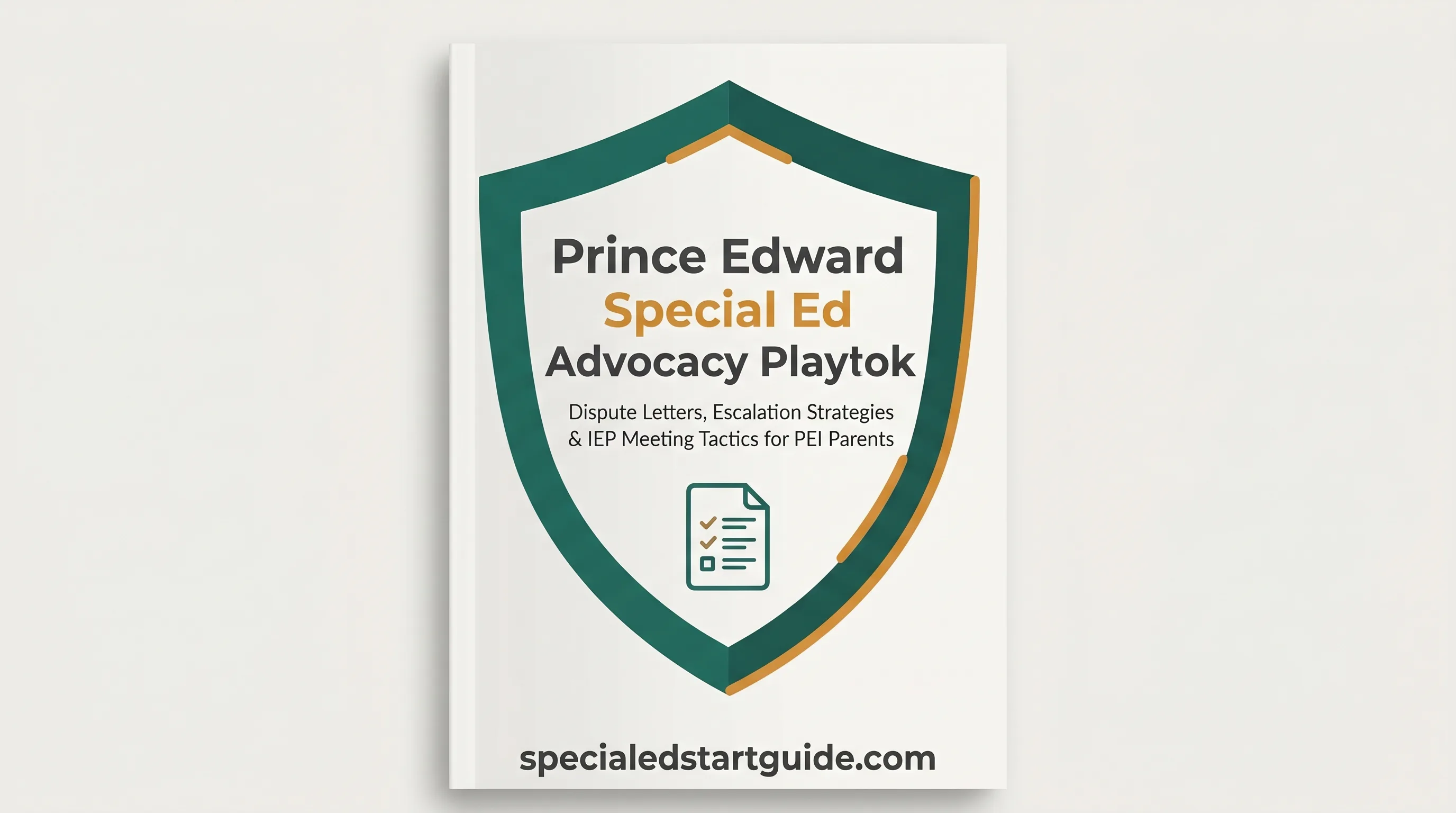
The Prince Edward Island Special Education Advocacy Playbook is the Dispute Resolution System that gives you exactly what the PSB won't: the precise PEI legal language, escalation steps, and fill-in-the-blank letter templates to hold the school accountable — without hiring a lawyer at $210 per hour.
What's Inside the Playbook
Fill-in-the-Blank Dispute Letter Templates
Each template cites the exact PEI statute or policy provision it enforces. Request a psychoeducational assessment and start the PSB's response clock. Reject an IEP that was pre-written without your input. Refuse an illegal exclusion when the school calls at 10 AM because the EA called in sick. Demand raw data and incident reports from a seclusion or restraint event. Escalate a denied service to the PSB Director of Student Services. File a formal complaint warning citing the PEI Human Rights Act. Every letter creates a legally binding paper trail the moment you hit send — the same paper trail a private advocate would build at hundreds of dollars per hour.
The PSB Escalation Roadmap
When the principal says "that's just how things are," you need to know who to contact next — and what to say. The Playbook maps every escalation step: classroom teacher to principal, principal to Director of Student Services, Director of Student Services to Director of the PSB, Director to Board of Trustees for a formal appeal under Governance Policy GP 11, and beyond to the PEI Human Rights Commission and the Office of the Child and Youth Advocate. Each step includes the template communication and the policy provision that compels a response.
The "Sent Home" Defence Protocol
If your child has been excluded from school because their EA was absent, the school denied your child's statutory right to education without due process. The OCYA has condemned this practice. The Playbook gives you the exact language to send to the principal — and the PSB Director of Student Services — to stop informal exclusions, document the pattern, and build evidence for a formal complaint if it continues.
IEP Meeting Prep System
Stop walking into Student Services meetings outnumbered and outprepared. The Playbook's meeting system covers what to request in writing before the meeting, how to verify the administrator present has decision-making authority, what to say when the team presents a completed IEP you've never seen, and how to send a Letter of Understanding within 24 hours that locks the school into what they promised — because if the IEP was finished before you walked in, the school decided without you.
Assessment Waitlist Strategies
Sitting on a multi-year waitlist for a public psychoeducational assessment? You do not need a formal diagnosis to demand classroom accommodations. The duty to accommodate under the PEI Human Rights Act does not pause pending an assessment. The Playbook explains how to leverage the MTSS framework and SNAP referral process to get immediate Tier 2 and Tier 3 interventions — and how private assessments ($2,100–$3,175) can bypass the queue if you can afford one, with the Medical Expense Tax Credit that offsets the cost.
PEI Terminology Decoder
Walk into a Charlottetown or Summerside school referencing a "504 Plan," an "IPRC meeting," or your rights under "IDEA," and the administration immediately knows you don't understand PEI's system — your credibility evaporates before the meeting starts. The Playbook provides the complete terminology translation so you speak the system's language from the first sentence: IEP, ALP, BSP, SNAP forms, MTSS, RTI, EA, Resource Teacher, Director of Student Services — every term mapped to its role in PEI's framework.
Who This Playbook Is For
- Parents navigating the Public Schools Branch or CSLF — in Charlottetown, Stratford, Summerside, Montague, Souris, or deep rural West Prince and Kings County
- Parents whose child is on informal "partial days" — sent home repeatedly for dysregulation without a formal suspension — and who need to assert their child's right to full-day instruction
- Parents stuck on a multi-year public assessment waitlist who need to secure interim accommodations through the MTSS framework while they wait
- Parents who moved to PEI from Ontario, Alberta, or another province and discovered the school cannot or will not honour the accommodations their child was already receiving
- Parents preparing for an IEP meeting who don't want to walk in outgunned by a team that does this every day
- Parents whose child transitioned from Early Years Autism Services into the school system and watched the intensive behavioural supports vanish overnight
- Rural families where the Resource Teacher covers multiple schools and the nearest private assessment is in Charlottetown — and nobody is offering interim supports
- Mi'kmaq families navigating the intersection of band-operated schools, Jordan's Principle, and the PSB system
Why Free Resources Aren't Enough
PEI has organizations doing critical work for families — the Autism Society, LDAPEI, the Council of People with Disabilities, CLIA PEI. Here's why parents still end up stuck:
- PEI has no comprehensive special education policy directive. The Minister's Directive on Special Education was repealed in 2016. The current framework is a patchwork of directives, operational procedures, and institutional practice — and no free guide maps how the pieces fit together or what to do when they break down.
- The Autism Society serves only autism-spectrum families — with waitlists. If your child has ADHD, dyslexia, or behavioural challenges without an ASD diagnosis, their services are not available. Even within their mandate, limited capacity means delays.
- LDAPEI focuses on tutoring, not escalation. Their public resources emphasise building good relationships with teachers. Collaboration is essential. But it does not cover what to do when the principal flatly refuses an accommodation due to budget constraints.
- The Child and Youth Advocate is a last resort, not a daily tool. The OCYA provides high-level systemic oversight — but their involvement comes after a crisis, not before. You need something at 11 PM on a Sunday night when preparing for a Monday morning meeting.
- American and Ontario IEP guides destroy your credibility. Walk into a PSB school referencing a "504 Plan," an "IPRC meeting," or your rights under "IDEA," and the administration immediately knows you haven't done your homework. These terms do not exist on Prince Edward Island.
The free resources describe what the system should look like. The Playbook gives you the tools to make the system actually work for your child.
— Less Than a Single Lawyer Consultation
The Psychological Association of PEI lists a private practice rate of $210 per hour. A private psychoeducational assessment costs $2,100 to $3,175. Community Legal Information offers a $25 lawyer referral for a 45-minute consultation — but 45 minutes barely scratches the surface. For less than a single brief legal consultation, you gain immediate, lifetime access to the exact templates, checklists, and PEI-specific legal language required to make the Public Schools Branch take your child's needs seriously — starting tonight.
Your download includes the complete Playbook guide plus 7 standalone printable tools:
- Complete Advocacy Playbook (guide.pdf) — 12 chapters covering PEI's legal architecture (Education Act, Human Rights Act, Charter rights, Minister's Directives), the MTSS framework and SNAP process, IEP components and red flags, dispute letter templates, the PSB escalation pathway, common advocacy scenarios, assessment waitlist strategies, transition planning, and the provincial resource directory
- Dispute Letter Templates (dispute-letter-templates.pdf) — all 6 fill-in-the-blank letter templates extracted for quick access: assessment request, informal removal challenge, IEP objection, formal escalation, records request, and Human Rights Commission warning
- PSB Escalation Roadmap (escalation-roadmap.pdf) — a visual reference card mapping every escalation level from classroom teacher to Human Rights Commission, with contact information and the policy provision for each step
- "Sent Home" Defence Protocol (sent-home-defence.pdf) — the step-by-step response when the school excludes your child, the complete informal removal challenge letter, and a fillable incident log to document every exclusion
- IEP Meeting Prep Checklist (iep-meeting-prep.pdf) — before, during, and after action items plus the Letter of Understanding template to lock the school into what they promised
- PEI Terminology Decoder (terminology-decoder.pdf) — a quick-reference card translating American and Ontario terminology into PEI's actual system, plus the MTSS tier framework
- Service Delivery Log (service-delivery-log.pdf) — a fillable weekly worksheet tracking what the IEP promises versus what your child actually receives — the evidence that powers every escalation
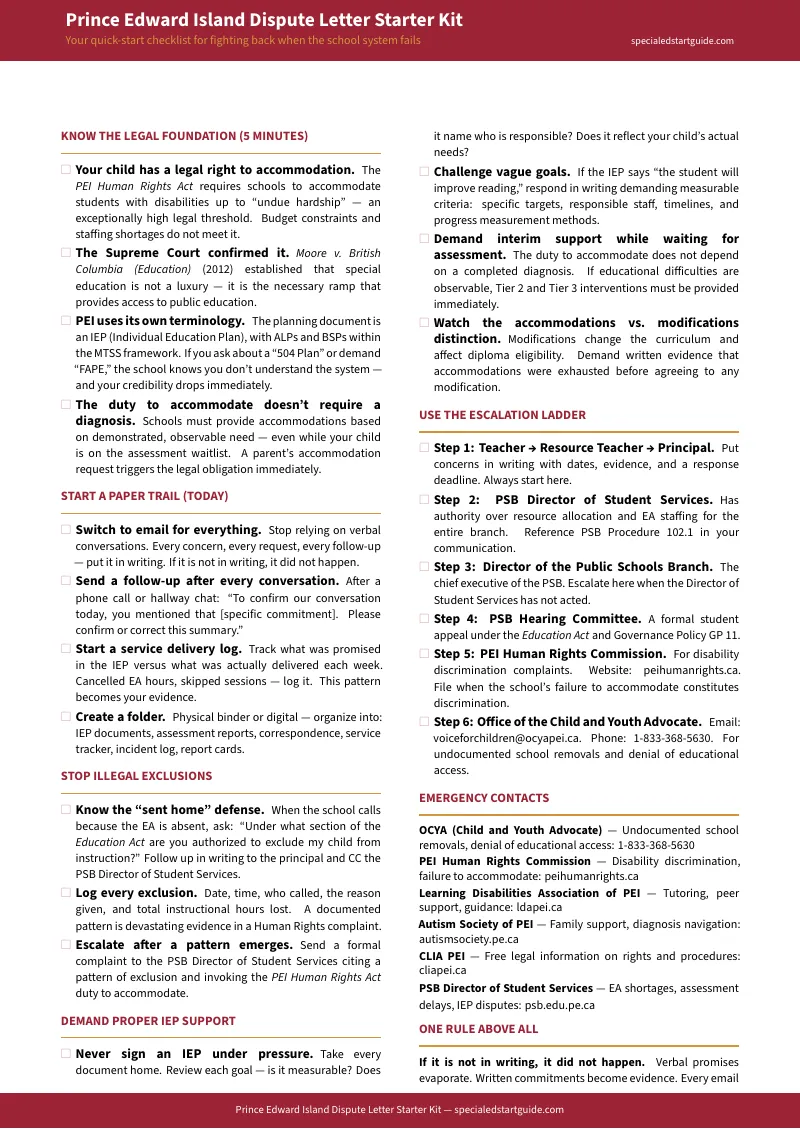
- Dispute Letter Starter Kit (checklist.pdf) — the quick-start checklist with immediate action items, paper trail setup, illegal exclusion defences, and IEP dispute steps — all citing PEI law
Instant PDF download. Send your first advocacy letter tonight. Walk into the next IEP meeting with PEI law on your side.
Money-back guarantee, no time limit. If the Playbook doesn't change how you approach IEP meetings on Prince Edward Island, email us for a full refund. No questions asked.
Not ready for the full Playbook? Download the free Prince Edward Island Dispute Letter Starter Kit — a printable checklist with paper trail setup, illegal exclusion defences, and the most critical advocacy steps. It's enough to take your first action tonight, and it's free.
Your child's education is a legal right, not a favour the school grants when resources allow. The PSB knows PEI policy. After tonight, so will you.