The IPRC Was Over Before You Sat Down. Here's How to Change the Next One.
You walked into your child's IPRC meeting — the principal, the classroom teacher, the SERT, and a board psychologist you'd never met. They discussed your child's "exceptionality category," referenced Regulation 181/98 like you should know what it says, and told you the placement recommendation was for a "regular class with resource assistance." You asked what specific support that meant. They said "appropriate accommodations will be outlined in the IEP." You asked about Educational Assistant hours. They said it was a "school-level staffing decision." You left with a Statement of Decision you barely understood and 30 days to decide whether to accept it — without anyone explaining what happens if you don't.
You were right to feel uneasy. And you are not alone. The Ontario Autism Coalition's 2023–2024 survey across 60 school boards found that only 43% of families reported their child's accommodations were actually being followed consistently. Forty percent rarely received updates on IEP goal progression. Sixty-three percent of elementary principals asked parents of children with special needs to keep their children home at some point during the year — due to safety or staffing reasons. Parents across Ontario describe this as "inclusion with abandonment": children placed in regular classrooms of thirty-plus students without the specialized support required to access the curriculum, while the school board calls it inclusion.
You live in a province where the closest thing to the American IEP system — the one every Google result describes — doesn't exist the way Americans know it. Ontario doesn't use IDEA, 504 Plans, or due process hearings. The entire system runs on the provincial Education Act, Ontario Regulation 181/98, binding Policy/Program Memoranda, and a statutory IPRC committee process that grants you specific legal rights — but only if you know how to invoke them. Bringing American special education terminology into a meeting with an Ontario principal destroys your credibility in the first sentence.
The Ontario IEP & IPRC Blueprint is the Regulation 181/98 Enforcement System — the advocacy toolkit that translates Ontario's Education Act, Regulation 181/98, binding PPMs, and the Ontario Human Rights Code into the exact meeting scripts, advocacy templates, and escalation strategies you need to secure your child's support. Every recommendation cites the applicable Ontario regulation or legal principle.
What's Inside the Blueprint
The Ontario Legal Framework Decoded
Regulation 181/98 carries the force of law — it governs every IPRC hearing, every placement decision, and every statutory timeline. The Blueprint translates every critical regulation, the relevant sections of the Education Act, binding PPMs (PPM 8 on Learning Disabilities, PPM 59 on Psychological Testing, PPM 140 on Autism, PPM 145 on Progressive Discipline, PPM 156 on Transitions), and the Supreme Court of Canada's Moore v. British Columbia decision into plain-language parental rights. When a school tells you they "don't have the budget" for your child's accommodation, the duty to accommodate under the Ontario Human Rights Code creates an exceptionally high legal threshold called "undue hardship" — and this guide teaches you exactly how to invoke it without needing a lawyer in the room.
Ontario's Five Categories of Exceptionality Explained
Ontario identifies exceptional students through five categories: Behavioural, Communicational (Autism, Deaf and Hard of Hearing, Language Impairment, Speech Impairment, Learning Disability), Intellectual (Giftedness, Mild Intellectual Disability, Developmental Disability), Physical, and Multiple Exceptionalities. Each category has specific Ministry-defined criteria, but individual school boards set the psychometric thresholds for meeting them. Schools sometimes resist formal identification to avoid triggering IPRC obligations. The Blueprint breaks down every category and subcategory in plain language — what qualifies, what assessment triggers it, and the exact language to use when you believe identification is being delayed or denied.
Copy-Paste Advocacy Templates
Every template cites the exact Ontario regulation. Request that the principal refer your child to the IPRC in writing — because Regulation 181/98 requires the principal to acknowledge your request within 15 school days. Demand a formal IEP revision when accommodations aren't being implemented. Challenge a shortened school day with a letter referencing the Education Act and the school's duty under the Ontario Human Rights Code. Escalate to the school board superintendent. File with the Human Rights Tribunal. These aren't generic form letters — they're Ontario enforcement tools that create a documented paper trail the moment you hit send.
TDSB, Peel, York, Ottawa & Northern Ontario Navigation
The Toronto District School Board is under provincial supervision for financial mismanagement while simultaneously integrating specialized communication classes into general classrooms. The Peel District School Board uses its own Parent Guide to Special Education that emphasizes collaboration while offering zero guidance on escalation. York Region screens all Grade 3 students for giftedness but has limited congregated placements. The Ottawa-Carleton District School Board is also under provincial oversight. Northern Ontario boards face diagnostic deserts where the SERT covers multiple schools hours apart and the psychologist visits quarterly. The Blueprint gives you district-specific strategies for each environment — because advocating in the TDSB requires different language than advocating in a rural Northern board.
The IPRC Process — Step by Step
What to do when the principal delays your IPRC referral. What to say when the committee recommends a placement you disagree with. What to do when the Statement of Decision arrives and you have 15 days to request a second meeting or 30 days to file a formal appeal. How to prepare your evidence for the Special Education Appeal Board (SEAB). When to escalate to the Ontario Special Education Tribunal (OSET). Each step cites the Regulation 181/98 section that governs it — so you're not asking the school for favours, you're citing law.
The Assessment Waitlist Survival Guide
Public psycho-educational assessment waitlists in Ontario stretch one to three years. Private assessments cost $2,000 to $4,000. In Northern Ontario, 24% of elementary schools have zero access to psychologists. The Blueprint teaches you how to secure an IEP and classroom accommodations while your child is waiting — because under the Ontario Human Rights Code, the school must accommodate demonstrated needs immediately, regardless of whether a formal IPRC identification has occurred. It also explains PPM 59's requirement that school boards accept and implement recommendations from private assessments by registered psychologists.
Stopping Illegal Exclusions
Six percent of Ontario students with disabilities who should have been attending school were fully excluded in 2023–2024. Thirty-seven percent were routinely excluded from field trips, specialized classes, or recess due to insufficient staff. The Blueprint provides step-by-step scripts to counter shortened school days and "stay home" requests, the specific Education Act provisions principals misuse to justify exclusions, and the documentation protocols that build the evidentiary foundation for a Human Rights Tribunal application.
The Dispute Resolution Escalation Ladder
When informal advocacy fails, Ontario offers escalation options governed by strict statutory timelines — but they are not clearly documented for parents anywhere. The Blueprint maps the complete chain: IPRC second meeting request (15 days) to Special Education Appeal Board (SEAB) to Ontario Special Education Tribunal (OSET) to the Human Rights Tribunal of Ontario (HRTO). It explains OSET's jurisdictional limit to identification and placement only, when the HRTO is the correct venue for IEP implementation failures and EA disputes, and how to build the paper trail that wins.
Who This Blueprint Is For
- Parents preparing for their first IPRC meeting who don't want to walk in blind against a committee that does this every day — and who need to understand Ontario's exceptionality categories before they're discussed at the table
- Parents whose child has been told they "don't qualify" for an Educational Assistant, a formal assessment, or a specialized placement — and who need the regulatory language to challenge that decision
- Parents in the GTA navigating the TDSB's integration of specialized classes, Peel's rigid IPRC gatekeeping, or York Region's giftedness screening process
- Parents in Ottawa dealing with OCDSB's boundary changes and provincial supervision, or parents in Hamilton, London, or Waterloo whose boards process IPRC referrals on their own timeline
- Parents in Northern, rural, or remote Ontario where the educational psychologist visits quarterly, the SERT covers multiple schools, and "specialized support" means a traveling specialist you've never met
- Parents whose child has ADHD, autism, a learning disability, or anxiety and was told they're "not severe enough" for formal identification — and who need to understand why the Ontario Human Rights Code mandates accommodation regardless of formal IPRC status
- Parents whose child's IEP says one thing but the classroom reality looks nothing like it — accommodations on paper, not in practice
- Parents who bought an "IEP Planner" from Etsy built for the American system and discovered that IEP, 504 Plan, FAPE, and IDEA don't apply the same way in Ontario
- Parents who called ARCH Disability Law Centre but found the resources too dense to act on before tomorrow's meeting
Why Not Just Use the Free Resources?
Ontario has genuine free special education resources. The Ministry of Education publishes the Special Education in Ontario: Policy and Resource Guide. ARCH Disability Law Centre provides legal analysis. The LDAO offers IPRC navigation guides. Autism Ontario runs workshops. Here's why parents still struggle after consulting all of them:
- The Ministry's Policy and Resource Guide is 200+ pages of institutional protection. It accurately defines the exceptionality categories and the IPRC process. It does not tell you what to do when the IPRC denies identification, the school ignores the IEP, or the principal asks you to keep your child home. The tone frames all interactions as collaborative partnerships — which is actively unhelpful when the partnership has broken down and you need tactical escalation language.
- ARCH Disability Law Centre produces exceptional legal analysis. Their Guide — Human Rights and Education in Ontario perfectly outlines the duty to accommodate and the undue hardship threshold. But the resources read like appellate court legal briefs — dense, text-heavy, and intimidating. A parent facing an adversarial IPRC meeting tomorrow morning cannot synthesize a 40-page legal treatise into a coherent argument overnight. They need copy-paste templates, which ARCH does not provide.
- The LDAO focuses on learning disabilities and IPRC basics. They rightly recommend formal IPRC identification over informal IEPs. But they lack the aggressive, template-driven approach required to combat an obstinate school administration that has already decided your child "doesn't meet criteria."
- Autism Ontario's School Advocacy Toolkit is excellent — but only for autism. Parents navigating ADHD, dyslexia, generalized learning disabilities, or behavioural exceptionalities need advocacy strategies that aren't diagnosis-specific. Autism Ontario also requires OAP funding waitlists for high-touch services.
- School board parent guides describe how the system should work — not what to do when it fails. The TDSB's own Special Education Advisory Committee (SEAC) reported that their parent guide causes intense frustration because it fails to explain what parents should do when the board ignores their input.
- Etsy and TPT planners organize paperwork — they don't enforce rights. A pastel IEP binder keeps documents in order. It won't decode Ontario's exceptionality criteria, explain why the school is pushing inclusion over specialized placement, or teach you to demand a formal IPRC hearing citing Regulation 181/98.
- Private advocates charge $100–$300 per hour. Private psycho-educational assessments cost $2,000–$4,000. Most Ontario families can't absorb that on top of therapy costs. The Blueprint gives you the same procedural frameworks and advocacy templates that professional consultants use — and if you do hire one, a documented paper trail saves hundreds in billable hours they'd otherwise spend understanding your situation.
The free resources explain what Ontario law says. The Blueprint gives you the tools to make the school follow it.
— Less Than One Hour of a Special Education Consultant
Special education consultants in Ontario charge $100 to $300 per hour. Private psycho-educational assessments run $2,000 to $4,000 — and the public waitlist can stretch three years. If you hand a consultant a disorganized pile of IEP documents and school emails, your first several billable hours go toward them understanding your situation. The Blueprint teaches you how to organize the paper trail, decode the exceptionality categories, and draft the initial advocacy letters — either empowering you to win at the IPRC table without a consultant, or saving hundreds in billable hours if you do hire one.
Your download includes a comprehensive 14-chapter Blueprint guide plus standalone printable tools — advocacy letter templates, IPRC and IEP meeting scripts, an exceptionality category decoder, a dispute resolution roadmap, an IEP goal tracking worksheet, and an IEP Meeting Prep Checklist. Every template is formatted so you can type directly into it or copy the text into an email, each citing the exact Ontario regulation that triggers a legal obligation.
Instant PDF download. Print the templates tonight. Walk into tomorrow's IPRC meeting with Regulation 181/98 on your side.
Money-back guarantee, no time limit. If the Blueprint doesn't change how you approach IPRC and IEP meetings in Ontario, email us for a full refund. No questions asked.
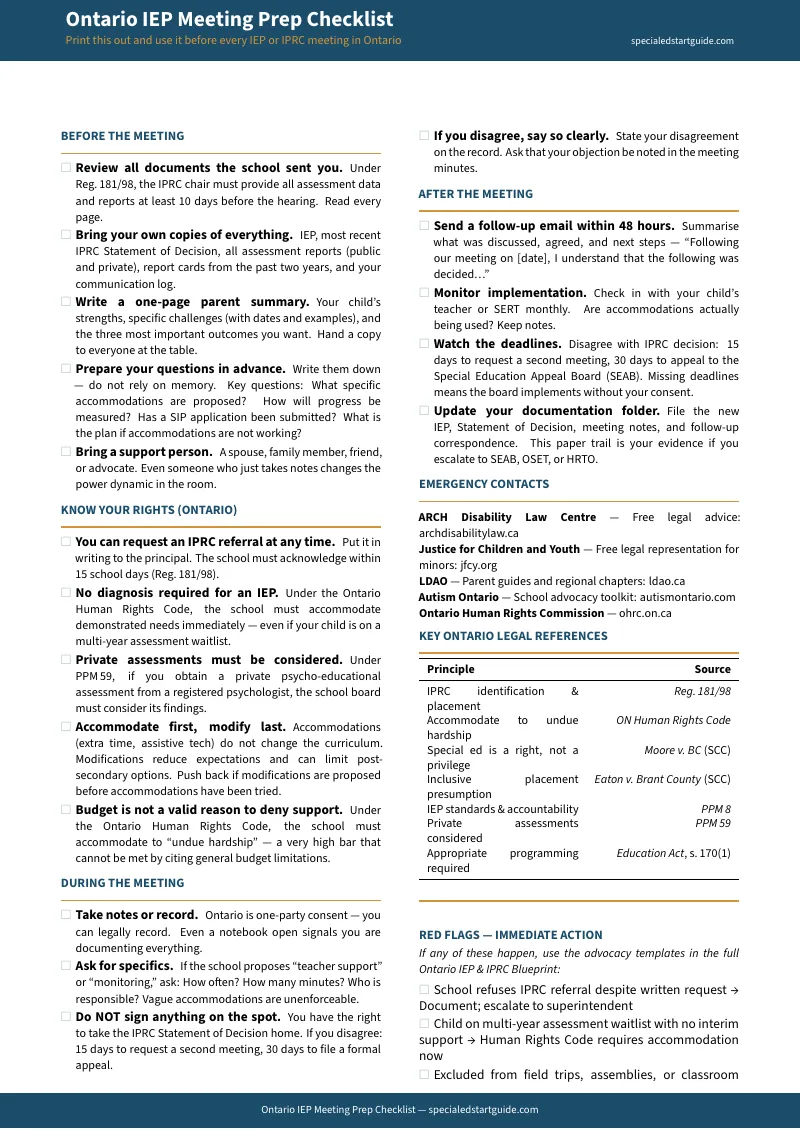
Not ready for the full Blueprint? Download the free Ontario IEP Meeting Prep Checklist — a printable pre-meeting checklist with Regulation 181/98 timelines, Ontario Human Rights Code citations, IPRC preparation steps, and red flags that require immediate action. It's enough to walk into your next meeting prepared, and it's free.
Your child's education is a legal right under the Ontario Human Rights Code and the Canadian Charter. The school knows Regulation 181/98. After tonight, so will you.