The School Made a Promise. The IEP Made It Official. Neither One Is Being Kept.
You left the last IEP review meeting with verbal assurances that your child's accommodations would be implemented "as soon as staffing allows." That was three months ago. The Educational Assistant who was supposed to provide daily support appears twice a week — sometimes less. The speech-language referral that was "in process" hasn't moved. The quiet space for assessments that was written into the IEP doesn't exist. You raised the issue at the next meeting and watched four school staff members nod sympathetically while writing nothing down. You sent a follow-up email. You received an acknowledgment. Nothing changed.
You are not imagining the problem. The Ontario Autism Coalition's 2023-2024 survey found that only 43% of families reported accommodations being followed consistently. Sixty-three percent of elementary principals asked parents of children with special needs to keep their children home at some point during the year — what the Ontario Human Rights Code considers an illegal exclusion. Across all 72 publicly funded school boards, chronic shortages of SERTs, EAs, and classroom teachers have turned "inclusion" into a filing designation rather than a classroom reality. As of early 2026, over 67,000 children remain on the Ontario Autism Program waitlist without active funding agreements, forcing the school system to absorb complex needs it was never staffed to support.
The free resources explained your rights. ARCH Disability Law Centre published excellent legal analysis of the Duty to Accommodate. The Ministry of Education published a 200-page policy guide explaining how the IPRC process is supposed to work. Autism Ontario provided family navigation support stretched across the entire province. The LDAO offered a seven-week advocacy course for $275. You read them all. None of them gave you the one thing you actually need: a dispute letter template citing Regulation 181/98 that you can fill in tonight and send before the filing deadline expires.
The Ontario Special Ed Advocacy Playbook is the Dispute Resolution System — the tactical field manual that converts Ontario's Education Act, Regulation 181/98, binding PPMs, and the Ontario Human Rights Code into the exact dispute letters, IPRC appeal procedures, meeting scripts, and escalation strategies you need when collaboration has failed and your child's supports are disappearing. Every template cites the specific provincial law that triggers the school's legal obligation to respond.
What's Inside the Playbook
Fill-in-the-Blank Dispute Letter Templates
Not generic form letters — Ontario enforcement tools pre-loaded with Education Act and Human Rights Code citations. Formal IPRC request letters with Regulation 181/98 timelines. IEP non-compliance notices documenting specific accommodations being ignored. Assessment demand letters for children stranded on multi-year waitlists. Escalation letters to the Superintendent of Special Education. Post-meeting follow-up confirmations that force the school to respond in writing — because verbal promises made across a conference table have zero legal weight when you need to prove the school failed to act.
The SEAB Appeal Blueprint
Most Ontario parents don't learn that the Special Education Appeal Board exists until the 30-day filing deadline has passed. The Playbook maps the full procedure: when to file the Notice of Appeal (30 days after the IPRC decision, or 15 days after a second meeting), how to select your panel member, how to structure your submission for maximum impact, what happens when the board trustees vote on the SEAB's recommendations, and the Ontario Special Education Tribunal (OSET) pathway if the board rejects the appeal. Every step cites the Regulation 181/98 section that governs it.
Human Rights Tribunal of Ontario — Strategic Leverage
When the school says "we don't have the budget" for your child's EA, the Ontario Human Rights Code says general budget constraints are not undue hardship. Most parents never invoke this because they don't know how. The Playbook teaches you when a dispute crosses from Education Act territory into human rights territory, how to use the threat of an HRTO application as negotiating leverage during school-level discussions, the one-year limitation period you cannot miss, and the critical warning about "inappropriate parental conduct" from HRTO case law — because hostile behaviour or refusal to provide medical documentation can legally sabotage your own case.
Meeting Scripts for the 6 Hardest Conversations
Exactly what to say when the principal claims an accommodation is "too expensive" — countering with the legal definition of undue hardship, which excludes general budget constraints and staffing shortages. What to say when the school suggests a shortened school day — identifying it as an illegal exclusion under the Human Rights Code. How to respond when the SERT says "we're waiting for the assessment" — citing PPM 8 and the duty to accommodate demonstrated need, not diagnostic labels. Plus scripts for EA reductions, modification pressure, and placement disputes.
The Documentation System That Wins Disputes
The 24-hour follow-up rule. The advocacy file structure. Email confirmation protocols. Ontario Student Record access requests under MFIPPA and Section 266 of the Education Act. The documentation standard that SEAB panels, OSET adjudicators, and HRTO members require before they will take your case seriously. If you ever need a lawyer, this system means they can execute strategy immediately instead of doing administrative triage at $300 to $700 per hour.
The Assessment Crisis Playbook
Public psycho-educational assessment waitlists stretch one to three years across Ontario. Private assessments cost $2,000 to $4,000. In Northern Ontario, 24% of elementary schools have no access to psychologists at all. The Playbook teaches you how to formally demand an assessment with Regulation 181/98 citations, secure interim accommodations during the waitlist under the Human Rights Code, and force the school to act on private evaluation data rather than bury it — because PPM 59 requires boards to consider independent assessments from registered psychologists.
TDSB, Peel, Ottawa-Carleton & Northern Ontario Strategies
The Toronto District School Board is under provincial supervision while integrating specialized classes into general classrooms. The Ottawa-Carleton DSB proposed phasing out special education classrooms in 2025, leaving 400+ children without placements. Northern Ontario boards face a crisis where 40% of schools lack a full-time SERT and the nearest psychologist is hours away. Each district requires different advocacy language — what works in the TDSB requires a completely different approach than a rural Northern board.
30-Day Quick-Start Action Plan
Week-by-week implementation: Week 1 assess and document, Week 2 communicate in writing using the dispute letter templates, Week 3 prepare for the meeting with scripts, Week 4 execute and follow up. You are not reading a book cover to cover — you are executing a plan with deadlines that force the school to respond on the record.
Who This Playbook Is For
- Parents whose child's IEP says one thing but the classroom reality looks nothing like it — accommodations on paper, nothing in practice — and who need the enforcement language to make the school accountable
- Parents facing an IPRC appeal deadline who need to understand the SEAB procedure and file their Notice of Appeal before the 30-day window closes
- Parents whose child has been sent home early, put on a shortened school day, or informally excluded — and who need the Human Rights Code citations that identify this as discrimination, not a "safety decision"
- Parents on the Ontario Autism Program waitlist whose school insists accommodations cannot begin until a formal diagnosis arrives — which is not what the Ontario Human Rights Code requires
- Parents in the TDSB, Peel, Ottawa-Carleton, or Northern Ontario dealing with district-specific challenges from provincial supervision, classroom phase-outs, or diagnostic deserts
- Parents who have tried the collaborative approach, attended every meeting, sent every email, and watched the school change nothing — and are ready to shift from requesting to demanding in writing
- Parents whose child was suspended for behaviour directly caused by a disability the school failed to accommodate, and nobody conducted a PPM 145 manifestation review
- Parents who bought an American IEP advocacy guide from Etsy or Wrightslaw and discovered that IDEA, FAPE, 504 Plans, and due process hearings do not exist in Ontario
Why Not Just Use the Free Resources?
Ontario has legitimate free special education resources. Here is what they give you and what they don't:
- ARCH Disability Law Centre publishes exceptional legal analysis. Their guides explain the Duty to Accommodate and the undue hardship threshold in rigorous legal language. But they read like appellate court briefs — a parent facing an adversarial IPRC tomorrow morning cannot synthesize a 40-page legal treatise into a dispute letter overnight. ARCH does not provide fill-in-the-blank templates, SEAB filing instructions, or meeting scripts.
- The Ministry of Education's Policy Guide is 200+ pages of institutional language. It explains how the IPRC process should work when everyone cooperates. It does not explain what to do when the school ignores the IEP, denies an assessment, or asks you to keep your child home. The entire document is written to guide school boards, not to help parents fight them.
- The LDAO's advocacy course is thorough — and requires seven weeks. At $275 for professionals, with a reduced fee for parents, it's a genuine educational resource. But if your IPRC appeal deadline is 30 days away or an illegal exclusion happened this week, you do not have two months to complete an online course.
- Autism Ontario stretches across the entire province. Their family navigation services are valuable but capacity-limited. Their advocacy resources focus on systemic lobbying and OAP navigation, not on micro-level school dispute resolution — they won't teach you how to counter a principal's refusal of EA support in a hostile IPRC meeting.
- Wrightslaw is built on American federal law. IDEA, FAPE, 504 Plans, and due process hearings do not exist in Ontario. Quoting them in a meeting with an Ontario principal tells the school you don't understand local law — and you can be easily dismissed. This playbook uses the legislation that actually applies in your school board.
- Private advocates charge $100–$200+ per hour. Education lawyers start at $300–$700 per hour with retainers. And bringing a lawyer to an IEP meeting immediately causes the board's legal counsel to step in, shutting down direct communication and turning a collaborative process into a cold, adversarial proceeding. The Playbook gives you the enforcement language used by professional advocates — and if you do hire one later, a documented paper trail saves them hundreds in billable hours.
The free resources explain what Ontario law says. This playbook gives you the tools to make the school follow it.
— Less Than One Hour With a Special Education Consultant
Special education consultants in Ontario charge $100 to $200+ per hour. Education lawyers start at $300 to $700 per hour with retainers of $5,000 or more. Private psycho-educational assessments run $2,000 to $4,000 — and the public waitlist stretches one to three years. If you hand a consultant a disorganized pile of IEP documents and school emails, your first several billable hours go toward them understanding your situation. The Playbook teaches you how to build the paper trail, draft the dispute letters, and navigate the escalation pathway — empowering you to resolve disputes without legal fees, or saving hundreds in billable hours if you do hire counsel.
Your download includes 7 PDFs — a comprehensive 14-chapter advocacy guide plus 5 standalone printable tools and the Ontario Dispute Letter Starter Kit:
- The Complete Advocacy Guide (53 pages) — Ontario legal architecture, exceptionality categories, the assessment crisis, IPRC procedures, IEP enforcement, the full dispute resolution escalation ladder (SEAB, OSET, HRTO, Ontario Ombudsman), MFIPPA records access, the documentation system, meeting scripts, special circumstances, SEAC engagement, Ontario resources directory, and a 30-day quick-start action plan
- Advocacy Letter Templates — 5 fill-in-the-blank dispute letters (IPRC request, IEP non-compliance, SEAB Notice of Appeal, Human Rights Code escalation, MFIPPA records request) ready to customize and send tonight
- Meeting Scripts — Word-for-word responses for 6 scenarios (budget refusals, assessment delays, shortened days, suspensions, modification pressure, identification denials) to print and bring to your next meeting
- Dispute Resolution Roadmap — One-page visual flowchart of the full escalation ladder with deadlines at every step
- Ontario Timeline Cheatsheet — Every critical deadline on one page (15-day IPRC acknowledgment, 30-day SEAB appeal, 1-year HRTO limitation) with legal sources and consequences of missing them
- Communication Log Worksheet — Printable tracking sheets for documenting every school interaction plus the Advocacy Binder Checklist
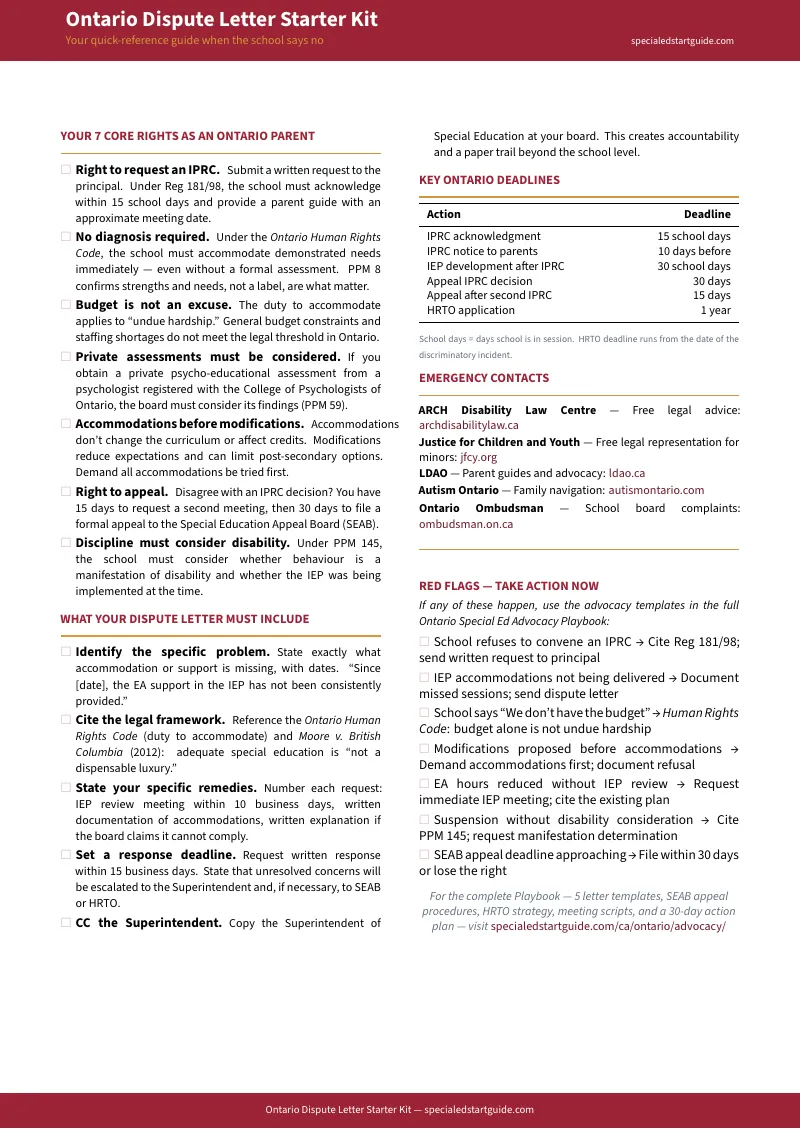
- Ontario Dispute Letter Starter Kit (free tier) — Sample dispute letter template, parent rights one-pager, and critical deadlines reference
Instant PDF download. Fill in a dispute letter template tonight. Send it to the principal before your next meeting.
Money-back guarantee, no time limit. If the Playbook doesn't change how you handle special education disputes in Ontario, email us for a full refund. No questions asked.
Not ready for the full Playbook? Download the free Ontario Dispute Letter Starter Kit — a sample dispute letter template with Human Rights Code citations, a parent rights one-pager covering your 7 core rights under Ontario law, and the critical deadlines reference that every Ontario parent should have before their next meeting. It's free.
Your child's education is a legal right under the Ontario Human Rights Code and the Canadian Charter. The school knows Regulation 181/98. After tonight, so will you.