The School Says They've Run Out of Options. The Education Act Says Otherwise.
You knew something was wrong months ago — maybe years ago. Your child is falling behind in reading. The behavioural outbursts are getting worse. The teacher says she's doing everything she can, but there's no specialist in the community, the assessment waitlist is two to three years long, and there's nothing more the school can offer until someone flies in from Ottawa or Edmonton to run a formal evaluation.
So your child waits. Another semester. Another year. Another new teacher who arrives in August, leaves in June, and has never seen an Individual Student Support Plan before.
The problem isn't that your child lacks services — it's that the Nunavut special education system uses a framework, terminology, and escalation structure that exists nowhere else in Canada. The territory calls its planning document an ISSP — not an IEP. It separates accommodations (IAPs) from modified curriculum plans (IEPs) in ways that directly affect diploma eligibility. The system is legally required to operate on Inuit Qaujimajatuqangit principles — but no one has ever shown you how to use those principles to hold the school accountable. And everything you've found online was written for families in Ontario, BC, or the United States, using terminology that marks you as uninformed the moment you use it.
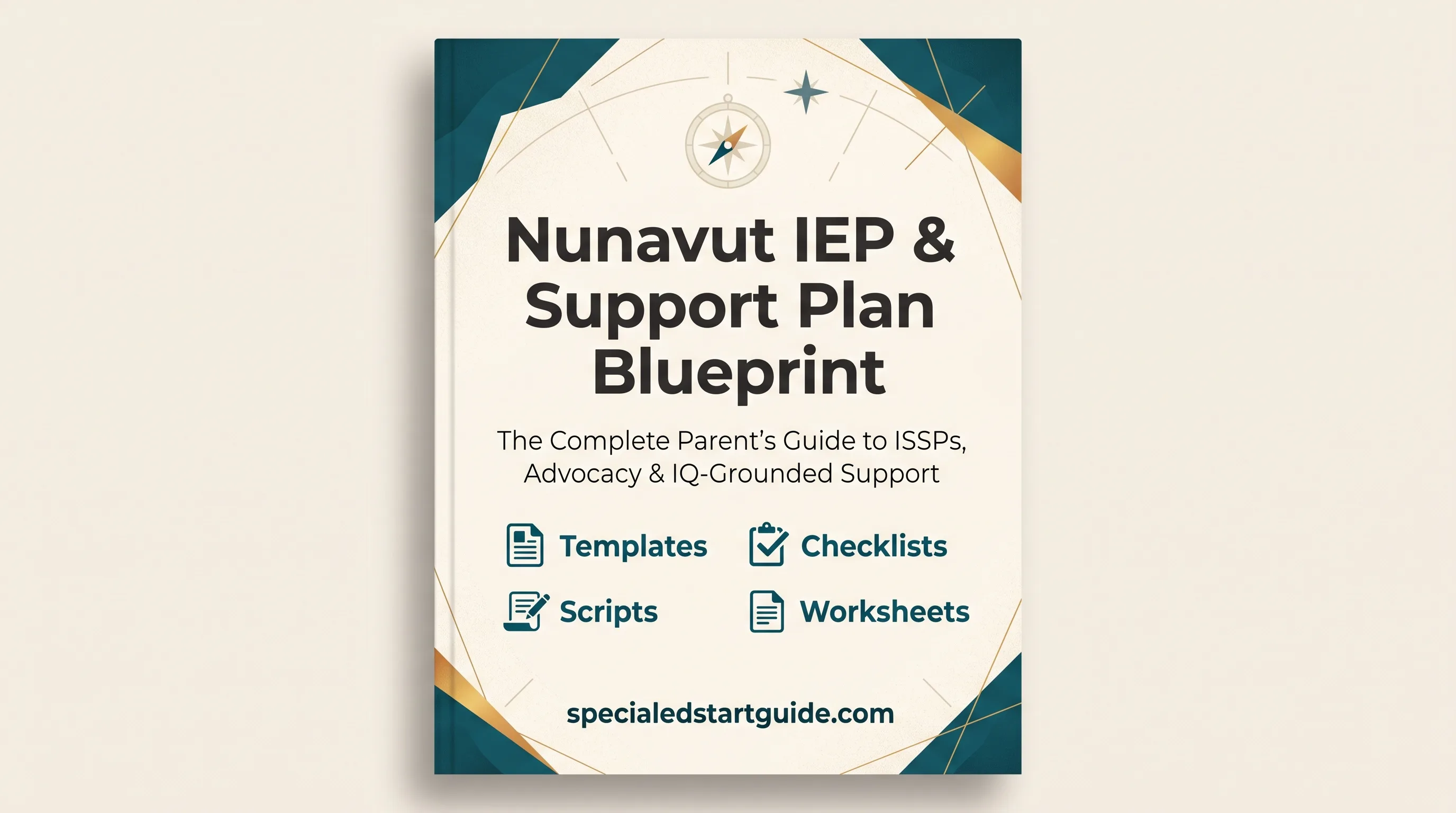
The Nunavut IEP & Support Plan Blueprint is the tactical navigation toolkit that bridges the gap between knowing your child has rights under the Education Act and actually exercising them — with every template, script, and checklist grounded in Nunavut law, IQ principles, and the reality of Arctic communities where the nearest specialist is a plane ride away.
What's Inside the Blueprint
The ISSP Translation Matrix
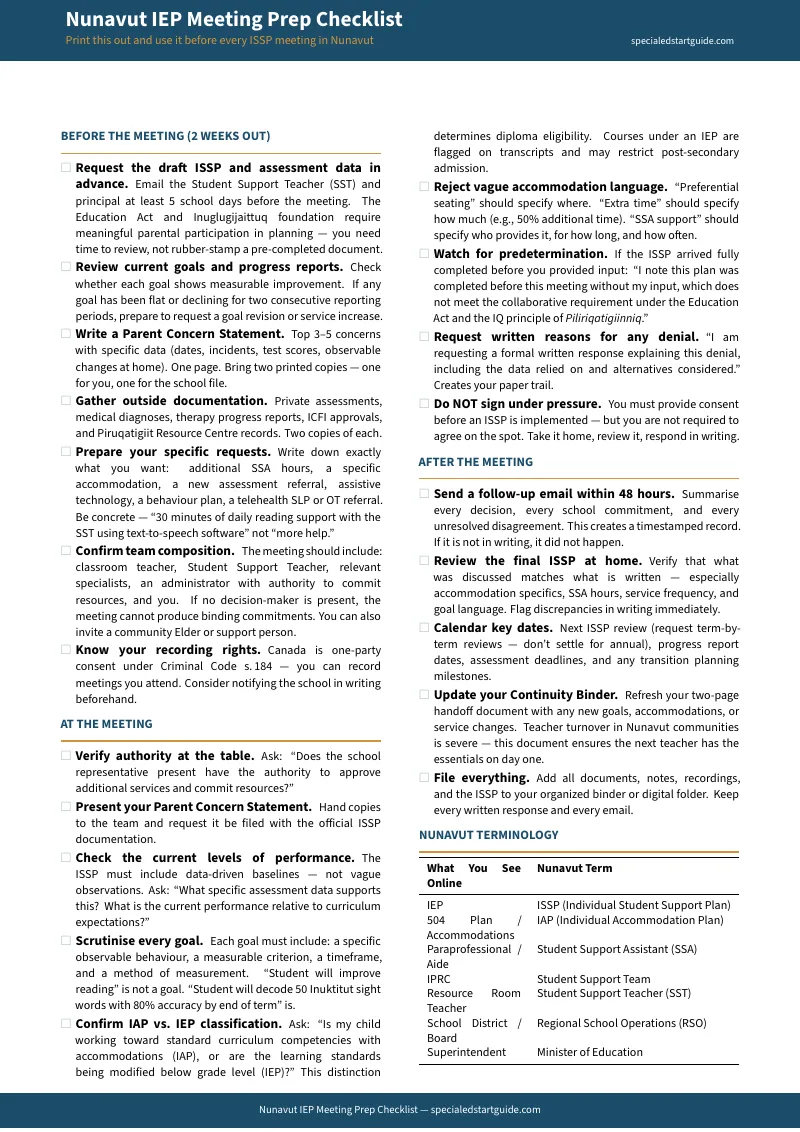
Nearly everything online about special education is written for American or Southern Canadian families. If you walk into a school in Rankin Inlet or Cambridge Bay referencing a "504 Plan," an "IPRC meeting," or your rights under "IDEA," the principal immediately knows you don't understand the territorial system — and your credibility as an advocate disappears before the meeting starts. The Blueprint provides a side-by-side translation of every term: IEP becomes ISSP. 504 Plan becomes IAP. Paraprofessional becomes Student Support Assistant. School district becomes District Education Authority. This matrix is the fastest way to prove you know exactly how Nunavut's system works.
The Copy-Paste Advocacy Email Library
Every email template cites the exact Nunavut statute or IQ principle. Request an assessment referral and document the date the school's response clock starts. Formally dispute an ISSP outcome by invoking the Education Act. Escalate a denied service to the District Education Authority using their own mandate. Request a meeting with the Student Support Teacher when the principal says nothing more can be done. These aren't generic letters — they're Nunavut-specific enforcement tools that create a legally binding paper trail the moment you hit send.
The IQ Principle Rebuttal Scripts
When the school says resources are exhausted and nothing more can be done, you don't start a fight — you hold them accountable to their own foundational values. The scripts guide you to invoke Qanuqtuurniq (being resourceful and innovative) to force a collaborative brainstorming session. You cite Piliriqatigiinniq (working together for a common cause) to reframe the meeting from adversarial refusal to shared problem-solving. You reference Pijitsirniq (serving the community) to remind the school that their own mandate requires them to find solutions — not declare defeat. These aren't confrontational weapons. They're the territory's own values turned into actionable advocacy language.
The Assessment Waitlist Navigator
A private psychoeducational assessment in southern Canada costs $3,200–$5,500, and that's before you factor in flights — $1,400–$2,300 round-trip from Iqaluit to Ottawa, over $2,100 from Cambridge Bay to Edmonton. The Blueprint explains how to secure interim ISSP accommodations through Ilitaunnikuliriniq (dynamic assessment) right now — without waiting years for a Southern specialist to fly in. Under Nunavut law, your child does not need a formal medical diagnosis to receive an ISSP and classroom support today. The guide teaches you exactly how to force classroom-level accommodations based on immediate observation and dynamic assessment.
The Remote Community Reality Check
A guide written for Toronto or Vancouver is useless in a fly-in community of 800 people with one school and no specialists. The Blueprint includes a dedicated section on low-bandwidth, low-resource accommodations that an isolated teacher can actually implement without specialized therapeutic equipment — because telling a parent in Taloyoak to "request occupational therapy services" when the nearest OT is 2,000 km away is not advocacy, it's cruelty.
The ISSP Meeting Prep System
The government's Inuglugijaittuq document tells you that parents are "essential participants" in the planning process. That's the theory. In practice, parents routinely walk into meetings where the ISSP has already been completed without their input, the team presents it as final, and the expectation is a signature. The Blueprint's pre-meeting system covers what documentation to bring, what to ask the Student Support Teacher in writing beforehand, how to prepare a Parent Concern Statement that forces the team to address your issues on the record, and the exact response when the plan arrives pre-completed: "I note this plan was completed before this meeting without my input, which does not meet the collaborative requirement under the Education Act and the IQ principle of Piliriqatigiinniq."
The Escalation Roadmap
When advocacy fails at the school level, you need to know where to go — and in Nunavut, that pathway looks nothing like the formal due process hearings available in the United States. Your escalation chain runs from the classroom teacher to the Student Support Teacher to the principal to the District Education Authority to the Regional School Operations office to the Minister of Education. Beyond that, the Nunavut Human Rights Tribunal handles disability discrimination complaints. The Blueprint maps every step with template communications for each level.
The Continuity Binder System
Teacher turnover in Nunavut communities is severe — your child may face a new teacher and new Student Support Assistant every September. The Continuity Binder is a structured two-page handoff document that gives incoming staff everything they need on day one: current ISSP goals, effective accommodations, behavioural triggers, communication strategies, and family contact preferences. It ensures the next teacher doesn't spend three months re-discovering what the previous teacher already knew.
Who This Blueprint Is For
- Parents in any of Nunavut's 25 communities — whether you're in Iqaluit, Rankin Inlet, Cambridge Bay, Arviat, or a hamlet of 400 people
- Parents whose child is stuck on a multi-year assessment waitlist — and who need interim classroom accommodations right now, not in 2028
- Parents who've been told the school has "done everything it can" — and who need the legal and cultural language to challenge that claim
- Parents dealing with informal exclusions — the school calling at lunchtime asking you to come pick up your child — and who need to assert their child's right to full-day instruction under the Education Act
- Parents confused about whether their child has an IAP (accommodations preserving grade-level outcomes) or an IEP (modified curriculum) — and what that distinction means for their diploma
- Parents preparing for their first ISSP meeting who don't want to walk in outgunned by a team that does this every week
- Inuit families who want to ensure their child's support plan respects IQ principles — not just Southern assessment frameworks
- Southern families who moved to Nunavut for work and are navigating a system that operates completely differently from what they know
Why Not Just Use the Free Resources?
Nunavut has organizations doing critical work for families. The Piruqatigiit Resource Centre offers exceptional FASD support. The Nunavummi Disabilities Makinnasuaqtiit Society advocates across disability types. The Department of Education publishes foundational policy documents. Here's why parents still struggle after consulting all of them:
- The government's policy documents are written for educators, not parents. Inuglugijaittuq and Ilitaunnikuliriniq are dense, academic policy directives that describe the philosophical framework for inclusive education. They contain no step-by-step guidance for preparing for an ISSP meeting, no communication templates, and no plain-language explanation of what you can legally demand.
- Piruqatigiit serves only FASD-affected families. Their programming is exceptional and IQ-grounded — but if your child has dyslexia, autism, a hearing impairment, anxiety, or a learning disability that isn't FASD-related, you fall outside their mandate.
- The NDMS focuses on adult advocacy, not K-12 navigation. Their resource directory emphasizes employment, accessible housing, and general disability awareness rather than the tactical ISSP preparation and school escalation tools parents need.
- National platforms like AIDE Canada are legally wrong for Nunavut. Their guides default to provincial overviews — primarily Ontario and BC — using terminology and legal frameworks that do not exist in the territory. Following their advice in a Nunavut school meeting will actively harm your credibility.
- American and Southern Canadian IEP guides are dangerous. Walk into a Kugluktuk school referencing IDEA, a 504 Plan, or an IPRC meeting, and the administration immediately knows you've been reading the wrong country's laws. Every dollar spent on a generic IEP planner from Etsy is wasted money.
The free resources describe what the system should look like. The Blueprint gives you the tools to make the system actually work for your child — in the Arctic, under Nunavut law, using the government's own IQ principles as your strongest lever.
— Less Than a Bag of Groceries at the Northern Store
A private psychoeducational assessment costs $3,200–$5,500 — plus $1,400–$2,300 in flights to get your child to Ottawa or Edmonton. The government's own policy documents were written for administrators, not parents. For less than what a bag of apples costs at the Northern Store, you gain immediate, lifetime access to the exact templates, checklists, and inside territorial knowledge required to make the school take your child's ISSP seriously — starting tonight.
Your download includes the complete Blueprint guide plus 7 standalone printable PDFs — every template, worksheet, script, and reference card, ready to print and bring to your next meeting.
- Complete Blueprint Guide (guide.pdf) — 14 chapters covering legal rights, IQ advocacy principles, the ISSP process, IAP vs. IEP classification, assessment navigation, advocacy communications, meeting preparation, progress monitoring, transition planning, remote community strategies, and the full escalation pathway
- ISSP Meeting Prep Checklist (checklist.pdf) — the before/during/after checklist with Nunavut Education Act citations and IQ principle references for every step
- Advocacy Letter Templates (advocacy-letters.pdf) — 5 copy-paste emails citing the Education Act and IQ principles for assessment requests, ISSP disputes, service reductions, DEA escalations, and post-meeting follow-ups
- ISSP Meeting Scripts (meeting-scripts.pdf) — 7 word-for-word "school says / you say" responses using Qanuqtuurniq, Piliriqatigiinniq, and Pijitsirniq when the school pushes back
- Escalation Pathway (escalation-pathway.pdf) — the 6-level escalation hierarchy from classroom teacher to Minister of Education, plus external paths through the Human Rights Tribunal and RCYO
- ISSP Goal-Tracking Worksheet (goal-tracking-worksheet.pdf) — fillable progress tracker for IAP, IEP, and IBP goals with accommodation monitoring between reviews
- ISSP Translation Matrix (issp-translation-matrix.pdf) — side-by-side cross-walk converting Southern IEP/504 terminology into Nunavut's ISSP framework, plus the IAP vs. IEP vs. IBP decision guide
- Continuity Binder (continuity-binder.pdf) — 2-page teacher handoff document covering current ISSP goals, effective accommodations, behavioural triggers, and family contact preferences for incoming staff each September
Instant PDF download. Print the checklist tonight. Walk into tomorrow's meeting with Nunavut law on your side.
Money-back guarantee, no time limit. If the Blueprint doesn't change how you approach ISSP meetings in Nunavut, email us for a full refund. No questions asked.
Not ready for the full Blueprint? Download the free Nunavut IEP Meeting Prep Checklist — a printable pre-meeting checklist covering what to bring, questions to ask, and accommodation requests for ISSP meetings in Nunavut. It's enough to walk into your next meeting prepared, and it's free.
Your child's education is a legal right — not a favour the school grants when the next specialist finally flies in. The Education Act is already on your side. After tonight, you'll know how to use it.