Every Free Resource You've Found Online Was Written for Ontario or the United States. This One Was Built for Nunavut.
You've searched for help. You've scrolled through advocacy guides that reference IEPs, 504 Plans, IDEA, and FAPE — American laws that hold zero weight in your child's school. You've found Ontario resources that train parents to demand IPRC meetings — a process that doesn't exist in the territory. You walked into a meeting prepared, and the terminology you used told the school you didn't actually understand the system.
Meanwhile, your child's ISSP sits in a file at the school, and the supports it promises are not showing up. The Student Support Assistant was reassigned three weeks ago. The assessment your child needs is sitting on a waitlist measured in years, not months. The school keeps saying "we're doing everything we can" — and you have no way to know if that's true or not, because nobody ever showed you what the Nunavut Education Act actually requires.
The Nunavut Special Ed Advocacy Playbook is the Arctic Advocacy System — the only toolkit on the internet built specifically from the ground up for the Nunavut Education Act, the Inuglugijaittuq framework, and the realities of advocating in small Arctic communities where the principal is your neighbour and the school is the centre of community life.
What's Inside the Playbook
6 Fill-in-the-Blank Dispute Letter Templates
Each template cites the exact Nunavut statute it enforces. Request a psychoeducational assessment and trigger the Minister's binding obligation under Section 43. Dispute an ISSP that was written without your input. Escalate a denied service to the District Education Authority or Regional School Operations. Request funding through the Inuit Child First Initiative. Demand your child's complete records under ATIPP. Request a formal Ministerial Review under Sections 50-51. Every letter creates a legally documented paper trail the moment you hit send — the same paper trail a special education advocate would build, except there are no special education advocates practising in Nunavut.
The 6-Step Escalation Ladder
When the principal says "we don't have the resources," you need to know who to contact next — and what to say. The Playbook maps every escalation step: Student Support Teacher to Principal, Principal to District Education Authority (DEA), DEA to Regional School Operations (Qikiqtani, Kivalliq, or Kitikmeot), RSO to Department of Education Headquarters in Iqaluit, Headquarters to Ministerial Review under Sections 50-51 — and beyond to the Nunavut Human Rights Tribunal. Each step includes the template letter and the legal provision that compels a response.
ISSP Meeting Prep System
Stop walking into ISSP meetings outnumbered and outprepared. The Playbook covers what to request in writing before the meeting, who should be at the table, how to write goals that integrate Inuit Qaujimajatuqangit principles, how to advocate for on-the-land learning, and how to send a follow-up summary within 24 hours that locks the school into what they promised — so when the teacher turns over next year, the commitments survive.
Assessment Waitlist Survival Strategies
A three-year waitlist for a psychoeducational assessment should not mean three years without classroom support. The Playbook explains how to use the Student Support Team process to get interim accommodations right now. It walks you through the Inuit Child First Initiative — the single most powerful federal funding mechanism available to Inuit families — including who to call, what to request, and a letter template your school can use to support the application.
The IAP vs. IEP Distinction
Nunavut uses two types of support plans under the ISSP umbrella, and most parents don't know the difference. An IAP keeps your child on the standard curriculum with accommodations. An IEP modifies the learning outcomes — and can affect your child's graduation pathway. If your child is on the wrong plan, the Playbook explains exactly how to request a change and what it means for their future.
Nunavut Terminology Guide
Every term in the Playbook uses Nunavut's actual language — ISSP, not IEP. SSA, not paraprofessional. DEA, not school board. IAP, not 504 Plan. Walk into your next meeting speaking the system's language so no one can dismiss you as uninformed.
Who This Playbook Is For
- Parents in any Nunavut community — Iqaluit, Rankin Inlet, Cambridge Bay, Arviat, Baker Lake, or any of the 25 hamlets — who are fighting for ISSP compliance, assessment access, or SSA support
- Parents stuck on a multi-year psychoeducational assessment waitlist who need classroom accommodations now, not when a southern specialist becomes available
- Parents whose child's SSA was reassigned or cut and who need to know what the Education Act actually requires
- Parents who tried using American or southern Canadian resources and realized none of it applies in Nunavut
- Parents navigating FASD, autism, or ADHD support without a formal diagnosis
- Grandparents, aunts, and extended family members raising children with special needs in overcrowded, multigenerational households
- Parents who want to advocate firmly without destroying the community relationships their child depends on every day
Why Free Resources Are Not Enough
Nunavut has organizations doing critical work for families — Nuability (the Nunavummi Disabilities Makinnasuaqtiit Society), the Coalition of Nunavut DEAs, NTI, AIDE Canada. Here's why parents still end up stuck:
- Government publications describe the system as it should work. They don't tell you what to do when it fails. The Inuglugijaittuq framework and the Education Act mandates are aspirational policy documents written for educators, not tactical manuals for parents. They contain zero letter templates, zero meeting prep strategies, and zero escalation pathways.
- Nuability provides essential advocacy support — from Iqaluit. They cannot attend a Tuesday morning meeting in Grise Fiord, Kimmirut, or Gjoa Haven. If you're in a hamlet of 200 people, you're on your own.
- National organizations like AIDE Canada cover Nunavut in a single paragraph. Their territory-specific guidance quotes the Education Act preamble and notes that teachers are responsible for identifying needs. That is not actionable advocacy.
- NTI fights systemic battles at the territorial level. They hold the government accountable on language rights and inclusive education funding. They do not provide individual families with dispute templates or ISSP meeting strategies.
The free resources explain what the system is supposed to look like. The Advocacy Playbook gives you the tools to hold the system accountable when it falls short.
— Less Than a Bag of Flour at the Northern Store
A private special education advocate in southern Canada charges $100–$200 per hour — and none of them practise in Nunavut. A private psychoeducational assessment costs $2,000–$5,000, and you'd need to fly south for it. For less than the cost of basic groceries in the Arctic, you get the same dispute resolution templates, escalation strategies, and Nunavut-specific legal language an advocate would provide — available tonight, not after weeks on a waitlist or a flight to Ottawa.
Your download includes the complete Playbook guide, the quick-start checklist, and 6 standalone printable tools — 8 PDFs total:
- Complete Advocacy Playbook (guide.pdf) — 13 chapters covering your legal rights under the Nunavut Education Act, the Nunavut Human Rights Act, and the Inuit Language Protection Act; the IAP vs. IEP distinction; assessment waitlist strategies; the Inuit Child First Initiative; ISSP meeting preparation; the intergenerational trauma context; the 6-step escalation ladder; 6 fill-in-the-blank letter templates; a Nunavut-specific resources directory; 7 common scenarios with step-by-step responses; the documentation system; and the complete Nunavut special education glossary
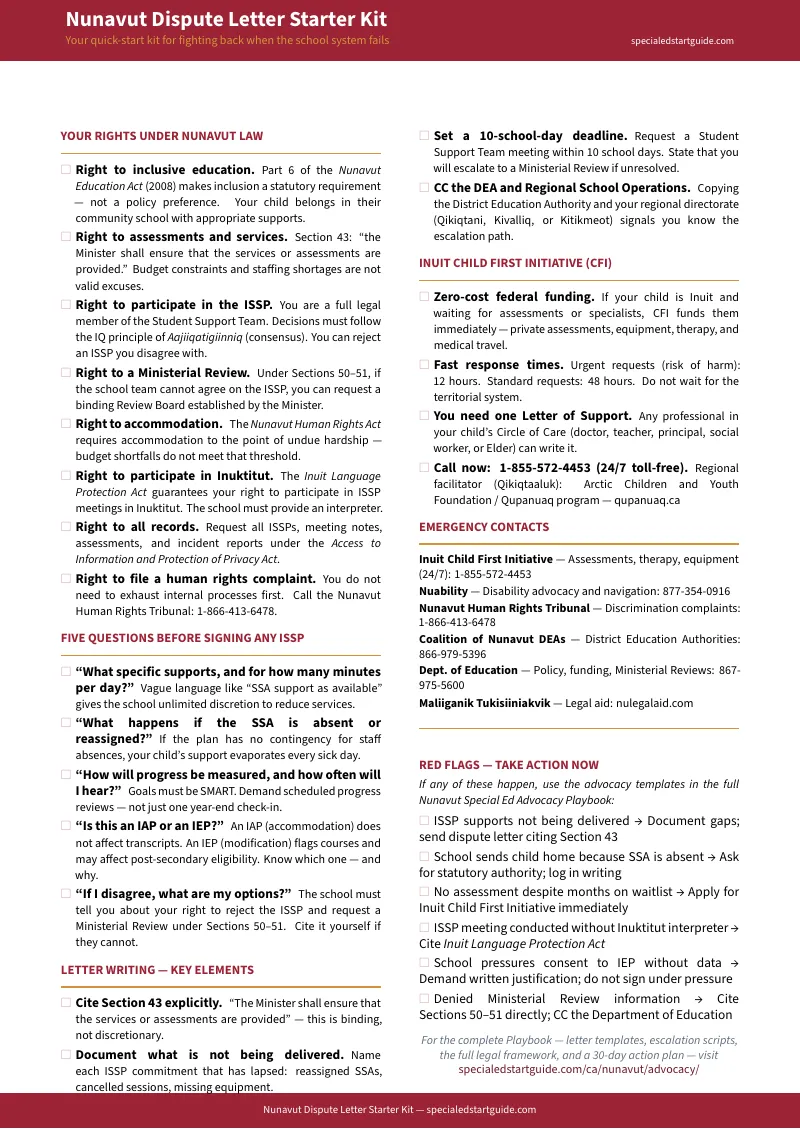
- Dispute Letter Starter Kit (checklist.pdf) — a quick-start checklist with the parent rights one-pager, a dispute letter template, the five questions to ask before signing any ISSP, and the Inuit Child First Initiative quick reference — all citing Nunavut law
- 6 Standalone Printable Tools — dispute letter templates with after-sending guidance, the escalation ladder reference card, the ISSP meeting prep checklist, the Nunavut terminology translation guide, the communication log worksheet, and the resources directory with every contact you need
Instant PDF download. Print the templates tonight. Send your first dispute letter before the next school day.
Money-back guarantee, no time limit. If the Playbook doesn't change how you handle ISSP disputes in Nunavut, email us for a full refund. No questions asked.
Not ready for the full Playbook? Download the free Nunavut Dispute Letter Starter Kit — a printable checklist with your rights under Nunavut law, a dispute letter template, and the five critical questions to ask before signing any ISSP. It's enough to take your first action tonight, and it's free.
Educators cycle out of the North every few years. Principals change. You are the only constant in your child's education. After tonight, you'll have the tools to make that count.