The RCE Knows Nova Scotia Policy. Now You Will Too.
You sat in that Program Planning Team meeting ready — or you thought you were. You read everything you could find online. You printed your child's report cards. You wrote down your concerns. And then the team smiled, rattled off acronyms you'd never heard — MTSS, TST, SPT — and told you your child "just needs more time" or that the supports you're asking for "aren't how we do things in this region."
You left the meeting with the same plan your child walked in with. No additional EA hours. No new assessments. No written explanation of why they refused your requests — because you didn't know you could demand one.
The problem isn't that you're uninformed. The problem is that Nova Scotia's special education system uses terminology, policies, and escalation pathways that exist nowhere else in Canada. The province calls its planning document an IPP — not an IEP. It separates Documented Adaptations from Individual Program Plans in ways that fundamentally affect your child's graduation eligibility. It replaced elected school boards with seven Regional Centres for Education that centralize decisions but decentralize accountability. And the only parent guide the Department of Education ever published was written in 2006 — fourteen years before the Inclusive Education Policy that now governs every classroom in the province.
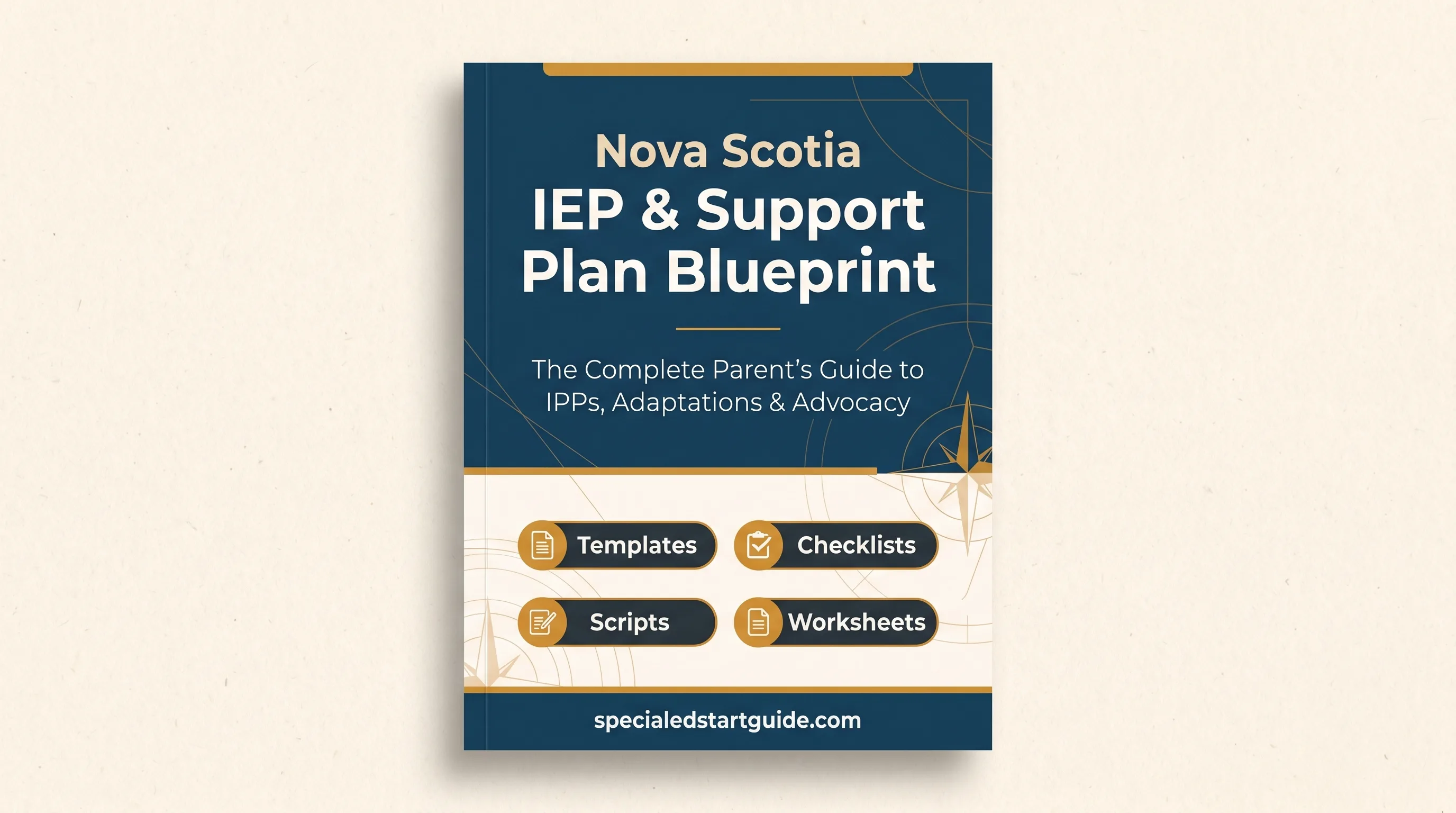
The Nova Scotia IEP & Support Plan Blueprint is the tactical navigation toolkit that bridges the gap between knowing your child has rights and actually exercising them — with every template, script, and checklist grounded in Nova Scotia law and the post-2020 policy framework.
What's Inside the Blueprint
The Copy-Paste RCE Advocacy Email Library
Every email template cites the exact Nova Scotia statute or policy. Request a psychoeducational assessment and document the date the RCE's response clock starts. Formally dispute an IPP outcome by invoking the Education Act. Escalate a denied service using your RCE's Parent/Guardian Concern Policy. Request a meeting with the Coordinator of Student Services when the principal stonewalls. These aren't generic letters — they're Nova Scotia-specific enforcement tools that create a legally binding paper trail the moment you hit send.
The Nova Scotia Terminology Translation Matrix
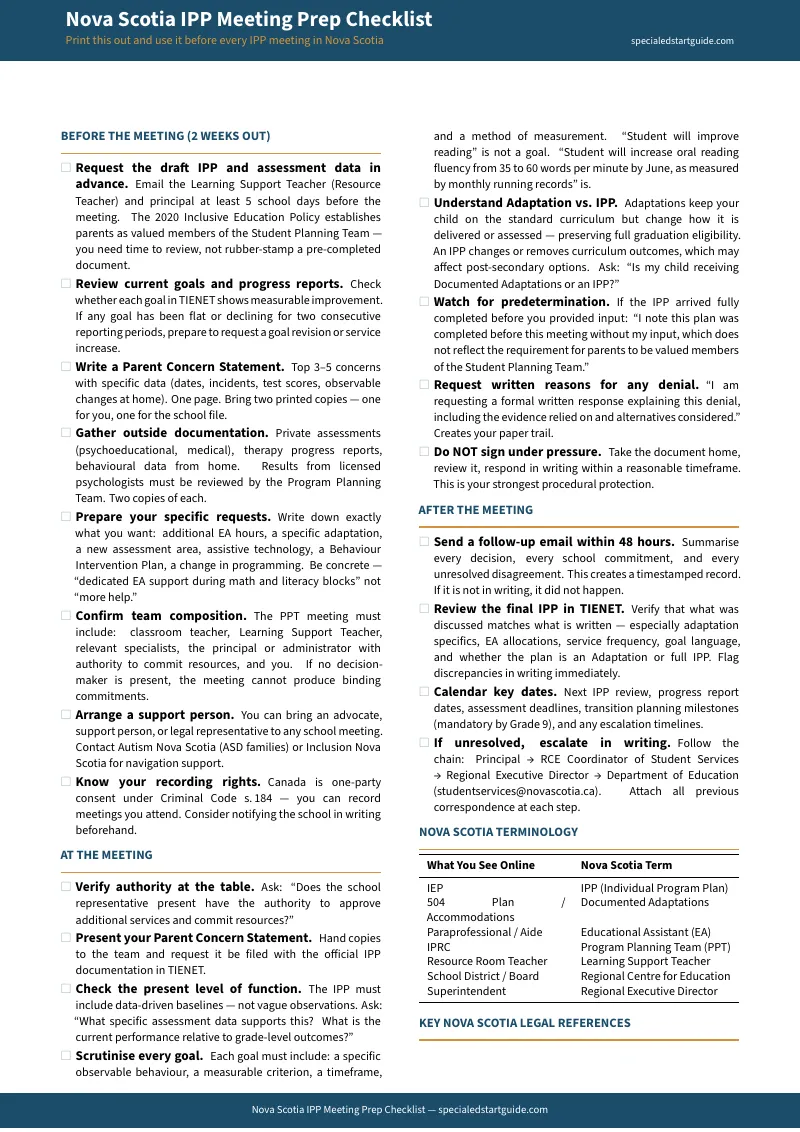
Nearly everything you find online about special education is written for American or Ontario families. If you walk into a Halifax or Truro school demanding an "IPRC meeting" to establish a "504 Plan" and an "IEP," the principal will immediately recognize that you don't understand the Nova Scotia system — and your credibility as an advocate is gone before the meeting begins. The Blueprint provides a side-by-side translation of every term: IEP becomes IPP. 504 Plan becomes Documented Adaptations. Paraprofessional becomes Educational Assistant. School district becomes Regional Centre for Education. This matrix is the fastest way to prove you know exactly how this province works.
The Adaptation vs. IPP Decision Guide
This is the single most consequential decision in your child's education, and most Nova Scotia parents don't even know it's being made. Documented Adaptations keep your child on the regular provincial curriculum — extra time, visual supports, assistive technology — while preserving full graduation eligibility and post-secondary options. An Individual Program Plan changes or removes curriculum outcomes entirely, altering your child's academic trajectory. Some children genuinely need an IPP. Others are placed on one because it's administratively easier for the school. The Blueprint explains exactly how each tier works, what questions to ask, and how to ensure your child is on the right track — not the convenient one.
The PPT Meeting Prep System
The provincial guide tells parents to "share information about your child's strengths and interests" at Program Planning Team meetings. That advice is so passive it's practically designed to fail. The Blueprint's pre-meeting system covers what documentation to bring, what to ask the Learning Support Teacher in writing beforehand, how to set the meeting agenda so the principal doesn't control the entire narrative, and the exact questions to ask when the team presents a completed IPP you've never seen before — because if the plan was finished before you walked in, the school violated the principle that parents are "essential decision-makers."
The Assessment Waitlist Navigator
Public psychoeducational assessments in Nova Scotia are backlogged by months to years. Private assessments cost $3,000–$4,500 out of pocket, and the school isn't obligated to implement a private report's recommendations. The Blueprint explains how the school prioritizes assessment requests, what the Teaching Support Team (TST) process requires before your child reaches the assessment queue, and how to build a case file that moves your child up the priority list — or how to use a private assessment strategically if you can afford one.
The Escalation Roadmap
When advocacy fails at the school level, you need to know where to go next — and most parents don't. Nova Scotia has no formal due process hearings like the United States. Your escalation pathway runs from the principal to the RCE's Coordinator of Student Services to the Regional Executive Director to the Department of Education's Student Services Division. Beyond that, the Nova Scotia Ombudsman accepts confidential complaints about provincial services, and the Nova Scotia Human Rights Commission handles disability discrimination claims. The Blueprint maps every step with template communications for each level.
IPP Goal-Tracking Worksheets
IPP goals in TIENET are legally required to be measurable — with baselines, targets, and assessment methods. But many goals are written so vaguely that progress is impossible to track. The worksheets give you a structured format to log data between meetings, compare school-reported progress against your own observations, and arrive at the next PPT meeting with documentation that either confirms the program is working or proves it isn't.
Who This Blueprint Is For
- Parents navigating any of Nova Scotia's seven RCEs or the CSAP — whether you're in Halifax, Truro, Cape Breton, or rural Yarmouth County
- Parents whose child is on an IPP that hasn't been reviewed or updated in over a year — and who need to know how to force a meaningful revision
- Parents who've been told their child "doesn't qualify" for intensive supports despite holding a private diagnosis — and who need the procedural knowledge to challenge that determination
- Parents dealing with informal exclusions — the "standby" protocol where the school calls at 10:30 AM demanding you pick up your dysregulated child — and who need to assert their child's right to full-day instruction under the 2020 Inclusive Education Policy
- Parents confused about whether their child has Documented Adaptations or a full IPP — and what that distinction means for graduation and post-secondary eligibility
- Parents preparing for their first Program Planning Team meeting who don't want to walk in outgunned by a team that does this every day
- Parents outside Halifax who have no access to private assessment clinics or specialized advocates — and who need to become their own expert navigator
Why Not Just Use the Free Resources?
Nova Scotia has dedicated organizations doing critical work for families. Autism Nova Scotia runs navigator programs. Inclusion Nova Scotia advocates for systemic change. The Department of Education publishes policy documents. Here's why parents still struggle after consulting all of them:
- The provincial parent guide is from 2006. It predates the 2020 Inclusive Education Policy by fourteen years. It contains no mention of MTSS, TST, Student Planning Teams, or any of the current frameworks principals use to allocate or deny services. Reading it is like studying for a test using last decade's textbook.
- Autism Nova Scotia serves only ASD families — with waitlists. Their navigators are exceptional, but they are restricted to autism-spectrum diagnoses. If your child has ADHD, dyslexia, anxiety, ODD, or a learning disability that isn't autism, you cannot use their services. Even within their mandate, capacity limits mean months before you get meaningful support.
- Inclusion Nova Scotia has two navigators for the entire province. A $500,000 pilot project funded exactly two positions to serve every family across 370+ schools. The vast majority of parents will never get one-on-one time with these professionals.
- American and Ontario IEP guides will destroy your credibility. Walk into an HRCE school referencing a "504 Plan," an "IPRC meeting," or your rights under "IDEA," and the administration immediately knows you haven't done your homework. These terms do not exist in Nova Scotia. Every dollar spent on a generic IEP planner from Etsy is wasted money and a credibility liability.
The free resources describe what the system should look like. The Blueprint gives you the tools to make the system actually work for your child.
— Less Than 10 Minutes of a Private Advocate
A private special education advocate in Nova Scotia charges $90–$125 per hour. A private psychoeducational assessment costs $3,000–$4,500. The free government guides haven't been updated since 2006. For the cost of two coffees, you gain immediate, lifetime access to the exact templates, checklists, and inside local knowledge required to make the Regional Centre for Education take your child's needs seriously — starting tonight.
Your download includes the complete Blueprint guide plus standalone printable PDFs — every template, worksheet, script, and reference card, ready to print and bring to your next meeting.
- Complete Blueprint Guide (guide.pdf) — 12 chapters covering legal rights, the IPP process, Adaptations, MTSS navigation, assessment strategies, advocacy communications, meeting preparation, progress monitoring, transitions, escalation procedures, and the Human Rights complaint pathway
- IPP Meeting Prep Checklist (checklist.pdf) — the before/during/after checklist with Nova Scotia policy citations and procedural requirements for every step
- RCE Advocacy Email Templates (letter-templates.pdf) — 8 fill-in-the-blank emails citing exact Nova Scotia statutes for PPT meeting requests, EA shortfalls, parent rights assertions, standby protocol refusals, escalation letters, and records requests
- Goal-Tracking Worksheet (goal-tracking-worksheet.pdf) — structured fillable worksheet for tracking IPP goals from TIENET with baselines, targets, and red flag checklists
- Nova Scotia Terminology Cheat Sheet (terminology-cheat-sheet.pdf) — the complete translation matrix from generic IEP/504 terminology to Nova Scotia's actual terms, plus the Adaptations vs. IPP comparison
- Escalation Roadmap (escalation-pathway.pdf) — every escalation step mapped from classroom teacher through the Human Rights Commission, with the full RCE directory and advocacy organization contacts
Instant PDF download. Print the templates tonight. Walk into tomorrow's meeting with Nova Scotia policy on your side.
Money-back guarantee, no time limit. If the Blueprint doesn't change how you approach IPP meetings in Nova Scotia, email us for a full refund. No questions asked.
Not ready for the full Blueprint? Download the free Nova Scotia IEP Meeting Prep Checklist — a printable pre-meeting checklist with the Nova Scotia terminology, policy citations, and red flags that require immediate action. It's enough to walk into your next meeting prepared, and it's free.
Your child's education is a legal right, not a favour the school grants when resources allow. The RCE knows Nova Scotia policy. After tonight, so will you.