The School Knows the NWT Education Act. After Tonight, So Will You.
You walked into that meeting as prepared as you could be. You read the GNWT inclusive schooling pages. You called Inclusion NWT. You even spoke with the Program Support Teacher, who was encouraging and kind — and who reports to the same principal sitting across the table from you.
So you sat across from the PST, the classroom teacher, the administrator, and maybe a specialist dialing in by phone from Yellowknife. They used NWT-specific terms you had never encountered — Student Support Plan, Ministerial Directive, TIENET, conditional funding allocation. They said your child was "responding to supports" and the School-Based Support Team needed "more observation data" before considering a referral for assessment. And you did not know enough to tell them that the Ministerial Directive on Inclusive Schooling requires support based on observed needs, not a formal diagnosis — meaning the school cannot withhold accommodations while they wait.
You left with no assessment timeline, no clear plan, and no written explanation of why your request was deferred — because you did not know to demand one in writing.
The problem is not that you lack effort. The problem is that the NWT special education system is built for educators and administrators, not for parents in crisis. A territory of 43,000 people spread across 33 communities and 49 schools, where half the population lives in Yellowknife and the other half is dispersed across remote settlements accessible only by air or winter road. An annual teacher turnover rate of 18% territory-wide — rising to 31% in the Beaufort-Delta. An itinerant specialist model where psychologists and therapists fly in on rotating schedules, and weather cancellations or recruitment failures can eliminate entire rounds of visits. And a school system where 38.3% of students are already on formalized support plans, stretching resources so thin that qualifying for a plan and actually receiving the services written into it are two entirely different things.
The Northwest Territories IEP & Support Plan Blueprint is the tactical advocacy toolkit that bridges the gap between knowing your child's rights exist and actually exercising them — with every template, script, and checklist grounded in the NWT Education Act, the Ministerial Directive on Inclusive Schooling, and the Canadian Charter of Rights and Freedoms.
What's Inside the Blueprint
The Assessment Referral System
The NWT relies on an itinerant service model — educational psychologists, speech-language pathologists, and occupational therapists are based in Yellowknife or contracted from southern provinces and fly to remote communities on a rotating schedule. Multi-year assessment backlogs are common. The Blueprint explains exactly how the School-Based Support Team referral works, what triggers a formal assessment, and how to write the request letter that starts the process — citing the specific provisions of the Ministerial Directive that require timely response to identified needs.
SSP vs. IEP — The Distinction That Determines Your Child's Diploma
The NWT uses two planning documents: the Student Support Plan (SSP) for accommodations that preserve grade-level curriculum, and the Individual Education Plan (IEP) for modifications that alter the academic standard. The distinction matters because an IEP can change your child's graduation pathway. If the school is recommending an IEP when an SSP with stronger accommodations would suffice, your child may be permanently moved off the standard diploma track without your full understanding of the consequences. The Blueprint explains both documents, their legal implications under Section 9(3) of the Education Act, and how to evaluate whether the school's recommendation is appropriate.
The Jordan's Principle Funding Walkthrough
Nearly half the NWT population is Indigenous. For First Nations families, Jordan's Principle is a federal legal requirement ensuring children receive health, social, and educational supports without jurisdictional delays over payment. When the school says they cannot afford an educational assistant, a specialized assessment, or assistive technology, Jordan's Principle may provide a pathway that bypasses territorial funding constraints entirely. The Blueprint dedicates a full chapter to explaining what qualifies, who to contact — including the 24/7 federal call centre, the Dene Nation focal point, and regional service coordinators — and how to prepare the required letter of support from a health professional, educator, or Elder. No commercially available IEP guide includes this information.
The Continuity Portfolio Template
When teacher turnover reaches 31% in some NWT regions, your child effectively starts over every September. A new educator arrives from southern Canada with no local context and no time to digest a complex TIENET file during orientation week. The Blueprint includes a printable two-page Continuity Portfolio template — a parent-managed executive summary of your child's plan, successful interventions, specific triggers, and communication preferences. You hand it to the new teacher on day one. It bridges the gap that the system's own data tools cannot fill when turnover destroys institutional memory.
Copy-Paste Advocacy Letter Templates
Every letter cites the exact NWT statute or Ministerial Directive provision. Request an assessment and start the school's response obligation. Demand a written explanation when the team refuses anything — because without it, the refusal is not documented and your paper trail has a gap. Formally request the PST's time allocation to verify that the 60% classroom support minimum required by the Directive is actually being met. These are not generic Canadian samples — they are NWT-specific enforcement tools that create a legally binding record the moment you send them.
The DEA/DEC Escalation Map
The NWT has a unique governance structure: District Education Authorities (DEAs), Divisional Education Councils (DECs), the Tłı̨chǫ Community Services Agency, and Commission scolaire francophone. The Blueprint maps every education body in the territory and explains the Sections 38-43 appeals process under the Education Act — the formal pathway when a decision significantly affects your child's education. It provides the specific escalation sequence: school principal → DEA/DEC superintendent → independent education appeal committee → Minister of Education, Culture and Employment.
IEP Meeting Scripts and Checklists
What to say when the team tells you the itinerant specialist is not available until next semester. What to say when they offer vague goals with no measurable criteria. What to say when the administrator claims the school "does not have the resources" for the accommodation you requested. Each script cites the NWT statute or Ministerial Directive provision that supports your position — so you are citing law, not arguing opinions. The pre-meeting checklist covers one-party recording consent under Section 184 of the Criminal Code of Canada, team composition verification, and the specific documents to bring.
Advocacy Without Burning Bridges
In a settlement of 500 people, the principal is your neighbour and the school is the social centre of the community. The aggressive, litigious advocacy that works in Toronto or New York carries intense social risk in the North. The Blueprint provides communication templates specifically designed for small, tight-knit northern communities — firm enough to hold the school accountable to the Ministerial Directive, but structured to preserve the collaborative relationships you depend on. Because in the NWT, you will see the people at the IEP table at the grocery store, at the hockey rink, and at the community hall every week for years.
Goal-Tracking Worksheets
IEP goals must be measurable — with baselines, targets, and criteria. But many goals are written so vaguely that progress is impossible to track. The worksheets give you a structured format to log data between meetings, compare school-reported progress against your observations, and arrive at the next review with documentation that either confirms the program is working or proves it is not.
Who This Blueprint Is For
- Parents in Yellowknife navigating Yellowknife Education District No. 1 or Yellowknife Catholic Schools — where the services technically exist but bureaucratic bottlenecks, assessment backlogs, and chronic staffing shortages mean qualifying for support and actually receiving it are two different things
- Parents in Inuvik, Hay River, Fort Smith, or Fort Simpson navigating their regional DEC — where the itinerant specialist visits twice a year if weather cooperates, and the next assessment slot is months away
- Parents in remote communities under the Beaufort-Delta, Sahtu, Dehcho, or South Slave DECs — where 31% teacher turnover means rebuilding the IEP framework from scratch every September with a teacher who arrived from southern Canada days earlier
- Indigenous families who have heard of Jordan's Principle but do not know how to use it to bypass territorial funding denials for assessments, educational assistants, assistive technology, and specialized therapies
- Military, government, or healthcare families who relocated to the NWT with a child who already has an IEP or support plan from another province — and who need to translate southern expectations into the NWT's inclusive schooling model before hard-won accommodations are lost in the transition
- Parents whose child is on an SSP but falling further behind — and who need to understand whether the school should be offering an IEP with modified outcomes or strengthening the SSP with additional accommodations
- Parents who have been told the school "does not have the budget" for the support their child needs — and who want the legal language to challenge that claim under the Education Act and the duty to accommodate
- Parents preparing for their first IEP or SSP meeting who do not want to walk in unprepared against a team that does this every day
Why Not Just Use the Free Resources?
The NWT has legitimate free special education resources. The GNWT Department of Education, Culture and Employment publishes the Inclusive Schooling Handbook. AIDE Canada offers an NWT-specific rights toolkit. Inclusion NWT and the NWT Disabilities Council provide support services. Here is why parents still struggle after consulting all of them:
- The GNWT Inclusive Schooling Handbook is written for educators, not parents. It is a 100+ page administrative compliance document that tells schools what they should do. It provides zero strategic advice for a parent whose child is actively being denied the supports described in it. When the school claims they lack the budget or the staff, the Handbook offers no counter-argument and no template for what to write in an email tonight.
- AIDE Canada's NWT toolkit focuses on the nuclear option. It is legally accurate and meticulously cites the Charter and Moore v. British Columbia. But its primary focus is launching human rights complaints — the extreme end of the advocacy spectrum that most parents want to avoid. It also focuses predominantly on autism and intellectual disabilities, leaving parents of children with ADHD, dyslexia, or behavioural challenges feeling excluded.
- Inclusion NWT and the NWT Disabilities Council serve adults and community integration. The NWT Disabilities Council's published resources lean heavily toward adult transition, including the $8,000 Learning Supports fund — which is strictly for residents aged 18+ who are out of high school. They provide excellent community programming but do not publish tactical JK-12 IEP negotiation guides.
- US-based guides are jurisdictionally irrelevant. Wrightslaw and similar American resources are built entirely on IDEA and Section 504 — federal US laws that have no application in Canada. Referencing a "504 Plan" or "IDEA compliance" in an NWT meeting immediately marks you as uninformed and destroys your credibility with the school team.
- Generic Canadian guides miss every NWT nuance. Ontario and BC guides reference provincial education acts, provincial funding models, and provincial appeal mechanisms that do not exist in the Northwest Territories. They have never heard of the Ministerial Directive, the TIENET system, the itinerant specialist model, or Jordan's Principle.
The free resources explain what the law says. The Blueprint gives you the tools to make the school follow it.
— Less Than Two Jugs of Milk in Yellowknife
A private educational psychologist assessment in the NWT costs $2,000-$4,000 — if you can find one willing to travel north. A single consultation with a special education advocate runs $150-$300. Even if you eventually need professional help, the organized paper trail you build with this Blueprint saves hours of billable time — because you are handing a professional a documented case, not a folder of unsigned plans and half-remembered conversations.
Your download includes 8 PDFs — the complete guide plus 7 standalone printable tools:
- Complete Blueprint Guide (57 pages) — 15 chapters covering the NWT special education landscape, the legal framework (Education Act, Ministerial Directive, Charter rights), SSP vs. IEP planning documents, the assessment and referral process, IEP components and goal-writing, placement and the inclusive model, Jordan's Principle funding, NWT governance structure, escalation and dispute resolution, advocacy communication templates, Indigenous education considerations, high school transition planning, the Continuity Portfolio template, NWT resources directory, and frequently asked questions
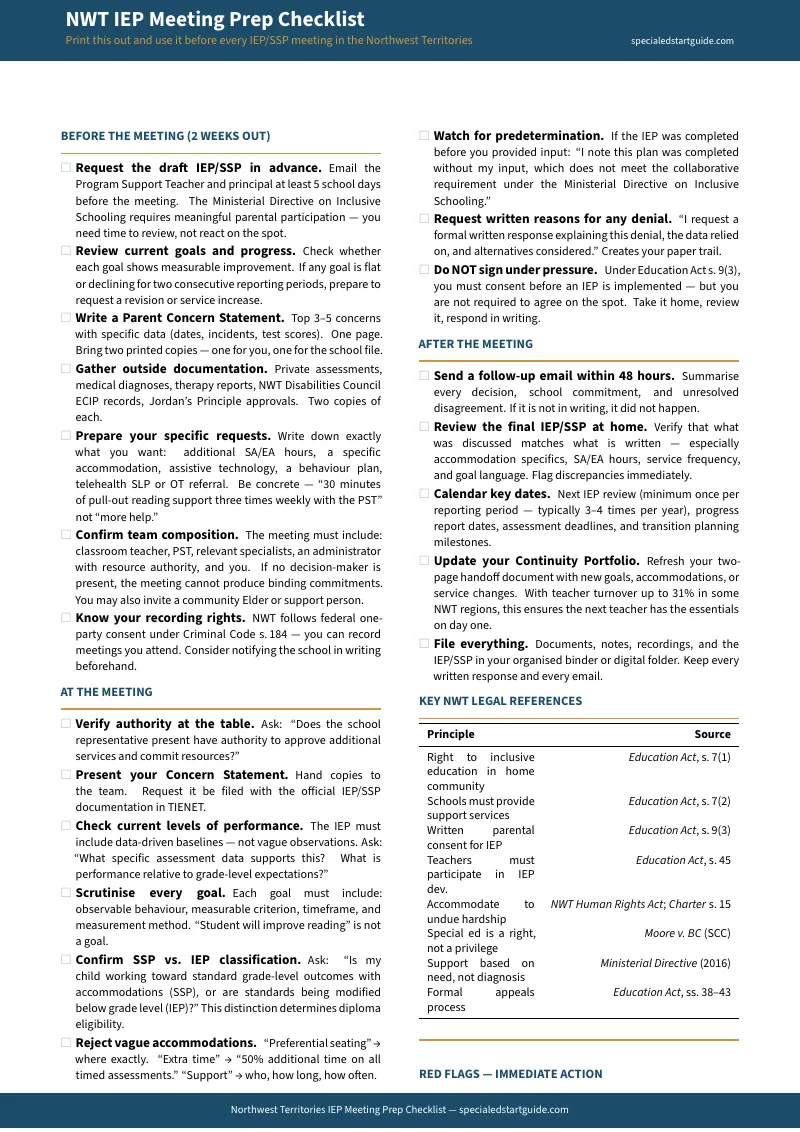
- IEP Meeting Prep Checklist — the before/during/after checklist with NWT timelines, team composition requirements, one-party recording rights, red flags requiring immediate action, and key NWT legal references
- IEP Meeting Scripts — word-for-word responses to 7 common school pushback scenarios, each citing the specific NWT statute or Ministerial Directive provision that supports your position
- Advocacy Letter Templates — 5 copy-paste letters for SBST referrals, assessment requests, non-compliance documentation, RISC/Superintendent escalation, and post-meeting follow-ups
- SSP vs. IEP Decision Guide — side-by-side comparison of the two NWT planning documents with the decision flowchart and Grade 9-10 transition warning
- DEA/DEC Escalation Map — the 5-level advocacy hierarchy plus every NWT education body mapped with communities served and fillable fields for your contacts
- Continuity Portfolio Template — the two-page teacher handoff document designed for regions with up to 31% annual turnover
- Goal-Tracking Worksheet — structured progress monitoring for up to 3 IEP goals with observation logs so you arrive at the next review with data
Instant PDF download. Print the checklist and meeting scripts tonight. Walk into tomorrow's meeting with the law on your side.
Money-back guarantee, no time limit. If the Blueprint does not change how you approach IEP meetings in the Northwest Territories, email us for a full refund. No questions asked.
Not ready for the full Blueprint? Download the free Northwest Territories IEP Meeting Prep Checklist — a printable pre-meeting checklist with NWT-specific timelines, team composition requirements, and the red flags that require immediate action. It is enough to walk into your next meeting prepared, and it is free.
Your child's education is a legal right, not a favour the school grants. The school knows NWT law. After tonight, so will you.