The RTL Policy Says Your Child Gets Responsive Teaching. Nobody Told You What to Do When the School Uses "Responsiveness" to Justify Doing Nothing.
You went to the Program Planning Team meeting. The Instructional Resource Teacher, the principal, and a school counsellor you had never met sat across from you. They referenced the "RTL Policy," mentioned "tiered intervention," and handed you an Individual Education Plan already drafted before you arrived. You asked about Student Assistant hours. They said the allocation was a "centralized decision." You asked what accommodations would look like in practice. They said "we'll do our best within the inclusive model." You signed because they were waiting. You left unsure what you agreed to — and whether your child would actually get any of it.
You are not alone, and you are not imagining the problem. Newfoundland and Labrador's special education system is under extraordinary pressure. Approximately 70 Speech-Language Pathologists serve the entire province — a staffing level that has remained stagnant for 15 years despite dramatically increasing demand. Psychoeducational assessments through the public system routinely take one to two years. The Janeway Children's Health and Rehabilitation Centre waitlist stretches 12 to 18 months. Private assessments cost $3,200 to $5,000. Student Assistants get reassigned to cover other classrooms. Instructional Resource Teachers get pulled to fill vacant teaching positions. The Responsive Teaching and Learning Policy is progressive. The execution is a staffing crisis wearing a policy badge.
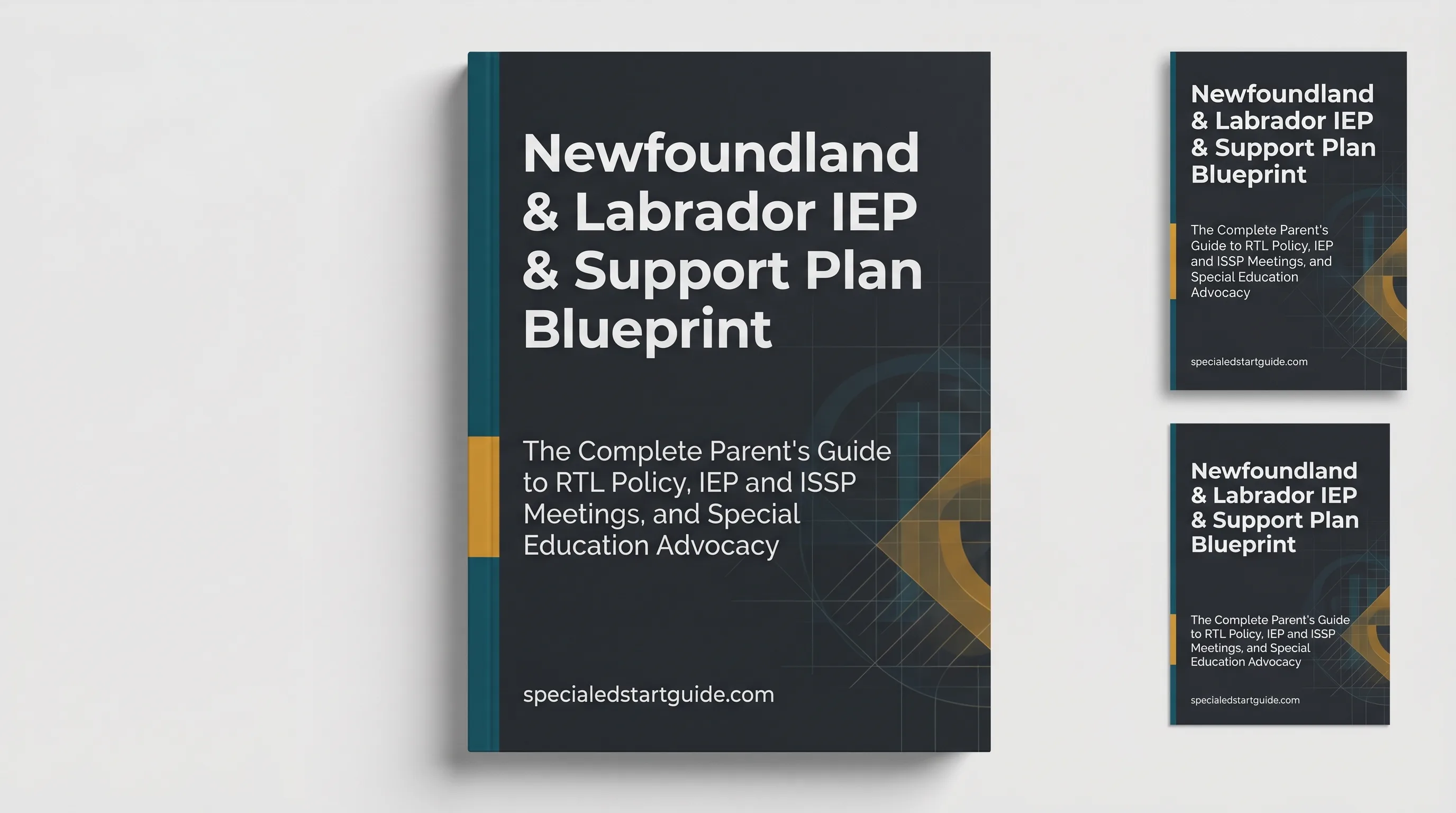
The Newfoundland & Labrador IEP & Support Plan Blueprint is the RTL Enforcement System — the tactical advocacy toolkit that translates the Schools Act, 1997, the RTL Policy, the NL Human Rights Act, and the duty to accommodate into the exact meeting scripts, email templates, and escalation strategies you need to secure your child's support. Every recommendation cites the applicable Newfoundland and Labrador regulation or legal principle. It does not tell you to "collaborate" harder with a system that is structurally unable to deliver what the law requires. It tells you exactly what to say, who to say it to, and what happens when they say no.
What's Inside the Blueprint
The NL Legal Framework Decoded
The Schools Act, 1997 provides the structural framework. The Responsive Teaching and Learning Policy governs how schools deliver programming to all students, including those with exceptionalities. But these documents are written for administrators, not parents. The Blueprint translates every critical provision of the Schools Act, the RTL Policy's tiered intervention model, and the Supreme Court of Canada's Moore v. British Columbia decision into plain-language parental rights. When a school tells you they "don't have the budget" for your child's accommodation, the duty to accommodate under the NL Human Rights Act and the Canadian Charter creates an exceptionally high legal threshold called "undue hardship" — and this guide teaches you exactly how to invoke it without needing a lawyer in the room.
IEP vs ISSP vs ASP — The Three Plans Demystified
Newfoundland and Labrador uses three distinct support plans, and the differences between them determine your child's entire support structure. The Individual Education Plan (IEP) is a school-based document outlining educational accommodations. The Individual Support Services Plan (ISSP) is a multi-agency plan triggered when a child requires services from two or more government departments — Education, Health, and Social Development. The Alternate Support Plan (ASP) is a behavioural stabilization program for children ages 6 to 15. Schools routinely default to the most limited plan type. The Blueprint gives you the exact criteria that trigger each plan, the questions to ask before consenting, and the specific language that protects your child from being underserved by the wrong plan type.
The Janeway Waitlist Survival Strategy
The most dangerous gap in the NL system is the assumption that your child must wait for a formal diagnosis before receiving meaningful support. The Janeway waitlist stretches 12 to 18 months. School-based psychoeducational assessments take one to two years. But the RTL Policy itself states that needs-based accommodations can be provided at Tier 2 and Tier 3 without a formal exceptionality designation. The Blueprint gives you the exact policy language to cite when the school says "we can't do anything until we have a diagnosis" — because that statement directly contradicts their own governing framework.
Copy-Paste Advocacy Templates
Every template cites the exact Newfoundland and Labrador regulation. Request a psychoeducational assessment and document the date you asked — because schools frequently delay without a paper trail. Challenge the removal of Student Assistant hours by citing the duty to accommodate. Demand written reasons for any resource denial. Escalate a complaint from classroom teacher to principal to Director of Education to the Minister, with each letter referencing the Schools Act section that triggers a formal obligation. These are not generic form letters — they are NL enforcement tools that create a documented paper trail the moment you hit send.
St. John's, Corner Brook, Labrador & Rural NL Navigation
Families on the Avalon Peninsula and in St. John's face bureaucratic bottlenecks — overcrowded schools, the Janeway waitlist, and the cost of private clinical services. Rural families on the West Coast, Central region, and Northern Peninsula face a different crisis entirely: absolute specialist shortages, itinerant teachers who visit quarterly at best, and schools where a single IRT serves dozens of students. For Labrador families, geographic isolation defines every aspect of the struggle — medical travel to St. John's requires multi-hour drives, ferries, or costly flights. The Blueprint gives you location-specific strategies because advocating in a St. John's school with access to ASNL and LDANL requires different tactics than advocating in a rural school where the educational psychologist visits once per semester.
PPT Meeting Scripts and Checklists
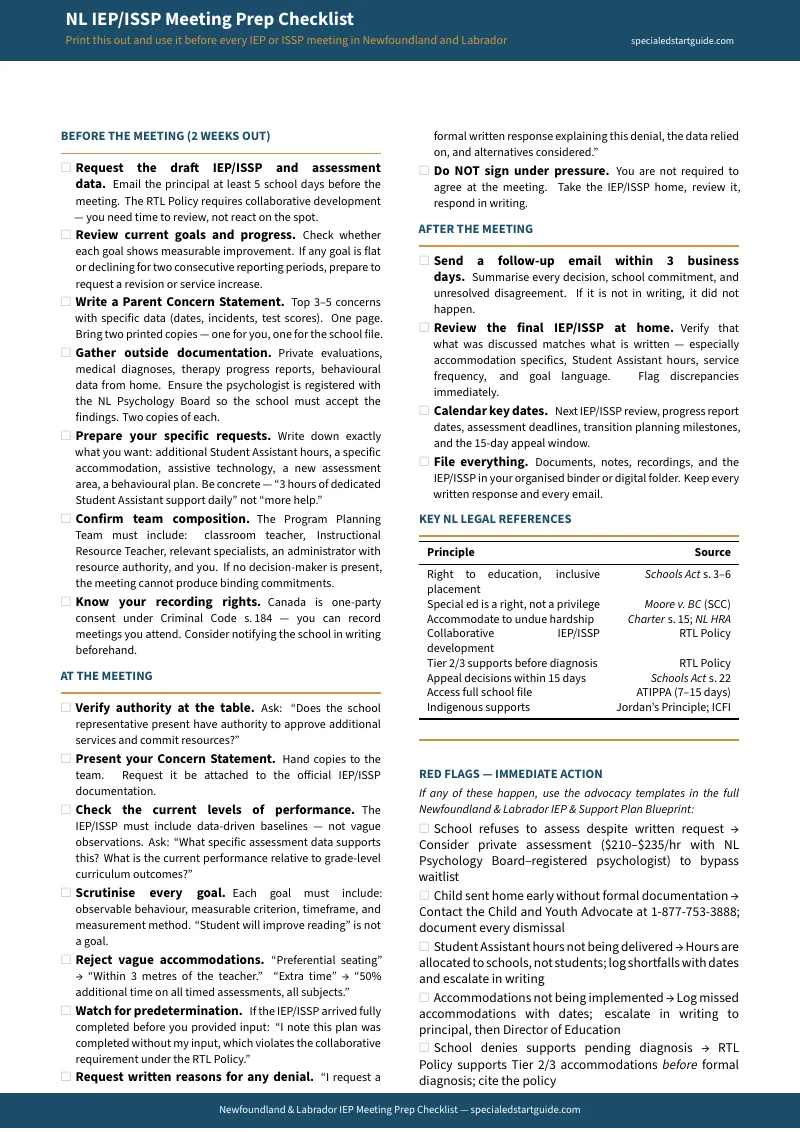
What to say when the team presents a completed IEP and expects your signature on the spot. What to say when they propose reducing your child's support without a formal assessment. What to say when the principal tells you Student Assistant hours are a "centralized decision" outside the school's control. Each script cites the NL regulation or legal principle that proves the school's obligation — so you are citing law at the PPT table, not arguing emotions. The pre-meeting checklist covers Newfoundland and Labrador's one-party consent recording rights under Section 184 of the Criminal Code and the specific documents you need to bring.
Indigenous Students — Jordan's Principle and the Inuit Child First Initiative
Indigenous families in NL can access federally funded supports that bypass provincial waitlists entirely. Jordan's Principle and the Inuit Child First Initiative cover educational assessments, assistive technology, therapeutic supports, and travel costs when the provincial system cannot deliver. The Blueprint covers eligibility criteria, application processes, and the specific services funded — because these programs can cut through the Janeway waitlist and the SA shortage in weeks rather than months.
The Dispute Resolution Escalation Ladder
When informal advocacy fails, Newfoundland and Labrador offers escalation options — but they are buried in disconnected government documents no parent would think to search for. The Blueprint maps the complete chain of command: PPT to classroom teacher to principal to the Director of Education to the Schools Act complaint process, and when the system itself fails, to the Office of the Child and Youth Advocate and the NL Human Rights Commission. It explains when each pathway applies and how to build the paper trail that wins — because in NL, the paper trail IS the enforcement mechanism.
Transition Planning — School Through Adulthood
The gap between school-based supports and adult services catches families off guard. Once your child transitions out of the school system, the IEP and ISSP frameworks cease to apply. The Blueprint covers how to ensure transition plans include concrete, measurable goals rather than the vague aspirational language that schools default to, how to coordinate with adult services agencies, and how to document your child's needs before they age out of the system that was finally beginning to understand them.
Who This Blueprint Is For
- Parents preparing for their first PPT meeting who don't want to walk in blind against a team that does this every day — and who need to understand the IEP, ISSP, and ASP before the school asks them to consent
- Parents whose child has been told they "don't qualify" for a Student Assistant, a formal assessment, or additional support — and who need the legal language to challenge that decision
- Parents in St. John's, Mount Pearl, or Corner Brook navigating overcrowded classrooms where teacher attention is stretched impossibly thin
- Parents in rural or coastal Newfoundland and Labrador where the school psychologist serves multiple schools, the SLP visits quarterly, and "specialized support" means an itinerant clinician you have never met
- Parents in Labrador where the Janeway is an expensive flight away and "just take them to St. John's" is not a realistic option
- Parents whose child has ADHD, autism, a learning disability, or anxiety and was told they are "not severe enough" for dedicated support
- Parents whose child has been placed on a partial-day schedule or sent home early repeatedly — and who don't know whether that's a legitimate safety measure or an illegal exclusion violating the duty to accommodate
- Parents whose child's IEP says one thing but the classroom reality looks nothing like it — accommodations on paper, not in practice
- Parents who bought an "IEP Planner" from Etsy built for the American system and discovered that IEP, 504 Plan, FAPE, and IDEA don't apply in Newfoundland and Labrador
- Families who recently moved to NL from another province or country and need to recalibrate their advocacy to a system that works fundamentally differently
Why Not Just Use the Free Resources?
Newfoundland and Labrador has genuine free special education resources. The Department of Education publishes the Handbook for Parents of Children with Exceptionalities. LDANL offers free 1:1 advocacy and tutoring. ASNL provides community support for registered members. AIDE Canada publishes a provincial toolkit. Here is why parents still struggle after consulting all of them:
- The Department of Education's Handbook is institutional documentation. It was last substantially updated around 2015. It explicitly states it is "not intended to be a legal document." It calls you a "vital part" of the educational team while providing zero tactical advice on what to do when the school denies a formal assessment, refuses necessary accommodations, or fails to deliver assigned Student Assistant hours. It tells you the rules exist — not how to enforce them when the school breaks them.
- LDANL provides exceptional free support — but with scope and capacity limits. Their caseworkers offer free 1:1 advocacy, but availability depends on intake volume. Their organizational scope primarily covers Specific Learning Disorders and ADHD. If your child's needs fall outside that scope — autism, physical disability, complex medical conditions — you may find limited guidance.
- ASNL's resources are generalized and diplomatically tempered. As an advocacy organization that maintains collaborative relationships with government and school boards, ASNL's publicly distributed materials do not include the aggressive, crisis-oriented advocacy strategies parents need when a school is denying services outright.
- AIDE Canada's provincial toolkit is an informational directory, not an advocacy strategy guide. It lists available programs and contact numbers. It does not equip you with the conversational strategies or legal leverage required when actually speaking to the administrators answering those phones.
- Etsy and TPT planners organize paperwork — they do not enforce rights. A pastel IEP binder keeps documents in order. It will not decode the RTL Policy's tiered intervention model, explain why the school handed you a completed IEP before the meeting, or teach you to escalate through the Schools Act complaint process. Nearly every Etsy guide references American law — IDEA, 504 Plans, FAPE — that holds zero jurisdiction in Newfoundland and Labrador.
- Private assessments cost $3,200 to $5,000. The Janeway waitlist stretches 12 to 18 months. The Blueprint gives you the same procedural frameworks and advocacy templates that professional consultants use — and if you do hire one, a documented paper trail saves hundreds in billable hours they would otherwise spend figuring out your situation.
The free resources explain what NL law says. The Blueprint gives you the tools to make the school follow it.
— Less Than One Hour With a Private Consultant
Private psychoeducational assessments in Newfoundland and Labrador cost $3,200 to $5,000. The Janeway waitlist stretches 12 to 18 months. If you hand a consultant a disorganized pile of IEP documents and school emails, your first several billable hours go toward them understanding your situation. The Blueprint teaches you how to organize the paper trail, decode the plan types, and draft the initial advocacy letters — either empowering you to win at the PPT table without a consultant, or saving hundreds in billable hours if you do hire one.
Your download includes 6 PDFs: a comprehensive 14-chapter Blueprint guide, a printable IEP/ISSP Meeting Prep Checklist, six fill-in-the-blank advocacy letter templates citing NL law, a printable escalation pathway reference card, a one-page IEP vs ISSP vs ASP plan type comparison, and a Newfoundland & Labrador resources directory with contact details for every organization that can help.
Instant PDF download. Print the checklist tonight. Walk into tomorrow's PPT meeting with Newfoundland and Labrador law on your side.
Money-back guarantee, no time limit. If the Blueprint doesn't change how you approach IEP and ISSP meetings in Newfoundland and Labrador, email us for a full refund. No questions asked.
Not ready for the full Blueprint? Download the free Newfoundland & Labrador IEP Meeting Prep Checklist — a printable pre-meeting checklist with NL timelines, RTL Policy references, one-party consent recording rules, and red flags that require immediate action. It is enough to walk into your next meeting prepared, and it is free.
Your child's education is a legal right under the NL Human Rights Act and the Canadian Charter. The school knows the RTL Policy. After tonight, so will you.