Policy 322 Says Your Child Gets Inclusion. Nobody Told You What to Do When Inclusion Means Sitting Alone in a Crowded Room.
You went to the PLP meeting. The Resource Teacher, the principal, and two people you had never met sat across from you. They referenced "Policy 322," mentioned "ESS Team recommendations," and handed you a Personalized Learning Plan already filled in before you arrived. You asked about Educational Assistant hours. They said the allocation was a "district-level decision." You asked what accommodations would look like in practice. They said "we'll do our best with the resources available." You signed because they were waiting. You left unsure what you agreed to — and whether your child would actually get any of it.
You are not alone, and you are not imagining the problem. New Brunswick's inclusion model is failing the children it was designed to protect. The Anglophone sector has six school psychologists serving approximately 70,000 students — a ratio of roughly 1:11,600. The Canadian Psychological Association recommends dramatically lower numbers. Educational Assistants get reassigned to manage crises in other classrooms. Partial-day schedules — where children are sent home for hours at a time — are imposed without proper Policy 323 documentation. Former Education Ministers have publicly admitted that inclusion in the province has become an "absurd situation." The philosophy is progressive. The execution is a staffing crisis wearing a policy badge.
The New Brunswick IEP & Support Plan Blueprint is the PLP Enforcement System — the tactical advocacy toolkit that translates Policy 322, the Education Act, the NB Human Rights Act, and the duty to accommodate into the exact meeting scripts, email templates, and escalation strategies you need to secure your child's support. Every recommendation cites the applicable New Brunswick regulation or legal principle. It does not tell you to "collaborate" harder with a system that is structurally unable to deliver what the law requires. It tells you exactly what to say, who to say it to, and what happens when they say no.
What's Inside the Blueprint
The NB Legal Framework Decoded
Policy 322 mandates inclusive education — no segregated classrooms, no alternative education for K-8, Universal Design for Learning in every classroom. But the policy document itself is written for superintendents and administrators, not parents. The Blueprint translates every critical provision of Policy 322, the relevant sections of the Education Act (including Section 12 on PLP mandates and Section 11 on appeal rights), and the Supreme Court of Canada's Moore v. British Columbia decision into plain-language parental rights. When a school tells you they "don't have the budget" for your child's accommodation, the duty to accommodate under the NB Human Rights Act and the Canadian Charter creates an exceptionally high legal threshold called "undue hardship" — and this guide teaches you exactly how to invoke it without needing a lawyer in the room.
The Three PLP Types — And the Consent Trap
New Brunswick uses three types of Personalized Learning Plans: Accommodated, Adjusted (Modified), and Individualized. The differences between them determine whether your child graduates with a standard diploma and full post-secondary eligibility — or a certificate of completion. Schools routinely propose moving a child from Accommodated to Adjusted, framing it positively as "meeting them where they are." What they do not always explain is that Adjusted designation can permanently restrict university and college admission. The Blueprint gives you the exact questions to ask before consenting, the clinical evidence to demand, and the specific PLP review language that protects your child's academic future.
Copy-Paste Advocacy Templates
Every template cites the exact New Brunswick regulation. Request an ESS Team referral and document the date you asked — because schools frequently delay without a paper trail. Formally refuse an illegal partial-day schedule by citing Policy 323's 90-day maximum and tier-three classification. Demand written reasons for any resource denial. Escalate a complaint from classroom teacher to principal to the School Appeals Committee to the District Appeals Committee, with each letter referencing the Education Act section that triggers a formal obligation. These are not generic form letters — they are NB enforcement tools that create a documented paper trail the moment you hit send.
Moncton, Fredericton, Saint John & Rural NB Navigation
Urban families in Moncton, Fredericton, and Saint John face overcrowded classrooms where teachers manage 29 or more students — including multiple students on PLPs, English language learners, and children requiring intensive behavioural support. Rural families in the Miramichi, northern New Brunswick, and smaller communities confront a different crisis: the near-total absence of specialists. School psychologists, speech-language pathologists, and occupational therapists are scarce outside urban centres. The Blueprint gives you location-specific strategies — because advocating in a Fredericton school with access to Inclusion NB requires different tactics than advocating in a rural school where the itinerant psychologist visits quarterly.
PLP Meeting Scripts and Checklists
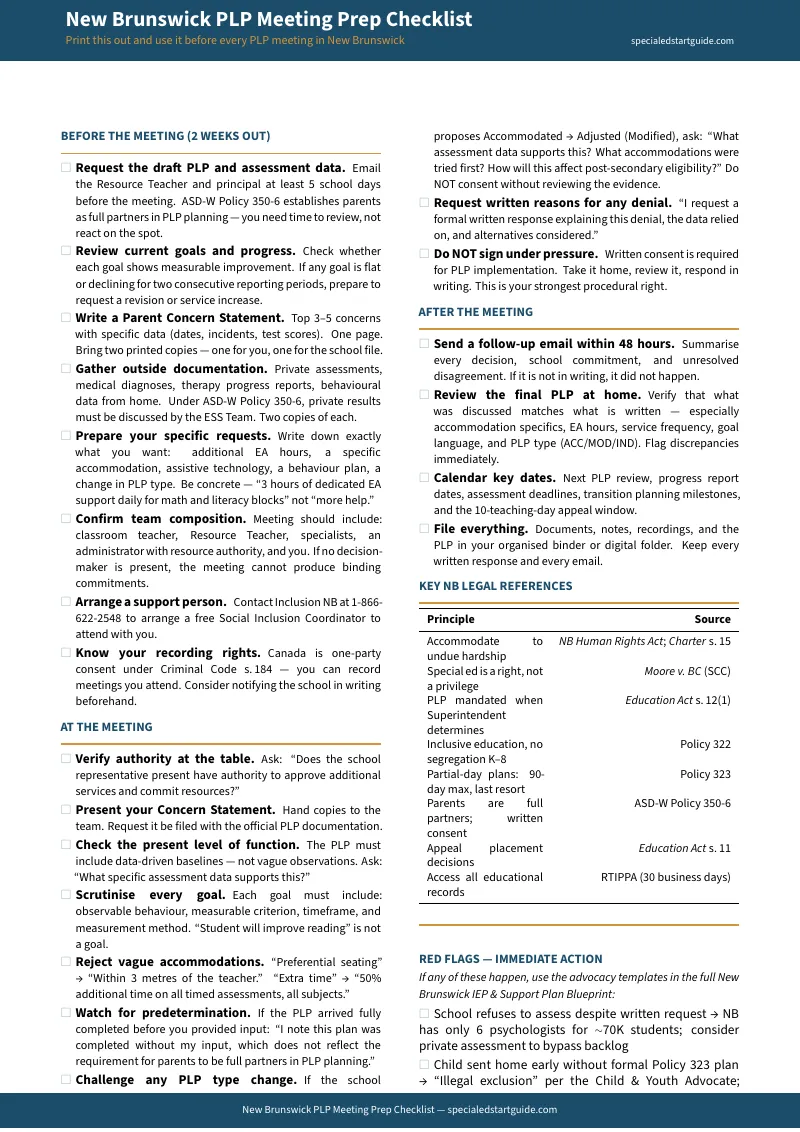
What to say when the team presents a completed PLP and expects your signature on the spot. What to say when they propose Adjusted designation without a formal assessment. What to say when the principal tells you EA hours are a "district decision" outside the school's control. Each script cites the NB regulation or legal principle that proves the school's obligation — so you are citing law at the PLP table, not arguing emotions. The pre-meeting checklist covers New Brunswick's one-party consent recording rights under Section 184 of the Criminal Code and the specific documents you need to bring.
The Bilingual System — Anglophone and Francophone Navigation
New Brunswick operates parallel Anglophone and Francophone school systems under a single provincial department. The sharing of specialist resources between sectors, the unique challenges of securing support for neurodivergent students in French Immersion, and the structural differences between Anglophone and Francophone district governance all create complexities that no generic guide addresses. The Blueprint covers both systems so you can advocate effectively regardless of which sector your child attends.
The Dispute Resolution Escalation Ladder
When informal advocacy fails, New Brunswick offers escalation options — but they are buried in disconnected government documents no parent would think to search for. The Blueprint maps the complete chain of command: ESS Team to classroom teacher to principal to the School Appeals Committee (10 teaching days to file, 5 days for a decision) to the District Appeals Committee, and when the system itself fails, to the NB Human Rights Commission and the Office of the Child, Youth and Senior Advocate. It explains when each pathway applies and how to build the paper trail that wins — because in New Brunswick, the paper trail IS the enforcement mechanism.
Transition Planning — Middle School Through Post-Secondary
Policy 316B governs graduation requirements in New Brunswick, including 100 credit hours and English Language Proficiency assessment. The intersection of PLP type and graduation pathway determines your child's post-secondary options — and schools do not always explain this clearly during transition planning. The Blueprint covers how to ensure transition plans include concrete, measurable goals rather than the vague aspirational language that schools default to, and how to protect the Accommodated pathway when a school pushes toward Adjusted.
Who This Blueprint Is For
- Parents preparing for their first PLP meeting who don't want to walk in blind against a team that does this every day — and who need to understand the PLP types before the school asks them to consent
- Parents whose child has been told they "don't qualify" for an Educational Assistant, a formal assessment, or additional support — and who need the legal language to challenge that decision
- Parents in Moncton, Fredericton, or Saint John navigating overcrowded classrooms where teacher attention is stretched impossibly thin
- Parents in rural or northern New Brunswick where the school psychologist serves multiple schools, the SLP visits monthly, and "specialized support" means an itinerant clinician you have never met
- Parents whose child has ADHD, autism, a learning disability, or anxiety and was told they are "not severe enough" for dedicated support
- Parents whose child is being sent home on partial-day schedules without a formal Policy 323 plan — and who need to know this may constitute illegal exclusion
- Parents whose child's PLP says one thing but the classroom reality looks nothing like it — accommodations on paper, not in practice
- Parents who bought an "IEP Planner" from Etsy built for the American system and discovered that IEP, 504 Plan, FAPE, and IDEA don't apply in New Brunswick
- Families who recently moved to New Brunswick from another province or country and need to recalibrate their advocacy to a system that works fundamentally differently — starting with the fact that it is called a PLP, not an IEP
Why Not Just Use the Free Resources?
New Brunswick has genuine free special education resources. The Department of Education publishes the Guidelines and Standards for Educational Planning. Inclusion NB offers the Achieving Inclusion Family Resource Binder. AIDE Canada provides provincial toolkits. The Learning Disabilities Association of NB runs support programs. Here is why parents still struggle after consulting all of them:
- The provincial Guidelines and Standards is institutional documentation. It comprehensively defines the PLP framework, references Response to Intervention (RTI), and uses acronyms like ESS-Connect, PLP-ADJ, and PLP-IND without explaining what they mean for your child's actual classroom experience. It was written for superintendents. It tells you the rules exist — not how to enforce them when the school breaks them.
- Inclusion NB's Achieving Inclusion binder is over 100 pages of policy analysis. It is thorough, well-intentioned, and overwhelming. It tells parents to "identify possible solutions" themselves and to "learn the administrative chain of command." If your child was sent home on a partial-day schedule this morning and you have an ESS Team meeting tomorrow, you do not need a 100-page academic resource — you need the exact email template to send tonight.
- AIDE Canada's provincial toolkit is an informational directory, not an advocacy strategy guide. It lists available programs and tells you that the school administrator is involved in PLP creation. It does not tell you what to say when that same administrator denies your request for an EA citing district budget cuts.
- LDANB focuses on learning disabilities — not the full spectrum of special education challenges. Their K-12 framework is excellent for LD-specific accommodations and assistive technology. It does not address the severe behavioural challenges, the complexities of autism spectrum inclusion, or the systemic crisis around seclusion rooms that currently dominates the province.
- Etsy and TPT planners organize paperwork — they do not enforce rights. A pastel IEP binder keeps documents in order. It will not decode New Brunswick's PLP types, explain why the school handed you a completed plan before the meeting, or teach you to escalate through the School Appeals Committee citing the Education Act. Nearly every Etsy guide references American law — IDEA, 504 Plans, FAPE — that holds zero jurisdiction in New Brunswick.
- Private advocates charge $75 or more per hour. Private psycho-educational assessments cost $2,700 to $3,200 — and the public waitlist, with only 6 school psychologists for 70,000 Anglophone students, can stretch years. The Blueprint gives you the same procedural frameworks and advocacy templates that professional consultants use — and if you do hire one, a documented paper trail saves hundreds in billable hours they would otherwise spend figuring out your situation.
The free resources explain what New Brunswick law says. The Blueprint gives you the tools to make the school follow it.
— Less Than One Hour of a Private Advocate
Private special education advocates in New Brunswick charge $75 or more per hour. Private psycho-educational assessments run $2,700 to $3,200 — and the public system has 6 school psychologists for 70,000 Anglophone students. If you hand a consultant a disorganized pile of PLP documents and school emails, your first several billable hours go toward them understanding your situation. The Blueprint teaches you how to organize the paper trail, decode the PLP types, and draft the initial advocacy letters — either empowering you to win at the PLP table without a consultant, or saving hundreds in billable hours if you do hire one.
Your download includes a comprehensive 11-chapter Blueprint guide, a printable IEP Meeting Prep Checklist, plus 4 standalone printable tools: fill-in-the-blank letter templates citing NB law, a PLP type comparison card with the Consent Trap warning, the NB escalation pathway fridge sheet with timelines at every level, and a resource directory with phone numbers for every organization that can help. Every template cites the exact New Brunswick regulation that triggers a legal obligation.
Instant PDF download. Print the templates tonight. Walk into tomorrow's PLP meeting with New Brunswick law on your side.
Money-back guarantee, no time limit. If the Blueprint doesn't change how you approach PLP meetings in New Brunswick, email us for a full refund. No questions asked.
Not ready for the full Blueprint? Download the free New Brunswick IEP Meeting Prep Checklist — a printable pre-meeting checklist with NB timelines, Policy 322 references, one-party consent recording rules, and red flags that require immediate action. It is enough to walk into your next meeting prepared, and it is free.
Your child's education is a legal right under the NB Human Rights Act and the Canadian Charter. The school knows Policy 322. After tonight, so will you.