The School Calls It "Collaboration." You Call It Being Outnumbered. Here's How to Change That.
You sat through the SSP meeting — the principal, the classroom teacher, the resource teacher, and a Student Services Administrator you'd never met before. They talked about your child's "block funding allocation," referenced "Regulation 155/2005" like you should know what that means, and told you the Educational Assistant hours were being reduced because the division needs to "distribute resources equitably." You asked why. They said it was a staffing decision. You asked what you could do. They said to "trust the Student Support Team." You left with a document you barely understood and a feeling that the outcome was decided before you walked in.
You were right. And you are not alone. Manitoba's special education system is under extraordinary strain. Assessment wait times for ASD stretch past two years. FASD assessments can take three years. The provincial ratio of school psychologists to students averages 1:1,652 — collapsing to 1:2,526 in northern and remote regions. Educational Assistant hours get slashed mid-year without explanation. Parents who don't understand the funding formula, the escalation pathways, or the legal obligations that the school would rather you not know about — those parents don't get heard. Parents who do, get results.
You live in a province where the closest thing to the American IEP system — the one every Google result describes — doesn't exist. Manitoba uses the Individual Education Plan (IEP) or Student Specific Plan (SSP), depending on the grade level and the school division. There are no due process hearings. There is no federal IDEA law. There are no 504 Plans. The entire system runs on the Public Schools Act, Regulation 155/2005, and a block funding model that gives school divisions discretion over how to spend provincial grants — which is exactly how schools justify telling you they "just don't have the resources." Bringing American IEP terminology into a meeting with a Manitoba principal destroys your credibility in the first sentence.
The Manitoba IEP & Funding Blueprint is the Funding Accountability System — the enforcement toolkit that translates Manitoba's Regulation 155/2005, the Public Schools Act, the Canadian Charter, and the Manitoba Human Rights Code into the exact meeting scripts, advocacy templates, and escalation strategies you need to secure your child's support. Every recommendation cites the applicable Manitoba regulation or legal principle.
What's Inside the Blueprint
The Manitoba Legal Framework Decoded
Regulation 155/2005 mandates "appropriate educational programming" — but the regulation itself is dense bureaucratic language designed to protect school divisions, not empower parents. The Blueprint translates every critical provision, the relevant sections of the Public Schools Act, and the Supreme Court of Canada's Moore v. British Columbia decision into plain-language parental rights. When a school tells you they "don't have the budget" for your child's accommodation, the duty to accommodate under the Manitoba Human Rights Code and the Canadian Charter creates an exceptionally high legal threshold called "undue hardship" — and this guide teaches you exactly how to invoke it without needing a lawyer in the room.
The Block Funding Model Exposed
In 2017, Manitoba shifted most special education funding from student-specific applications to block grants distributed to divisions based on enrollment data and socio-economic indicators. The government called it reducing "negative labeling." The practical effect is that parents can no longer point to a specific dollar amount attached to their child's diagnosis. Division administrators use this opacity as a shield, claiming the block Student Services Grant is distributed "equitably" across classrooms rather than dedicated to individual students. The Blueprint decodes the entire funding architecture — Level 2 ($9,500), Level 3 ($21,130), the exceptions that still require student-specific applications (EBD3, URIS Group A, Funded Independent Schools), and the exact questions to ask that force the school to account for how your child's portion of the block grant is being used.
Copy-Paste Advocacy Templates
Every template cites the exact Manitoba regulation. Request an assessment and document the date you asked — because Regulation 155/2005 prohibits delaying programming pending assessments, and without a written record, months vanish without action. Demand a formal IEP/SSP revision when accommodations aren't being implemented. Escalate an EA hours reduction with a letter that references Regulation 155/2005 and the school's duty to provide appropriate educational programming. File a formal complaint with the school board trustees. These aren't generic form letters — they're Manitoba enforcement tools that create a documented paper trail the moment you hit send.
Winnipeg, Brandon & Rural Manitoba Navigation
Winnipeg School Division (WSD) and the Louis Riel School Division (LRSD) face intense demand with growing enrollment pressuring already-stretched Student Services departments. Brandon families navigate a smaller division with fewer specialists. But the real crisis is outside the Perimeter Highway — the provincial average school psychologist-to-student ratio of 1:1,652 collapses to 1:2,526 in northern regions. Communities like The Pas and Thompson rely on itinerant clinicians who visit infrequently, making consistent assessment and intervention practically impossible. The Blueprint gives you division-specific strategies for each environment — because advocating in Winnipeg requires different language than advocating in a rural division three hours north of Brandon.
IEP/SSP Meeting Scripts and Checklists
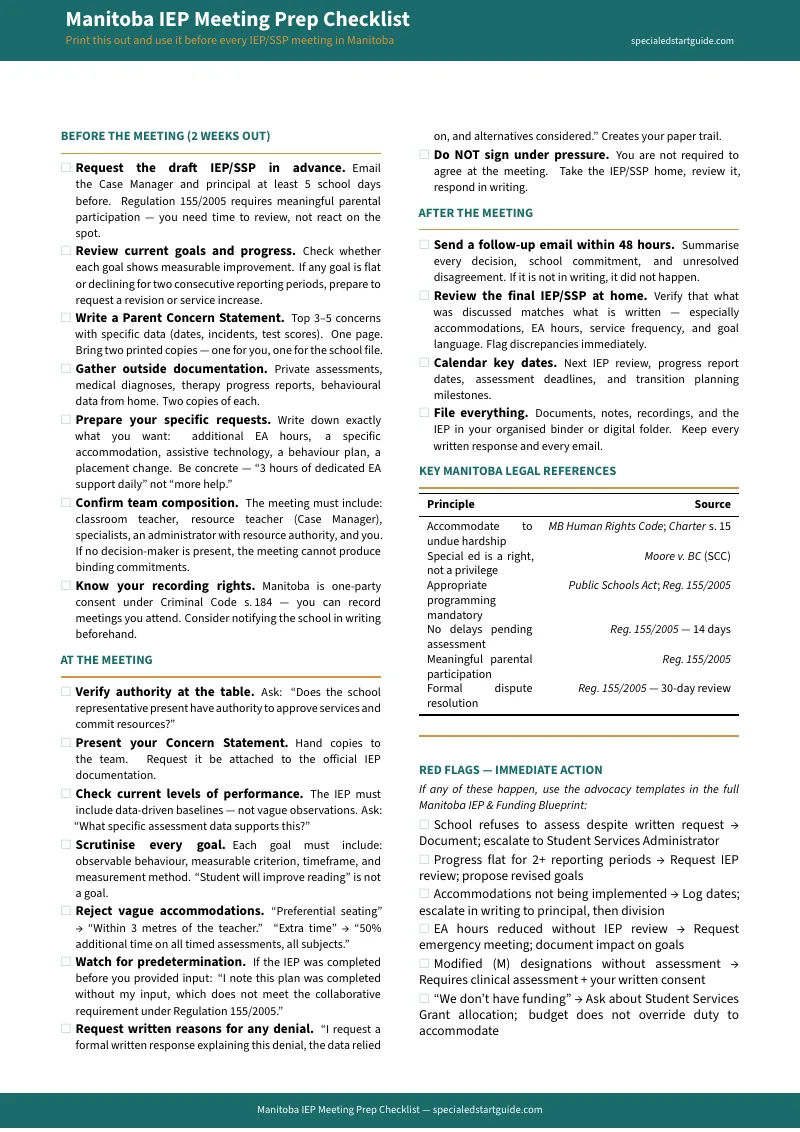
What to say when the team tells you "we need to wait for the assessment before we can provide support" — and Regulation 155/2005 says they cannot. What to say when they reduce EA hours mid-year and claim it's a "staffing decision." What to say when the principal tells you the Student Support Team has decided your child doesn't need a formal assessment. Each script cites the Manitoba regulation or legal principle that proves them wrong — so you're not arguing emotions at the IEP table, you're citing law. The pre-meeting checklist covers Manitoba's one-party consent recording rights under Section 184 of the Criminal Code and the specific documents you need to bring.
Jordan's Principle — A Transformative Resource for Indigenous Families
For First Nations children in Manitoba, Jordan's Principle provides federal funding for assessments, therapies, educational supports, and assistive technology that the provincial system fails to deliver — particularly in rural and northern communities where provincial services are virtually non-existent. The Blueprint explains eligibility criteria, the application process, how Jordan's Principle interacts with provincial school programming, and how to use it to bypass the years-long provincial assessment waitlist entirely.
The Dispute Resolution Escalation Ladder
When informal advocacy fails, Manitoba offers escalation options — but they are not clearly documented for parents anywhere. The Blueprint maps the complete chain of command: classroom teacher to resource teacher to principal to Student Services Administrator at the division level to the Board of Trustees, and ultimately to the Manitoba Advocate for Children and Youth (MACY) — an independent oversight body with jurisdiction over educational programming for children with IEPs. It explains when to file a complaint with the Manitoba Human Rights Commission, and how to build the paper trail that wins — because in Manitoba, the paper trail IS the enforcement mechanism.
Transition Planning — High School Through Post-Secondary
Manitoba requires transition planning for students moving toward post-secondary education, employment, or community living. But "requires" and "delivers" are different things. The Blueprint covers credit designation requirements (Grades 9-12), the distinction between modified and regular graduation tracks, transition to Community Living disABILITY Services (CLdS), and how to ensure your child's transition plan includes concrete, measurable goals rather than the vague aspirational language that schools default to.
Who This Blueprint Is For
- Parents preparing for their first IEP or SSP meeting who don't want to walk in blind against a Student Support Team that does this every day — and who need to understand Manitoba's funding model before it's discussed at the table
- Parents whose child has been told they "don't qualify" for an Educational Assistant, a formal assessment, or additional support hours — and who need the regulatory language to challenge that decision
- Parents in Winnipeg navigating WSD or LRSD where demand for Student Services far outpaces capacity, or dealing with multi-year waitlists at SSCY and MATC
- Parents in Brandon dealing with a smaller division's limited specialist availability
- Parents in rural, remote, or northern Manitoba where the school psychologist visits quarterly, the speech-language pathologist covers multiple divisions, and "specialized support" means an itinerant clinician you've never met
- Parents whose child has ADHD, autism, a learning disability, or anxiety and was told they're "not severe enough" for dedicated support — and who need to understand how block funding is supposed to work versus how divisions actually use it
- Parents whose child's IEP/SSP says one thing but the classroom reality looks nothing like it — accommodations on paper, not in practice
- Parents who bought an "IEP Planner" from Etsy built for the American system and discovered that IEP, 504 Plan, FAPE, and IDEA don't apply in Manitoba
- First Nations families who need to understand how Jordan's Principle can fill the gaps that the provincial system cannot
- Families who recently moved to Manitoba from another province or country and need to recalibrate their advocacy to a system that works fundamentally differently
Why Not Just Use the Free Resources?
Manitoba has genuine free special education resources. Manitoba Education publishes Working Together: A Handbook for Parents of Children with Special Needs in School. Community Living Manitoba offers A Parent's Guide to Inclusive Education. The Learning Disabilities Association of Manitoba runs support groups and the Barton Reading Program. Here's why parents still struggle after consulting all of them:
- Manitoba Education's Working Together handbook is institutional protection. It comprehensively defines the philosophy of inclusion, emphasizes "partnerships" and "collaboration," and assumes a perfectly functioning system. It does not tell you what to do when the "collaborative team" says your child's EA hours are being cut and the person making that decision isn't in the room. The tone frames all interactions as collegial partnerships — which is actively unhelpful when the partnership has broken down and you need tactical escalation language.
- Community Living Manitoba's parent guide defends full inclusion on an academic level. It details best practices like the Three Block Model of Universal Design for Learning and ensures "all children attend field trips." If your child is currently serving an out-of-school suspension for behavioural dysregulation, you don't need an academic treatise on universal design — you need immediate crisis management protocols to force a re-entry meeting.
- LDAM focuses on community support and tutoring, not tactical advocacy. Their support groups and Barton Reading Program are excellent long-term resources. But they require ongoing time commitments in specific cities and do not serve as an immediate, on-demand reference manual for navigating an adversarial SSP meeting scheduled for tomorrow morning.
- AIDE Canada covers national legal frameworks — not Manitoba's operational mechanics. Their Moore v. BC analysis is valuable, but they cannot tell you the difference between how WSD and LRSD handle IEP disputes, or how the 2017 block funding shift affects your child's classroom.
- Etsy and TPT planners organize paperwork — they don't enforce rights. A pastel IEP binder keeps documents in order. It won't decode Manitoba's block funding model, explain why the school is hiding behind "equitable distribution," or teach you to demand a formal IEP revision citing Regulation 155/2005. Nearly every Etsy guide references American law — IDEA, 504 Plans, FAPE — that holds zero jurisdiction in Manitoba.
- Private advocates charge $90–$120 per hour. Private psycho-educational assessments cost $2,400 to $2,475 or more. Most Manitoba families can't absorb that — especially those in rural areas already bearing travel costs to Winnipeg for assessments. The Blueprint gives you the same procedural frameworks and advocacy templates that professional consultants use — and if you do hire one, a documented paper trail saves hundreds in billable hours they'd otherwise spend figuring out your situation.
The free resources explain what Manitoba law says. The Blueprint gives you the tools to make the school follow it.
— Less Than One Hour of a Private Advocate
Private special education advocates in Manitoba charge $90 to $120 per hour. Private psycho-educational assessments run $2,400 to $2,475 — and the public waitlist can stretch two to three years. If you hand a consultant a disorganized pile of IEP documents and school emails, your first several billable hours go toward them understanding your situation. The Blueprint teaches you how to organize the paper trail, decode the funding model, and draft the initial advocacy letters — either empowering you to win at the IEP table without a consultant, or saving hundreds in billable hours if you do hire one.
Your download includes a comprehensive 13-chapter Blueprint guide plus five standalone printable tools: an IEP Meeting Prep Checklist, fill-in-the-blank Advocacy Letter Templates with Regulation 155/2005 citations, the Manitoba Escalation Pathway (classroom to MACY in one visual reference), an IEP Goal Tracking Worksheet with a service delivery log, and a Manitoba Special Education Acronym Guide. Every template is formatted so you can type directly into it or copy the text into an email, each citing the exact Manitoba regulation that triggers a legal obligation.
Instant PDF download. Print the templates tonight. Walk into tomorrow's IEP meeting with Manitoba law on your side.
Money-back guarantee, no time limit. If the Blueprint doesn't change how you approach IEP meetings in Manitoba, email us for a full refund. No questions asked.
Not ready for the full Blueprint? Download the free Manitoba IEP Meeting Prep Checklist — a printable pre-meeting checklist with Manitoba timelines, Regulation 155/2005 citations, one-party consent recording rules, and red flags that require immediate action. It's enough to walk into your next meeting prepared, and it's free.
Your child's education is a legal right under the Manitoba Human Rights Code and the Canadian Charter. The school knows Regulation 155/2005. After tonight, so will you.